Best Inverter Generator (2026): 7 Clean-Power Picks Compared
The best inverter generator for a home is the one that delivers clean, stable power to the electronics you care about, runs quietly enough that neighbors do not notice, and still has enough output for the essentials when the grid goes down. Inverter generators convert the engine’s raw output to direct current and back to smooth alternating current, so the voltage waveform is cleaner than a conventional open-frame generator’s, and the engine can throttle down at light loads. That makes them the natural choice for laptops, modems, TVs, furnace controls and RVs. This roundup sorts current inverter models from small carry units to 12,000-watt home-backup machines.
Part of our Home Electrical guide — start there for the full picture →
As an Amazon Associate we earn from qualifying purchases.
How we compared: we compared 15 current Amazon listings for gasoline, dual-fuel and tri-fuel inverter generators on what each listing states: running and peak watts by fuel, stated total harmonic distortion (THD), noise figures, outlet panel, carbon monoxide detection, weight, transfer-switch readiness and warranty. We did not lab-test or run any of these units. Listing claims such as decibel figures are the manufacturers’ own and are measured under different conditions. Prices and availability change often, so check the current listing before buying.
Quick picks: the best inverter generators by use
| Product | Best for | Key features | Price | Buy |
|---|---|---|---|---|
| Westinghouse iGen8200TFc | Best overall home-backup inverter |
| $1,399.00as of Nov 13, 2026 3:06 am GMT+0000 | Buy now →Check current price |
| WEN DF360iX | Best lightweight dual fuel |
| $521.00as of Nov 13, 2026 3:06 am GMT+0000 | Buy now →Check current price |
| Westinghouse iGen12000DFc | Best whole-home inverter |
| $1,899.00as of Nov 13, 2026 3:06 am GMT+0000 | Buy now →Check current price |
| WEN DF680iX | Best 240V mid-size inverter |
| $798.00as of Nov 12, 2026 8:55 pm GMT+0000 | Buy now →Check current price |
| WEN 56477i | Best gas-only with CO shutoff |
| $634.99as of Nov 12, 2026 8:55 pm GMT+0000 | Buy now →Check current price |
| BILT HARD 5500W | Best digital readout |
| — | Buy now →Check current price |
| Evernexta YH2800i | Quietest stated noise |
| — | Buy now →Check current price |
Prices are Amazon’s listed prices as of the time shown and change often; check Amazon for today’s price. As an Amazon Associate we earn from qualifying purchases.
The 7 picks, compared listing by listing
1. Westinghouse iGen8200TFc — Best Overall Home-Backup Inverter Generator

Tri-fuel inverter with a 50A home-backup outlet, under 3 percent THD, CO sensor and up to 17 hours at 25 percent load.
Check price on Amazon$1,399.00 as of Nov 13, 2026 3:06 am GMT+0000 — prices change; see Amazon for current price.Why we like it
- Inverter clean power plus a 50A home-backup outlet
- Runs on gasoline, propane or natural gas
- About 60 dBA at 25 percent load stated
- Remote electric start and parallel capable
- CO sensor and automatic low-oil shutdown
| Specification | Details |
|---|---|
| Output | Gas 6,600 / 8,200 W; propane 5,940 / 7,380 W; natural gas 5,280 / 6,560 W (running / peak) |
| Power quality | Less than 3% THD |
| Engine and tank | 298cc OHV, cast iron sleeve; 3.9-gallon tank, up to 17 hours at 25% load |
| Outlets | One 14-50R 50A, one TT-30R 30A, one GFCI 5-20R duplex |
| Noise | About 60 dBA at 25% load (manufacturer figure) |
| Weight / warranty | 134.5 lb; 3-year limited |
Westinghouse iGen8200TFc — tri-fuel inverter, 6,600/8,200 W gas, <3% THD, 298cc, 3.9 gal, 17 hr at 25%, 50A + TT-30R, CO sensor, 134.5 lb
The Lowest-Output Listing Here With a 50A Home-Backup Outlet
Five of the 15 listings include a 50A outlet that can feed a transfer switch or interlock: three Westinghouse iGen and ecoGen models, the GENMAX GM10500XiT, and this one. At 6,600 running watts on gasoline, the iGen8200TFc has the lowest output of those five, which keeps it closer to a typical essential-load plan instead of burning fuel to carry capacity you never use. It is also one of just three tri-fuel listings on the shelf, alongside the larger Westinghouse iGen12000TFc and the GENMAX.
That combination is what most Front Range households actually need: enough output to run a gas furnace blower, refrigerator, sump pump, lights and electronics through a transfer switch, clean enough power to keep a home office running, and fuel flexibility for a multi-day outage. It is also one of the few listings that gives wattage for each fuel separately, so you can size the load list on propane or natural gas with confidence.
The listing says “CO sensor” rather than describing an automatic shutdown sequence. Westinghouse’s other listings on this shelf use the same wording; the WEN listings, by contrast, spell out that their sensor turns the generator off. Check the manual for how the sensor responds.
Pros
- 50A outlet in a sub-140-lb inverter
- Tri-fuel with per-fuel wattage stated
- Under 3 percent THD stated
- 17-hour runtime claim at 25 percent load
Cons
- Smaller tank than the 12,000-watt models
- CO sensor behavior not fully described
- Too heavy to carry; wheels needed
Check Westinghouse iGen8200TFc price on Amazon
2. WEN DF360iX — Best Lightweight Dual-Fuel Inverter

49-lb dual-fuel inverter rated 2,900 watts on gas, with Watchdog CO shutdown, fuel shutoff and a TT-30R RV outlet.
Check price on Amazon$521.00 as of Nov 13, 2026 3:06 am GMT+0000 — prices change; see Amazon for current price.Why we like it
- Dual fuel in a 49-lb package
- Watchdog sensor turns it off at dangerous CO
- Tool-free propane quick-connector included
- Fuel shutoff empties the carburetor before storage
| Specification | Details |
|---|---|
| Output | Gas 2,900 rated / 3,600 surge W; propane 2,600 / 3,500 W |
| Fuel | Gasoline or propane |
| Outlets | Two 120V three-prong, one TT-30R, one 12V DC, two 5V USB |
| Safety | WEN Watchdog CO shutdown sensor; fuel shutoff |
| Power quality | “Clean power” for electronics; THD figure not stated in listing |
| Weight / warranty | 49 lb; 3-year limited |
WEN DF360iX — dual-fuel inverter, 2,900/3,600 W gas, 2,600/3,500 W propane, TT-30R, Watchdog CO, 49 lb, 3-yr
The Lightest Dual-Fuel Listing on the Shelf
Four of the 15 listings are dual fuel (gasoline and propane) without natural gas. At 49 lb, the DF360iX is the lightest of the four by a wide margin; the BILT HARD lists 61.73 lb and WEN’s own DF680iX lists 99.2 lb. That makes it a realistic one-person carry from the garage to a spot 20 feet from the house.
It is also one of five listings that describe an automatic CO shutoff in plain terms. WEN says its Watchdog sensor turns the generator off when dangerous carbon monoxide levels are detected, which matches the shut-off feature the CPSC tells buyers to look for.
What it will not do is back up a panel. There is no 30A twist-lock or 50A outlet, so you run cords to a refrigerator, lamps and chargers. WEN describes the output as clean power for phones and laptops but gives no THD number, while nine other listings here state 3 percent or lower.
Pros
- Lightest dual-fuel unit compared
- Clearly described CO auto shutoff
- Propane connector and fuel shutoff included
- Per-fuel ratings stated
Cons
- No transfer-switch outlet
- No THD figure
- 2,900 rated watts limits big motor loads
Check WEN DF360iX price on Amazon
3. Westinghouse iGen12000DFc — Best Whole-Home Inverter Generator

Dual-fuel inverter, 9,000 running watts on gas, 7.9-gallon tank, 50A and L14-30R outlets and an LED data center.
Check price on Amazon$1,899.00 as of Nov 13, 2026 3:06 am GMT+0000 — prices change; see Amazon for current price.Why we like it
- Tied for the most running watts on the shelf
- Both 50A and L14-30R transfer-ready outlets
- Display shows remaining run time and fuel level
- Up to 19 hours at 25 percent load stated
| Specification | Details |
|---|---|
| Output | Gas 9,000 running / 12,000 peak W; propane 8,100 / 11,000 W |
| Power quality | 3% THD or less |
| Engine and tank | 457cc OHV; 7.9-gallon tank |
| Outlets | One 14-50R 50A, one L14-30R 30A twist-lock, one GFCI 5-20R duplex |
| Noise | As low as 64 dBA (manufacturer figure) |
| Weight / warranty | 187.4 lb; 3-year limited |
Westinghouse iGen12000DFc — dual-fuel inverter, 9,000/12,000 W gas, ≤3% THD, 457cc, 7.9 gal, 50A + L14-30R, LED data center, 187.4 lb
Open-Frame Output With Inverter Power Quality
Two listings tie for the highest running output among the 15: this dual-fuel model and its tri-fuel twin, the iGen12000TFc, both at 9,000 running watts on gasoline. We picked the dual-fuel version because it is slightly lighter (187.4 lb vs 191 lb) and most homes without a gas meter will not use the natural gas option.
Nine thousand running watts is open-frame territory, enough to cover an essential-load panel with headroom for a well pump or a window air conditioner. The difference from a conventional generator like those in our portable generator roundup is the stated 3 percent THD ceiling and the listing’s claim that the engine throttles down to match demand, which Westinghouse says can cut fuel use by up to half compared with traditional generators. That is a manufacturer claim, not something we measured.
The LED data center is a practical extra. Showing remaining run time and fuel level means fewer trips outside in a storm to check the tank.
Pros
- Tied for most running watts
- Two transfer-ready outlets
- Run time and fuel level on the display
- Remote start fob, battery and charger included
Cons
- 187.4 lb
- Fuel savings claim is unverified
- CO sensor wording does not describe shutdown
Check Westinghouse iGen12000DFc price on Amazon
4. WEN DF680iX — Best 240V Mid-Size Inverter

Dual-fuel inverter rated 5,100 watts on gas with an L14-30R 120/240V outlet, Watchdog CO shutdown and electric start.
Check price on Amazon$798.00 as of Nov 12, 2026 8:55 pm GMT+0000 — prices change; see Amazon for current price.Why we like it
- L14-30R 120/240V outlet for a 30A inlet
- Bonded-neutral 240V for slow EV charging
- Watchdog CO sensor turns the engine off
- Electric start, wheels and telescoping handle
| Specification | Details |
|---|---|
| Output | Gas 5,100 rated / 6,800 surge W; propane 4,500 / 6,000 W |
| Engine | 224cc dual fuel |
| Outlets | One L14-30R 120/240V, two 120V, one TT-30R, one 12V DC, two USB; voltage selector |
| Safety | Watchdog CO shutdown sensor; fuel shutoff |
| Tank / runtime | Not stated in listing |
| Weight / warranty | 99.2 lb; 3-year limited |
WEN DF680iX — dual-fuel inverter, 5,100/6,800 W gas, L14-30R 120/240V, bonded-neutral, Watchdog CO, 99.2 lb, 3-yr
The Only Sub-100-lb Listing With a 120/240V Twist-Lock Outlet
Many homes do not need a 50A connection. A 30A interlock or transfer switch fed by an L14-30 cord covers a furnace, refrigerator, sump pump and a handful of light circuits, and it is the most common small-generator hookup electricians install. Among the 15 listings, the DF680iX is the only unit under 100 lb that offers that 120/240V L14-30R outlet. The other units with 240V outlets all weigh 120 lb or more.
The listing also describes a bonded-neutral 240V configuration for low-power Level 2 charging of plug-in vehicles. A bonded neutral is relevant for panel hookups too; ask your electrician whether your transfer switch expects a bonded or floating neutral generator.
WEN does not give tank size, runtime or a THD figure, and it is still a two-handed move at 99.2 lb. The CO shutdown wording, on the other hand, is explicit.
Pros
- 240V twist-lock under 100 lb
- Explicit automatic CO shutdown
- Per-fuel ratings stated
- Electric start
Cons
- No tank or runtime figures
- No THD figure
- No 50A outlet
Check WEN DF680iX price on Amazon
5. WEN 56477i — Best Gas-Only Inverter With CO Shutoff

224cc gasoline inverter rated 4,000 watts with four 120V outlets, a TT-30R RV outlet and Watchdog CO shutdown.
Check price on Amazon$634.99 as of Nov 12, 2026 8:55 pm GMT+0000 — prices change; see Amazon for current price.Why we like it
- 4,000 rated watts on gasoline
- Four 120V household receptacles plus TT-30R
- Watchdog CO sensor shuts it down automatically
- Wheels and a telescoping handle
| Specification | Details |
|---|---|
| Output | 4,000 rated / 4,800 surge W |
| Fuel | Gasoline only |
| Engine | 224cc |
| Outlets | Four 120V three-prong, one TT-30R, one 12V DC, two 5V USB |
| Safety | Watchdog CO shutdown sensor; fuel shutoff |
| Weight / warranty | 72.7 lb; 3-year limited |
WEN 56477i — 4,000/4,800 W gas inverter, 224cc, 4x 120V + TT-30R + USB, Watchdog CO, 72.7 lb, 3-yr
Most Household Receptacles Among the Mid-Size Gas-Only Units
Eight of the 15 listings run on gasoline only. Among the mid-size ones in the 3,000 to 4,500 running-watt class, most offer two 120V household receptacles. The 56477i lists four, which matters when you are running separate cords to a refrigerator, a freezer, a space heater circuit you have safely planned for, and a charging station.
It is one of only two gasoline-only listings in that size class that describe automatic CO shutdown. The other, the PowerSmart DL5040C, gives two different weights, 61 lb in the bullets and 39 lb in the specifications, so we left it out.
No THD figure is given, and gasoline-only means no long-storage propane option. If you plan to leave a generator idle for most of the year, a dual-fuel model like the DF360iX avoids stale-gas starts.
Pros
- Four 120V receptacles
- Explicit CO auto shutdown
- Wheels and handle at 72.7 lb
- Fuel shutoff for storage
Cons
- Gasoline only
- No THD figure or runtime claim
- No 240V or transfer-switch outlet
Check WEN 56477i price on Amazon
6. BILT HARD 5500W — Best Digital Readout
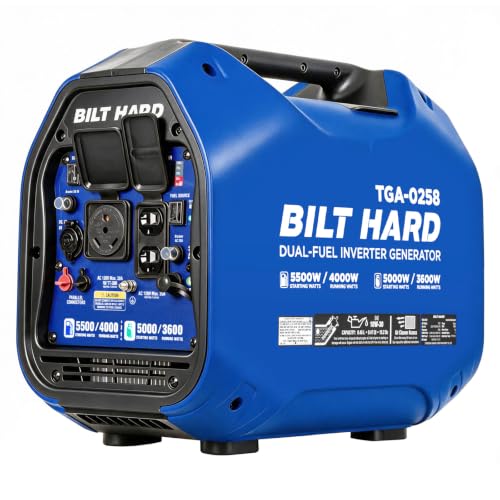
Dual-fuel 160cc inverter, 4,000 running watts on gas, with a cycling display, CO auto-shutoff and parallel connectors.
Check price on AmazonWhy we like it
- Display cycles volts, amps, watts, runtime and fuel
- Dual fuel with per-fuel ratings stated
- Built-in carbon monoxide auto-shutoff
- Parallel connectors for a second identical unit
| Specification | Details |
|---|---|
| Output | Gas 4,000 running / 5,500 starting W; LPG 3,600 / 5,000 W |
| Engine and tank | 160cc OHV, recoil start; 1.14-gallon tank |
| Outlets | 120V 20A outlets, TT-30R, 12V DC 8A, USB-C/USB-A adapter |
| Safety | CO auto-shutoff, low-oil protection, AC/DC breakers |
| Warranty | Not stated in listing |
| Weight | 61.73 lb |
BILT HARD 5500W — dual-fuel inverter, 4,000/5,500 W gas, 3,600/5,000 W LPG, 160cc, 1.14 gal, display, CO auto-shutoff, 61.73 lb
The Most Detailed Readout Among the Small Inverters
The larger Westinghouse units have data centers, but among the compact inverters on this shelf, the BILT HARD listing describes the most complete display: volts, frequency, amps, watts, runtime hours and fuel level. Seeing live watts is genuinely useful when you are learning what your refrigerator and furnace draw on startup.
It joins the WEN DF360iX and DF680iX as one of three dual-fuel units with an explicit CO auto-shutoff, and it lists the most rated output of the small dual-fuel models under 65 lb.
The weak points are the 1.14-gallon tank, which is the smallest stated capacity among the picks, recoil-only starting, and no warranty in the listing at all. It is a newer brand with less track record than WEN or Westinghouse, so confirm warranty support before buying.
Pros
- Rich digital display
- Dual fuel with CO auto-shutoff
- 4,000 running watts at under 62 lb
Cons
- Small 1.14-gallon tank
- Recoil start only
- No warranty stated
- No THD figure
Check BILT HARD 5500W price on Amazon
7. Evernexta YH2800i — Quietest Stated Noise Level
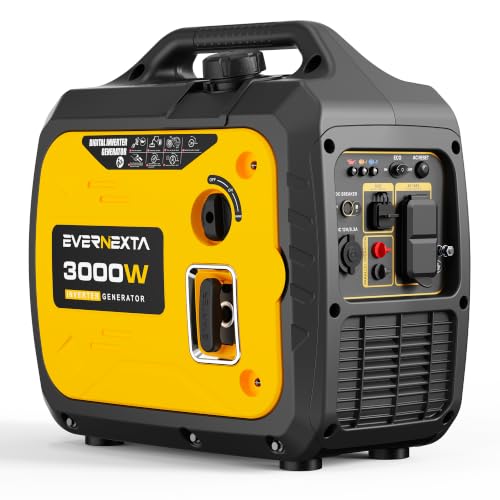
Compact 97.7cc gasoline inverter rated 2,350 running watts, listed at 53 to 56 dB from 23 feet and 41.8 lb.
Check price on AmazonWhy we like it
- Lowest noise figure stated on the shelf
- 41.8 lb, lightest stated weight of the picks
- Under 3 percent THD stated
- USB-C and USB-A outputs built in
| Specification | Details |
|---|---|
| Output | 2,350 running / 3,000 starting W |
| Engine | 97.7cc 4-stroke OHV, gasoline |
| Power quality | THD under 3% |
| Noise | 53 to 56 dB from 23 ft (manufacturer figure) |
| Outlets | Two 120V 20A, USB-A and USB-C, 12V DC; parallel connection |
| Weight / warranty | 41.8 lb; 2-year manufacturer; CO shutdown not stated |
Evernexta YH2800i — 2,350/3,000 W gas inverter, 97.7cc, <3% THD, 53–56 dB at 23 ft, 41.8 lb, 2-yr
The Lowest Decibel Claim Among the 15 Listings
Eight listings give a noise figure, and they are measured differently, so treat comparisons loosely. Even so, Evernexta’s 53 to 56 dB at 23 feet is the lowest number on the shelf, below the Oxseryn’s under-72 dBA and the PowerSmart’s 76 dB at the same distance. For a townhome or a tight lot where the generator has to sit 20 feet from your house but close to a neighbor’s, that matters.
It is the smallest pick at 2,350 running watts: enough for a refrigerator, lights, a modem and phones, not for a well pump. The listing tells buyers to operate it outdoors only, away from doors, windows and vents, but does not mention a CO sensor. Pair it with indoor CO alarms and follow the 20-foot rule strictly.
Pros
- Lowest stated noise figure
- 41.8 lb carry weight
- THD under 3 percent stated
- USB-C output built in
Cons
- No CO shutoff stated
- Only 2,350 running watts
- Gasoline only; tank size not stated
Check Evernexta YH2800i price on Amazon
Inverter vs conventional: what you actually get
An inverter generator rectifies the alternator’s output to DC and then rebuilds a clean AC sine wave electronically. Two practical benefits follow. First, the output has low total harmonic distortion, which is what listings mean by “safe for sensitive electronics.” Nine of the 15 listings here state a THD of 3 percent or less. Second, because the frequency is set by electronics rather than engine speed, the engine can slow down at light loads. That is the “Eco Mode” many listings describe, and it is the main source of quieter running and longer runtime claims.
Conventional open-frame generators spin at a fixed speed and usually deliver more watts per dollar and per pound of engine, which is why the biggest home-backup units are still conventional. Our comparison of inverter generators vs regular generators goes deeper into the trade-offs. In short: choose an inverter when electronics, noise or fuel economy matter most; choose a conventional unit when raw output for an all-electric house matters most.
Reading the spec sheet: running watts, starting watts and THD
Running (rated) watts is what the generator can sustain. Starting (surge or peak) watts covers the brief spike when a motor starts. Size on running watts and check that the surge figure exceeds the running total plus your largest motor’s startup draw. As a rough, labeled rule of thumb, list the essentials, add their nameplate running watts, add the biggest single starting surge, and keep about 20 percent headroom. Our guide to what size generator you need has a worked load list.
Per-fuel ratings matter for dual-fuel and tri-fuel units. Propane typically yields around 10 percent less output than gasoline on the listings that give both: the WEN DF360iX drops from 2,900 to 2,600 rated watts and the Westinghouse iGen12000DFc from 9,000 to 8,100. Natural gas drops further, as the iGen8200TFc’s 5,280 running watts on natural gas shows.
THD is only meaningful as a stated number. “Clean power” without a figure, which is how the WEN 56477i and DF360iX listings describe their output, is not wrong, but it is not comparable.
CO safety: an inverter is still a gas engine
Quiet and compact does not mean safe indoors. Inverter generators produce carbon monoxide just like any other gas engine, and the CPSC warns that CO from portable generators can make people unconscious before they recognize symptoms such as nausea, dizziness or weakness. The rules from the CDC, CPSC and NFPA are the same for every generator in this guide:
- Never run it in a home, garage, basement, crawlspace, shed, carport or on a porch, even with doors and windows open. The EPA notes deadly CO levels can linger for hours after the generator shuts off.
- Place it at least 20 feet from the house with the exhaust pointed away from windows, doors and vents.
- Prefer models with an automatic CO shut-off feature, which the CPSC specifically recommends. Five of the 15 listings describe automatic shutdown in plain terms; five more mention a CO sensor or alarm without describing what it does.
- Run battery-powered or battery-backup CO alarms inside while the generator is running, as the CDC advises. See our best carbon monoxide detector picks.
If you need power indoors, in an apartment, or anywhere a 20-foot setback is impossible, a battery unit is the safer tool. Our portable power station roundup covers models that run silently and produce no exhaust.
Getting inverter power into the house safely
Small inverters feed appliances directly through heavy-duty outdoor extension cords sized for the load. Larger inverters with an L14-30R or 14-50R outlet can feed selected circuits, but only through a transfer switch or interlock. Never backfeed through a dryer receptacle or wall outlet. The CDC warns against connecting generators to home circuits without approved devices, because a generator still connected when grid power returns can start a fire and endanger utility line workers.
A generator transfer switch or a panel interlock kit, installed by a licensed electrician with any required permit, is the right way to do it. Ask the electrician about the generator’s neutral configuration as part of the job.
Front Range use: altitude, cold starts and wind
Gas engines lose output as elevation rises, and none of these listings publish an altitude derating, so a unit sized with no margin at sea level may struggle along the Front Range. Leave extra headroom and check the manual for high-altitude carburetor guidance. Cold weather makes recoil starts harder; electric start on the larger units, cold-rated oil, and fresh or stabilized fuel help. Propane stores better than gasoline but vaporizes more slowly from small cylinders in deep cold.
Wind is the local wildcard. Exhaust that drifts away on a still night can blow back toward a door during a downslope wind event, so check the direction and keep that side of the house sealed. If you are buying a home with a generator inlet or transfer switch already installed, a pre-purchase inspection should confirm it was permitted and wired correctly. Reach out through our contact page to connect with a vetted Front Range inspector.
Frequently asked questions
Is an inverter generator better than a regular generator?
For electronics, noise and fuel economy, usually yes. Inverters produce cleaner power, with most listings stating 3 percent THD or less, and can throttle down at light loads. Conventional open-frame generators still offer more raw output per pound, which matters for all-electric homes with large loads.
What size inverter generator do I need for home backup?
Add the running watts of your essential appliances, add the largest single starting surge, and leave about 20 percent headroom. A gas-heated home running a furnace blower, refrigerator, lights and electronics may fit a mid-size inverter, while well pumps, electric ranges or central air push toward the 9,000-running-watt class. An electrician can confirm with a load calculation.
Can I run an inverter generator in my garage if the door is open?
No. The CDC and CPSC say never to run any generator in a garage, home, basement or shed, even with doors and windows open, because CO builds up quickly. Run it outdoors at least 20 feet from the house with the exhaust pointed away, and use battery-backup CO alarms inside.
Can an inverter generator power my furnace?
Yes, if it has enough running watts for the blower and controls, and it is connected properly. The clean output suits furnace control boards. Connect it through a transfer switch or interlock installed by a licensed electrician, or use a furnace-specific transfer setup; never backfeed through an outlet.
Do inverter generators lose power at high altitude?
Yes. Like all gasoline engines, inverter generators produce less power in thinner air, so output at Front Range elevations is lower than the sea-level rating on the listing. Size with extra margin and check the manual for high-altitude guidance.
Can it rain on an inverter generator?
No, an inverter generator should not run in rain or snow unprotected, because water can reach the outlets and electronics. Use a purpose-made generator tent or cover that leaves the exhaust fully open, and keep the unit at least 20 feet from doors, windows and vents.
How loud is an inverter generator?
Small inverter generators typically produce about 50 to 60 decibels at 23 feet under light load, which is similar to normal conversation. Larger home-backup inverters are louder, especially near full load. Eco mode reduces noise considerably by lowering engine speed when demand is low.
Do inverter generators need maintenance?
Yes, inverter generators need regular oil changes, spark plug checks and air filter cleaning, usually per the hours in the owner's manual. Before storage, add fuel stabilizer or run the carburetor dry. Start the generator monthly under a light load so it is ready for an outage.
More Questions About Inverter Generators
How long can an inverter generator run on a tank of gas?
Most inverter generators run about 8 to 12 hours on a full tank at a quarter to half load, according to typical manufacturer ratings. Runtime falls sharply at full load, often to a third or less of the stated figure. Eco or economy mode helps by idling the engine down when demand is light. For a multi-day outage, plan fuel on the generator’s actual load: a refrigerator and a few lights use far less than a well pump or space heater. Store gasoline safely outdoors in approved cans.
Is an inverter generator safe for computers and TVs?
Yes, inverter generators are safe for computers, TVs and other sensitive electronics because they produce stable power with low total harmonic distortion, usually under 3 percent. Conventional open-frame generators can produce rougher, less stable power that may stress electronic power supplies. Even with an inverter generator, use a quality surge protector, start the generator before plugging devices in, and avoid overloading it. Shut sensitive devices off before stopping the engine or switching the load.
How much does an inverter generator cost?
Inverter generators typically cost more per watt than conventional generators, roughly ranging from a few hundred dollars for small 2,000-watt units to several thousand for large 8,000-watt-plus home-backup models. Dual-fuel capability, electric start, a CO shutoff sensor, remote start and 240-volt output all raise the price. Installation adds cost if a transfer switch or inlet box is wired in by an electrician. A conventional generator of similar wattage is usually cheaper but louder and less fuel-efficient at light load.
Can you run two inverter generators together?
Yes, many inverter generators can run in parallel to double the available power, but only when both units are parallel-capable and connected with the correct parallel kit. Most manufacturers recommend pairing identical models. Running in parallel lets two small, light generators act like one larger unit while staying portable. Parallel kits usually provide a 30-amp RV or household outlet, which can feed a properly installed transfer switch or inlet. Never connect generators together with improvised wiring or back-feed through a dryer outlet.
References
- CPSC Safety Tips to Prevent Carbon Monoxide Poisoning and Fires During Winter Storms — U.S. Consumer Product Safety Commission
- Carbon Monoxide Poisoning Basics — Centers for Disease Control and Prevention
- Natural Disaster Safety — Centers for Disease Control and Prevention
- Carbon Monoxide’s Impact on Indoor Air Quality — U.S. Environmental Protection Agency
- Carbon Monoxide Safety — National Fire Protection Association