Best Garage Floor Epoxy (2026): 7 Kits Compared by Listing

The best garage floor epoxy is the one your slab can actually hold. Most failed garage coatings do not fail because the resin was weak. They fail because the concrete was damp, dusty, sealed or still releasing moisture from below, and the coating lifted in sheets the first summer a hot tire parked on it. So this guide starts with the product type (100% solids epoxy, water-based epoxy, polycuramine and clear sealers) and ends with the slab checks that decide whether any kit will last. Below are seven picks matched to specific garages and schedules, followed by a buying guide on prep, moisture testing, cure times and safety.
Part of our Structure & Exterior guide — start there for the full picture →
As an Amazon Associate we earn from qualifying purchases.
How we compared: we compared 13 current Amazon listings for garage floor coating kits on what each listing states: chemistry, solids content, coverage, included prep materials, foot and vehicle traffic times and recoat rules. Three how-to books that came up in the same searches were set aside. We did not lab-test any coating or apply it hands-on. Several listings are color variants of the same kit, so the 13 listings cover seven distinct product lines. Prices and availability change often, so check the current listing before buying.
Quick picks: the best garage floor epoxy kits by use case
| Product | Best for | Key features | Price | Buy |
|---|---|---|---|---|
| Gorilla 2.5-Car Epoxy Kit | Best overall for a two-car garage |
| $376.00as of Nov 19, 2026 7:39 am GMT+0000 | Buy now →Check current price |
| Rust-Oleum RockSolid | Fast return to service |
| $250.29as of Nov 19, 2026 7:39 am GMT+0000 | Buy now →Check current price |
| Rust-Oleum EpoxyShield 2.5-Car | Forgiving water-based kit |
| $185.00as of Nov 19, 2026 7:39 am GMT+0000 | Buy now →Check current price |
| ArmorPoxy 300 Sq Ft Kit | Best for slip resistance |
| $439.00as of Nov 19, 2026 9:49 pm GMT+0000 | Buy now →Check current price |
| Oycevila Clear Epoxy | Clear coat over bare concrete |
| — | Buy now →Check current price |
| Gorilla 1-Car Epoxy Kit | Best for a one-car garage |
| $245.42as of Nov 19, 2026 9:49 pm GMT+0000 | Buy now →Check current price |
| DWIL Water-Based Epoxy | Low-odor budget option |
| $67.71as of Nov 19, 2026 9:49 pm GMT+0000 | Buy now →Check current price |
Prices are Amazon’s listed prices as of the time shown and change often; check Amazon for today’s price. As an Amazon Associate we earn from qualifying purchases.
The 7 picks, compared listing by listing
1. Gorilla Epoxy Garage Floor Coating Kit (2.5-Car) — Best Overall
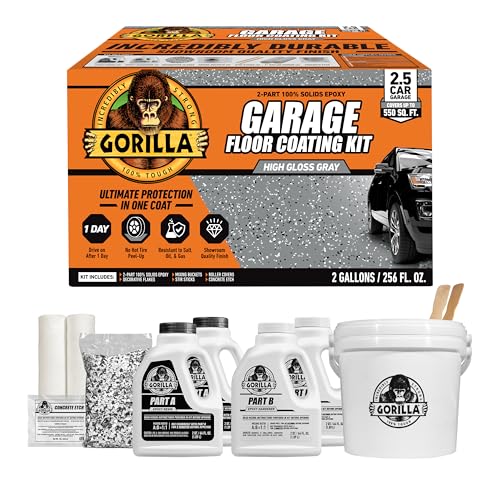
Two-part 100% solids epoxy kit with etch, flakes and rollers, rated for 550 sq ft and drive-on after one day.
Check price on Amazon$376.00 as of Nov 19, 2026 7:39 am GMT+0000 — prices change; see Amazon for current price.Why we like it
- 100% solids resin builds a thicker film per coat
- Covers a full 2.5-car floor in one kit
- Fastest stated drive-on time on the shelf
- Concrete etch, buckets and rollers all included
| Specification | Details |
|---|---|
| Chemistry | Two-part epoxy resin and hardener, 100% solids |
| Coverage | Up to 550 sq ft from two gallons of material |
| Return to service | Space usable 24 hours after application, per listing |
| Kit contents | 12 pieces: resin, hardener, gray flakes, concrete etch, mixing buckets, stir sticks, roller covers, printed steps |
| Finish | High gloss gray; described as low VOC |
| Weight / model | 27 lb shipping weight; model 117994DF |
Gorilla 117994DF — 2-part 100% solids epoxy, 550 sq ft, 24-hour drive-on, etch + flakes included, high gloss gray
The Only Large Kit Pairing 100% Solids With a One-Day Drive-On Time
Four of the 13 listings describe a 100% solids formula: both Gorilla kits, ArmorPoxy and the Oycevila clear coat. Of those four, only the two Gorilla kits state that the floor can be used 24 hours after application, and this is the larger of the pair. The ArmorPoxy listing says 72 hours before vehicles, and the Oycevila listing gives a 7-day full cure.
A 100% solids product has no water or solvent to evaporate, so what goes on the floor is roughly what stays on it. That generally means a thicker film from a single coat compared with water-based kits, but it also means a shorter working time once the two parts are mixed. The listing does not state a pot life, so read the label before mixing a full batch on a warm day.
The listing also leaves out a few details worth knowing. It does not state a mil thickness, a moisture limit for the slab or whether a primer is recommended on porous concrete. It calls the kit “peel proof,” which is a marketing claim no coating can guarantee over a damp or poorly prepared slab.
Pros
- 100% solids two-part formula
- 550 sq ft coverage suits most two-car garages
- 24-hour return to use, the fastest stated here
- Etch included for surface prep
Cons
- Pot life not stated in the listing
- No moisture limit or primer guidance listed
- 27 lb kit is heavy to haul and mix
Check Gorilla 2.5-Car Epoxy Kit price on Amazon
2. Rust-Oleum RockSolid Polycuramine Kit (Gray) — Best Fast Return to Service
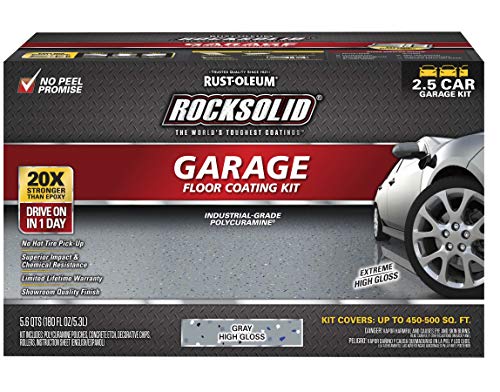
Self-leveling polycuramine coating with chips and etch, foot traffic in 8 to 10 hours and vehicles in 24 to 36 hours.
Check price on Amazon$250.29 as of Nov 19, 2026 7:39 am GMT+0000 — prices change; see Amazon for current price.Why we like it
- Foot traffic in as little as 8 hours
- Seven-day window to recoat without sanding
- Formulated without VOC-containing solvent
- Self-leveling, so roller marks flatten out
| Specification | Details |
|---|---|
| Chemistry | Polycuramine (a hybrid coating, not a classic epoxy) |
| Foot / vehicle traffic | Foot traffic in 8 to 10 hours; vehicles in 24 to 36 hours |
| Kit contents | Burst pouch coating, foam roller, decorative chips, concrete etch |
| Recoat | 7-day recoat window without sanding |
| Coverage | 2.5-car kit; square footage not stated in listing |
| Weight / model | 15.8 lb; model 293513 |
Rust-Oleum RockSolid 293513 — polycuramine, self-leveling, foot 8–10 h, vehicles 24–36 h, 7-day recoat, chips + etch
The Only Product Line Here That Names a Recoat Window
Four listings on the shelf are RockSolid kits in different colors: gray, dark gray, black and modern greige. All four share the same bullets, and they are the only listings that describe a polycuramine coating. They are also the only ones that state a recoat window, seven days without sanding. That matters if a first coat goes on thin or a section needs touch-up, because many coatings need to be scuffed before a second coat will bond.
The stated foot traffic time of 8 to 10 hours is the shortest on the shelf. Vehicle traffic at 24 to 36 hours is close behind the Gorilla kits and well ahead of EpoxyShield at three days. The burst pouch packaging keeps the two components sealed until you squeeze them together, which reduces mixing mistakes.
Because RockSolid is not an epoxy, it is a fair alternative rather than a direct match for buyers who specifically want epoxy. The listing also does not give a square-foot coverage figure for the 2.5-car kit, so measure the floor and compare with the label before buying a single box for a large garage.
Pros
- Shortest stated foot traffic time on the shelf
- Recoat within 7 days without sanding
- Low odor, suitable for indoor application per listing
- Four color options
Cons
- Not a true epoxy
- Coverage in square feet not stated
- Foam roller only; no squeegee included
Check Rust-Oleum RockSolid price on Amazon
3. Rust-Oleum EpoxyShield 2.5-Car Kit (Dark Gray) — Best Forgiving Water-Based Kit
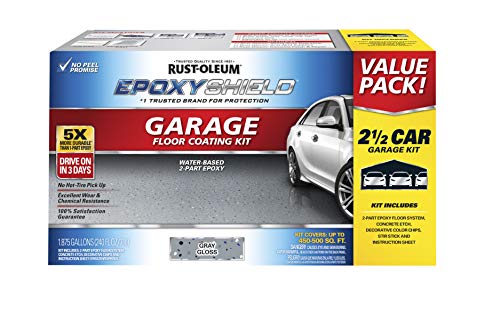
Water-based two-part epoxy with chips and etch, applied in 4x4 ft sections; vehicles after 3 days.
Check price on Amazon$185.00 as of Nov 19, 2026 7:39 am GMT+0000 — prices change; see Amazon for current price.Why we like it
- Water-based formula is easier for first-timers
- Clear section-by-section application method stated
- Etch and decorative chips in the box
- Optional matching clear topcoat sold separately
| Specification | Details |
|---|---|
| Chemistry | Two-part water-based epoxy |
| Traffic times | Light foot 12 to 16 hours; normal use 24 to 48 hours; vehicles 3 days |
| Kit contents | Burst pouch coating, decorative chips, concrete etch |
| Application | Synthetic nap roller, 4 x 4 ft sections, chips scattered into wet coating |
| Surface condition | For concrete floors in good, sound condition |
| Model | 365186; roller not stated as included |
Rust-Oleum EpoxyShield 365186 — water-based 2-part epoxy, gloss with chips, etch included, vehicles in 3 days
The Only Kit That States It Needs a Floor in Good, Sound Condition
Three EpoxyShield listings (dark gray 2.5-car, gray 1-car and tan 2.5-car) share the same bullets, and a fourth EpoxyShield gray listing uses older wording. The three newer ones are the only listings on the shelf that say outright that the product is for concrete in good, sound condition. That is an honest limit. A water-based epoxy is a thinner film than a 100% solids coat, and it will not bridge cracks, spalls or flaking concrete.
The trade-off for that thinner film is a slower, more forgiving application. The listing lays out a clear method: roll a 4 x 4 foot section, broadcast chips into it while wet, and move on. Light foot traffic waits 12 to 16 hours and vehicles wait three days, the longest stated time among the epoxy kits other than DWIL.
The listing does not say a roller is included, though it names the roller type to use. It also does not give a square-foot coverage figure. The older 261845 listing states the formula is five times harder than one-part epoxy floor paint, a useful comparison if you are deciding between this kit and a one-part paint.
Pros
- Water-based, gentler to apply than 100% solids
- Step-by-step section method in the listing
- Etch and chips included
Cons
- Three-day wait before parking
- Thin film will not hide damaged concrete
- Roller and square-foot coverage not stated
Check Rust-Oleum EpoxyShield 2.5-Car price on Amazon
4. ArmorPoxy 100% Solids Garage Kit (300 Sq Ft) — Best for Slip Resistance

17-piece 100% solids epoxy kit with etch, flakes, a non-slip additive, roller and squeegee; vehicles in 72 hours.
Check price on Amazon$439.00 as of Nov 19, 2026 9:49 pm GMT+0000 — prices change; see Amazon for current price.Why we like it
- Only kit that includes a non-slip additive
- Squeegee included for spreading thick resin
- Three-step, multi-layer system described
- Optional extra flake bags for full coverage
| Specification | Details |
|---|---|
| Chemistry | 100% solids epoxy, applied in three layers |
| Coverage | 300 sq ft per kit |
| Kit contents | 17 pieces: etching solution, flake mix, non-slip additive, roller, squeegee |
| Cure | 24-hour cure; vehicle ready at 72 hours |
| Finish | High gloss with textured, slip-resistant option |
| Weight | 37.2 lb |
ArmorPoxy Designer Gray — 100% solids, 300 sq ft, 3-layer system, non-slip additive + squeegee, vehicles at 72 h
The Only Kit on the Shelf With a Non-Slip Additive in the Box
A high-gloss floor gets slick when snow melts off a car or water tracks in from the driveway. Of the 13 listings, only ArmorPoxy includes a non-slip additive, and it is also the only kit that ships with a squeegee. Thick 100% solids resin spreads more evenly when it is pulled out with a squeegee and then back-rolled, so the extra tool is practical, not decorative.
The coverage is the catch. At 300 sq ft, this kit covers a little more than a typical one-car bay, so a two-car garage needs a second kit. The listing’s 72-hour vehicle time is also three times longer than the Gorilla kits state, even though both are 100% solids.
Some claims here deserve skepticism. “10x stronger than steel” and “military-grade” are not defined or tied to a named test. The useful facts are the ones you can check: the kit contents, the coverage and the cure schedule.
Pros
- Non-slip additive included
- Squeegee plus roller for thick resin
- Most complete kit by piece count
Cons
- 300 sq ft may need two kits
- 72 hours before vehicles
- Strength claims are not tied to a named test
Check ArmorPoxy 300 Sq Ft Kit price on Amazon
5. Oycevila 3-Gallon Clear Epoxy — Best Clear Coat Over Bare Concrete

Clear 2:1 100% solids self-leveling epoxy, 3 gallons for about 250 sq ft, up to 15 mils in one coat.
Check price on AmazonWhy we like it
- Clear finish keeps the look of bare or stained concrete
- States a film build of up to 15 mils
- Can serve as primer, topcoat or sand binder
- Zero VOC and ultra-low odor per listing
| Specification | Details |
|---|---|
| Chemistry | Two-part 100% solids epoxy, 2:1 mix ratio, self-leveling |
| Volume / coverage | 3 gallons; about 250 sq ft (a standard one-car garage) |
| Film build | Up to 15 mils in one coat |
| Cure | Walk on in 12 to 24 hours; full cure in 7 days |
| Kit contents | Mixing pail, paddle, gloves, cleaning wipe; no etch or flakes |
| Color | Clear |
Oycevila clear — 2:1 100% solids, 3 gal / 250 sq ft, up to 15 mils, walk 12–24 h, full cure 7 days
The Only Listing That States a Mil Thickness
None of the other 12 listings gives a film thickness. Oycevila says one coat can build up to 15 mils, which is a concrete number you can compare with other coatings’ technical data sheets. It is also the only clear product on the shelf, and its listing describes three roles: a primer under colored epoxy, a topcoat over another coating, or a binder for a sand-texture finish.
Clear epoxy shows everything underneath it. Oil stains, patched cracks and tire marks will stay visible under a glossy film, so the slab has to be clean and evenly prepared. The kit does not include an etch or degreaser, unlike 10 of the 13 listings, so plan to buy prep products separately.
Three gallons for 250 sq ft is a heavy application rate, which is how it reaches the stated thickness. The listing does not say when vehicles can return, only a 7-day full cure, so plan on keeping the car out for the full week.
Pros
- Only clear coating on the shelf
- Stated 15-mil film build
- Multiple uses: primer, topcoat or binder
Cons
- No etch or degreaser included
- Vehicle return time not stated
- Shows every stain and patch underneath
Check Oycevila Clear Epoxy price on Amazon
6. Gorilla Epoxy Garage Floor Coating Kit (1-Car) — Best for a One-Car Garage
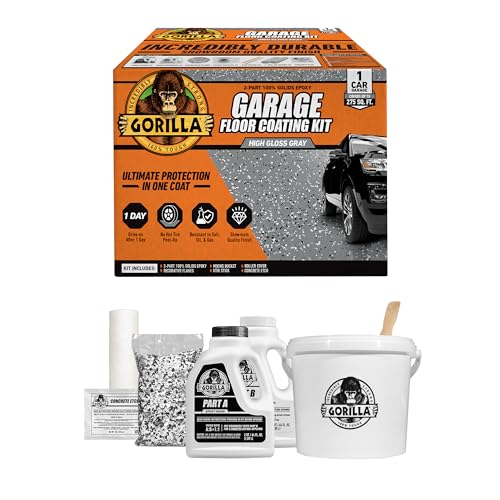
One-gallon 100% solids epoxy kit for about 275 sq ft with etch, flakes, bucket and roller; drive-on after one day.
Check price on Amazon$245.42 as of Nov 19, 2026 9:49 pm GMT+0000 — prices change; see Amazon for current price.Why we like it
- Same chemistry as the 2.5-car Gorilla kit
- Sized for a single bay or workshop
- Etch, flakes, bucket and roller included
- 24-hour return to use per listing
| Specification | Details |
|---|---|
| Chemistry | Two-part 100% solids epoxy |
| Coverage | Up to 275 sq ft from one gallon |
| Return to service | Usable 24 hours after application |
| Kit contents | 7 pieces: resin, hardener, gray flakes, etch, mixing bucket, stir stick, roller cover |
| Weight / model | 14.95 lb; model 118492DF |
Gorilla 118492DF — 2-part 100% solids epoxy, 1 gal / 275 sq ft, 24-hour drive-on, etch + flakes included
The Highest Stated Coverage Among the One-Car Kits
Four listings are sized for one car or roughly 250 to 300 sq ft: this Gorilla kit, the EpoxyShield 1-car kit, the Oycevila clear coat and DWIL, with ArmorPoxy close at 300 sq ft. This Gorilla kit claims 275 sq ft from a single gallon, while Oycevila uses three gallons to cover 250 sq ft. That difference tells you the Gorilla kit is designed for a thinner coat per square foot, so spreading it further than stated will leave a weak film.
It keeps the 24-hour use time of its larger sibling, which makes it a reasonable choice for a single-bay garage, a workshop or a storage room where a car has to come back in the next evening.
The same gaps apply as on the larger kit: no pot life, no moisture limit and no mil thickness in the listing. A one-car kit also has less margin for error. If the slab is rough or porous, it will soak up more material than the stated coverage assumes.
Pros
- Right-sized for a single bay
- 24-hour drive-on time
- Prep etch included
Cons
- Little margin on rough or porous concrete
- Pot life and thickness not stated
- Only one roller cover
Check Gorilla 1-Car Epoxy Kit price on Amazon
7. DWIL Water-Based Garage Floor Epoxy (Light Gray) — Best Low-Odor Budget Option

Water-based low-VOC two-part epoxy for about 250 sq ft; touch dry in 2 to 3 hours, vehicles after 7 days.
Check price on Amazon$67.71 as of Nov 19, 2026 9:49 pm GMT+0000 — prices change; see Amazon for current price.Why we like it
- Water-based and low VOC for enclosed spaces
- Self-leveling formula aimed at first-timers
- Mixing directions with water ratios stated
- Resin, hardener and tools included
| Specification | Details |
|---|---|
| Chemistry | Two-part water-based epoxy, self-leveling |
| Coverage | Up to 250 sq ft (110 fl oz) |
| Dry / traffic | Touch dry in 2 to 3 hours; foot traffic in 3 days; vehicles in 7 days |
| Mixing | Mix A and B, then add about 10% water |
| Primer | Color option labeled “no primer”; etch not stated as included |
DWIL Light Gray — water-based 2-part epoxy, 250 sq ft, low VOC, foot 3 days, vehicles 7 days
The Longest Stated Wait Before Vehicles
DWIL is one of two water-based product lines on the shelf, alongside EpoxyShield. It is the more cautious of the two on timing: three days for foot traffic and seven for vehicles, compared with EpoxyShield’s 12 to 16 hours and three days. That slow schedule is a reasonable trade for a low-odor product in a garage attached to living space.
The listing claims a 5 to 10 year lifespan, which depends entirely on prep and use. It does not say an etch is included, does not give a moisture limit and does not mention hot tire resistance, which 12 of the 13 listings do mention. If daily parking on a hot tire is the main job, the 100% solids or polycuramine picks are better documented for it.
Pros
- Water-based, low odor, low VOC
- Clear mixing ratio in listing
- Covers a one-car floor
Cons
- Seven days before vehicles
- Hot tire resistance not mentioned
- No etch listed in the kit
Check DWIL Water-Based Epoxy price on Amazon
100% solids, water-based or polycuramine: how to choose
Garage floor kits fall into three groups on this shelf, and the label on the box matters more than the brand.
100% solids epoxy
These kits contain no water or solvent to evaporate. The film that cures is close to the film you rolled on, so one coat builds real thickness. That helps on a floor that sees daily parking, dropped tools and road salt. The drawbacks are a short working time after mixing, more physical effort to spread, and less forgiveness if you mix too much at once. Use a squeegee and roller, work in small batches and keep a wet edge.
Water-based epoxy
Water-based kits go on thinner, are easier to roll and have lower odor. They are a good match for sound, smooth concrete in a lightly used garage. They need longer before vehicles return, and they do not fill or hide surface damage. Both water-based lines here state wait times of three to seven days before parking.
Polycuramine and other hybrids
RockSolid is marketed as a polycuramine coating. Its selling points are faster traffic times and a recoat window. Buyers who want a classic epoxy can skip it; buyers who mainly want a hard, glossy floor back in service quickly will find it the best documented option for that job.
For background on how coatings compare with sealers, stains and tile, see our main guide to garage floor epoxy.
Test the slab for moisture before you buy a kit
None of the 13 listings mentions a moisture test. That is the biggest gap on the shelf, because moisture moving up through a slab is a common reason epoxy blisters and peels. The EPA’s moisture control guidance for buildings states that flooring and coatings will fail if they are applied before surfaces are dry enough, and that concrete must be thoroughly dry before it is coated with paint or other water-sensitive materials.
Older garage slabs often have no vapor retarder underneath. The same EPA guidance notes that plastic film directly beneath a slab is what provides a vapor barrier and capillary break, and that such layers are often required by building codes today. A slab poured without one can wick ground moisture indefinitely.
The plastic-sheet test
The simplest screening check is the plastic-sheet method, described in the standard ASTM D4263. Tape a square of clear plastic, about 18 by 18 inches, tightly to the bare floor on all four edges. Leave it at least 16 hours, ideally a full day, out of direct sun. Then lift it and look:
- Droplets on the underside of the plastic usually mean moisture is coming up from below.
- Darkened concrete under the sheet points the same way.
- Droplets on the top side suggest humid air condensing on a cold slab, which is a timing issue rather than a slab problem.
Test in several spots, including near the garage door and the back wall. The plastic test is a quick screen, not a measurement. If it shows moisture, or if the floor has white powdery deposits (efflorescence), a calcium chloride test or in-slab relative humidity probe gives a real number that a coating manufacturer can compare with its limits. The EPA’s mold guidance puts it plainly: moisture control is the key to mold control. A garage that stays damp may benefit from a garage dehumidifier.
Vapor emission versus surface water
Vapor emission is moisture rising as vapor through the concrete itself. Surface water is snowmelt, rain or a hose running under the door. Epoxy handles surface water well once cured; it does not stop vapor pushing up from below. If water pools where the floor slopes toward a drain, check our guide to garage floor drains before coating around one.
Surface prep that decides whether the coating lasts
Ten of the 13 listings include a concrete etch, which tells you how much the manufacturers depend on prep. A typical sequence:
- Clear the garage and sweep thoroughly.
- Degrease oil and fluid stains. Etch will not cut through oil.
- Fill cracks and spalls with a compatible patch product and let it cure.
- Etch, scrub and rinse, then let the slab dry fully. A properly etched floor feels like medium sandpaper.
- Do a water-drop test: if a few drops bead instead of soaking in, there is a sealer or old coating that has to be removed, usually by grinding.
- Check the weather. Most labels give a minimum floor and air temperature and humidity range; follow them.
Grinding with a rented diamond grinder is the most reliable prep, and it is what most professional installers do. Acid or citric etch works on clean, unsealed concrete but can leave a weak surface if the floor is not rinsed well.
Safety: ventilation, skin contact and fumes
Even low-VOC products deserve respect in a closed garage. The EPA lists paints and related coatings among household sources of volatile organic compounds and advises increasing ventilation and following label precautions when using them. Open the garage door, run a fan pointed outdoors and keep the door to the house closed. An exhaust fan for the garage helps if the space is used as a workshop.
Epoxy resins and hardeners can irritate skin. CDC’s NIOSH notes that contact dermatitis is the most commonly reported form of occupational skin disease and that some chemicals prompt an allergic skin response. Wear nitrile gloves, long sleeves and eye protection, and wash off any skin contact promptly. Shut off pilot lights on water heaters or furnaces in the garage if the product label calls for it, and never mix more resin than you can apply within its working time, because a large mixed batch can heat up as it cures.
Front Range conditions that affect a coated garage
Colorado garages see freeze-thaw cycles, magnesium chloride and road salt dripping off cars, and wide temperature swings in spring and fall. A few practical points:
- Apply in late spring or early fall when the slab stays above the label’s minimum temperature through the cure. A cold slab slows cure and can trap moisture.
- Chemical resistance matters. Twelve of the 13 listings mention hot tire resistance and several name salt resistance specifically; look for both if you park a car that comes in covered in winter slush.
- Add slip resistance. Snowmelt on a glossy floor is slippery, so consider the additive in the ArmorPoxy kit or a separate anti-slip aggregate for other kits.
- Expect cracks to telegraph. Expansive clay soils in parts of the Front Range can move slabs; epoxy will not stop a crack from reopening.
When a coating is not the answer
A coating cannot fix a slab that is heaving, settling, badly cracked or wet from below. Wide cracks with one side higher than the other, a floor that slopes toward the house, or water entering at the base of walls are structural or drainage questions. In those cases, a professional evaluation is worth more than a kit. Our structure and exterior inspection guide explains what an inspector looks for in garages and slabs.
If you are buying a home with a coated garage floor, peeling patches or bubbles are a clue worth asking about, since they often point to moisture. To talk through what you are seeing with a qualified local inspector, reach out through our contact page.
Frequently asked questions
What is the best garage floor epoxy for a DIY install?
For most two-car garages, a two-part 100% solids kit with concrete etch included gives the thickest single coat. Water-based kits are easier to apply but go on thinner and need longer before parking. The slab's condition and moisture level matter more than the brand.
How do I know if my garage floor is too wet for epoxy?
Tape a sheet of clear plastic tightly to the floor for at least 16 hours. Droplets underneath or darkened concrete mean moisture is coming through the slab. If the test shows moisture, get a calcium chloride or relative humidity test and compare it with the product's limits before coating.
How long before I can park on a new epoxy floor?
Stated times on current listings range from 24 hours for some 100% solids kits to 24 to 36 hours for polycuramine and 3 to 7 days for water-based kits. Cold temperatures slow curing. Follow the label for your product and conditions rather than the fastest number on the box.
Is polycuramine better than epoxy for a garage?
Polycuramine coatings such as RockSolid are marketed for faster traffic times and a recoat window. They are not epoxy, so buyers who want epoxy specifically should look elsewhere. Both depend on the same prep and moisture conditions to bond well.
Can epoxy go over cracked or previously sealed concrete?
Small cracks should be patched before coating, and the coating will not stop moving cracks from reopening. Sealed or previously coated floors usually need grinding, because new epoxy will not bond to a sealer. If water beads on the surface, the floor is not ready.
Is epoxy flooring safe for indoor use?
Epoxy coatings can release fumes while curing, so ventilate well and wear the gloves, eye protection and respirator the label calls for. Once fully cured, epoxy floors are generally considered inert. Keep children and pets away during application.
Can garage floor epoxy be removed?
Yes, garage floor epoxy can be removed, usually by diamond grinding or shot blasting, and sometimes chemical strippers. Removal is labor-intensive and noisy, so many owners hire a contractor. Recoating over sound old epoxy is often possible.
Does garage floor epoxy add home value?
A clean, durable garage floor coating can improve buyer impressions, especially in garages used as workshops, but it rarely returns its full cost at sale. A peeling coating may count against a home, so quality installation matters.
More Questions About Garage Floor Epoxy
How much does it cost to epoxy a garage floor?
A DIY garage floor epoxy kit typically costs a few hundred dollars or less for a one- or two-car garage, while professional installation of epoxy or polyaspartic coatings typically costs several dollars per square foot and can reach a few thousand dollars for a two-car garage. Professional prices include diamond grinding, crack repair, a moisture check and multiple coats. Extra costs for DIY can include a grinder rental, etching products, crack filler, rollers, spike shoes and anti-slip additives.
How long does garage floor epoxy last?
A professionally installed 100 percent solids epoxy or polyaspartic garage floor coating typically lasts many years, often 10 years or more, while thin water-based DIY kits may last only a few years before peeling under hot tires. Lifespan depends on surface preparation, slab moisture, coating thickness and traffic. Hot tire pickup, peeling and bubbles are usually caused by poor prep or moisture rather than the product alone. Cleaning regularly and avoiding dragging heavy, sharp objects help a coating last.
Is epoxy garage flooring slippery?
Yes, epoxy garage floors can be slippery when wet or oily, especially high-gloss finishes. Most coating systems offer anti-slip additives that are mixed into or broadcast on the top coat, and decorative paint chips also add texture. Matte finishes and broadcast chip systems provide more grip than smooth clear coats. Keep the floor dry, use mats near entry doors and wipe up oil spills. Garages used as workshops or gyms should include anti-slip additive in the final coat.
Can garage floor epoxy be applied in cold weather?
Most garage floor epoxy should not be applied in cold weather, because many products need slab and air temperatures of roughly 50 to 60 degrees Fahrenheit or warmer to cure properly. Cold slows curing, can cause a cloudy or tacky finish and weakens adhesion. The slab must also stay above the dew point to avoid condensation. Some polyaspartic and fast-cure systems tolerate lower temperatures. Check the product’s temperature range, and wait for warmer weather rather than heating a garage briefly.
How long does garage floor epoxy take to cure?
Most garage floor epoxy coatings are dry to walk on within about a day, but they typically need several days before vehicles can park on them, often around a week for full cure. Curing time depends on the product, coating thickness, temperature and humidity. Polyaspartic and polyurea coatings can allow light use sooner. Parking too early can leave tire marks or cause hot tire pickup, where the coating lifts with the tire. Follow the label’s walk-on and drive-on times.
References
- Moisture Control Guidance for Building Design, Construction and Maintenance — U.S. Environmental Protection Agency
- Volatile Organic Compounds’ Impact on Indoor Air Quality — U.S. Environmental Protection Agency
- About Skin Exposures and Effects — CDC National Institute for Occupational Safety and Health
- A Brief Guide to Mold, Moisture and Your Home — U.S. Environmental Protection Agency