Basement Floor Paint: Epoxy vs Paint and Moisture Testing First
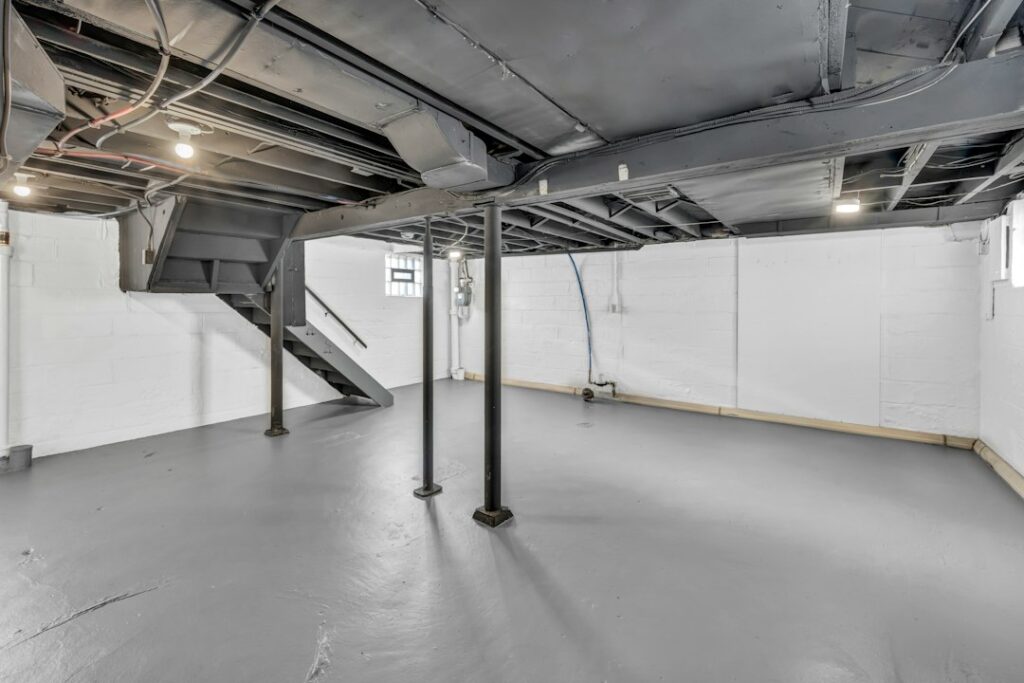
A painted concrete floor can turn a dusty, gray basement into usable space for a fraction of the cost of carpet or tile. It can also peel, blister and flake within a season if the slab is pushing moisture upward, and a fresh coat of gray epoxy can hide the very clues a buyer or inspector would use to judge a basement’s condition. Choosing the right paint for a basement floor is less about brand and more about what the concrete is doing underneath. This guide explains how to test for moisture first, what hydrostatic pressure and efflorescence mean, how epoxy, latex floor paint and penetrating sealers compare, how to prepare and etch concrete safely, and why coatings are not a radon or mold solution. It summarizes EPA guidance current as of 2026; consult a qualified professional for radon testing, mold remediation or structural concerns.
Part of our Structure & Exterior guide — start there for the full picture →
Start With a Moisture Test, Not a Paint Can
Concrete is porous. Even a slab that looks dry can move water vapor from the soil below into the basement air, and any coating applied on top sits right in that path. When vapor or liquid water gets trapped under a film, pressure builds and the coating loses its grip. Peeling paint in a ring around a floor drain, bubbles in epoxy and white powder pushing up through cracks are typical results.
The simplest screening method is the plastic-sheet test. In general terms, a square of clear plastic sheeting, often about 18 to 24 inches on a side, is taped tightly to the bare concrete on all four edges and left in place for a day or two. Afterward:
- Moisture on the underside of the plastic or a darkened patch of concrete beneath it suggests moisture is coming up through the slab.
- Moisture on top of the plastic suggests condensation from humid basement air rather than slab moisture.
- Dry on both sides is encouraging, though a single test in one spot during one season is not conclusive.
Testing in several locations, including near exterior walls and low spots, gives a better picture. Results can change with the seasons; a slab that tests dry in a dry Colorado winter may behave differently after spring snowmelt or a wet summer. Coating manufacturers often specify more precise tests, such as calcium chloride vapor emission kits or in-slab relative humidity probes, and list maximum allowable readings for their products. When a coating carries a warranty, following the manufacturer’s test method is usually required to keep it valid.
If the test shows significant moisture, the job changes from “paint the floor” to “solve the water problem first.” Painting over an active moisture problem wastes money and can make the problem harder to see.
Hydrostatic Pressure and Efflorescence
Two terms show up constantly in basement floor discussions, and both point to water.
Hydrostatic pressure
Hydrostatic pressure is the force exerted by groundwater in saturated soil. When the water table rises or soil around a foundation stays soaked after heavy rain or snowmelt, water presses against the slab and walls and can push through cracks, joints and the concrete itself. No floor paint is designed to resist meaningful hydrostatic pressure from the negative side. Coatings that claim waterproofing ability usually describe limits in the fine print, and they do not replace drainage, grading or a sump system. The basement waterproofing guide explains interior and exterior approaches to managing that water.
Efflorescence
Efflorescence is the white, chalky or crystalline deposit that appears on concrete and masonry. It forms when water moving through the concrete dissolves salts and then evaporates at the surface, leaving the salts behind. Efflorescence on a basement floor is not harmful in itself, but it is evidence that water is moving through the slab. It also interferes with adhesion: salts can push coatings off from underneath, and a coating applied over efflorescence will typically fail. Brushing it off and painting is not a fix.
Cracks are part of the same story. Hairline shrinkage cracks are common in basement slabs, but cracks that are wide, offset, growing or leaking deserve a closer look before they disappear under a coating. The basement floor cracks guide covers which patterns are cosmetic and which merit evaluation.
Best Basement Floor Paint: our top 3 picks
| Product | Best for | Key features | Price | Buy |
|---|---|---|---|---|
| Rust-Oleum EpoxyShield Basement | Best overall for basement slabs |
| $108.94as of Nov 19, 2026 11:48 am GMT+0000 | Buy now →Check current price |
| KILZ 1-Part Epoxy Floor Paint | Best one-part paint |
| $39.79as of Nov 19, 2026 11:48 am GMT+0000 | Buy now →Check current price |
| Rust-Oleum Home Interior Floor | Best over old tile or vinyl |
| $62.78as of Nov 19, 2026 11:48 am GMT+0000 | Buy now →Check current price |


Prices are Amazon’s listed prices as of the time shown and change often; check Amazon for today’s price. As an Amazon Associate we earn from qualifying purchases.
Epoxy vs Floor Paint vs Penetrating Sealers
Once moisture is understood and under control, three broad product families are typical choices.
Latex (acrylic) porch and floor paint
Water-based porch and floor paints are the most familiar option. They are inexpensive, easy to apply with a roller, low in odor compared with solvent products and easy to touch up. They are also the least durable. Latex floor paint can scuff, wear through in traffic lanes and lift under rolling loads or hot tires in a garage. In a basement used for storage, a home gym with mats or light foot traffic, they can be perfectly adequate. Some formulations are labeled for concrete and include adhesion promoters; product labels specify primers and recoat windows.
Epoxy coatings
Epoxy is a two-part system: a resin and a hardener that are mixed and react chemically to form a hard, thick coating. Options range from water-based one-day kits sold at home centers to high-solids or 100 percent solids professional systems, often with decorative flakes and a clear topcoat. Epoxy is much more abrasion- and chemical-resistant than latex paint and can produce a glossy, easy-to-clean surface. The tradeoffs:
- Prep is demanding. Epoxy needs a clean, profiled surface. Many professional installers diamond-grind the slab rather than acid-etch it.
- Pot life is short. Once mixed, the material must be applied within a limited window.
- Moisture sensitivity. Many epoxies will blister or delaminate over slabs with high vapor emission unless a moisture-mitigating primer is used.
- Slipperiness. Glossy epoxy can be slick when wet; anti-slip additives are often recommended for stairs, entries and laundry areas.
- Fumes and ventilation. Solvent-based and some high-performance products release strong vapors during application and curing. Labels specify ventilation and respirator requirements.
Hybrid systems, including polyaspartic or polyurea topcoats, are increasingly common for garages and basements. They cure faster and tend to cost more; most are installed by contractors.
Penetrating sealers
Penetrating sealers, such as silane, siloxane and silicate products, soak into the concrete rather than forming a film on top. They do not change the floor’s color much and do not peel because there is no surface film to lift. They can reduce dusting, staining and surface water absorption. They are not decorative, and they are not a cure for liquid water under pressure, but for a basement where moisture readings are borderline they are often a lower-risk choice than a film-forming paint. The concrete sealer guide compares sealer chemistries in more detail.
Which to choose
A practical rule of thumb: penetrating sealers for slabs with marginal moisture or where appearance is secondary; latex floor paint for low-traffic, dry slabs on a budget; epoxy or hybrid systems for dry slabs where durability and a finished look matter. If the plan is to install finished flooring later, the basement flooring guide discusses which surfaces tolerate basement conditions and whether a coating will interfere with adhesives.
Preparation and Etching Safety
Most coating failures trace back to preparation. Typical steps include removing old paint that is loose, degreasing oil spots, filling cracks with a compatible filler, opening the surface profile and allowing the slab to dry completely before coating.
Profiling the surface is usually done one of two ways:
- Mechanical grinding with a diamond grinder, often rented or done by a contractor. Grinding concrete produces fine dust that can contain crystalline silica, so dust-collection equipment, wet methods and appropriate respiratory protection are standard practice.
- Acid etching, commonly with muriatic (hydrochloric) acid or a milder citric or phosphoric acid product, diluted per the label, spread on the floor, scrubbed and thoroughly rinsed.
Acid etching is the step that most often injures DIYers. Hydrochloric acid is corrosive to skin, eyes and lungs, and its vapors are irritating in an enclosed basement. Safe practice generally includes:
- Chemical-splash goggles and, ideally, a face shield.
- Acid-resistant gloves, long sleeves and rubber boots.
- A respirator rated for acid gases if the label calls for it, plus strong cross-ventilation with fans exhausting to the outdoors.
- Always adding acid to water, never water to acid, in a plastic container.
- Keeping children and pets out of the area and having clean water available for flushing skin or eyes.
- Neutralizing and rinsing as the product directs, and disposing of rinse water according to local rules rather than flushing it into a yard or storm drain.
Acid etching also adds a lot of water to a basement floor. The slab must dry thoroughly afterward, which can take days, before any coating goes down. Many coating manufacturers now recommend grinding or a non-acid etching product instead.
Older basements carry one more prep caution. Existing paint, adhesive or floor tile in homes built before the late 1970s and 1980s may contain lead or asbestos. Sanding or grinding those materials without testing can release hazardous dust, so testing before removal is the prudent step.
Temperature and cure time
Basements stay cool, and many coatings list minimum slab and air temperatures for application and cure. Applying epoxy or floor paint to a cold slab in midwinter can slow curing, leave a soft or tacky film and reduce adhesion. Labels also give recoat windows and the time before light foot traffic, furniture and heavy loads; moving storage back too soon is a common cause of marks and early wear.
Radon: Coatings Do Not Mitigate, So Test Anyway
Much of the Front Range sits in an area where elevated indoor radon is common, and basements are where it tends to enter. EPA describes radon as a naturally occurring radioactive gas that can cause lung cancer, notes that it cannot be seen or smelled, states that testing is the only way to know the level of exposure and recommends that all homes be tested.
A painted or epoxy-coated floor is not a radon mitigation system. Coatings may slightly reduce soil gas entry through the slab surface, but radon also enters through cracks, joints, floor drains, sump pits, utility penetrations and the gap where the slab meets the wall, and coatings tend to crack and wear over time. Sealing is commonly used as a supplement to an active mitigation system rather than as a standalone fix. Buyers should not assume that a freshly coated basement floor means lower radon, and sellers should not present it that way.
The practical sequence: test for radon, mitigate if results call for it, and then coat the floor in a way that is compatible with the mitigation system, keeping the suction point and any sealed sump lid accessible. The radon in basements guide explains testing and mitigation options for below-grade spaces. A retest after major basement renovation is also worthwhile, since finishing work can change airflow and pressure.
Mold Under Failing Coatings
EPA’s guidance on mold and moisture states that the key to mold control is moisture control, that water-damaged areas should be dried within 24 to 48 hours, and that indoor humidity is best kept below 60 percent, ideally between 30 and 50 percent. That matters for basement floors because a coating that traps moisture, or a coated floor covered with rugs, cardboard storage boxes or carpet pads, can create damp, dark conditions where mold grows on organic material sitting on the slab.
EPA is also explicit that moldy surfaces should not be painted or caulked: mold should be cleaned up and surfaces dried before painting, and paint applied over moldy surfaces is likely to peel. For cleanup, EPA’s guidance says homeowners can handle many areas smaller than about 10 square feet themselves, while larger areas or significant water damage warrant following professional remediation guidance. A musty odor in a basement with a peeling floor coating is a signal to look for the moisture source, not to repaint.
A dehumidifier sized for the space, sealed and directed gutters, good grading and a functioning sump system address the causes. Coatings only address the surface.
What Inspectors and Buyers Should Watch For
Under the ASHI Standard of Practice, home inspectors inspect floors but are not required to inspect paint, wallpaper or other finish treatments, or floor coverings. A coating itself is generally outside the scope, but what it reveals or hides is not. Inspectors commonly note peeling or blistering coatings, efflorescence, water staining, rust marks around metal posts, cracks, signs of past water lines on walls and the absence of a sump or drainage where one would be expected.
A freshly painted basement floor in a home that is about to be listed deserves a few questions: when was it coated, why, and were there water issues before? Disclosure forms, seller interviews and moisture meter readings at slab edges can help. For a broader view of how to scope an inspection and which specialists to bring in for foundations and drainage, see the structure and exterior hiring guide and the main guide to hiring a home inspector.
Costs to Expect
These are general 2026 ranges; actual prices vary with slab size, condition and region:
- Latex porch and floor paint typically costs tens of dollars per gallon. A DIY job on a typical basement may total a few hundred dollars including primer, etcher and tools.
- DIY epoxy kits commonly run from roughly $100 to $300 or more per kit, with coverage that varies by product and number of coats.
- Penetrating sealers are often comparable to or somewhat more than floor paint per square foot, depending on chemistry.
- Professional epoxy or polyaspartic systems with grinding, crack repair, flake and topcoat often range from a few dollars to well over $10 per square foot, depending on the system and prep needed.
- Radon testing with a short-term kit is usually inexpensive; mitigation systems commonly cost in the low thousands installed.
Waterproofing or drainage repairs, when needed, can easily exceed the cost of the coating itself, which is why moisture testing belongs at the very start of the project.
More Questions About Basement Floor Paint
How long does basement floor paint last?
Basement floor paint typically lasts two to five years, while a properly applied two-part epoxy coating can last 10 years or more in a residential basement. Lifespan depends heavily on slab moisture, surface preparation, foot traffic, furniture dragging and cleaning methods. Latex porch and floor paint wears fastest in walkways and around laundry areas. Peeling soon after application usually points to moisture coming up through the slab or poor preparation rather than the product. Touch-up coats can extend the life of a floor paint finish.
Can you paint over existing basement floor paint or epoxy?
Yes, you can paint over existing basement floor paint or epoxy if the old coating is well bonded and compatible with the new product. Loose, peeling or blistered areas must be scraped or ground off, and glossy surfaces should be cleaned and scuff-sanded for adhesion. Many epoxies do not bond well over latex paint, so the coating maker’s guidance matters. Testing a small area first reveals compatibility problems. Paint in older homes may contain lead, so avoid dry sanding old coatings without testing.
How do you make a painted basement floor less slippery?
To make a painted basement floor less slippery, mix an anti-slip additive, usually a fine grit, into the final coat or broadcast it onto the wet paint. Epoxy systems often include a broadcast option for traction. Textured finishes are especially helpful near laundry areas, stairs, and floor drains where water may collect. Using rugs with non-slip backing designed for coated floors also helps. Glossy, smooth coatings can be very slippery when wet, so traction is worth adding during application rather than after.
How long before you can walk on a painted basement floor?
Most latex basement floor paints allow light foot traffic after about 24 hours, while full cure for heavy use and furniture usually takes about five to seven days. Two-part epoxy coatings often allow walking after 12 to 24 hours and full cure in about a week, depending on temperature and humidity. Cold, damp basements slow curing. Heavy items, rugs and appliances should wait until the coating has fully cured to avoid marks and adhesion problems. The product label lists specific times.
References
- Radon — U.S. Environmental Protection Agency
- A Brief Guide to Mold, Moisture and Your Home — U.S. Environmental Protection Agency
- Mold Cleanup in Your Home — U.S. Environmental Protection Agency
- ASHI Standard of Practice for Home Inspections — American Society of Home Inspectors
Frequently asked questions
What is the best paint for a basement floor?
It depends on moisture and use. Penetrating sealers suit slabs with borderline moisture, latex porch and floor paint suits dry, low-traffic floors, and epoxy or polyaspartic systems suit dry slabs needing durability. A moisture test should come first.
How do you test a basement floor for moisture before painting?
A simple screen is to tape a square of plastic sheeting tightly to the bare concrete for a day or two. Moisture under the plastic suggests slab moisture; moisture on top suggests condensation. Coating makers may specify more precise tests.
Will painting a basement floor reduce radon?
Not reliably. Radon enters through cracks, joints, drains, sumps and wall-floor gaps, and coatings wear over time. EPA says testing is the only way to know radon levels; elevated results call for a mitigation system, not paint.
Why is my basement floor paint peeling?
Common causes are moisture moving up through the slab, efflorescence salts pushing the coating off, poor surface preparation or paint applied over mold. EPA notes paint applied over moldy surfaces is likely to peel. Find the moisture source before recoating.
Is acid etching a basement floor safe to do yourself?
It can be done with care, but muriatic acid is corrosive to skin, eyes and lungs. Goggles, acid-resistant gloves, ventilation and a suitable respirator are standard. Many coating makers now recommend grinding or non-acid etching products instead.
Can you paint a basement floor that has cracks?
Yes, but cracks should be cleaned and filled with a concrete crack filler or epoxy patch first. Active cracks that are widening, uneven, or leaking water need diagnosis before painting, since a coating will hide them and may fail over moving concrete.
Does basement floor paint prevent mold?
Basement floor paint does not prevent mold by itself. Mold grows where moisture and organic material are present. A sealed floor is easier to clean, but humidity control and fixing water entry are what prevent mold. Coatings that trap slab moisture can even cause peeling.
Can rugs be placed on an epoxy basement floor?
Yes, rugs can go on an epoxy basement floor once the coating fully cures. Choose rugs with backings that breathe and do not react with coatings, and lift them periodically to check for trapped moisture or mildew, especially on slabs that have shown dampness.
Thinking about a home with a freshly coated basement floor and want to know what might be underneath? Get in touch to connect with a Front Range inspector who can look at moisture, cracks and radon risk before you commit.