Best Caulk Removers (2026): 7 Tools and Softeners Compared

The best caulk remover is usually two things: a chemical that softens the old bead and a blade or scraper that lifts it without gouging tile, acrylic or a fiberglass tub. Removal is the step that decides whether a recaulking job lasts. New silicone will not bond over old silicone, new caulk laid over a cracked bead fails along the old line, and caulking over mold traps it in place. Below are seven picks, from a softening spray and a citrus solvent to stainless and hardened-steel scrapers, then a guide to removal technique and the hazards that can hide in old caulk, from mold to PCBs and lead paint.
Part of our Structure & Exterior guide — start there for the full picture →
As an Amazon Associate we earn from qualifying purchases.
How we compared: we compared 14 current Amazon listings for caulk removal products, including four chemical softeners and solvents and ten scraper tools and kits, on what each listing states: caulk types it works on, surfaces it is safe for, blade material, included accessories, solvent ingredients disclosed and safety warnings. The search also returned two caulk whitening gels, which brighten stained caulk rather than remove it; we left those out. Two listings are the same Saker tool in different colors, and one Cocew kit includes a caulk gun. We did not test these products or use them hands-on. Prices and availability change often, so check the current listing before buying.
Quick picks: the best caulk removers by job
| Product | Best for | Key features | Price | Buy |
|---|---|---|---|---|
| Krud Kutter Caulk Remover | Softening old beads before scraping |
| $14.95as of Oct 20, 2026 10:07 pm GMT+0000 | Buy now →Check current price |
| Saker 3-in-1 tool | Best all-around removal tool |
| $12.47as of Oct 20, 2026 10:07 pm GMT+0000 | Buy now →Check current price |
| TRUXXON 2-pack | Stubborn, hardened caulk |
| $12.99as of Oct 20, 2026 10:07 pm GMT+0000 | Buy now →Check current price |
| GE sealant remover tool | Simple tool safe on tile |
| $6.88as of Oct 20, 2026 10:07 pm GMT+0000 | Buy now →Check current price |
| Orange-Sol De-Solv-it Pro | Cleaning residue after scraping |
| $15.95as of Oct 20, 2026 10:07 pm GMT+0000 | Buy now →Check current price |
| DIYSELF 4-in-1 | Push or pull removal |
| $7.99as of Oct 20, 2026 10:07 pm GMT+0000 | Buy now →Check current price |
| Goopreen 5-in-1 kit | Remove and refinish in one kit |
| $14.99as of Oct 20, 2026 10:07 pm GMT+0000 | Buy now →Check current price |
Prices are Amazon’s listed prices as of the time shown and change often; check Amazon for today’s price. As an Amazon Associate we earn from qualifying purchases.
The 7 picks, compared listing by listing
1. Krud Kutter Caulk Remover 336250 — Best Softener Before Scraping

24 oz spray that softens silicone, latex and acrylic caulk and adhesive residue so it scrapes off more easily.
Check price on Amazon$14.95 as of Oct 20, 2026 10:07 pm GMT+0000 — prices change; see Amazon for current price.Why we like it
- Names silicone, latex and acrylic caulk
- Spray works on walls as well as floors
- Largest container on the shelf at 24 oz
- Built for prep before recaulking
| Specification | Details |
|---|---|
| Type | Chemical caulk softener, spray |
| Caulk types named | Silicone, latex, acrylic; sealant and adhesive residue |
| Surfaces | Bathroom, kitchen, windows, tile; horizontal and vertical |
| Size | 24 fl oz; about 1.6 lb |
| Dwell time | Not stated in listing |
| Ingredients / warnings | Not stated in listing; read the label |
Krud Kutter 336250 — caulk softener spray, silicone / latex / acrylic, 24 oz, horizontal and vertical surfaces
The Only Softener That Names All Three Common Caulk Types
Four listings on the shelf are chemical products rather than tools. The Krud Kutter is the only one that names silicone, latex and acrylic caulk together, and the only one sold specifically as a caulk remover in a large 24-ounce spray. The others are a citrus solvent, a small 6.76-ounce silicone softener from OverZyn and an adhesive-remover gel from Goo Gone.
The listing is honest about what it does: it softens caulk to reduce scraping effort, rather than dissolving it away. Spray, wait, then lift the softened bead with a plastic or stainless scraper such as the Saker or GE tools below.
The gap is detail. The listing does not state a dwell time, the active ingredients or any safety precautions, so read the label carefully, ventilate the room and test on a hidden spot of acrylic tub or cultured marble first.
Pros
- Silicone, latex and acrylic named
- Large 24 oz spray
- Works on vertical surfaces
Cons
- Dwell time not stated
- Ingredients and warnings not listed
- Softens rather than dissolves
Check Krud Kutter Caulk Remover price on Amazon
2. Saker SAK4609 3-in-1 Caulking Tool — Best All-Around Removal Tool

3-in-1 tool with a stainless steel removal blade, internal and flat angle scrapers, silicone trowel and smoothing pads.
Check price on Amazon$12.47 as of Oct 20, 2026 10:07 pm GMT+0000 — prices change; see Amazon for current price.Why we like it
- Stainless steel blade for removing old caulk
- Silicone trowel to clear residue and bumps
- Smoothing pads for the new bead
- Rated for interior and exterior caulking
| Specification | Details |
|---|---|
| Type | Handheld 3-in-1 removal and finishing tool |
| Blade | Hard stainless steel |
| Functions | Internal angle scraper, flat angle scraper, silicone smoother |
| Use | Interior and exterior caulking |
| Size / weight | About 7.5 in; 0.15 lb |
| Caution stated | Plastic end can wear on cement and hard surfaces |
Saker SAK4609 — 3-in-1, stainless blade, angle scrapers, silicone smoother, 7.5 in, interior and exterior
One Small Tool That Handles Removal and the Finish
Ten of the 14 listings are scraper tools or kits. The Saker 3-in-1 is the most practical starting point because it combines a hard stainless blade for cutting out the old bead with a silicone trowel for clearing residue and a smoothing edge for the new caulk. Two listings on the shelf are this same Saker tool, in black and in black and blue.
The listing includes two usage notes worth repeating. It suggests loosening the screws on the back slightly for a smoother glide, and it warns that one end is plastic and can wear when used on cement or other hard surfaces. Use the stainless end for cutting and the plastic end for cleanup on tile and tubs.
It is a small tool, about 7.5 inches long. For long runs of hardened exterior caulk, a longer, heavier blade like the TRUXXON is easier on the hand.
Pros
- Removal and finishing in one tool
- Stainless blade
- Light and pocketable
Cons
- Plastic end wears on hard surfaces
- Small for long exterior runs
- Screws may need adjusting
Check Saker 3-in-1 tool price on Amazon
3. TRUXXON CG001 2-Pack — Best for Stubborn, Hardened Caulk

Two caulk removal tools with heat-treated steel 90-degree blades and solid wood handles for caulk, grout and sealant.
Check price on Amazon$12.99 as of Oct 20, 2026 10:07 pm GMT+0000 — prices change; see Amazon for current price.Why we like it
- Heat-treated, high-strength steel blade
- 90-degree blade fits floor and wall joints
- Solid wood handle for grip
- Two tools per pack
| Specification | Details |
|---|---|
| Type | Handheld scraper, 2-pack |
| Blade | Heat-treated steel, 90-degree angle |
| Handle | Solid wood |
| Materials named | Caulk, silicone, grout, glue, sealant |
| Length | About 6.9 in |
| Durability claim | Seller claims 50% more durable than standard blades; basis not stated |
TRUXXON CG001 — 2 tools, heat-treated steel 90° blade, solid wood handle, caulk / silicone / grout, 6.9 in
The Only Heat-Treated Blade on the Shelf
Most removal tools here use stainless steel heads or blades. The TRUXXON is the only listing that describes a heat-treated, high-strength steel blade, and its 90-degree angle is shaped to sit tight in the corner where a tub meets a wall or a floor meets a baseboard. That is the geometry for scraping hardened acrylic caulk or brittle old silicone that a plastic tool skates over.
The solid wood handle gives a fuller grip than the thin plastic handles on most kits, and the two-pack means one can stay in the bathroom kit and one in the garage.
The seller’s claims of 50 percent more durability and 20 percent more comfort have no stated basis, so treat them as marketing. A hard steel blade can also scratch acrylic, fiberglass and cultured marble. On those surfaces, soften first and use a plastic scraper for the final pass.
Pros
- Hard, heat-treated steel blade
- 90-degree corner geometry
- Two tools, wood handles
Cons
- Can scratch soft tub surfaces
- Durability percentages unexplained
- No smoothing tool included
Check TRUXXON 2-pack price on Amazon
4. GE Sealant and Caulk Remover Tool 3023666 — Best Simple Tool for Tile and Fixtures

One-piece GE tool with a pointed end and flat scraping edge for silicone and acrylic, safe on most tile.
Check price on Amazon$6.88 as of Oct 20, 2026 10:07 pm GMT+0000 — prices change; see Amazon for current price.Why we like it
- Pointed end for digging, flat edge for scraping
- Removes silicone and acrylic per listing
- Described as safe on tile, countertops, fixtures
- From a major sealant brand
| Specification | Details |
|---|---|
| Type | One-piece 2-in-1 hand tool |
| Ends | Sharp pointed end; flat scraping edge |
| Caulk types named | Silicone, acrylic and other common sealants |
| Surfaces | Safe on most surfaces including tile, countertops, bathroom fixtures |
| Size / weight | About 9.3 in; very light |
| Material | Not stated in listing |
GE 3023666 — 2-in-1 sealant remover tool, pointed end + flat edge, silicone and acrylic, safe on most tile
The Brand-Name Tool Built for Finished Surfaces
GE also sells the Advanced and All Purpose silicone caulks, and this is its matching removal tool. Its listing is the clearest of the tools about surface safety, describing it as gentle enough for tile, countertops and bathroom fixtures. The pointed tip gets under the end of a bead and the flat edge peels the rest away.
That gentleness is the point. Steel blades cut faster but risk scratching the glaze on tile or the gelcoat on a fiberglass tub. A non-steel tool, used after a softener, is the safer choice on finished bathroom surfaces.
The listing does not state what the tool is made of, and it is a single tool with no smoothing pads or spare blades. Pair it with a separate finishing tool for the new bead.
Pros
- Designed to be safe on finished surfaces
- Two working ends
- Simple and light
Cons
- Material not stated
- Slower on hardened caulk than steel
- No finishing tool included
Check GE sealant remover tool price on Amazon
5. Orange-Sol De-Solv-it Pro Contractors Solvent 10022 — Best for Residue After Scraping

Citrus-based solvent spray for caulk, silicone, tar and adhesive residue; lists no benzene, xylene or toluene.
Check price on Amazon$15.95 as of Oct 20, 2026 10:07 pm GMT+0000 — prices change; see Amazon for current price.Why we like it
- Lists caulk and silicone among targets
- Discloses what it does not contain
- Short 20 to 30 second dwell for most residues
- Non-corrosive per listing
| Specification | Details |
|---|---|
| Type | Citrus-based solvent spray |
| Targets named | Caulk, silicone, tar, paint, adhesives |
| Excluded ingredients | No benzene, xylene, toluene, phosphates or chlorinated solvents per listing |
| Dwell time | About 20 to 30 seconds for most substances |
| Size | 12 oz |
| Surfaces | Described as gentle on sensitive surfaces |
Orange-Sol De-Solv-it Pro 10022 — citrus solvent, caulk / silicone / adhesive residue, no chlorinated solvents, 12 oz
The Only Listing That Discloses Its Solvent Exclusions
Of the four chemical products on the shelf, Orange-Sol is the only one that tells you what it leaves out: no benzene, xylene, toluene, phosphates or chlorinated solvents. That matters for a caulk remover. The EPA has listed adhesive removers among the consumer products that historically contained methylene chloride, a chlorinated solvent, and in 2024 it finalized a rule prohibiting methylene chloride for all consumer uses.
It is best used for the film that stays behind after scraping. Silicone in particular leaves a slick residue that new silicone will not bond to, and a short dwell followed by a wipe removes it. The listing claims most substances need only 20 to 30 seconds.
Its “non-toxic, no harmful vapors” wording is the seller’s claim, not a certification. Citrus solvents still have a strong odor, so ventilate as you would for any solvent, and wear gloves.
Pros
- Discloses excluded solvents
- Fast dwell time stated
- Good for silicone residue
Cons
- Not a bulk caulk softener
- Safety claims are self-described
- Strong citrus odor
Check Orange-Sol De-Solv-it Pro price on Amazon
6. DIYSELF 4-in-1 Caulking Remover Tool — Best for Push-or-Pull Removal
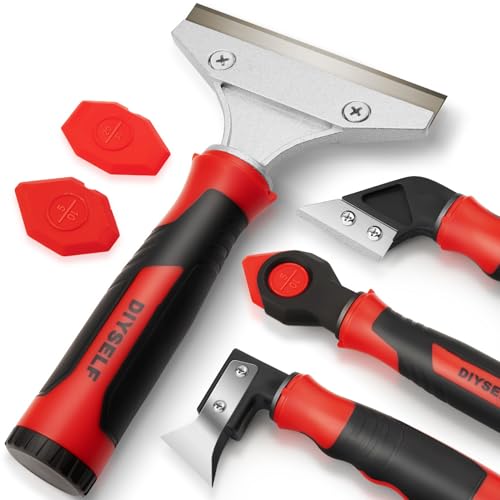
Interchangeable-head tool: covered flat scraper, push-pull remover head and two dual-profile smoothers.
Check price on Amazon$7.99 as of Oct 20, 2026 10:07 pm GMT+0000 — prices change; see Amazon for current price.Why we like it
- Removal head works pushing or pulling
- Interchangeable heads on one handle
- Flat scraper with a protective cover
- Stainless steel and silicone construction
| Specification | Details |
|---|---|
| Type | Multi-head handle, 4-in-1 |
| Heads | Flat scraper, caulk remover head, 2 dual-profile silicone smoothers |
| Removal action | Push or pull along edges and seams |
| Materials | Stainless steel and silicone |
| Storage | Protective cover for the flat scraper |
| Size / weight | Not stated in listing |
DIYSELF 4-in-1 — interchangeable heads, push/pull remover, covered flat scraper, 2 silicone smoothers
The Only Removal Head Described for Both Directions
Most removal blades work best pulled toward you. The DIYSELF listing describes a remover head that works pushing or pulling, with an angled metal edge for tight areas. That helps along a tub where you cannot get a good pulling angle at one end, or along the top of a backsplash where pushing away from you is more natural.
Heads swap onto one handle, and the flat scraper ships with a protective cover. Covered blades are a small but useful detail in a household toolbox, where an exposed scraper edge is easy to grab by accident.
The listing gives no dimensions or weight, and the manufacture data labels it as a razor-blade scraper, so treat the flat head as sharp and keep it off soft tub finishes.
Pros
- Push or pull removal
- Interchangeable heads
- Covered flat scraper
Cons
- Size and weight not stated
- Sharp scraper can mark soft surfaces
- Small heads can be misplaced
Check DIYSELF 4-in-1 price on Amazon
7. Goopreen SD002 5-in-1 Caulking Tool Kit — Best Remove-and-Refinish Kit

5-in-1 caulking kit with stainless steel head, removal scrapers and 6 replaceable smoothing pads from 3R to 17R radius.
Check price on Amazon$14.99 as of Oct 20, 2026 10:07 pm GMT+0000 — prices change; see Amazon for current price.Why we like it
- Stainless steel head resists rust
- Six smoothing pads from 3R to 17R
- Black plastic scraper plus four shaped scrapers
- Clear safety warning on the listing
| Specification | Details |
|---|---|
| Type | 5-in-1 removal and finishing kit, 13 pieces |
| Head | Stainless steel |
| Smoothing pads | 6 replaceable silicone pads: 3R, 6R, 10R, 13R, 15R, 17R |
| Scrapers | 1 black removal scraper, 4 shaped caulking scrapers |
| Warning | Sharp blades; wear gloves and safety goggles; keep from children |
| Weight | About 0.33 lb |
Goopreen SD002 — 5-in-1 kit, stainless head, 6 smoothing pads 3R–17R, 5 scrapers, gloves and goggles advised
The Widest Range of Finishing Pads, and the Only Explicit PPE Warning
Several kits on the shelf include smoothing pads, but the Goopreen SD002 lists the most, six radius sizes from 3R to 17R. Matching pad size to the joint gives a consistent concave bead, which sheds water better than a flat smear. Removal is covered by a stainless head, a black plastic scraper and four shaped scrapers.
It is also the only listing on the shelf that tells buyers to wear protective gloves and safety goggles because the kit contains sharp stainless scrapers. Eye protection is sensible for any scraping job, since brittle old caulk can snap off in small pieces.
Thirteen pieces are a lot to keep track of in a bathroom drawer. If you only recaulk once every few years, the Saker covers the essentials in one tool.
Pros
- Six smoothing pad sizes
- Plastic and stainless options
- Clear PPE guidance
Cons
- Many small parts
- No softener included
- Storage case not mentioned
Check Goopreen 5-in-1 kit price on Amazon
How to remove old caulk without damaging the surface
- Identify the caulk. Silicone feels rubbery and resists paint; acrylic latex is firmer and often painted. Softeners like Krud Kutter name both, but silicone usually needs more mechanical work.
- Cut the bond. Run a sharp blade along both edges of the bead, where it meets each surface.
- Soften if needed. Apply a caulk softener, wait the label’s dwell time and keep the room ventilated.
- Lift the bead. Pull the softened caulk out in strips with a scraper, using plastic on acrylic, fiberglass and cultured marble and steel on ceramic tile and masonry.
- Remove residue. Wipe the joint with a solvent such as the Orange-Sol, or the cleaner the new caulk’s label recommends, and let it dry fully.
- Deal with mold before recaulking. The EPA’s mold cleanup guidance says plainly not to paint or caulk moldy surfaces. Scrub mold off hard surfaces with detergent and water and dry completely. Our mold remover guide and mildew and mold remover guide cover products for that step.
For more detail on the removal process, see our caulk remover guide.
Chemical softeners vs tools: which you need
For a single tub surround with fairly fresh caulk, a good tool alone is usually enough. For old, hardened or thick beads, especially acrylic that has been painted over several times, a softener saves time and reduces the risk of slipping with a blade. For silicone, residue is the real problem, and a solvent wipe matters more than the scraper.
Of the 14 listings, four are chemicals and ten are tools. Most people need one of each: a softener or solvent and a scraper, plus a smoothing tool for the new bead.
Safety: solvents, PCBs and lead
Solvents and ventilation
Caulk removers and adhesive removers are solvent products. The EPA notes that indoor VOC levels can rise very high while such products are used and remain elevated after, and advises increasing ventilation, following label precautions and, when a label calls for a well-ventilated area, working outdoors or with an exhaust fan running. The EPA has specifically identified adhesive removers among the consumer products that used to contain methylene chloride; consumer paint and coating removal uses were prohibited in 2019, and the 2024 rule prohibits methylene chloride for all consumer uses. Check the label of any older product in the garage and dispose of it through a household hazardous waste program.
PCBs in old caulk
Caulk is one of the building materials EPA flags for polychlorinated biphenyls. EPA research found that caulk installed between 1950 and 1979 may contain as much as 40 percent PCBs and can contaminate adjacent masonry or wood. EPA’s guidance, aimed mainly at schools and other buildings, includes a summary of tools and methods for caulk removal and protective measures. If you are removing original exterior caulk around windows or masonry on a building from that era, consider testing first and avoid power grinding or heat guns, which spread dust and fumes.
Lead paint on trim
In pre-1978 homes, caulk often sits against trim painted with lead-based paint. Scraping can disturb that paint. The EPA’s Renovation, Repair and Painting program sets lead-safe work practices for contractors in older homes; homeowners doing their own work should follow the same precautions. Our guide to Peel Away lead paint remover covers one approach to painted trim.
Choosing the right blade for the surface
The surface under the caulk matters as much as the caulk itself. Glazed ceramic and porcelain tile, stone and masonry tolerate a steel blade held at a low angle. Acrylic and fiberglass tubs and shower pans, cultured marble vanity tops and painted trim do not; a steel edge leaves fine scratches that collect soap scum and are hard to polish out. On those materials, soften first, then use a plastic edge or a tool described as safe on finished surfaces, such as the GE tool or the plastic end of the Saker.
- Ceramic tile and grout lines: stainless or steel blade, followed by a solvent wipe.
- Acrylic or fiberglass tub: softener, plastic scraper, then a gentle solvent on a cloth.
- Window frames and exterior trim: steel blade for hardened caulk, with care around painted wood.
- Countertop backsplash: plastic or GE-style tool to protect the counter edge.
Whatever the surface, work slowly at the ends of a bead, where most slips happen, and keep the blade moving along the joint rather than prying against the surface.
Front Range notes
Exterior caulk on Front Range homes takes a beating from high-altitude sun and big temperature swings, so it often comes out hard, chalky and cracked. Hardened exterior beads usually need a steel blade and patience rather than a softener. Work in mild temperatures, since many removal products and replacement caulks perform poorly in the cold, and check the joint behind the old caulk for soft wood or gaps that need repair before resealing.
Indoors, caulk that peels repeatedly in a bathroom often points to a ventilation problem rather than a caulk problem. A bathroom fan that does not exhaust outdoors keeps joints damp and mold returning.
When to call a pro
Call a contractor if old caulk hides rotted wood, a soft subfloor around a tub, a failing tub surround or water damage behind tile. Those are repairs, not recaulking jobs. Our guide to hiring for structure and exterior work and the broader hiring process section explain how to vet contractors. If you are buying a Front Range home and want wet areas, windows and the exterior envelope checked, connect with a vetted local inspector through our contact page.
Frequently asked questions
What is the best way to remove old silicone caulk?
Cut along both edges of the bead, lift it out with a scraper, then remove the slick residue with a solvent or the cleaner the new caulk recommends. New silicone does not bond to old silicone, so the joint must be completely clean and dry before recaulking.
Do caulk remover sprays dissolve caulk?
Most soften it rather than dissolve it. The Krud Kutter listing we compared describes softening caulk to make scraping easier. Expect to scrape after the dwell time on the label.
Will a caulk removal tool scratch my tub?
Steel blades can scratch acrylic, fiberglass and cultured marble. Use a plastic scraper or a tool described as safe on finished surfaces for those, after softening the caulk, and save steel blades for ceramic tile and masonry.
Should I remove moldy caulk or clean it?
If mold has grown into or behind the caulk, remove it. The EPA advises against caulking or painting over moldy surfaces. Clean the joint, dry it completely and fix the moisture source, such as a weak bathroom fan, before applying new caulk.
Is old caulk hazardous to remove?
It can be. EPA research found caulk installed between 1950 and 1979 may contain up to 40 percent PCBs, and pre-1978 homes may have lead paint on adjacent trim. Consider testing and use lead-safe practices on older work.
References
- Mold Cleanup in Your Home — U.S. Environmental Protection Agency
- Volatile Organic Compounds’ Impact on Indoor Air Quality — U.S. Environmental Protection Agency
- Risk Management for Methylene Chloride — U.S. Environmental Protection Agency
- Polychlorinated Biphenyls (PCBs) in Building Materials — U.S. Environmental Protection Agency
- Lead Renovation, Repair and Painting Program — U.S. Environmental Protection Agency