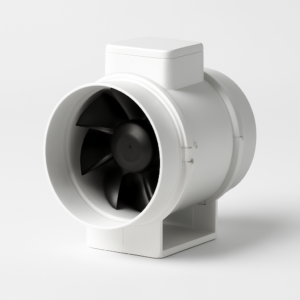
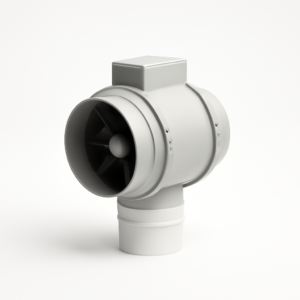
RadonAway GP501 Inline Fan
The RadonAway GP501 (part 23005-1) is a radon mitigation fan with 3-inch duct connections that accept 3- or 4-inch pipe through couplings.
The RadonAway GP501 (part 23005-1) is a radon mitigation fan with 3-inch duct connections that accept 3- or 4-inch pipe through couplings. It is aimed at sub-slab depressurization systems where a mitigator has specified this model. What distinguishes it in the listing is installation flexibility combined with a safety listing: it can mount on the pipe or by an integral flange, its electrical box accepts hard-wiring or a plug-in cord, and it is ETL listed for indoor or outdoor use.
Specifications
| Specification | Details |
|---|---|
| Model / part number | GP501; part 23005-1 |
| Duct connections | 3-inch ducts, used with 3- or 4-inch pipe |
| Mounting | On the duct pipe or with the built-in flange |
| Electrical | Electrical box set up for hard-wire or plug-in connection |
| Safety listing / location | ETL listed; rated for indoor or outdoor installation |
| Housing | Seams sealed under negative pressure; white |
| Size / weight | About 12.5 x 12.5 x 13 in; 6 lb |
| Warranty | Five-year limited manufacturer’s warranty (airflow and wattage not stated in listing) |
RadonAway GP501 (23005-1) — 3-in ducts for 3/4-in pipe, pipe or flange mount, hard-wire or plug-in, ETL indoor/outdoor, 5-yr limited warranty
How It Compares
The Only Radon Fan on This Shelf Whose Listing Names a Safety Listing
We read 20 similar listings. Just three of them are other radon fans: the RadonAway RP145, a Festa AMG Maverick installation kit and an aftermarket replacement fan sold as compatible with Tjernlund products. None of those three listings names an ETL or UL listing; the RP145 says only that it meets electrical code requirements. The GP501 is also the only one of the four radon fans that spells out both pipe and flange mounting options.
Ten of the 20 listings are general-purpose inline duct fans from VIVOSUN, AC Infinity, Hon&Guan, ONVEAN and Voltset, sold for grow tents, bathrooms and workshops. Two cite ETL-listed motors and most advertise high airflow numbers, but none mentions radon or a housing sealed against soil-gas leakage, which is the key requirement for a fan that may sit in an attic or garage. The remaining listings are accessories such as vent caps, installation kits with manometers, a replacement hood and a condensate bypass.
The GP501 listing leaves out performance data. It does not state airflow, maximum suction or power draw, so it cannot be compared numerically with the RP145 or Festa fans from Amazon alone. A mitigator selects a fan like this based on diagnostic suction readings, not on a product page.
Who It’s For — and Who Should Skip It
The GP501 suits homeowners whose certified mitigator has recommended it after measuring sub-slab conditions, and owners replacing a failed GP501 in an existing system. The indoor or outdoor rating gives installers flexibility in Colorado homes with tight attics or no garage.
Skip it if no one has diagnosed the slab, since the wrong fan can waste power or fall short on suction. It is also not a substitute for a general bathroom or basement ventilation fan.
Using It at Home
Front Range mitigators typically place the fan outside the living space, in an attic, garage or on an exterior wall, with the discharge routed above the roof. Fan selection, mounting and electrical connection belong with an NRPP- or NRSB-certified mitigation professional; the EPA explains how to find a certified radon mitigation professional. Homeowners do not need to touch the wiring to keep the system healthy.
- Look at the U-tube manometer on the suction pipe monthly. Uneven fluid columns mean the fan is pulling suction; level columns suggest it has stopped.
- Compare the reading to the value written on the system label at installation.
- After heavy snow, confirm the roof discharge is clear and the fan is still running.
- Retest radon after installation and every couple of years.
If the manometer reads level, the fan is noisy or silent, or a retest comes back high, contact us for retesting or a referral.
Pros
- ETL listed for indoor or outdoor installation
- Pipe or flange mounting options
- Hard-wire or plug-in electrical box
- Five-year limited warranty
Cons
- No airflow, suction or wattage figures in the listing
- 3-inch ducts need couplings for 4-inch pipe
- Requires professional sizing to choose correctly
Related Guides
- Radon fans explained
- Radon pumps and suction
- Sealing cracks for radon reduction
- What your radon level means
- Shop radon mitigation fans and parts
As an Amazon Associate we earn from qualifying purchases. Product details come from the current Amazon listing; we have not lab-tested this unit, and prices and availability change.
$261.32 as of Nov 6, 2026 6:21 pm GMT+0000
Prices change often — check the live price on Amazon. As an Amazon Associate we earn from qualifying purchases.