First Alert CO Alarm
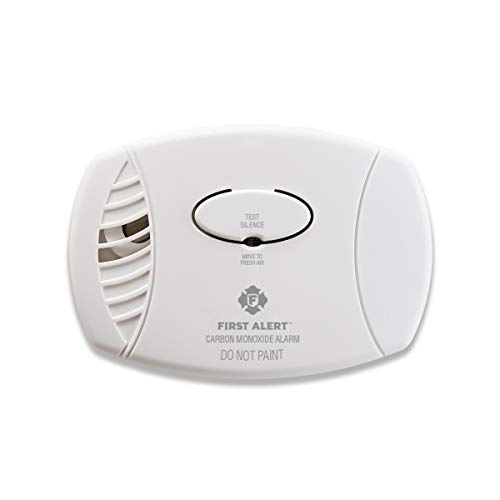
The First Alert CO400 is a battery-powered, carbon-monoxide-only alarm with no wiring and no outlet needed.
The First Alert CO400 is a battery-powered, carbon-monoxide-only alarm with no wiring and no outlet needed. It suits renters, bedrooms far from an outlet, and anyone filling a gap near a sleeping area quickly. Its appeal is simplicity: an electrochemical sensor, a loud 85-decibel horn, one button and an end-of-life chirp that tells you when the whole unit needs replacing. There is no screen and no ppm readout, so it tells you that CO is present, not how much.
Specifications
| Specification | Details |
|---|---|
| Detects | Carbon monoxide only (no smoke, no explosive gas) |
| Sensor | Electrochemical CO sensor |
| Power | Replaceable batteries; battery type not stated in listing |
| Alarm | 85-decibel horn; test should produce a 5–6 second alarm sequence |
| Display | None stated in listing |
| End-of-life signal | Yes, a chirp when the unit should be replaced |
| Size / weight | About 5 x 3 x 1 in; 0.7 lb |
| Model / warranty | CO400; 5-year limited warranty |
First Alert CO400 — battery CO-only alarm, electrochemical sensor, 85 dB, end-of-life chirp, 5-yr limited warranty
How It Compares
The Most Basic Battery CO Alarm on the Shelf, With an End-of-Life Chirp
Of the 17 similar listings we compared, three are not really comparable: an industrial four-gas monitor, a handheld CO meter and a 12-volt RV detector. Of the rest, eight are plug-in units and three are battery smoke-and-CO combination alarms. That leaves three battery-only, CO-only wall alarms alongside the CO400: two Kidde AA models and First Alert’s own 10-year sealed-battery version with a digital display.
Against those, the CO400 is the stripped-down option. The two Kidde AA units both describe a memory feature that records the last time CO was detected or the unit was tested, which the CO400 listing does not mention. The 10-year First Alert adds a backlit screen showing CO concentration and temperature plus a peak-level reading. What the CO400 does have, and the two Kidde battery listings do not state, is an end-of-life chirp.
The warranty is the clearest trade-off. Every similar home-alarm listing that states a warranty offers 7 or 10 years; the CO400’s 5-year term is the shortest stated. The listing also says only that First Alert alarms are tested “to meet UL standards” without naming UL 2034, while two Kidde plug-in listings name UL 2034 5th Edition specifically. The listing does not state the battery type or battery life.
Who It’s For — and Who Should Skip It
Buy the CO400 if you need a dependable alarm in a spot without an outlet, such as a bedroom hallway, a basement bedroom or a rental where you cannot hardwire anything. Battery power means it keeps working through an outage, which matters in winter storms when people run generators or gas appliances with the power down.
Skip it if you want to see low-level CO before it reaches alarm thresholds; a model with a ppm display and peak memory is more informative. Also skip it if you dislike battery swaps, since a sealed 10-year unit avoids them, or if the location also needs smoke protection, where a combination alarm covers both.
Using It at Home
Colorado homes lean heavily on gas furnaces, gas water heaters, fireplaces and attached garages, and houses stay sealed up for months in winter. State law requires a working CO alarm within 15 feet of each sleeping room in homes with fuel-burning appliances or an attached garage, and First Alert’s own guidance is one per level and one in each bedroom.
- Mount it on a wall or set it on a shelf near sleeping areas; keep it away from the furnace closet door, bathrooms and direct sunlight.
- Press the test button monthly and listen for the full 5–6 second sequence. No alarm with fresh batteries means replace the unit.
- Write the install date on the back and replace it when the end-of-life chirp starts.
If it alarms, get everyone outside and call 911 or your gas utility from fresh air. Repeat alarms with no obvious cause, or headaches that ease when you leave the house, point to a combustion appliance or venting problem; contact us to have the furnace, water heater and flues evaluated.
Pros
- No wiring or outlet needed; works in a power outage
- Electrochemical sensor named in the listing
- End-of-life chirp signals when to replace
- Small, light and easy to place in any room
Cons
- No display, ppm reading or peak memory
- 5-year warranty is the shortest among similar listings
- Listing does not name UL 2034 or the battery type
Related Guides
- Best carbon monoxide detectors
- First Alert carbon monoxide detectors
- Carbon monoxide detector installation
- Why a carbon monoxide detector is beeping
- More CO and gas detectors in the shop
As an Amazon Associate we earn from qualifying purchases. Product details come from the current Amazon listing; we have not lab-tested this unit, and prices and availability change.
$21.99 as of Nov 25, 2026 8:02 am GMT+0000
Prices change often — check the live price on Amazon. As an Amazon Associate we earn from qualifying purchases.