Why Was Lead Paint Used: A Plain-Language Guide
Homeowners researching pre-1978 housing often ask why was lead paint used at all, given what we know now about neurological harm in children. The short answer is that lead-based paint had real and measurable performance advantages over alternatives available at the time: it covered better, dried faster, resisted mildew, and lasted longer than zinc, titanium, or early synthetic substitutes. Those advantages were valuable enough that the paint industry resisted reformulation for decades. This guide summarizes EPA, CDC, and HUD guidance current as of 2026 — consult a certified lead-risk assessor for testing decisions on your specific property.
Part of our Lead Paint & Lead Testing guide — start there for the full picture →
Is this mold, asbestos, or water damage? Get a free instant screen
Upload a clear photo of the suspect area. You'll get an instant AI screening opinion and what to do next. This is screening guidance, not a professional determination.
Screening guidance only. AI can be wrong. Confirm asbestos, mold type, or lead with lab testing or a licensed professional before acting.
Why was lead paint used: the five core reasons
Lead-based pigments and additives delivered five performance characteristics that mattered to painters and homeowners through most of the twentieth century. Opacity and hiding power meant fewer coats. Faster drying meant faster project turnaround. Mildew and microbial resistance meant longer service life in damp climates. Color stability meant the paint did not yellow or fade as quickly. Durability and adhesion meant the coating bonded tightly to wood, metal, and plaster substrates. Each property had a chemical explanation rooted in the lead compound used.
How white lead delivered opacity
White lead, formally lead carbonate hydroxide, was the dominant white pigment from antiquity through the mid-twentieth century. Its high refractive index gave it superior hiding power, meaning a single coat could obscure dark substrates that titanium dioxide or zinc oxide would require multiple coats to cover. Painters quoting by the gallon liked it. Homeowners liked the smooth, even finish. The trade-off, invisible to consumers at the time, was the lead content, often 50 percent or higher by weight in the dry film.
Drying speed and lead driers
Oil-based paints in the lead era used metallic driers to accelerate the curing of linseed and tung oils. Lead-based driers, particularly lead naphthenate and lead octoate, were standard additions until safer cobalt and manganese alternatives became cost-competitive. The faster a coating cured, the sooner a second coat could be applied or a room could be returned to use. Lead driers cut hours or days off the work cycle, which mattered both to professional painters and to homeowners doing weekend projects.
Mildew and microbial resistance
Lead compounds, particularly basic lead silicochromate and lead-based fungicides, suppressed mold and mildew growth on exterior surfaces and in humid interior spaces like bathrooms and kitchens. In coastal climates and pre-air-conditioning era homes, mildew was a persistent problem that cut paint life by years. Lead-containing formulations kept the coating intact through more wet-dry cycles. The benefit was visible in side-by-side comparisons that the industry cited in marketing materials throughout the 1920s and 1930s.
Color stability and pigment range
Beyond white lead, the industry used lead chromate yellows and oranges, basic lead carbonate in light tints, and red lead as a rust-inhibitive primer on iron and steel. These pigments held their hue without fading under sunlight or chemical exposure better than most organic dyes available before 1950. Architectural specifications in the early twentieth century called for specific lead-based pigments because the color match held up across batches and over time. Continue reading our pre-1978 housing hazard guide for the regulatory and remediation side.
Why lead in primers mattered
Red lead, lead tetroxide, was the dominant rust-inhibitive primer for iron and steel from the late nineteenth century through the 1970s. Its mechanism was electrochemical: the pigment passivated the metal surface, slowing rust formation under intact paint and inhibiting creep where the coating was nicked. Bridges, ironwork, and structural steel in commercial and residential buildings routinely received red-lead primer. The 1978 consumer ban did not initially affect industrial and military uses, which continued for additional years.
The economics of lead paint
For most of the twentieth century, lead-based pigments were cheaper per unit of hiding power than titanium dioxide. The titanium dioxide industry scaled up after World War II, and by the 1960s titanium became cost-competitive on a per-square-foot basis. The economic argument for lead paint weakened in parallel with growing public health evidence of harm. By the mid-1970s, the case for keeping lead in residential paint had eroded on both safety and economic grounds. The use-cases explanation covers the application detail.
The CDC and EPA position on harm
CDC and EPA guidance establishes that no level of lead exposure is considered safe for children. Lead is absorbed through ingestion of paint chips and dust, and through inhalation of dust generated by sanding, scraping, or renovating lead-painted surfaces. Childhood exposure is linked to cognitive deficits, behavioral changes, and reduced IQ at blood lead levels once considered acceptable. The CDC reference value for elevated blood lead in children, last updated to 3.5 micrograms per deciliter, reflects an evolving understanding that harm occurs at progressively lower exposures.
The 1978 CPSC ban and what it covered
The Consumer Product Safety Commission banned lead-based paint for residential and consumer use effective February 27, 1978, under 16 CFR 1303. The rule set a 0.06 percent (600 ppm) lead-by-weight limit on dry paint film for consumer use. The limit was tightened to 0.009 percent (90 ppm) in 2009. The CPSC ban did not cover all uses: industrial, military, and some artistic and specialty paints remained exempt under separate rules. For residential housing, the 1978 date became the bright line for risk assessment.
Why pre-1978 housing carries the lead label
EPA estimates that roughly 87 percent of homes built before 1940 contain some lead-based paint, with the percentage declining to 24 percent for homes built between 1960 and 1977. Even where homeowners have repainted, the original lead-painted layers typically remain underneath. Renovation, demolition, friction surfaces like windows and doors, and weathered exterior paint all generate dust that disperses lead into living spaces. The 1978 cutoff drives federal disclosure rules, including HUD’s Lead Disclosure Rule and EPA’s Renovation, Repair, and Painting (RRP) Rule.
The HUD Lead Disclosure Rule
For homes built before 1978, federal law requires sellers and landlords to disclose known lead-based paint hazards and provide the EPA pamphlet “Protect Your Family From Lead in Your Home” before the sale or lease is signed. Buyers receive a ten-day window to conduct lead testing. HUD enforces the rule on federally assisted housing and partners with EPA on private-market enforcement. Disclosure does not require the seller to remove lead paint; it requires honesty about what is known.
The EPA RRP Rule for renovation
For pre-1978 homes, EPA’s Renovation, Repair, and Painting Rule requires that contractors performing work that disturbs paint on more than six square feet of interior surface or 20 square feet of exterior surface be certified, follow lead-safe work practices, and provide owners the lead-hazard information pamphlet. The rule does not apply to owner-occupied homes without children under six or pregnant women, though EPA strongly recommends lead-safe practices regardless. Penalties for non-compliance reach into the tens of thousands of dollars per violation.
What testing options look like today
Two consumer-accessible methods identify lead paint. XRF analyzer surveys, performed by certified lead inspectors, read lead content directly through the paint film without disturbing the surface. Per-component fees range from $5 to $15, with a typical full-house survey running $300 to $700. Lab-based paint chip sampling is cheaper per sample, around $25 to $50, but requires surface disturbance. The EPA-recognized 3M LeadCheck swab kits identify lead in surface films but produce only a positive-or-negative result, not a quantitative measurement.
What lead paint looks like in service
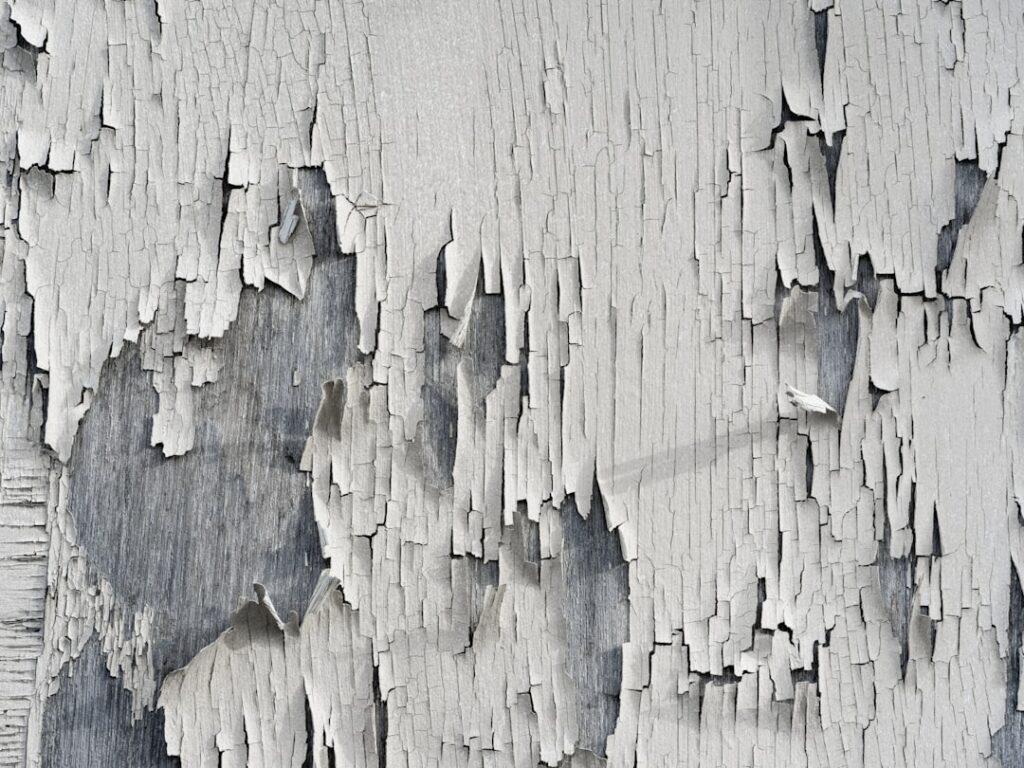
Intact lead paint on stable surfaces does not present an immediate hazard. The risk arises when paint is deteriorating, chalking, peeling, or generating dust on friction surfaces. Window sashes, door jambs, stair treads, and porch floors are the highest-risk components because routine use generates abrasion and dust. EPA’s dust-lead standards treat any reportable level as a hazard, with post-abatement action levels of 5 micrograms per square foot of lead in floor dust and 40 micrograms per square foot on window sills. Dust wipe sampling by a certified risk assessor measures these levels.
The historical context that drove decades of use
The paint industry knew of lead’s toxic effects by the early 1900s, with European countries banning interior residential use as early as 1909 (France, Belgium, and Austria) and the League of Nations recommending broader restrictions in 1922. The United States did not follow until 1978, in part because of effective industry lobbying and in part because the consumer-protection regulatory framework was slow to mature. The Lead Industries Association coordinated marketing and regulatory defense through most of the twentieth century. Lead paint history is more thoroughly covered in the history of lead paint guide.
Putting it all together for homeowners today
Lead paint was used because it worked, by the standards of its era. The performance advantages were real, the cost was competitive, and the health evidence was either ignored or actively suppressed for decades. For homeowners of pre-1978 housing, the practical implications today are testing before renovation, lead-safe work practices for any disturbance, and dust-wipe verification after the work. The benefits of lead paint accrued to past generations of painters and homeowners; the obligations to manage it now fall to current owners.
The international context for the US ban
The 1978 US ban was late by international standards. France, Belgium, and Austria banned interior residential lead paint in 1909 under treaty obligations following the International Labour Conference. The League of Nations recommended broader restrictions in 1922. Czechoslovakia, Greece, Tunisia, Yugoslavia, and Spain followed in the interwar period. By the time the US acted, the global precedent had been established for nearly 70 years. The delay is one of the more frequently cited examples of regulatory capture in US public health history, with the Lead Industries Association coordinating effective lobbying defense through much of that period.
What pre-1978 testing identifies in practice
An XRF survey on a typical pre-1978 home identifies lead-based paint on most exterior trim, all interior trim and millwork added before the renovation history, original window sashes and jambs, original doors and door frames, baseboards, stair components, and exterior siding. The original layer typically sits under several coats of post-1978 latex or alkyd paint, but the XRF reads through the topcoats. Components added during renovations post-1978 will read clean. The survey produces a component-by-component map of where lead-based paint exists, informing both renovation planning and lead-safe practices on routine maintenance.
If you’re in the Denver metro or Front Range and want to talk to a vetted inspector about a pre-1978 home, reach out through our contact page.
More Questions About Historic Lead Paint Use
Was lead paint used more on exteriors or interiors?
Lead paint was used heavily on both, but exterior paints and trim enamels generally carried higher lead levels because durability and weather resistance were the main selling points. Interior walls in many homes were later painted with lower-lead or lead-free products, while trim, doors and windows often kept high-lead layers.
That pattern matters today. Exterior siding, porches, window sashes and door frames are the surfaces most likely to test positive in an older home, and weathering exterior paint is a common source of lead in the soil around foundations and drip lines.
Did old furniture, toys and cribs have lead paint?
Yes, painted furniture, cribs and toys made before the 1978 ban could contain lead paint, and children’s products were a recognized source of exposure because of chewing and mouthing. Antique and vintage pieces are still a concern if the paint is chipping or worn.
Imported toys and painted products have also triggered recalls long after 1978. For vintage cribs, high chairs and toys used by young children, testing the finish or choosing items with original wood or newer finishes is the cautious approach. Avoid sanding old painted furniture indoors without lead-safe precautions.
Is lead paint still used on bridges, ships or roads?
Lead-based paints were used for decades on steel bridges, water towers, ships and road striping because they protected metal and lasted, and much of that paint is still in place. New use in the United States has largely ended for most applications, though some industrial and specialty uses were not covered by the 1978 consumer ban.
Removing old lead coatings from bridges and industrial structures is regulated work requiring containment. Homeowners mainly encounter this history through old metal railings, fences and steel elements on older properties, which may carry lead primers worth testing before sanding.
Why did it take so long to stop using lead paint in the US?
Lead paint stayed in US homes until 1978 mainly because it performed well, was widely available, and the paint and lead industries resisted restrictions for decades. Several European countries restricted interior white lead paint in the early 1900s, much earlier than the United States.
Some US cities and manufacturers acted sooner. Voluntary standards reduced lead in interior paints from the 1950s, and by the 1970s federal limits were tightened. The 1978 Consumer Product Safety Commission ban then removed lead-based paint from residential consumer use nationwide.
References
- EPA lead information for homeowners — U.S. Environmental Protection Agency
- CDC childhood lead poisoning prevention — Centers for Disease Control and Prevention
- HUD Office of Lead Hazard Control — U.S. Department of Housing and Urban Development
- EPA Renovation, Repair and Painting Program — U.S. Environmental Protection Agency
Frequently asked questions
When was lead paint banned in the United States?
The Consumer Product Safety Commission banned lead-based paint for consumer use effective February 27, 1978, under 16 CFR 1303. The limit was tightened from 0.06 percent to 0.009 percent lead by weight in 2009.
Is intact lead paint a hazard?
Intact, stable lead paint on non-friction surfaces does not present an immediate exposure hazard. Risk arises when paint deteriorates, chalks, peels, or is disturbed by renovation, sanding, or friction at windows and doors.
How do I know if my home has lead paint?
Homes built before 1978 are presumed to contain lead-based paint until tested. EPA-certified lead inspectors use XRF analyzers or lab-based paint chip sampling to confirm presence and concentration.
Do I have to remove lead paint from my home?
Federal law does not require removal of intact lead paint in private homes. EPA and HUD recommend lead-safe practices during any renovation and prompt repair of deteriorating paint, especially in homes with children under six.
What colors of old paint usually contained the most lead?
White paints based on white lead carbonate, along with yellows and oranges made with lead chromate and the red lead primer used on metal, were among the highest-lead paints. Any color can contain lead, though, so testing is the only way to know.
Was lead paint used in schools and public buildings?
Yes, lead paint was used widely in schools, hospitals and public buildings before 1978, and many older public buildings still contain it under newer layers. Child-occupied facilities built before 1978 are covered by EPA renovation rules when painted surfaces are disturbed.
Did people know lead paint was dangerous when it was used?
Yes, lead poisoning from paint was documented by doctors as early as the late 1800s and early 1900s, including cases in children. Knowledge of the hazard grew for decades before the 1978 US residential ban, which is why the delay remains a subject of litigation and public health history.
Lead paint test kits
Instant swab kits flag lead on painted surfaces in minutes — useful before a renovation in any pre-1978 home.
| Product | Why | Buy |
|---|---|---|
 3M LeadCheck Swabs | EPA-recognized instant swabs. | Amazon — $13.99 |
 Lead Test Kit (lab-based) | Mail-in for a documented result. | Amazon — $75.00 |