Why Did They Use Lead in Paint: Use-Cases Explained

Why did they use lead in paint — and why for so long — comes down to a set of specific performance properties that lead compounds delivered better than any commercially available alternative for most of the twentieth century. The answer is not that paint chemists ignored toxicity. It is that lead carbonates, lead chromates, and lead-based driers solved real engineering problems: durable surface coverage, weather resistance on exterior wood, fast drying for production-scale building, and mildew suppression. Each of those properties took lead-free chemistry decades to match. This guide reflects EPA, CDC, HUD, and FTC consumer-information guidance current as of 2026 and frames the use-case story rather than the toxicology story.
Part of our Lead Paint & Lead Testing guide — start there for the full picture →
Asbestos or biohazard concern? Speak with a certified contractor.
📞 Call (877) 742-8496The Five Properties Lead Delivered
Paint is an engineered material composed of binder, pigment, solvent, and additives. Lead compounds played four distinct functional roles depending on which compound was used. White lead — basic lead carbonate — was a high-hiding pigment with exceptional opacity. Red lead — lead tetroxide — was an anti-corrosion primer pigment. Lead chromates were yellow and orange pigments with intense color saturation and weather resistance. Lead-based driers — lead naphthenate and lead octoate — accelerated the oxidative cure of oil-based paint.
Together those four roles delivered five field-level performance properties: durability, weather stability, fast drying, mildew and mold resistance, and color saturation. Each is worth examining individually because each is what the historical guide on lead-paint adoption establishes from a different angle.
Durability for High-Traffic Surfaces
The first reason lead remained in paint long after toxicity was suspected is that lead-based paint was genuinely durable. White-lead oil paint applied to wood trim, doors, baseboards, and stair stringers produced a film with high abrasion resistance, good adhesion to oil-primed wood, and resistance to chalking and cracking under normal interior wear.
The competing pigments through the 1920s through the 1950s — primarily zinc oxide and lithopone — produced softer, less durable films. Titanium dioxide, the modern white pigment that eventually displaced white lead, did not reach industrial scale until the 1940s and was not economically competitive in general-purpose architectural paint until the 1950s. For surfaces that needed to survive twenty or thirty years of cleaning, scrubbing, and repainting cycles, lead was simply better at the job.
Best Lead Paint Test Kit: our top 3 picks
| Product | Best for | Key features | Price | Buy |
|---|---|---|---|---|
| LeadCheck Swabs | EPA-recognized instant swab |
| $207.00as of Nov 26, 2026 4:12 am GMT+0000 | Buy now →Check current price |
| SLGi Lead Test Kit 1-Pack | Lab result for paint, dust or soil |
| — | Buy now →Check current price |
| Safe Home Lead in Solids Combo | Swab screen plus lab follow-up |
| $19.99as of Nov 25, 2026 10:03 pm GMT+0000 | Buy now →Check current price |
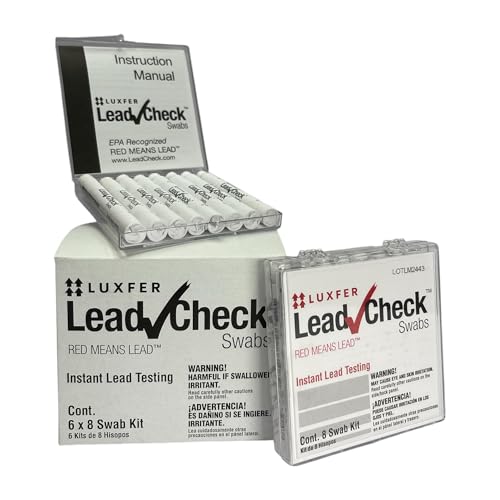


Prices are Amazon’s listed prices as of the time shown and change often; check Amazon for today’s price. As an Amazon Associate we earn from qualifying purchases.
Paint Stability in Extreme Weather
The second use-case driver was weather performance on exterior wood. White-lead oil paint on cedar, pine, fir, and redwood siding survived temperature swings, freeze-thaw cycles, ultraviolet exposure, and rain-and-snow weathering significantly better than the early lead-free alternatives.
In climates with extreme weather — and that includes much of the Colorado Front Range, with its 60-degree daily temperature swings, intense UV at altitude, and rapid freeze-thaw cycling — exterior paint life was a real economic concern for homeowners. A lead-based paint job that lasted eight to twelve years before recoating was substantially cheaper over the life of the home than a lead-free paint that needed recoating every four to six years. This economic differential helped lead paint persist in exterior applications even after consumer awareness of the toxicity issue was rising.
Fast-Drying for Production-Scale Building
The third driver was drying speed. The U.S. residential construction industry from the 1920s through the 1970s ran on schedules that demanded paint dry to recoat within hours, not days. Lead-based driers — primarily lead naphthenate and lead octoate, used at concentrations of fractions of a percent — accelerated the oxidative cure of linseed-oil and alkyd binders dramatically. A coat of trim enamel that might have taken 24 hours to recoat without a lead drier could be recoated in 6 to 8 hours with one.
For tract-housing construction, where painters were on a critical-path schedule between drywall finish and final move-in, this drying-speed advantage translated directly into project economics. Cobalt and manganese driers eventually displaced lead, but the transition took decades and was not complete in U.S. architectural paint until well after the 1978 ban took effect.
Mildew and Mold Resistance
The fourth use-case was biological resistance. Lead-based paint, particularly in oil-binder formulations, suppressed mildew and mold growth on the paint film. Lead compounds are biocidal at very low concentrations to the fungi and mildew organisms that colonize paint surfaces in humid conditions.
For bathroom paint, kitchen paint, basement paint, and exterior paint in humid climates, this property was meaningful. Lead-free alternatives required either substantially higher biocide loadings of other chemistries — which raised their own toxicity questions — or accepted shorter paint life. Modern paints use a combination of zinc oxide, organic biocides, and improved binder systems to achieve similar mildew resistance, but matching lead’s performance took into the 1990s.
Color Saturation and Pigment Brightness
The fifth use-case was color performance, particularly in yellow, orange, and red ranges. Lead chromate pigments — chrome yellow, chrome orange, molybdate orange — produced intense, saturated color that the available cadmium-based and iron-oxide alternatives could not match through the 1950s and 1960s.
This is why school buses, road-marking paint, traffic signs, and certain industrial coatings used lead chromate pigments long after architectural use was banned in 1978. Some non-residential applications retained limited lead-chromate use into the 2000s before fully transitioning to bismuth vanadate, organic, and improved cadmium-free chemistries.
The Role of Lead in Industrial and Marine Paint
Beyond architectural use, lead-based paint had specific industrial applications that drove demand and production scale. Marine paint relied heavily on red-lead anti-fouling and anti-corrosion primer through the 1970s. Steel structural-coating systems for bridges, water tanks, and industrial equipment used lead-based primers because of their corrosion resistance on steel substrates. Railroad freight cars, agricultural equipment, and farm structures consumed substantial volumes of lead paint as both topcoat and primer.
The industrial volume mattered because it kept production lines profitable through the period when residential demand was beginning to shift toward titanium-dioxide chemistry. Manufacturers had little incentive to fully retool while industrial customers continued to specify lead-based products. This is part of why the residential transition lagged the technical feasibility of replacement by several decades.
Why Some Old Lead Paint Still Has Excellent Adhesion
Drive past Denver bungalows from the 1920s and 1930s and the original woodwork often still carries paint layers that have survived nearly a century. The reason is the binder chemistry combined with substrate preparation. Pre-war oil-based paint used linseed oil and natural resins that penetrated wood fiber deeply and produced a strong mechanical anchor. The lead pigment contributed to film hardness and longevity.
Modern latex paints, while safer and easier to apply, do not penetrate wood the same way and rely on different adhesion mechanisms. A 1928 wood-trim paint job that has weathered fine for nine decades is a testament to the durability of the original system. The same chemistry that produced that durability is also why the legacy lead-paint inventory in pre-1978 homes is so persistent.
How Each Lead Compound Solved a Specific Problem
Each major lead compound in paint addressed a distinct technical challenge. Basic lead carbonate (white lead) provided high opacity at competitive cost. Lead tetroxide (red lead) provided exceptional corrosion inhibition on steel substrates by reacting with the substrate to form a protective passivation layer. Lead chromates provided vivid yellow, orange, and red coloring with weather resistance. Lead naphthenate and lead octoate accelerated oxidative cure in linseed-oil and alkyd binders. Each compound could in principle be replaced individually with non-lead alternatives, but doing so required testing, reformulation, and field validation of every product the compound was used in.
The replacement process took place product by product, decade by decade. Premium architectural paints transitioned first because manufacturers could pass the higher reformulation cost through to consumers. Industrial coatings transitioned later because customers prioritized established performance over reformulation cost. By the time the 1978 ban took effect, much of the consumer residential market had already substantially reduced lead content, but the pre-1978 housing stock retains paint applied during peak lead-use years.
The Cost Floor and the Slow Replacement Curve
Paint chemistry replacement is slow because reformulation requires not just an equivalent pigment or drier but an entire system that delivers the same field performance. Manufacturers replaced lead one application at a time over decades. White-lead house paint largely transitioned to titanium dioxide-based formulations by the late 1950s for high-end products and the late 1960s for general-purpose products. Lead-based driers persisted longer because the cobalt and manganese alternatives produced different gloss and yellowing behavior. Lead chromate pigments persisted longest because color matching is unforgiving.
The 1978 Consumer Product Safety Commission ban on residential paint exceeding 0.06 percent lead by dry weight forced the final transition in consumer architectural paint. The 2009 reduction to 0.009 percent closed the remaining gap.
Comparison With Modern Premium Paint Chemistry
Today’s premium architectural paints achieve performance that approaches or exceeds the legacy lead-based standard through entirely different chemistry. Titanium dioxide provides the white pigment opacity. Acrylic and modified-alkyd binders provide adhesion and durability. Zinc oxide, organic biocides, and improved cross-linking chemistry handle mildew resistance. Cobalt and manganese driers replaced lead driers in oil-based systems. Bismuth vanadate, complex inorganic pigments, and improved organic pigments cover the colorant range that lead chromates once dominated.
The combined performance — durability, weather resistance, drying speed, biological resistance, color saturation — now matches or beats the lead-paint era. The transition took roughly fifty years from initial titanium-dioxide commercialization to a credible match across every performance dimension. That timeline is part of the answer to the underlying question of why lead paint persisted: the alternatives weren’t ready until they were.
Specific Application Examples That Reveal the Use-Case Logic
Certain specific applications illustrate the use-case-driven adoption of lead paint better than any general explanation. Window-sash paint had to withstand decades of friction against painted jambs while remaining decoratively attractive. Lead-based oil enamel delivered this combination. Exterior porch-floor paint had to handle foot traffic, UV exposure, rain, and freeze-thaw cycling. Lead-based porch enamel was the dominant choice through the 1960s. Industrial machinery paint had to resist solvents, oils, and abrasion in shop environments. Lead-based industrial coatings dominated until specialty epoxy and urethane chemistries became available in the 1960s and 1970s.
Each of these applications had specific performance requirements that lead-based formulations met better than the available alternatives at the time. The pattern of “specific use-case demands specific material properties” explains why lead paint persisted in commercial markets longer than in general consumer markets and why some industrial applications retained lead chemistry into the 2000s.
Why This History Matters for Today’s Homeowner
The deeper a homeowner reads into pre-1978 paint, the more it becomes clear that lead was not a careless choice. It was a performance-driven choice that the industry stayed with because alternatives were genuinely inferior for decades. The toxicity case was building through the same period — the public-health concern was credible by the 1940s and overwhelming by the 1970s — but the engineering case for replacement materials needed to catch up before the ban could take effect without unacceptable disruption to building.
For owners of pre-1978 homes today, the upshot is that lead paint applied during peak years was meant to last. It often still is on the wall, in good condition, decades later. The pre-1978 hazard pillar covers identification and management; this guide covers why the paint is so often still there to be found.
More Questions About the History of Lead Paint
When was lead paint banned in the United States?
Lead paint was banned for residential use in the United States in 1978, when the Consumer Product Safety Commission prohibited paint containing more than 0.06 percent lead for homes, toys and furniture. Some cities and states restricted lead paint earlier. Many other countries banned or restricted lead paint decades earlier than the US. Industrial and some specialty paints were treated differently. Because of the 1978 cutoff, homes built before 1978 are presumed to possibly contain lead-based paint under federal disclosure rules.
What did lead paint look like?
Lead paint looks like ordinary paint, so it cannot be identified by appearance alone. Older lead-based paint was often glossy and very durable, and when it ages it may show a distinctive cracked pattern called alligatoring, with square or scaly chips. It can also leave chalky white residue on surfaces. Lead paint was commonly used on windows, doors, trim, porches and exterior siding. Testing with an EPA-recognized test kit, an XRF analyzer or lab analysis of paint chips is the only reliable way to confirm it.
What replaced lead in paint?
Titanium dioxide largely replaced lead as the white pigment in paint, offering strong hiding power without the toxicity. Zinc oxide also served as a pigment and mildew inhibitor. Lead driers that sped up curing in oil paints were replaced with other metal driers based on cobalt, manganese and zirconium. The growth of latex and acrylic water-based paints after World War II also reduced reliance on lead. Modern paints achieve durability, color stability and mildew resistance through additives and resin chemistry instead.
Were homes built in the 1970s painted with lead paint?
Homes built in the 1970s may have lead paint, although it was less common than in older homes. Lead paint use declined through the 1950s and 1960s as titanium dioxide and latex paints gained ground, but some lead paint was still sold until the 1978 ban. Federal rules therefore treat all pre-1978 homes as potentially containing lead paint. Homes built before 1950 have the highest likelihood. Testing painted surfaces before sanding or renovating a 1970s home is the safest approach.
References
- EPA lead paint history and regulatory background — U.S. Environmental Protection Agency
- CDC childhood lead exposure prevention — Centers for Disease Control and Prevention
- HUD Office of Lead Hazard Control history — U.S. Department of Housing and Urban Development
- FTC consumer information on lead in paint — Federal Trade Commission
Frequently asked questions
When did manufacturers know lead paint was harmful?
Industrial-health awareness of lead's toxicity dates to the early 1900s, with credible public-health concerns published by the 1920s. Consumer-paint regulation moved more slowly because the engineering case for replacements had not matured. The 1978 ban marked the regulatory endpoint, but the science long preceded it.
Did lead paint actually perform better than the alternatives?
For most of the twentieth century, yes — for specific properties like durability, fast drying, exterior weather resistance, and mildew suppression. Modern paints have closed and in some cases exceeded those properties, but the substitution took decades because of how many performance dimensions had to be matched simultaneously.
Why is some pre-1978 paint still in good condition?
Lead-based paint film, applied to a sound substrate with good surface preparation, was engineered for long service life. Many residential paint applications from the 1940s through the 1970s remain intact today, particularly on interior trim and woodwork. Intact paint is generally lower risk than failing paint.
Is any paint sold today lead-based?
U.S.-sold consumer architectural paint cannot contain lead above 0.009 percent by dry weight under current Consumer Product Safety Commission rules. Certain industrial coatings and specialty products outside the residential consumer category may still contain lead under narrower regulations.
Did people know lead paint was dangerous when they used it?
Yes, the dangers of lead were known long before the ban. Lead poisoning in painters and children was documented in the early 1900s, and several countries restricted interior lead paint in the 1920s. The US did not ban residential lead paint until 1978.
Is lead paint dangerous if it is painted over?
Lead paint that is intact and covered by newer paint is less hazardous, but it can still become dangerous when surfaces wear, chip, or are sanded or scraped. Friction surfaces like windows and doors can release dust. Painting over is a temporary control, not removal.
Was lead used in other household products besides paint?
Yes, lead was used in gasoline, plumbing pipes and solder, some ceramic glazes, older toys, and certain cosmetics and folk remedies. Leaded gasoline was phased out of US cars by 1996, and lead solder in drinking water plumbing was banned in 1986.
Front Range homeowners considering lead-paint testing or remediation can reach out through our contact page to connect with a certified risk assessor.