Toilet Safety Rails: Freestanding Frames vs Wall Grab Bars
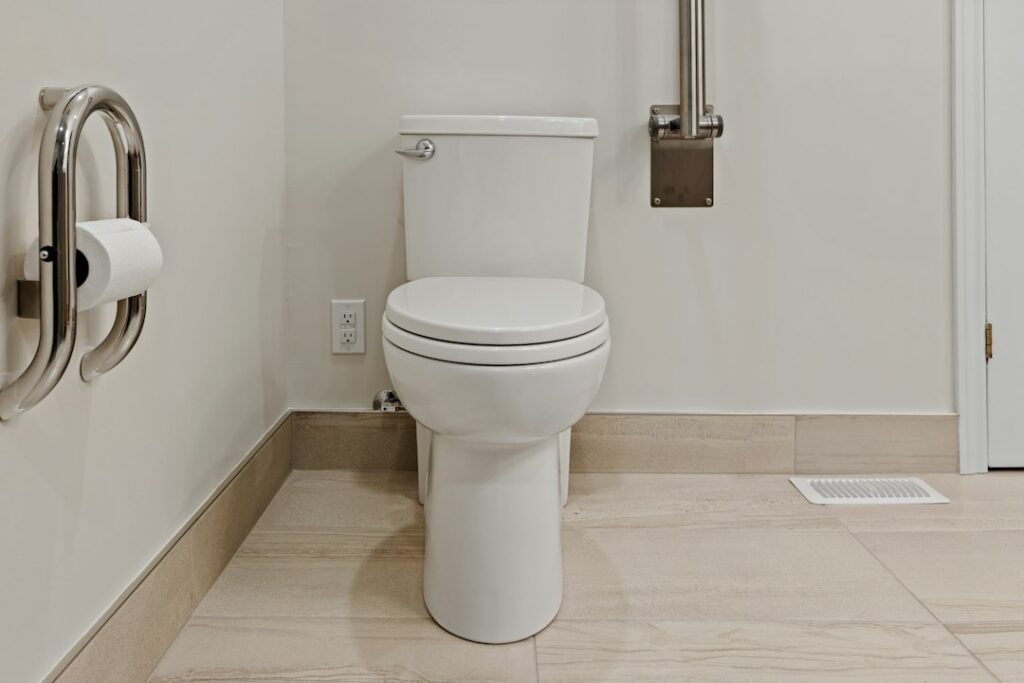
Sitting down on a toilet and standing back up is one of the most frequent strength-and-balance tasks of the day, and it happens in a small room with hard, often wet surfaces. For an older adult, someone recovering from surgery or a person with a chronic condition, that motion can become the riskiest part of using the bathroom. Toilet safety rails give the hands something solid to push against. The category covers several very different products: freestanding frames that surround the toilet, arms that clamp to the bowl or bolt under the seat, and permanent grab bars anchored into the wall. Each has strengths, and each can fail if it is the wrong type for the bathroom or is installed carelessly. This guide compares the options, explains what weight ratings mean, describes how wall bars should be anchored, puts the fall risk in context using CDC information, and covers typical costs and what a home inspector may notice.
Part of our Plumbing & Water guide — start there for the full picture →
Plumbing problem? Talk to a local plumber now.
📞 Call (877) 637-1527Why Toilet Safety Rails Matter
The CDC describes falls as a serious threat to older adults’ health and independence. Its older adult fall prevention pages report that more than one out of four people 65 and older falls each year, that falling once doubles the chances of falling again, and that falls are the leading cause of injury death for that age group. The CDC also lists home hazards among the risk factors that can be changed, alongside lower body weakness, balance problems, certain medications and vision problems.
The bathroom is singled out in the CDC’s Check for Safety home fall prevention checklist. For people who need support getting in and out of the tub or up from the toilet, the checklist recommends having grab bars put in next to and inside the tub and next to the toilet. It also suggests non-slip mats or strips in the tub or shower and a nightlight on the path from the bedroom to the bathroom.
Toilet rails address one specific moment: the transition between standing and sitting. Without support, many people grab whatever is nearby, such as a towel bar, the sink edge, a toilet paper holder or the tank lid. None of those is designed to carry body weight, and a towel bar pulling out of drywall mid-transfer is a common way a near miss becomes a fall.
Freestanding Toilet Safety Frames
A freestanding frame is a metal frame with two padded armrests and four legs that straddles the toilet. Many have adjustable leg heights and rubber feet. Some are combined with a raised seat, creating what is sometimes called a toilet safety frame with seat or a three-in-one commode.
Advantages:
- No drilling, which suits renters and short-term recovery situations.
- Armrests on both sides, so the user can push up evenly with both hands.
- Usually height-adjustable to suit the user’s arm length.
- Can be moved to another bathroom or removed when no longer needed.
Limitations:
- Stability depends on the floor. On uneven tile or a sloped floor, a leg may lift slightly under load.
- The frame can shift sideways if the user pushes harder on one arm, which is common after a stroke or one-sided surgery.
- The footprint can block a narrow toilet alcove, a cabinet or a walker’s approach.
- Some models attach to the toilet with brackets for added stability; others simply rest on the floor.
Freestanding frames are often the first thing a hospital discharge planner or therapist suggests because they can be in place the day someone comes home. For longer-term use, especially with heavier users or one-sided weakness, a wall-mounted option usually provides firmer support.
Best Raised Toilet Seats: our top 3 picks
| Product | Best for | Key features | Price | Buy |
|---|---|---|---|---|
| Medline G4-503LRX1 | Best overall locking riser with arms |
| $45.99as of Nov 18, 2026 12:33 pm GMT+0000 | Buy now →Check current price |
| HealthSmart 4-inch Locking | Round bowls, highest capacity |
| $39.99as of Nov 18, 2026 12:33 pm GMT+0000 | Buy now →Check current price |
| HOMLAND TRB10-1 | Adjustable freestanding frame |
| $65.99as of Nov 18, 2026 12:33 pm GMT+0000 | Buy now →Check current price |


Prices are Amazon’s listed prices as of the time shown and change often; check Amazon for today’s price. As an Amazon Associate we earn from qualifying purchases.
Clamp-On and Seat-Mounted Rails
A second group of products attaches directly to the toilet. The most common design bolts through the two seat-hinge holes at the back of the bowl, using the same bolts that hold the seat on, with padded arms extending forward on each side. Other designs clamp around the bowl or combine arms with a raised seat that locks onto the rim.
These rails are compact and inexpensive, and they move with the toilet so nothing sits on the floor. The tradeoff is that their stability depends on two small bolts and the porcelain around them. Over time, the seat bolts can loosen, letting the arms rock. Users who put most of their weight on one arm may feel the whole assembly twist. Manufacturers usually advise checking and tightening the hardware regularly.
A raised seat with integrated arms solves two problems at once by reducing the depth of the squat. For a closer look at seat heights, locking mechanisms and the hygiene considerations of raised seats, see our guide to the raised toilet seat. A comfort-height toilet, which typically sits a couple of inches higher than a standard bowl, is the permanent alternative when a bathroom is being remodeled anyway.
Wall-Mounted Grab Bars Beside the Toilet
A permanent grab bar is the most solid support option when it is installed correctly. Common configurations near a toilet include a horizontal bar on the side wall, a vertical bar for people who pull themselves up rather than push, an angled bar, and a fold-down or swing-up bar mounted on the wall behind or beside the toilet when there is no side wall close enough.
Installation quality is everything. Drywall alone will not hold a person’s weight. A wall bar should be anchored in one of these ways:
- Into wood studs with screws of the length and type the manufacturer specifies. Stud locations rarely line up with where the bar is needed, so this sometimes limits placement.
- Into blocking installed between studs during construction or a remodel. Many remodelers now add solid wood or plywood backing behind bathroom walls even when no bars are planned, which makes future installation simple.
- With specialty anchors designed and rated for grab bars in hollow walls. These are distinct from ordinary drywall anchors, which are not suitable. Follow the anchor manufacturer’s limits and instructions exactly.
Tile adds complexity because holes must be drilled carefully and sealed to keep water out of the wall. Fiberglass or acrylic surrounds often require specific anchors. A handyman or contractor experienced with accessibility work can usually install a pair of bars in a few hours. Our guide to grab bars for the shower covers bar diameter, finishes and wet-area installation in more detail.
Suction-cup bars deserve a note of caution. They can release without warning if the seal is broken by grout lines, textured surfaces or temperature changes. Many are labeled as balance aids only, not for supporting body weight. They are not a substitute for an anchored bar beside a toilet.
Placement basics
Accessibility standards for public buildings specify exact grab bar heights and lengths around toilets. Homes are generally not required to meet those standards, but they offer useful reference points. In practice, the right height depends on the user. An occupational therapist can watch the person transfer and recommend where hands naturally land, which is often more valuable than a generic measurement. Bars should not block the toilet paper holder or force awkward reaching, and a vertical bar near the front of the toilet often helps the final stage of standing.
Weight Ratings and What They Mean
Every rail and frame should carry a maximum user weight or load rating from the manufacturer. These ratings vary widely across products and are set by each manufacturer, so check the packaging or instructions rather than assuming a figure. A few points help interpret them:
- The rating applies to the product as installed per the instructions. A wall bar rated for a high load in the lab is only as strong as the screws, studs or anchors holding it.
- Dynamic loads exceed body weight. A person who stumbles and grabs a bar can momentarily put far more force on it than standing weight. Leaving margin above the user’s weight is sensible.
- Bariatric models exist for heavier users, with wider frames, heavier tubing and higher stated capacities.
- Wear changes things. Padding compresses, adjustment pins wear and seat-mounted bolts loosen. A product that felt solid on day one may not stay that way without periodic checks.
Check rails at least monthly: push and pull on each arm, look for cracks at welds or in plastic housings, confirm that height-adjustment pins are fully engaged and tighten any bolts. For wall bars, look for movement, cracked tile or caulk around the flanges, and any sign that the bar has started to pull away from the wall.
Choosing Between the Options
There is no single best type. The right choice depends on the user, the bathroom and the timeline:
| Situation | Often a good fit |
|---|---|
| Short-term recovery, renter, or no drilling allowed | Freestanding frame or seat-mounted arms |
| Long-term need, owner-occupied home | Wall-mounted grab bars anchored into studs or blocking |
| No side wall near the toilet | Fold-down wall bar behind the toilet, or a freestanding frame |
| One-sided weakness | Wall bar on the stronger side, sometimes paired with another support |
| Deep squat is the main problem | Raised seat with arms or a comfort-height toilet |
| Heavier user | Bariatric frame or professionally anchored wall bars |
Toilet support is usually one part of a broader bathroom safety plan. A shower chair or transfer bench reduces risk in the tub, non-slip flooring helps everywhere, and for some households a walk-in tub or curbless shower makes sense during a remodel. Good lighting, including the nightlight the CDC checklist recommends, often costs the least and helps the most during nighttime trips.
Plumbing and space checks before buying
Measure the space from the toilet centerline to any side wall, vanity or tub, and from the front of the bowl to the door or opposite wall. Note whether the bowl is round or elongated, since seat-mounted rails and raised seats are often made for one shape. If the toilet rocks on the floor, fix that first: a loose toilet can damage the wax seal and lead to hidden leaks, and it also makes any toilet-mounted rail less stable. A plumber can reset the toilet with a new seal and secure the flange.
Common Installation and Use Mistakes
Most problems with toilet support come from small decisions made quickly, often in the days before someone comes home from the hospital. Watching for these mistakes avoids the most common failures:
- Using the towel bar as a grab bar. Towel bars are typically held by small screws or plastic anchors in drywall. They are not designed for a pulling or pushing load, and they tend to fail exactly when someone needs them most. Some manufacturers make combination towel bars that are rated as grab bars; ordinary towel bars are not.
- Skipping the stud finder. Guessing where studs are, or relying on a single screw hitting wood, leaves a bar that feels firm at first and loosens over time.
- Setting frame arms at the wrong height. Arms set too low force the user to lean forward and push from an awkward angle; arms set too high reduce leverage. Adjust them with the user seated, so elbows bend comfortably.
- Ignoring the floor. Bath mats and throw rugs under a freestanding frame’s legs make it slide. Set the feet directly on the hard floor and keep rugs out of the transfer area, as the CDC checklist suggests for throw rugs generally.
- Overtightening seat-mounted rails. Cranking hinge bolts too hard can crack porcelain. Tighten to snug, then check again after a few days of use.
- Forgetting the second user. In shared bathrooms, a frame that suits one person may get in the way of another. A fold-up wall bar can be a good compromise.
- Mismatched hardware. Using the screws that come in the box without checking whether they suit the wall type can undermine an otherwise good bar. Follow the instructions for the specific wall construction, and when in doubt, have a professional install it.
After any change, the user should practice sitting and standing a few times with someone nearby, so problems show up during a calm moment rather than during a hurried nighttime trip.
Typical Costs
Prices vary by brand, materials and region. As rough 2026 ranges:
- Seat-mounted or clamp-on arms: often in the range of a few tens of dollars.
- Freestanding safety frames: commonly around forty to over one hundred dollars, more for bariatric or combination models.
- Raised seat with arms: similar to or somewhat more than basic frames.
- Wall grab bars (product only): from basic stainless bars at modest prices to designer finishes costing considerably more.
- Professional grab bar installation: often a modest service charge per bar, higher for tile, fiberglass or walls that need opening to add blocking.
- Comfort-height toilet replacement: typically a few hundred dollars for the fixture plus plumber labor.
Some health insurance plans, Medicare Advantage plans, veterans’ programs or local aging services offer coverage or assistance for home safety equipment. Coverage varies, so check directly with the plan or agency. Get written quotes that state the number of bars, the anchoring method and whether wall repair is included.
What a Home Inspector May Notice
A general home inspection focuses on the house rather than portable equipment, so freestanding frames are typically outside the scope. Inspectors do operate plumbing fixtures and look at the toilet itself, and common findings include a toilet that rocks or is loose at the floor, signs of leaks at the base, cracked tanks or bowls, and soft or damaged flooring around the fixture. Existing wall-mounted grab bars may be noted if they are loose, damaged or obviously mounted with inadequate anchors.
For buyers planning to age in place, or purchasing for a parent, it is worth asking the inspector to point out where walls might accept bars easily and whether the bathroom layout leaves room for frames, transfers and a walker. A separate accessibility assessment by an occupational therapist or a certified aging-in-place specialist goes further than a standard inspection.
Our plumbing-focused inspection material is collected under plumbing and water inspections, and the main guide to hiring a home inspector explains how to choose an inspector and what a standard inspection covers.
More Questions About Toilet Safety Rails
Does Medicare cover toilet safety rails?
Original Medicare generally does not cover toilet safety rails or grab bars, because they are classed as comfort or convenience items rather than durable medical equipment. A raised toilet seat with arms or a bedside commode is treated differently in some cases when prescribed, so it is worth asking.
Some Medicare Advantage plans offer supplemental benefits that include bathroom safety items, and state Medicaid waiver programs, Area Agencies on Aging, and veterans’ programs sometimes help fund home modifications. Check the specific plan’s benefits or ask a doctor or occupational therapist for guidance.
How high should toilet safety rails be?
Toilet safety rails work best when the armrests sit roughly level with the user’s forearms while seated, which for many adults is about 26 to 30 inches from the floor. Most freestanding frames and clamp-on rails adjust in steps so the height can be fitted to the person.
For wall grab bars, accessibility guidelines commonly place the bar 33 to 36 inches above the floor. An occupational therapist can recommend a height based on the user’s reach, strength and how they stand up, which matters more than a single standard number.
Can toilet safety rails be installed on a rental property?
Yes, freestanding toilet safety frames and clamp-on rails are usually the best choice in a rental, because they install without drilling walls and come out without leaving damage. Clamp-on rails attach under the toilet seat bolts, and freestanding frames simply sit around the bowl.
Wall-mounted grab bars need landlord permission because they require drilling into studs or blocking. Under the federal Fair Housing Act, tenants with disabilities can generally request reasonable modifications like grab bars, though the tenant may be responsible for the cost and for restoring the wall later.
What is the safest toilet rail for someone with balance problems?
For someone with balance problems, a properly anchored wall grab bar or a sturdy freestanding frame with two armrests is usually the safest choice. Both give support on each side and do not shift when the user leans or pushes off.
Clamp-on rails that rely only on the seat bolts can loosen over time and are less stable under sideways loads. Suction-cup bars are not designed to bear body weight. Whatever type is chosen, check the stated weight rating and test stability before daily use, and ask a doctor or therapist which support suits the person.
References
- Facts About Older Adult Falls — Centers for Disease Control and Prevention
- About Older Adult Fall Prevention — Centers for Disease Control and Prevention
- Check for Safety: A Home Fall Prevention Checklist for Older Adults — Centers for Disease Control and Prevention
Frequently asked questions
Are toilet safety rails better than wall grab bars?
It depends on the situation. Freestanding frames and seat-mounted rails need no drilling and suit short-term or rental use. Properly anchored wall grab bars are usually firmer for long-term use, especially for heavier users or people who push harder on one side.
Can grab bars be installed in drywall?
Not with ordinary drywall anchors. A grab bar should be screwed into studs or solid blocking, or installed with specialty anchors specifically rated for grab bars in hollow walls, following the manufacturer's instructions.
How much weight can a toilet safety frame hold?
It varies by product. Each manufacturer states a maximum user weight on the packaging or instructions, and bariatric models carry higher ratings. Leave margin above the user's weight because grabbing during a stumble adds force.
Do suction-cup grab bars work beside a toilet?
They are risky for weight-bearing use. Suction cups can release without warning, and many are labeled only as balance aids. An anchored wall bar is the safer choice for standing up from a toilet.
Will a home inspector check grab bars and toilet rails?
A general inspection looks at the toilet, nearby plumbing and the condition of installed fixtures, and may note loose wall bars. Portable frames and full accessibility assessments are usually outside the standard scope.
How do you clean toilet safety rails?
Toilet safety rails can usually be cleaned with a standard household bathroom cleaner or mild soap and water, wiped dry to prevent rust at joints. Check the armrest pads and any adjustment pins for grime buildup, and inspect fasteners while cleaning so a loose leg or clamp is caught early.
Do toilet safety rails fit elongated toilets?
Most toilet safety rails fit both round and elongated toilets, but it is worth checking the product's stated width and fit range. Freestanding frames need enough clear width around the bowl, while clamp-on rails must match the seat bolt spacing. Measure the bowl and surrounding floor space before buying.
How often should toilet safety rails be checked?
Toilet safety rails should be checked at least monthly for loose bolts, wobbling legs, worn rubber feet and cracked armrests. Clamp-on rails are the most likely to loosen and may need retightening more often. Replace any rail that flexes, rocks or shows cracked welds.
Buying a home for a parent who plans to age in place? Get in touch and we will connect you with a Front Range inspector who looks closely at bathrooms, toilets and the floors around them.