Stair Treads: Slip Resistance, Loose Treads and Replacement

A staircase gets used thousands of times a year, usually by people carrying laundry, groceries or a toddler and paying no attention to their feet. That is exactly why small defects matter. A tread that rocks slightly, a nosing that sticks out farther on one step than the next, a polished hardwood surface in socks or a single riser that is half an inch taller than the rest can catch a foot that has learned the rhythm of the other steps. Stair treads are the part of the stair people actually stand on, and their condition, dimensions and surface have a direct bearing on safety. This guide covers loose and squeaky treads, nosing, the general dimensional expectations found in residential codes, slip resistance and fall risk, carpet runners, exterior steps in Front Range winters, stringer problems underneath, handrails and typical repair and replacement costs.
Part of our Structure & Exterior guide — start there for the full picture →
What Stair Treads Are and How They Are Built
A stair has a few basic parts. The treads are the horizontal boards you step on. The risers are the vertical boards between treads, though some stairs, especially exterior and modern designs, have open risers. The stringers are the inclined supports, typically notched boards along each side and sometimes in the middle, that carry the treads. The nosing is the front edge of the tread that overhangs the riser below.
Interior stairs in Front Range homes built in recent decades are often built with inexpensive treads, frequently particleboard, OSB or pine, covered with carpet. Hardwood treads are common in older homes, higher-end builds and remodels where carpet has been pulled up. Exterior stairs use pressure-treated lumber, composite decking, concrete or stone. Each material wears and fails differently, but the dimensional and safety principles are the same.
Loose, Squeaky and Damaged Treads
Squeaks are the most common stair complaint, and most of the time they are a nuisance rather than a hazard. They usually come from a tread rubbing against the riser, the stringer or a nail as it flexes under load. Shrinkage of wood over Colorado’s dry winters makes this especially common; small gaps open up and boards that were snug at installation start moving.
A tread that visibly moves, rocks or deflects is a different matter. Common causes include:
- Failed fasteners or glue. Nails can work loose and construction adhesive can let go, especially under carpet where the problem goes unseen for years.
- Shrinkage and gaps between tread, riser and stringer.
- Damaged or cracked treads, including split hardwood or crumbling particleboard, sometimes from water exposure.
- Stringer problems underneath, such as a cracked, over-notched or poorly supported stringer, which let the whole stair flex.
Common fixes range from screwing the tread into the riser and stringers from above, with countersunk screws and wood plugs on finished treads, to adding glue blocks or shims from below where the underside is accessible from a basement or closet. A tread that is split, soft or rotted should be replaced rather than patched. If several treads are moving, or the stair bounces noticeably, the stringers deserve a closer look.
Water damage and rot
Basement stairs that sit on a damp slab, exterior stairs and stairs near entry doors where snow gets tracked in are the usual places to find rotted treads or stringer bottoms. Soft wood, dark staining or a tread that gives at the nosing are warning signs. On exterior stairs, rot often starts where the stringer meets the ground or a concrete pad.
Best Stair Treads: our top 3 picks
| Product | Best for | Key features | Price | Buy |
|---|---|---|---|---|
| MBIGM 8x30 carpet treads | Best overall for wood stairs |
| $41.99as of Nov 19, 2026 6:09 am GMT+0000 | Buy now →Check current price |
| COSY HOMEER Edging 28x9 | Deeper 9-inch coverage |
| $76.49as of Nov 19, 2026 6:09 am GMT+0000 | Buy now →Check current price |
| LifeGrip 6x32 grit treads | Outdoor, basement and deck steps |
| $24.99as of Nov 19, 2026 6:09 am GMT+0000 | Buy now →Check current price |
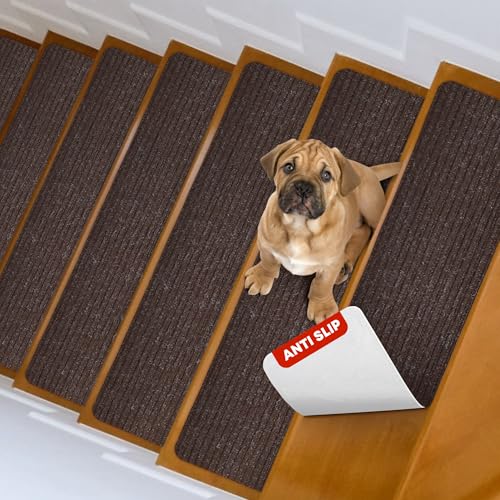


Prices are Amazon’s listed prices as of the time shown and change often; check Amazon for today’s price. As an Amazon Associate we earn from qualifying purchases.
Nosing and Uniform Dimensions
The nosing gives the foot a little extra landing area and helps people see the edge of each step. A nosing that is missing, worn, rounded off, loose or covered by a sloppy carpet wrap can make the edge hard to judge. A nosing that projects too far can catch a heel when walking up.
Residential building codes include specific limits for stair geometry. Widely adopted model residential codes generally set a maximum riser height of around 7 3/4 inches, a minimum tread depth of around 10 inches, and a nosing projection range for solid-riser stairs of roughly 3/4 inch to 1 1/4 inches. Just as important, these codes generally limit how much riser heights and tread depths may vary within a single flight, commonly to no more than 3/8 inch between the largest and smallest. Exact requirements depend on which code edition the local jurisdiction has adopted and any local amendments, so the local building department is the authority for any new work or permitted remodel.
The reason for the uniformity limit is simple: people learn a stair’s rhythm after the first step or two and stop looking. A single odd riser, often the top or bottom step where flooring was added or a landing was poured, interrupts that rhythm. Common sources of nonuniform steps include:
- New flooring added at the top landing or bottom floor without adjusting the first or last step.
- Thick hardwood treads installed over existing treads on some steps but not others.
- Exterior concrete or paver steps that have settled or heaved unevenly.
- Garage-to-house steps built by a homeowner long after the original construction.
Older homes may have been built under earlier rules and are generally not required to be rebuilt to current standards simply because a code has changed. Inspectors still note steep, irregular or uneven stairs as safety concerns, because they can affect anyone using them regardless of when they were built.
Slip Resistance and Fall Risk
Falls are a serious public health issue, particularly for older adults. According to the Centers for Disease Control and Prevention, falls among adults 65 and older caused over 43,000 deaths in 2024, making falls the leading cause of injury death for that group, and emergency departments recorded about 4.5 million visits for older adult falls that year. CDC states that falls can be prevented.
CDC’s fall-prevention guidance for older adults includes making the home safer by getting rid of things you could trip over, putting railings on both sides of stairs, adding grab bars in and near the tub or shower and next to the toilet, and making sure the home has plenty of light. Stairs combine several of those risks at once.
For treads specifically, a few factors affect slip resistance:
- Surface finish. High-gloss finishes on hardwood treads look good and can be slippery, especially in socks. Satin or matte finishes, or finishes with a slip-resistant additive, reduce that risk.
- Treads and strips. Adhesive anti-slip strips, rubber treads and carpet stair treads add grip. They need to be firmly attached; a loose stair mat or pad is itself a trip hazard.
- Visible edges. Contrasting nosing strips or a change in color at the edge help people see where each step ends, particularly on stairs with a uniform color or pattern.
- Lighting. Switches at the top and bottom of interior stairs and good exterior lighting at entry steps matter as much as the tread surface itself.
- Clutter. Shoes, bags and items “waiting to go upstairs” are a common cause of trips.
For aging-in-place planning, stair safety usually goes alongside bathroom safety. Our guide to grab bars for the shower covers that side of the home.
Carpet Runners and Carpeted Stairs
Carpet adds grip and cushions a fall, but it introduces its own issues. Thick pad and plush carpet can round over the nosing, making the edge of each step harder to judge and effectively shortening the tread. Carpet that is loose, worn through at the nosing or pulling away from the tack strip creates a trip hazard. On stairs where carpet was removed to expose hardwood, the treads underneath are sometimes construction-grade material that was never intended to be seen, with staple holes and glue residue.
A stair runner, a strip of carpet down the center of a hardwood stair, is a popular compromise. It adds traction and softens noise while leaving wood visible at the sides. Runners need to be installed tightly over each nosing and securely fastened, either with tack strips and staples or stair rods, so they do not shift. Our stair runner guide covers materials and installation styles.
Exterior Steps, Ice and Front Range Winters
Exterior stair treads face conditions interior stairs never see. Front Range weather can swing from sunny and dry to icy in a day, and repeated freeze-thaw cycles open up gaps, loosen fasteners and heave concrete. Snowmelt running off a roof onto the steps below, especially from a valley or an undersized gutter, can refreeze into a sheet of ice on north-facing entries.
Common exterior tread issues include:
- Composite and PVC treads that are slick when wet or frosty, or that sag between stringers set too far apart for the product’s span rating.
- Wood treads that cup, split or rot, often with fasteners backing out.
- Concrete steps that settle, crack, spall from deicing salts or pull away from the house.
- Stone or paver steps with loose units or uneven heights.
Practical mitigations include grit-type anti-slip treads or coatings, managing roof runoff with gutters and downspouts so water does not drip onto steps, using deicers recommended for the surface material, and ensuring exterior lighting covers the full run. Our guides to deck stairs and front porch steps go into construction details for exterior stairs.
Stringers: The Structure Under the Treads
When treads feel springy or uneven, the problem is sometimes the stringer beneath. Stringers can crack along the notches, especially when the notch cuts leave too little solid wood below, which is sometimes called the throat. They can pull away from a deck rim or landing, sit directly on soil and rot, or be undersized for the span. Interior stringers occasionally show cracks or excessive notching where a previous owner modified the stair.
Exterior stair stringers are a frequent inspection finding because they are often added after the deck or porch itself, with less attention to connections and spacing. Our stair stringer guide explains what to look for and when to call a contractor.
Handrails Go With Treads
Good treads and a solid handrail work together. CDC’s fall-prevention guidance specifically recommends railings on both sides of stairs. Inspectors commonly flag missing handrails, handrails that are too high or low, loose brackets, rails that cannot be grasped securely and guard openings large enough for a child to pass through.
Our guide to stair railing height covers typical handrail and guard expectations, and our wrought iron railing guide covers metal railings commonly found on exterior steps and porches.
Choosing Replacement Tread Materials
When treads need replacing, the material choice affects durability, slip resistance and how well the new steps match the rest of the stair.
- Red oak and white oak. The most common hardwood treads, widely stocked in standard widths and lengths with a pre-rounded nosing. They take stain well and hold up to daily traffic, though a glossy finish can be slippery.
- Maple, hickory and other hardwoods. Harder and often more dent-resistant, with a different grain and color that may not match existing oak railings or floors.
- Retrofit treads. Thin hardwood caps designed to install over existing treads after the old nosing is cut flush. They are popular for carpet-to-hardwood conversions but must be planned so the finished rise of the first and last steps stays consistent with the rest.
- Pine and construction-grade treads. Inexpensive and intended to be carpeted. They dent easily and are usually a poor choice for an exposed finish.
- Exterior options. Pressure-treated lumber, composite and PVC treads, each with manufacturer span limits that set how far apart the stringers may be. Composite stair treads often require closer stringer spacing than wood, so swapping materials on existing stringers is not always a straight substitution.
Whatever the material, treads should be fastened to every stringer, fitted tightly to the risers and finished on all faces where moisture is a concern, including the underside of exterior treads where practical.
Replacement Options and Typical Costs
Costs depend on materials, the number of steps, access and whether the stair structure needs work. The following are general 2026 ranges rather than quotes:
- Fixing squeaks or loose treads: often a modest handyman or carpenter charge, roughly $150 to $500 for a typical stair, more if the underside must be opened.
- Anti-slip strips or adhesive treads: commonly well under $100 to a few hundred dollars for a full interior or exterior flight as a DIY project.
- Replacing a single damaged tread: often roughly $100 to $300 per tread installed, depending on species and finish matching.
- Hardwood tread retrofit over an existing carpeted stair: commonly about $1,500 to $5,000 or more for a typical straight flight, depending on species, risers, nosing details and finishing.
- Stair runner installation: often around $500 to $2,500 depending on carpet choice and stair layout.
- Rebuilding exterior wood or composite steps: commonly several hundred to a few thousand dollars, and more if stringers, footings or railings must also be replaced.
Any change that alters riser heights, such as adding thick new treads or new flooring at a landing, should be planned so the steps remain uniform. That often means adjusting the first or last riser, or choosing a tread retrofit system designed to keep heights consistent.
What a Home Inspection Covers
The ASHI Standard of Practice requires inspectors to inspect steps, stairways and railings in the interior and attached decks, balconies, stoops, steps, porches and their associated railings on the exterior. Inspectors typically walk every stair, look for loose or damaged treads, irregular risers, missing or loose handrails, inadequate guards, rot and stringer problems on exterior steps. They do not usually measure every step to code or certify that a stair complies with current standards, but obvious nonuniform steps and safety hazards are reported. The structure and exterior inspection section covers the exterior side of the inspection, and our main guide to hiring a home inspector explains how to choose an inspector and read the report.
More Questions About Stair Treads
What is the best wood for stair treads?
Red oak and white oak are the most common and practical woods for stair treads, because they are hard, durable and stain well. Maple and hickory are even harder, while softer woods like pine dent more easily and are better suited to painted or carpeted stairs.
Treads are commonly about 1 inch thick for hardwood. Engineered or laminate stair treads exist but may show wear at the nosing sooner. Exterior treads need rot-resistant lumber, composite or metal.
Can new stair treads be installed over old ones?
Yes, retrofit stair treads and riser covers can be installed over existing treads, typically after cutting off the old nosing so the new tread sits flush. This avoids tearing out the stairs and is common when removing carpet.
The added thickness raises each step slightly. The bottom and top steps must be adjusted so riser heights stay uniform, since a different height at either end is a common trip hazard. Retrofit treads should be glued and fastened according to the manufacturer’s instructions.
What are the best outdoor stair treads?
Good outdoor stair tread materials include pressure-treated lumber, rot-resistant woods such as cedar, composite decking, and metal treads with a slip-resistant surface. Concrete and stone steps are durable but can be slippery when wet or icy.
Composite treads require closer stringer spacing than wood. Adding grip tape, textured coatings or abrasive nosings helps in wet climates. Treads should shed water easily and stay securely attached, since outdoor treads loosen faster as wood swells and shrinks.
How do you refinish hardwood stair treads?
Refinishing hardwood stair treads usually involves sanding off the old finish, vacuuming dust, applying stain if desired and finishing with several coats of a durable floor finish such as polyurethane. Each coat needs drying time before the next.
Work on alternating steps so the stairs remain usable. Pay special attention to the nosing, where wear is heaviest. A slip-resistant additive in the final coat can improve traction. In pre-1978 homes, test old finishes and paint for lead before sanding.
References
- About Older Adult Fall Prevention — Centers for Disease Control and Prevention
- Preventing Falls and Hip Fractures — Centers for Disease Control and Prevention
- ASHI Standard of Practice for Home Inspections — American Society of Home Inspectors
Frequently asked questions
How do you fix a loose stair tread?
Most loose treads are fixed by screwing the tread into the riser and stringers from above, with countersunk screws and wood plugs on finished wood, or by adding glue blocks and shims from below. A split, rotted or soft tread should be replaced.
What is the standard size of a stair tread?
Widely adopted model residential codes generally call for a minimum tread depth of around 10 inches and a maximum riser height of around 7 3/4 inches, with limited variation between steps. Check with the local building department for the code edition that applies.
How can I make wooden stairs less slippery?
Options include a satin or slip-resistant finish, adhesive anti-slip strips, securely attached carpet treads or a stair runner. Good lighting, visible nosing edges and handrails on both sides also help reduce fall risk.
Why does one step feel different from the others?
Often the top or bottom riser differs in height because flooring was added or a landing settled. Codes generally limit variation within a flight because people stop watching their feet after the first few steps.
Do home inspectors check stair treads?
Yes. The ASHI Standard of Practice includes steps, stairways and railings, so inspectors look for loose or damaged treads, irregular steps, handrail and guard problems and rot on exterior stairs.
Are carpet stair tread pads safe?
Carpet stair tread pads can make stairs safer by improving grip, but they must have a non-slip backing or adhesive that holds firmly. Pads that slide or curl at edges become trip hazards. Check them regularly and replace pads that move under foot.
How thick should stair treads be?
Interior hardwood stair treads are commonly about 1 inch thick, while exterior treads made of 2x lumber or composite are about 1.5 inches thick depending on stringer spacing. Thinner treads may flex between stringers and loosen.
Can laminate flooring be used on stair treads?
Laminate flooring can be used on stair treads with matching stair nosing pieces, but it must be glued and fastened to each tread rather than floated. Laminate can be slippery. Many homeowners choose laminate stair tread kits designed for this purpose.
Concerned about a bouncy staircase, uneven entry steps or missing handrails in a home you are considering? Schedule an inspection with us and a Front Range inspector will walk every stair and flag what needs repair.