Sidewalk Repair: Trip Hazards, Lifting and Who Is Responsible
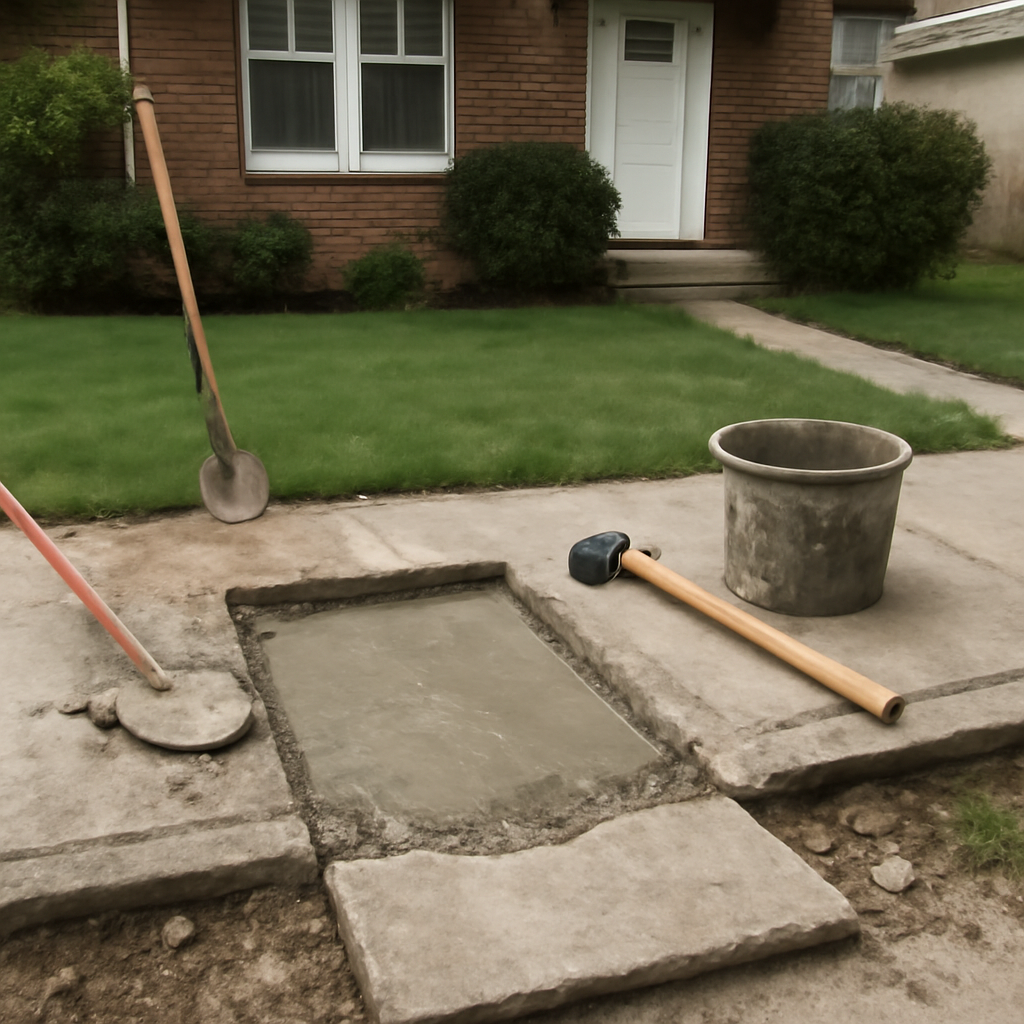
A sidewalk panel that has lifted an inch at one edge does not look like much until someone catches a toe on it. Uneven walks are among the most common exterior defects on older Front Range properties, where mature street trees, expansive clay soils and decades of freeze-thaw cycles push and pull concrete out of line. Sidewalk repair raises two questions at once: what fix is appropriate, and who is supposed to pay for it. The answer to the second depends heavily on the city and on whether the walk is public or private. This guide covers trip hazards and height differences, how responsibility is commonly divided between cities and adjacent owners, the main causes of displacement, the options from lifting and grinding to full replacement, safety steps before digging and typical costs. Local rules vary, so treat this as a starting point and confirm details with your municipality.
Part of our Structure & Exterior guide — start there for the full picture →
What Sidewalk Repair Involves
Sidewalk repair covers any work that restores a walk to a safe, reasonably level surface. On a typical residential property, that can mean the public sidewalk along the street, the private walk from the sidewalk to the front door, side walks to the backyard or gate, and transitions at driveways and steps.
Most repairs fall into four groups:
- Trip-hazard removal: grinding or saw-cutting a raised edge so the transition is smooth.
- Lifting: raising a sunken panel back to grade with mudjacking (a cement-based slurry) or polyurethane foam injection.
- Patching: filling small holes, spalls and cracks with repair mortar, which is usually cosmetic and short-lived on exterior walks.
- Replacement: removing damaged panels and pouring new concrete, sometimes after removing roots or improving the base.
The right choice depends on why the panel moved, how much it moved, whether it is cracked through and whether the cause is still active.
Trip Hazards and Height Differences
Most trips on walks happen at vertical offsets, where one panel sits higher than the next, or at broken pieces and holes. Small offsets matter more than people expect, because a foot swinging forward clears the surface by only a small margin.
For public sidewalks and other facilities covered by federal accessibility rules, the ADA Standards for Accessible Design treat changes in level as follows: vertical changes up to 1/4 inch are permitted without edge treatment, changes between 1/4 and 1/2 inch are expected to be beveled, and changes greater than 1/2 inch are expected to be treated as ramps. Those rules apply to covered public and commercial facilities, not to private residential walks, but many cities use similar thresholds to decide which public sidewalk offsets need attention. Thresholds in local codes and sidewalk programs vary, so the city’s own criteria are what count for a public walk.
On private property, there is no single required standard, but the same physics applies. An offset of about 1/2 inch or more is commonly treated as a trip hazard worth fixing, and smaller lips can still catch a cane, walker, stroller wheel or snow shovel.
Falls are a serious concern for older residents in particular. The CDC reports that more than one in four adults age 65 and older falls each year, that falls among adults 65 and older caused over 43,000 deaths in 2024, making falls the leading cause of injury death in that group, and that there were about 4.5 million emergency department visits for older adult falls in 2024. The CDC lists broken or uneven steps among the home hazards that contribute to falls. Not all of those falls happen outdoors, but a level, well-lit route from the street to the door is a reasonable priority for any household with older adults.
Who Is Responsible for Sidewalk Repair?
Responsibility for public sidewalks varies widely across the country and within Colorado. Broadly, there are three models:
- Adjacent-owner responsibility: the city owns the right-of-way, but local code requires the abutting property owner to maintain and repair the sidewalk. Cities using this model may inspect, notify owners and sometimes perform the work and bill the owner if repairs are not made.
- City responsibility: the municipality maintains public sidewalks through its own budget or a dedicated program, sometimes with cost-sharing or fees.
- Hybrid arrangements: the city handles damage caused by city street trees or utility work, while owners handle other damage, or the city offers a reimbursement or cost-share program.
Many Front Range cities have historically placed sidewalk repair duty on adjacent owners, and some have changed their approach in recent years through new programs or fees. Because these rules change, the reliable source is the city’s public works or right-of-way department, along with any notice the owner has received. HOAs add another layer: some maintain common walks, while others leave sidewalks to the city and the owner.
Private walks on the lot, such as the path from the public sidewalk to the porch, are almost always the owner’s responsibility. For buyers, a city notice of a required sidewalk repair is worth asking about during the transaction, since the obligation typically follows the property.
Liability is a separate question from repair duty and depends on state law, local ordinances and the specific facts of an incident. Owners with concerns about liability should speak with an attorney or their insurer rather than relying on general guides.
Common Causes of Sidewalk Damage
Tree roots
Roots of large street trees, especially shallow-rooted species, grow beneath the slab where moisture collects and gradually lift panel edges. Root-related lifts often show up as a single raised edge near the tree, sometimes with a crack running toward the trunk. Cutting major roots to replace a panel can harm or destabilize a tree, and street trees are often city property protected by a forestry ordinance, so many cities require a permit or an arborist’s review before root pruning. Root barriers, wider planting strips or rerouting the walk around the tree are common long-term fixes.
Frost heave
When moist, fine-grained soil under a slab freezes, ice lenses can form and push the concrete upward, then let it settle unevenly on thaw. Poor drainage and soils that hold water make it worse. Front Range winters bring many freeze-thaw cycles, and walks on the shaded north side of a house often show more movement and more scaling.
Expansive soils and settlement
Much of the Front Range has expansive clay that swells when wet and shrinks when dry, lifting and dropping slabs with seasonal moisture. Settlement is the opposite problem: soil that was poorly compacted, washed out by a leaking downspout or disturbed by a utility trench can sink and leave a panel lower than its neighbors. Water from downspouts, sprinklers and sump discharge lines is often a contributing factor and is worth fixing alongside the repair.
Surface wear
Scaling, spalling and pitting from deicers and freeze-thaw cycles roughen the surface without necessarily moving the panel. Those are cosmetic problems unless pieces break loose. For heavily scaled but stable panels, resurfacing may be an option; our guide to concrete resurfacing explains when overlays work.
Repair Options: Lifting, Grinding or Replacement
Grinding and saw-cutting
For a raised edge that is otherwise sound, trip-hazard removal is often the fastest and least expensive fix. Contractors grind the high edge down to a gentle slope or use a horizontal saw cut to slice a wedge off the raised panel, leaving a smooth transition. It works best on offsets up to roughly an inch or so; beyond that, the slope becomes too long or the panel too thin. It does nothing about the cause, so a root-lifted panel may rise again.
Grinding and cutting concrete creates dust. OSHA explains that respirable crystalline silica is created when cutting, sawing, grinding and drilling concrete, and that inhaling it increases the risk of silicosis, an incurable lung disease, along with lung cancer and other serious diseases. Contractors should use wet cutting or shrouded tools with dust collection, and homeowners should keep doors and windows closed nearby while work is underway.
Mudjacking and foam lifting
Slabs that have sunk but remain largely intact can often be raised. Mudjacking pumps a cement-based slurry through holes drilled in the panel to fill voids and lift it. Polyurethane foam lifting injects expanding foam through smaller holes; the foam is lighter and cures quickly, so the walk can often be used the same day. Both work best when the panel is not badly cracked and the soil below has stabilized. Lifting does not help heaving caused by roots or expansive soil, and a panel lifted over soil that keeps washing out may sink again.
Replacement
Panels that are broken into pieces, badly heaved, sunk too far to lift or damaged by roots that must be addressed usually need replacement. A good replacement job removes the damaged panel, corrects the base (compacted gravel, root management, drainage), forms the new panel to match neighboring grades and joints, and uses a mix and finish suited to exterior exposure. Public sidewalk replacement often requires a city permit and must meet the city’s specifications for width, thickness, cross-slope and joint spacing.
After a new pour, many contractors recommend keeping deicers off the concrete during its first winter and sealing it once it has cured. Our guide to concrete sealer covers product choices.
Choosing among them
- Raised edge, intact panel, offset under about an inch: grinding or saw-cutting is often enough.
- Sunken but intact panel: mudjacking or foam lifting is usually cheaper than replacement.
- Broken, root-heaved or badly displaced panel: replacement, with the cause addressed.
- Surface scaling only: sealing or resurfacing, not structural repair.
Call 811 Before Digging
Sidewalks often sit directly above buried utilities: water services, gas lines, communications cables and irrigation. Replacing panels, removing roots, setting new forms or installing root barriers all involve digging. Colorado requires a locate request through the state 811 one-call system before excavating, and utilities then mark their lines. Lifting contractors drilling through slabs also need to know what is below.
Our guide to call before you dig explains how the locate process works, how long it takes and what the paint and flag colors mean. Private lines, such as a gas line to a detached garage or low-voltage landscape wiring, are generally not marked by the utility locate and may require a private locator.
Steps, Transitions and Drainage
Sidewalk problems rarely stop at the walk. The joint where a walk meets the porch steps is a common trip point, because steps and walks often move differently: the steps may rest on a separate footing or be tied to the foundation, while the walk floats on soil. Uneven risers, a step that has pulled away from the house or a walk that has dropped below the bottom step all change the step height people expect. Our guide to front porch steps covers riser consistency, handrails and repair options.
Driveway aprons and transitions to the public walk are another frequent problem area, since vehicle loads and plowing add stress. Cracks there often reflect base or drainage issues; see our guide to driveway cracks for how to read them.
Drainage ties all of this together. Walks should shed water away from the house. A walk that has settled toward the foundation can channel water against basement walls, and a low spot that holds water will freeze into an ice patch on winter mornings. Fixing the slope is often part of a lasting repair.
Routine upkeep slows the cycle. Sealing joints between panels with a flexible sealant limits the water that reaches the base, clearing grass and weeds from joints keeps them from widening, and checking walks each spring after the freeze-thaw season catches new offsets while they are still small enough to grind. Marking a new lip with bright paint until it is fixed is a simple stopgap.
What Sidewalk Repair Costs
Costs vary with the method, panel size, access, permits and local labor. As general 2026 ranges, not quotes:
- Trip-hazard grinding or saw-cutting: often priced per location or per linear inch of offset; many jobs run from roughly $75 to $250 per trip point, with minimum charges for small jobs.
- Mudjacking: commonly a few hundred dollars per panel, with small jobs often around $300 to $1,000 total.
- Polyurethane foam lifting: typically higher per panel than mudjacking, often several hundred dollars to over $1,500 depending on the area raised.
- Panel replacement: often around $8 to $20 or more per square foot including removal, with permits, root work, curb ramps or decorative finishes adding cost.
Some cities with owner-responsibility rules offer cost-share, rebate or bulk-contract programs that lower the price of public sidewalk work. It is worth checking before hiring privately.
How Inspectors Treat Walkways and When to Get Help
The ASHI Standard of Practice lists adjacent and entryway walkways, patios and driveways among the exterior items a home inspector inspects, along with steps, stoops and their railings, and grading and drainage likely to adversely affect the building. The same standard excludes geological and soil conditions. In practice, an inspector will typically note trip hazards, heaved or settled panels, damaged steps and walks that slope toward the house, but will not determine who is responsible for the public sidewalk or engineer a repair.
Consider bringing in a concrete contractor, arborist or the city when:
- A public sidewalk shows a notable offset and you need to know the city’s rules and programs.
- Roots from a large tree are lifting the walk and root pruning may affect the tree.
- Panels keep sinking, suggesting a washout, leaking pipe or drainage issue below.
- Steps and walks have separated from the house or each other.
For more on how exterior items fit into an inspection, see our structure and exterior inspection section and the main guide to hiring a home inspector.
References
- Facts About Older Adult Falls — Centers for Disease Control and Prevention
- About Older Adult Fall Prevention — Centers for Disease Control and Prevention
- Silica, Crystalline: Overview — Occupational Safety and Health Administration
- ASHI Standard of Practice for Home Inspections — American Society of Home Inspectors
Frequently asked questions
Who is responsible for repairing the sidewalk in front of my house?
It depends on the city. Many municipalities require the adjacent owner to maintain the public sidewalk, others maintain it themselves, and some split costs or handle tree-caused damage. Check with your city's public works or right-of-way department for current rules.
How big does a sidewalk lip have to be to count as a trip hazard?
Federal accessibility standards for covered public facilities allow up to 1/4 inch without treatment, expect beveling from 1/4 to 1/2 inch, and treat larger changes as ramps. Many cities use similar thresholds for public walks, and an offset of about 1/2 inch is commonly treated as worth fixing on private walks.
Is mudjacking or foam better for sidewalk repair?
Both lift sunken but intact panels. Foam uses smaller holes, weighs less and cures quickly, but usually costs more per panel. Mudjacking is often cheaper. Neither fixes heaving caused by roots or expansive soils.
Can a raised sidewalk be ground down?
Yes. For sound panels with offsets up to roughly an inch, grinding or horizontal saw-cutting can remove the lip. It does not address the cause, and the work creates silica dust, so wet cutting or dust-collecting tools should be used.
Do I need to call 811 before replacing a sidewalk?
Yes. Colorado requires a locate request through 811 before excavation, and sidewalks often sit above water, gas and communications lines. Private lines may need a separate private locator.
Buying a home with a heaved front walk or crumbling steps? Drop us a line and we can help you connect with an inspector who will document trip hazards, drainage and exterior concrete before closing.