Radon Test Price: Homeowner Guide
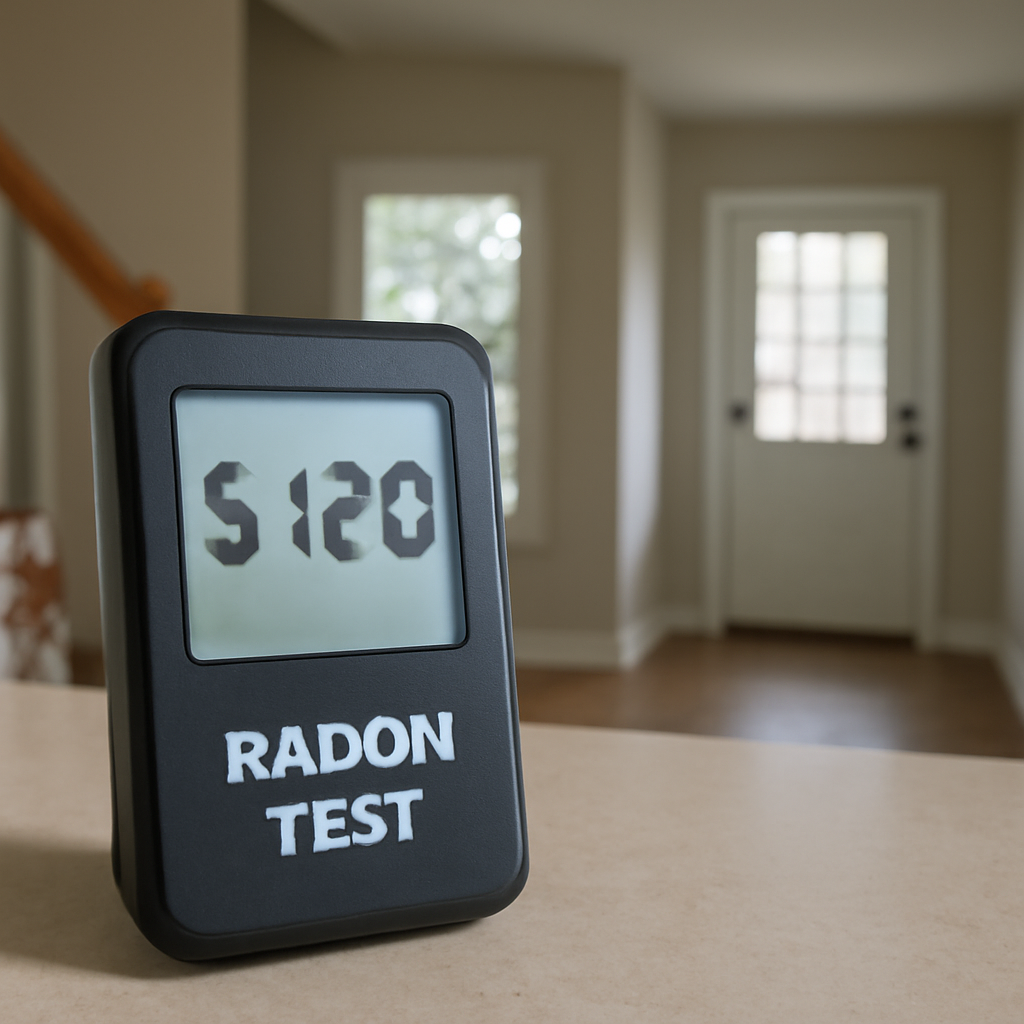
Radon test prices in 2026 span a wide range depending on the testing method, the duration, and whether the work is performed by the homeowner or a certified professional. DIY short-term kits cost $15 to $30. DIY long-term alpha-track detectors run $25 to $50. Professional tests with continuous monitors cost $150 to $300. Continuous monitor rentals for 48-hour homeowner use run $100 to $200. Homeowner-owned digital monitors run $200 to $500. This guide walks through each option, what the price includes, what it does not include, and which method makes sense for which use case. This summary reflects EPA, CDPHE, and AARST guidance current as of 2026 — consult an NRPP-certified professional for specific testing decisions on a property.
Part of our Radon Levels guide — start there for the full picture →
Short-term DIY test kits: $15 to $30
The most common DIY option is a short-term test using an activated-charcoal canister or charcoal liquid scintillation detector. The homeowner purchases the kit at a hardware store, big-box retailer, or online, opens it in the lowest occupied level of the home, exposes it for 48 hours to 7 days under closed-house conditions, and mails it back to the lab in a prepaid envelope. The kit price typically includes the canister or detector, the placement instructions, the return mailer, and the lab analysis fee.
Lab analysis takes 5 to 10 business days after the lab receives the sample. The results are emailed or mailed to the homeowner, showing the measured indoor radon concentration in pCi/L and a comparison to the EPA action level of 4 pCi/L. Some kits include access to an online portal where results are posted.
This is the right option for an initial screen of an owner-occupied home, particularly for homeowners who want to verify whether testing-and-mitigation conversation is warranted before paying for a professional test. The kit’s accuracy is acceptable for screening purposes; long-term tests or professional continuous monitors provide more reliable data for decision-making.
Long-term DIY alpha-track detectors: $25 to $50
Long-term alpha-track detectors run for 90 days to a year. The detector consists of a small plastic chamber holding a strip of polycarbonate film. Alpha particles from radon decay produce tracks on the film that the lab counts after exposure. Long-term tests produce an annual-average radon concentration that captures seasonal variation more accurately than short-term tests.
Long-term tests are the gold standard for residential radon assessment per EPA guidance. They are most useful when the homeowner wants definitive long-term data rather than an initial screen, or when a short-term test produced borderline results in the 2 to 6 pCi/L range. The longer exposure period reduces the influence of day-to-day variability that can produce misleading short-term readings.
The kit price includes the detector, placement instructions, return mailer, and lab analysis. Results take 2 to 4 weeks after lab receipt because the integration period produces a larger signal that takes longer to count accurately. A radon home testing methodology guide walks through long-term test selection in more detail.
Professional radon testing: $150 to $300
Professional radon testing performed by an NRPP-certified measurement professional typically uses a continuous radon monitor (CRM) deployed for 48 hours under closed-house conditions. The monitor produces hourly radon readings throughout the test period, which the tester uses to identify any unusual variability and to confirm that closed-house conditions were maintained. The cost includes the equipment, the deployment, the data analysis, and a written report.
Real-estate transactions in Colorado almost always use professional CRM testing because the chain-of-custody documentation and certified-tester signature are required for transaction-grade results. Buyers conditioning purchase on radon results need professional testing rather than DIY kits, both for documentation quality and for tester independence.
The professional report includes the average radon concentration, the hourly variability, the deployment conditions, the calibration documentation for the monitor, and the tester’s NRPP credentials. The report serves as legal documentation in real-estate disclosures, lender underwriting, and insurer interactions.
Continuous monitor rental for homeowner use: $100 to $200
Some testing companies and hardware-rental services offer continuous radon monitors for short-term homeowner rental. The homeowner picks up the monitor, deploys it in their home for 48 hours to 7 days, and returns it for data analysis. The rental price typically includes the monitor, the deployment instructions, and a basic data report.
This option falls between DIY kits and full professional testing. The data quality is higher than a passive charcoal canister but the rental does not include certified-tester signature or chain-of-custody documentation. The rental option works well for homeowners who want better data than a $20 kit produces but do not need transaction-grade documentation.
Homeowner-owned digital monitors: $200 to $500
Several manufacturers sell continuous radon monitors directly to consumers. Models range from $200 to $500 for the unit, with no recurring lab fees. The monitor sits in the home permanently, producing daily and long-term average readings that the homeowner can review through a smartphone app or display panel.
Owned monitors are the right choice for homeowners who want ongoing visibility into their home’s radon level. They are particularly useful for homeowners post-mitigation who want to verify continuous mitigation system performance, and for homeowners in pre-1978 housing with seasonal variability who want year-round monitoring. The upfront cost is higher than rental, but the lack of recurring fees makes the long-term cost lower for any homeowner who plans to test more than three or four times.
Calibration is a consideration. Continuous monitors should be calibrated periodically — typically annually — to maintain accuracy. Manufacturer calibration services run $50 to $150 and are recommended for owned units. The InspectandTest radon hub covers calibration practices.
What additional costs may apply
Several adjacent costs can affect the total radon-testing budget:
- Re-testing after mitigation — typically $20 to $30 for a DIY short-term kit, or $150 to $250 for a professional re-test. Mitigation projects typically include the initial post-installation test, but follow-up testing every two years is recommended by EPA.
- Multiple-unit testing in multi-family — costs scale with the number of units. Building-scale testing programs typically use continuous monitors and run $75 to $200 per unit at scale.
- Specialty test methods — some buildings or transactions warrant grab-sampling, working-level measurement, or extended deployment beyond 7 days. These specialty tests can run $300 to $800 depending on the scope.
- Lab re-analysis — occasionally a result is ambiguous or the lab requests re-analysis. Most reputable test kit vendors and labs handle this at no additional cost.
- Travel surcharges — professional testers serving mountain or rural Colorado properties sometimes add travel fees of $50 to $150.
What determines the price within each category?
Within the DIY-kit category, price differences typically reflect detector type (charcoal canister vs liquid scintillation vs alpha-track), the rigor of the lab analysis, the speed of result reporting, and the strength of the vendor’s quality program. EPA-listed labs maintain participation in the National Radon Proficiency Program, which verifies analytical accuracy.
Within the professional-testing category, price differences typically reflect the NRPP certification level of the tester, the calibration date and rigor of the equipment, the data analysis depth in the written report, the local market rate, and whether closing-day documentation is included. Higher-priced professional tests typically come with more thorough reports and faster turnaround.
When to spend more, when to spend less
The right level of investment depends on the use case:
- Initial screen of an owner-occupied home — $15 to $30 DIY kit is sufficient. If the result is below 2 pCi/L, no further testing is immediately needed. If it is between 2 and 4 pCi/L, consider a long-term test. If it is above 4 pCi/L, move to mitigation.
- Real-estate transaction — professional testing ($150 to $300) is required. DIY kits do not produce transaction-grade documentation.
- Post-mitigation verification — a DIY short-term test ($15 to $30) confirms the mitigation system is reducing indoor radon. Many mitigation contractors include the initial post-installation test as part of the project scope.
- Ongoing monitoring — an owned continuous monitor ($200 to $500) provides year-round visibility with no recurring fees.
- Borderline results between 2 and 6 pCi/L — a long-term alpha-track test ($25 to $50) clarifies whether seasonal variation pushed the short-term result above or below the action level.
What to avoid
Several testing-related cost traps are worth knowing about. Free radon tests offered as a marketing tool by some mitigation contractors create a conflict of interest — the same firm that benefits from selling mitigation also delivers the test result. The result may still be accurate, but an independent test from a non-mitigator source is more defensible if the result is later questioned. Very cheap tests below $10 sometimes come from non-NRPP-listed labs whose accuracy is not verified through national proficiency testing. Highly priced “premium” testing services above $500 for residential single-family use rarely justify their premium relative to a standard professional CRM test.
Cost comparison across Front Range counties
Pricing varies modestly across Colorado Front Range counties. Denver, Boulder, and Jefferson counties typically sit at the upper end of the professional testing range at $200 to $300. Adams, Arapahoe, and Douglas counties run closer to $175 to $250. El Paso County, anchored by Colorado Springs, sometimes prices $25 to $50 below the Denver-metro median. Mountain properties west of I-25 face travel surcharges that can add $100 or more to the base professional testing fee. DIY kit pricing is essentially identical statewide because the kits are nationally distributed.
Bundled testing during inspection
Many Front Range home inspectors offer radon testing as an add-on to a base home inspection. The bundled price is often slightly lower than the standalone radon-testing price because the inspector is already on site. Typical bundled radon-testing add-on pricing runs $125 to $200 versus $150 to $300 for a standalone professional test. Buyers conditioning purchase on a home inspection should ask whether the inspector offers NRPP-certified radon testing as a bundled service.
The bundled approach has a practical benefit: the inspector deploys the continuous monitor at the start of the inspection visit, then the test runs during and after the inspection. The buyer receives both the home inspection report and the radon results within the same week, which keeps the inspection contingency timeline tight.
What the cost does not include
Radon testing cost does not include mitigation. If a test produces an elevated result, the homeowner then commissions a separate project to install a mitigation system. Typical Front Range mitigation runs $1,200 to $2,500 for a single-family home with a poured-concrete basement. The total budget for a homeowner moving from “no testing” to “tested and mitigated” therefore runs $1,250 to $2,800 in most cases. Homeowners should plan for both line items when budgeting for radon-related work.
Frequency: how often should homeowners retest?
EPA recommends retesting every two years to confirm continued radon levels at or below the action threshold. Homes with mitigation systems should be retested every two years to verify continued effectiveness. Homes that have never been retested following a major renovation, foundation work, HVAC replacement, or significant changes in occupancy patterns should be retested promptly because any of these changes can affect indoor radon dynamics. Long-term testing every several years is a sensible default for any pre-1990s Front Range home.
This recurring testing pattern is one of the reasons that homeowner-owned digital monitors become cost-effective over the long run. A homeowner doing four short-term tests over eight years spends $60 to $120 in kit costs. A homeowner with a $300 owned monitor over the same period has lower total cost and continuous visibility into year-round variation.
References
- EPA Citizen’s Guide to Radon — U.S. Environmental Protection Agency
- American Lung Association radon resource — American Lung Association
- CDPHE radon testing guidance — Colorado Department of Public Health and Environment
Frequently asked questions
What is the cheapest radon test?
A DIY short-term activated-charcoal kit costs $15 to $30 including lab analysis. This is the right option for an initial screen of an owner-occupied home. Real-estate transactions require professional testing for transaction-grade documentation.
How much does a professional radon test cost?
$150 to $300 for a 48-hour continuous monitor deployment by an NRPP-certified tester. The price includes the equipment, the deployment, the data analysis, and a written report suitable for real-estate disclosures and lender underwriting.
Is a long-term test worth the extra time?
For decision-making in borderline cases, yes. Long-term alpha-track tests run 90 days to a year and produce an annual-average reading that captures seasonal variation. They cost $25 to $50 and are the EPA gold standard for residential assessment.
Should I buy my own radon monitor?
If you plan to test more than three or four times, an owned continuous monitor at $200 to $500 has lower long-term cost than repeated DIY kits. Owned monitors are especially useful for post-mitigation verification and ongoing visibility into seasonal variation.
Front Range homeowners ready to test or mitigate radon can reach out through our contact page for guidance on test selection and certified professional referrals.
Test your home for radon
Radon is invisible and odorless, so a test is the only way to know your level. A short-term kit gives a first reading in days; a digital monitor tracks it over time.
| Product | Why | Buy |
|---|---|---|
 AirChek Charcoal Radon Test Kit AirChek Charcoal Radon Test Kit | Lab fee usually included; EPA short-term protocol. | Amazon — $21.95 |
 First Alert RD1 Radon Test Kit First Alert RD1 Radon Test Kit | Widely stocked; 48-hour charcoal test. | Amazon — $16.98 |
 Airthings Corentium Home Airthings Corentium Home | Digital monitor with a long-term average. | Amazon — $143.65 |