Radon Alarm: Continuous Monitor Threshold Guide 2026
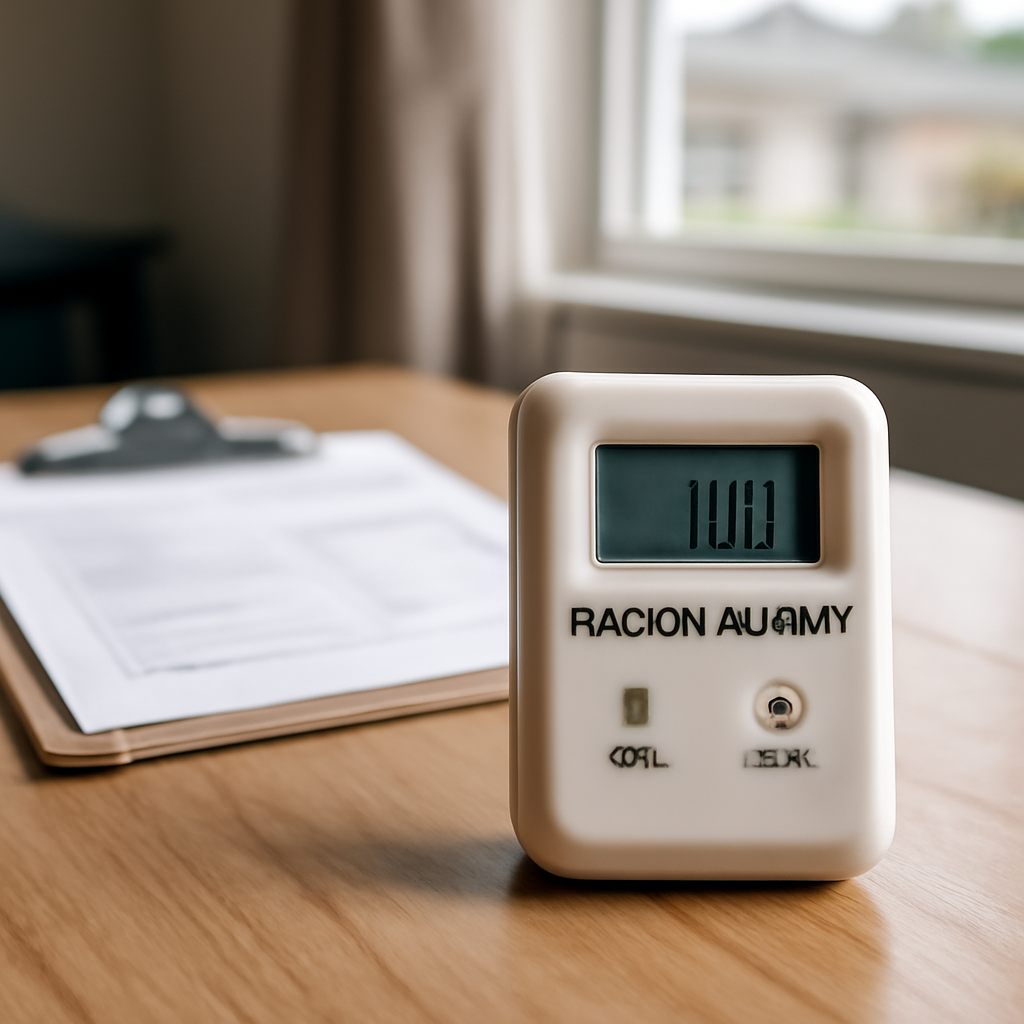
A radon alarm is the household equivalent of a smoke detector for an invisible, odorless radioactive gas that EPA links to roughly 21,000 lung-cancer deaths each year in the United States. The device sits in a basement or lowest occupied floor, samples ambient air continuously, calculates a rolling average concentration, and sounds an audible alert when concentration crosses a user-set threshold (most commonly EPA’s 4.0 pCi/L action level). The category sits between disposable short-term test kits and pro-grade NRPP-certified Continuous Radon Monitors used for real-estate transactions. This guide summarizes EPA, state radon program, and trade-association guidance current as of 2026 — consult a certified radon professional for measurement decisions tied to a real-estate transaction or known elevated levels. For the parent topic see the Front Range radon testing guide.
What is a radon alarm and how does it work?
A radon alarm is a household continuous radon monitor with built-in audible alerts. The device pulls air through a small detection chamber where radon-daughter decay products (polonium-218 and polonium-214) emit alpha particles. A solid-state alpha-detection sensor counts particles per unit time, software converts the count rate to picocuries per liter (pCi/L) using a calibration factor, and a rolling average updates every hour or every 24 hours depending on the model.
When the rolling average crosses the user-set threshold, the device sounds an audible alarm and (on connected models) sends a push notification to a paired smartphone application. The alarm threshold is typically configurable: EPA’s 4.0 pCi/L action level is the default; some devices allow setting at the WHO 2.7 pCi/L recommendation or at custom values for users in elevated-radon regions.
The technology stack is meaningfully different from short-term charcoal canisters or alpha-track films. A canister is a passive collector analyzed in a laboratory; an alarm is an active electronic device producing real-time output. Both are valid measurement tools, but the alarm answers the “is my exposure changing right now” question that a canister cannot.
What devices fall in the radon alarm category?
Two product tiers dominate the household market.
Consumer continuous monitors with alarm function
Devices in this tier include continuous radon monitors marketed for homeowner long-term measurement. Typical features: alpha-detection sensor, 1-to-24-hour rolling-average display, Bluetooth or Wi-Fi connection to a smartphone app, alarm threshold configuration at the device or via app, and supplementary temperature and humidity sensors. Prices range from $150 to $350. Calibration is typically factory-set with no field calibration option; manufacturers recommend replacement at 5-to-10-year intervals.
Pro-grade continuous radon monitors (CRMs)
NRPP-certified continuous radon monitors used by radon professionals during real-estate measurement carry full audible alarm capability plus tamper detection (motion sensors that flag if the device is moved during the test). Pro-grade units are calibrated annually at certified calibration laboratories. Prices run $800 to $3,500 for the device plus annual calibration fees. Pro-grade units produce reports acceptable for real-estate transaction documentation; consumer units typically do not.
What threshold should a radon alarm trigger at?
EPA’s action level is 4.0 pCi/L as a long-term annual average. EPA recommends mitigation at or above this concentration. The agency also notes that no safe radon level exists, and homeowners may reasonably choose to mitigate at lower concentrations. The WHO recommendation is 2.7 pCi/L (100 Bq/m³) as the action threshold for residential dwellings.
A homeowner setting an alarm threshold can reasonably choose any of three options.
4.0 pCi/L (EPA action level)
The default threshold matching EPA’s published action level. Triggers mitigation consideration when long-term average crosses the threshold. Appropriate for homeowners who want to follow the federal guideline without additional conservatism.
2.7 pCi/L (WHO recommendation)
A more conservative threshold matching the World Health Organization residential recommendation. Appropriate for homeowners in elevated-radon regions, homes with young children, or homes where the lower floor is occupied as bedrooms.
2.0 pCi/L (mitigation success target)
The threshold typically used to verify successful mitigation. A post-mitigation home should achieve average concentrations below this level. Appropriate for homeowners verifying that an installed mitigation system continues to perform.
The EPA radon information hub publishes the underlying action level guidance.
Where to place a radon alarm
EPA’s “Protocols for Radon Measurement in Homes” specifies placement parameters. The device should sit on the lowest occupied floor (basement if used as bedroom, office, or play area; otherwise first floor). Place at least 20 inches above the floor (radon is heavier than air but distributes throughout the room volume over hours). Place at least three feet from exterior walls, windows, doors, and HVAC supply registers. Avoid drafty locations, direct sunlight, and high-humidity areas.
Front Range placement considerations
Most Front Range homes have finished or semi-finished basements occupied for substantial time. Place the alarm in the basement living area at the EPA-specified parameters. Avoid placing in the utility room near the furnace return because the airflow creates artificially low readings. Place at least 36 inches from the radon mitigation system fan if one is already installed.
How accurate is a consumer radon alarm?
Consumer continuous monitors with alarm function typically claim accuracy of plus or minus 10 to 20 percent of true concentration. The accuracy depends on the underlying detection technology (alpha spectroscopy is more accurate than photodiode counting) and the manufacturer’s calibration program. Independent testing by state radon programs and university radon laboratories has generally confirmed manufacturer accuracy claims for the consumer tier devices.
The single largest source of measurement error is placement. A correctly placed consumer monitor produces reliable trend data. A poorly placed monitor (next to an HVAC return, in a draft, in direct sunlight) produces artificially low or noisy readings regardless of underlying sensor accuracy. The CDC radon topic page reinforces placement importance.
How long does the alarm need to run before the reading is meaningful?
Radon concentrations vary substantially across hours, days, and seasons. A short-duration reading (under 48 hours) reflects current conditions rather than long-term exposure. EPA recommends a minimum 48-hour measurement period for short-term assessment and at least 90 days for the long-term average that drives mitigation decisions. A continuous alarm running for at least 90 days produces the rolling average appropriate for action-level evaluation.
The Front Range climate produces strong seasonal variation. Winter readings often run 30 to 50 percent higher than summer readings because closed windows and stack effect concentrate soil gas indoors. A homeowner measuring only in summer can substantially underestimate annual average exposure. For deeper context see the related radon test duration guide.
Radon alarm vs short-term test kit: which is appropriate?
The choice depends on the homeowner’s question.
Short-term charcoal canister kit
Appropriate for an initial 48-hour screening, often as part of a real-estate transaction or first-time homeowner assessment. Costs $15 to $35 including laboratory analysis. Produces a single average reading at the end of the 48-hour exposure period. Does not provide ongoing visibility.
Continuous alarm
Appropriate for ongoing exposure monitoring, verification of mitigation system performance, or for homeowners who want visibility into seasonal variation. Higher upfront cost ($150 to $350) but no per-test laboratory fee. Produces continuous data and alerts.
Many homeowners use both: an initial short-term kit to determine whether mitigation is needed, and a continuous alarm afterward to verify ongoing performance. See the related radon gas detector category guide for the broader device landscape.
What does a Front Range homeowner pay for a radon alarm?
Consumer continuous monitors with alarm function are widely available at Front Range home improvement stores and through online retailers. Common consumer-grade devices include AirThings Wave Plus ($200 to $250), AirThings Corentium Home ($150 to $200), RadonEye RD200 ($175 to $225), and Ecosense RadonEye ($175 to $250). Pro-grade NRPP-certified units (Sun Nuclear 1027, Femto-Tech CRM-510, Radalink Aircat) run $800 to $3,500 and are typically rented for $50 to $100 per test from radon professionals rather than purchased outright.
When to call a professional rather than rely on an alarm
A consumer alarm is appropriate for ongoing visibility but not for real-estate transactions, post-mitigation testing required by lenders, or any case where the result must be defensible in a contract negotiation. Real-estate measurement requires an NRPP-certified or NRSB-certified Measurement Specialist using a calibrated CRM with tamper detection. The InterNACHI radon testing resource covers the certified-measurement framework. The CDPHE radon program page publishes Colorado-specific resources.
Smartphone-connected alarm features worth paying for
Most consumer continuous monitors above $200 ship with smartphone connectivity via Bluetooth or Wi-Fi. Three features deliver practical value beyond the on-device display.
Push notifications on threshold crossing
The smartphone app alerts when the rolling average crosses the configured threshold. The push notification reaches the homeowner anywhere with cell service, which matters more than on-device audible alarm for users who travel or maintain second properties.
Historical trend data
The app stores months or years of historical concentration data. Trend visualization shows seasonal patterns, response to ventilation changes, and the long-term effect of installed mitigation. A homeowner reviewing the trend can identify the early-winter concentration buildup typical of stack-effect basement infiltration.
Multi-device aggregation
Households deploying two or three monitors in different rooms can view all device readings in a single app dashboard. The aggregated view supports diagnostic comparison between basement and first-floor concentrations.
What an alarm cannot do
Three limitations apply to all consumer continuous monitors regardless of price tier.
Real-estate transaction reporting
Consumer alarms are not NRPP-certified, do not have tamper detection, and do not produce reports acceptable for transaction documentation. A pre-purchase measurement requires a certified Measurement Specialist using pro-grade equipment.
Mitigation system diagnostic
An alarm alerts on elevated concentration but does not identify the source. Diagnostic measurement of soil-gas pathways, slab penetrations, or sump-pit infiltration requires professional equipment and methodology beyond consumer monitor capability.
Mitigation system design
The alarm confirms elevated readings exist but does not specify the appropriate mitigation system design. Sub-slab depressurization sizing, fan selection, and termination location require professional evaluation.
Front Range seasonal context for alarm operation
Colorado homes commonly show 30 to 50 percent higher winter readings than summer readings. Three Front Range factors drive the seasonal pattern.
First, closed windows during heating season eliminate the natural ventilation that dilutes basement radon during summer months. Second, forced-air heating creates stack effect that pulls soil-gas radon through slab penetrations and rim joist gaps. Third, frozen ground reduces lateral soil ventilation and concentrates radon in the gas column under the slab.
A homeowner deploying a new alarm in summer should expect winter readings to rise, and should evaluate the annual-average rolling display rather than reacting to seasonal peaks. The 90-day rolling average is the most useful display for action-level decisions. The 1-hour readings show variability that does not necessarily indicate long-term concern. See the related safe radon levels homeowner guide for the threshold context.
How an alarm reading translates to mitigation decisions
The reading alone does not specify the mitigation response. Three threshold zones guide typical decision-making.
Below 2.0 pCi/L
No action needed. Continue periodic verification at 2-to-5-year intervals or with continuous monitor visibility. The home sits below EPA’s action level with margin.
2.0 to 4.0 pCi/L
The “consider action” zone. EPA recommends mitigation consideration. WHO recommendation suggests action at 2.7 pCi/L. The homeowner’s age sensitivity, basement occupancy, and budget all play into the decision. Many Front Range homeowners proceed with mitigation in this zone because Colorado’s geology produces elevated radon and proactive mitigation has long-term cost benefit.
Above 4.0 pCi/L
The EPA action level. Mitigation is recommended. The mitigation contractor evaluates the home, designs a sub-slab depressurization system, and installs to specification. Typical Front Range installation cost runs 1,800 to 2,800 dollars. Post-mitigation verification typically confirms reduction to 1.0 to 2.0 pCi/L.
Setting up the alarm for the first time
Most consumer alarms require a 10-to-15-minute setup process.
Power on the device. Download the manufacturer’s smartphone app. Pair the device via Bluetooth (some models also support Wi-Fi). Configure the alarm threshold (default 4.0 pCi/L; consider 2.7 pCi/L for conservative configuration). Set the device location label in the app. Place the device at the correct height and distance per the EPA placement protocol. Allow 24 to 72 hours for the rolling-average algorithm to stabilize.
Most users find the smartphone-app setup more intuitive than the on-device controls. The app also serves as the primary interface for historical data review during the device’s service life.
References
- EPA radon information hub — U.S. Environmental Protection Agency
- CDC radon topic page — Centers for Disease Control and Prevention
- Colorado Department of Public Health and Environment radon program — CDPHE
- InterNACHI radon testing resource — International Association of Certified Home Inspectors
Front Range homeowners wanting professional radon measurement before purchase or after mitigation can reach out through our contact page for a referral to an NRPP-certified Measurement Specialist.