Protimeter Moisture Meter: What Homeowners Need to Know
Protimeter is one of the oldest names in moisture-measurement instruments, originating in the UK in the 1950s and now owned by Amphenol Advanced Sensors (a General Electric subsidiary). The brand sits at the prosumer-to-professional tier of the moisture meter market, with a product line that ranges from the entry-level Aquant pinless scanner to the flagship MMS3 hybrid combining pin, pinless, and humidity-probe modes in a single instrument. This protimeter moisture meter guide covers the major models, what each does well, price ranges, and how to think about whether the Protimeter line earns its premium over generic prosumer alternatives. Our home inspection tools pillar places moisture meters in the broader inspector toolkit.
Part of our Moisture Meters & Water Damage Detection guide — start there for the full picture →
Brand background and ownership
Protimeter started as a British company manufacturing moisture meters for the construction and building-survey market. The brand became standard kit for UK damp-and-survey contractors who needed reliable readings on plaster, masonry, and timber in older housing stock. Amphenol Advanced Sensors (formerly GE Sensing) acquired the line and continues to manufacture under the Protimeter name. The product range emphasizes building-material measurement (drywall, plaster, masonry, timber) more than wood-flooring or grain applications, which differentiates Protimeter from competitors like Wagner Orion that lean heavily into wood-floor installer markets.
The buyer profile is largely professional: home inspectors, restoration contractors, building surveyors, and damp-proofing specialists. The product line is engineered for repetitive professional use rather than occasional homeowner use, which both justifies the price premium and signals where the dollar makes sense.
Protimeter Surveymaster: the entry pro instrument
The Surveymaster is Protimeter’s volume seller at the entry-professional tier, priced in the $300 to $500 range from authorized dealers. It combines pin-type and pinless sensing in a single handheld unit. The pinless mode (called “Search” mode by Protimeter) scans non-destructively across walls to identify suspect zones; the pin mode (called “Measure” mode) confirms specific readings via the pin probes built into the front face of the unit.
The Surveymaster reports moisture-content percentages for timber and relative readings for building materials, with a color-coded LED indicator system (green/yellow/red) showing dry/at risk/wet zones at a glance. The color indicator is one of the design choices that distinguishes Protimeter from competitors: rapid visual feedback while scanning, with the numeric reading available for documented records.
Protimeter Aquant: pinless-only entry
The Aquant is Protimeter’s pinless-only entry product at $200 to $350. It functions as a pure scanning instrument without pin-measurement capability. The use case is rapid non-destructive scanning across walls, floors, and ceilings to identify suspect zones, with confirmation handled by a separate pin meter or hybrid unit. For contractors whose workflow is dominated by scanning surveys before invasive investigation, the Aquant is the lighter and faster tool.
For most homeowner and inspector applications, the Surveymaster is the better dollar because it eliminates the need to carry two instruments. The Aquant earns its place in workflows where a separate pin meter is already in the kit or where the pinless-only application dominates.
Protimeter MMS3: the flagship hybrid
The MMS3 (Moisture Measurement System 3) is Protimeter’s flagship at $700 to $1,200. It combines pin, pinless, and relative-humidity-probe modes in a single instrument with onboard data logging. The relative-humidity probe option adds equilibrium-moisture-content measurement for concrete subfloors via the ASTM F2170-style probe inserted into a drilled hole, which is the industry-standard method for measuring concrete moisture before flooring installation.
The MMS3’s combination of three sensing modes covers nearly every building-material moisture-measurement application a professional contractor encounters. The price premium over the Surveymaster reflects the relative-humidity probe capability and the data-logging features for documented reports. For full-time restoration contractors and building surveyors, the MMS3 is the typical workhorse. Our moisture meter for walls covers wall-specific measurement scenarios that the MMS3 addresses.
What the Protimeter line does well
Three strengths stand out across the product line. First, building-material sensing. Protimeter’s calibration is tuned for plaster, drywall, brick, and concrete more than for wood, which matches the building-survey and restoration use case better than wood-flooring-tuned competitors. Second, color-coded visual feedback. The LED indicator system supports rapid scanning workflow where the operator does not want to read the numeric display constantly.
Third, ecosystem depth. Protimeter offers a range of accessory probes (deep wall probes for plaster, hammer probes for thick timber, surface temperature probes) that integrate with the main instruments. The accessory ecosystem supports specialized work that single-instrument competitors cannot match without changing brands.
What the Protimeter line does less well
Two weaknesses appear in user reports. First, wood-flooring applications. Protimeter’s species coverage for hardwood-floor installation is less detailed than Wagner Orion’s, and the EMC chart support is more building-survey-oriented than wood-floor-installer-oriented. For dedicated wood-flooring contractors, Wagner is often the better choice.
Second, U.S. market accessibility. Protimeter’s authorized-dealer network is dense in the UK and Europe and adequate but not extensive in the U.S. Authorized-channel purchases support warranty and recalibration; gray-market purchases through third-party online marketplaces may lack support. The Protimeter U.S. service network requires more planning for recalibration logistics than incumbent U.S. brands.
Price ranges and what to budget
Authorized-dealer pricing in the U.S. typically runs:
Aquant pinless: $200 to $350.
Surveymaster pin and pinless: $300 to $500.
MMS3 pin, pinless, and humidity probe: $700 to $1,200.
Hygromaster 2 (relative humidity reader): $300 to $500.
Accessory probes range from $50 for surface-temperature probes to $200 for deep-wall hammer probes.
The dollar comparison against Wagner Orion 940 ($200 to $300 for the unit alone) favors the Surveymaster when the use case involves building-material survey work; favors the Orion when the use case is wood-flooring installer or restoration contractor focused on wood substrates. Both are credible professional choices; the right answer depends on dominant application.
Sourcing and authorized dealers
Authorized Protimeter dealers in the U.S. include specialty inspection-supply retailers, some restoration-industry distributors, and direct sales through Amphenol Advanced Sensors. Authorized-channel purchases support warranty coverage and factory recalibration eligibility. Third-party online marketplace listings should be verified for authorized status before purchase; counterfeit and gray-market units do circulate.
For homeowners considering Protimeter, the practical question is whether the building-survey use case justifies the spend. For most one-time-use homeowner applications, the Protimeter premium is not the right dollar; a $40 to $90 consumer pinless meter is sufficient. For inspectors and restoration contractors adding Protimeter to a working toolkit, the Surveymaster is the typical entry point.
Care, calibration, and common mistakes
Three care items extend service life. Replace pin probes when they bend or corrode; bent pins skew readings. Keep pinless sensor surfaces clean of paint, adhesive, and dust. Run a calibration check on the manufacturer’s reference block before documented measurements; Protimeter’s pin-check procedure verifies the pin-mode reading against a known reference, and the manufacturer offers factory recalibration service when needed.
Common mistakes include reading through paint with the pinless mode and treating the result as a true reading (the paint skews dielectric measurement), failing to check battery condition before high-stakes measurements, and using the pin mode without first scanning with pinless to identify the right location for the pin reading. Our coverage of how to use a moisture meter covers the scan-then-confirm workflow that applies to Protimeter and similar hybrid instruments.
DIY vs. professional positioning
Protimeter is a professional-grade brand. The Surveymaster and MMS3 earn their cost for full-time inspectors, surveyors, and restoration contractors; they do not earn the cost for one-time homeowner use. A homeowner buying a Protimeter for a single pre-purchase floor check is overspending by a factor of three to five compared to the right tool for the use case. A homeowner with ongoing renovation, restoration, or rental-property work spanning years gets value from the prosumer tier.
Protimeter and the building-survey use case
The British “building survey” trade has different conventions and tools than the U.S. “home inspection” trade, and Protimeter’s product positioning reflects its origin. Building surveyors work to RICS (Royal Institution of Chartered Surveyors) standards, which include explicit damp-and-moisture assessment as a survey deliverable. The Protimeter color-coded LED system, the relative-reading scale for building materials, and the accessory probe ecosystem all support this survey workflow.
U.S. home inspectors and restoration contractors have adopted Protimeter to varying degrees. The brand’s strongest U.S. presence is in restoration contracting, where the MMS3’s three-mode capability matches the contractor’s daily workflow. Home inspectors more commonly carry single-mode meters (pin-only Delmhorst or pinless-only Wagner), with Protimeter representing the hybrid-meter choice for inspectors who want one tool covering more applications.
Probe accessories and specialized use
The Protimeter probe ecosystem is one of the line’s distinguishing strengths. The Heavy Duty Hammer Probe drives extra-long pins into thick timber for framing inspection. The Deep Wall Probe inserts into a small drilled hole for measuring inside masonry or thick plaster walls. The Insulation Probe extends measurement into wall insulation cavities through small access points. Each probe extends the meter’s reach into materials and depths that surface-contact measurement cannot access.
For building surveyors working on older UK housing stock with thick stone or solid-brick walls, the deep-wall probe is essential equipment. For U.S. wood-frame construction, surface measurement with occasional pin penetration is usually sufficient and the deep probes are specialty items rather than daily-use tools. The accessory premium ($50 to $200 per probe) makes sense for full-time professional use cases that exercise the specialty capability regularly.
Software ecosystem and data management
The Protimeter MMS3 ships with companion software for managing logged readings, generating reports, and exporting data to project management systems used in restoration contracting. The software integrates with FlirOne thermal images on some configurations, supporting hybrid moisture-and-thermal reports for documented professional use. Software licensing is bundled with the unit rather than sold separately, which is a competitive advantage against some industrial-tier competitors that charge for analysis software.
For homeowner buyers, the software ecosystem is rarely the deciding factor. For full-time professional users producing client-facing reports, the software workflow can save substantial time across many projects. The MMS3’s tighter integration with project workflows is part of why it commands a premium over single-mode meters that produce only point readings without logging.
Calibration and factory service in the U.S. market
Protimeter factory recalibration is handled through Amphenol Advanced Sensors’ service network. Turnaround times for U.S. customers historically run two to four weeks depending on service load. The recalibration includes verification against reference materials, firmware updates if applicable, and a calibration certificate that supports documented professional measurements.
For comparison, Wagner Meters offers similar factory recalibration with potentially faster turnaround due to their Oregon-based service center. The geography is not the only factor; service-quality consistency across the year matters more for full-time professionals than nominal turnaround times. Both networks are credible; the choice often comes down to which brand the user has already invested in.
Common Protimeter applications by user type
Five user types map cleanly to specific Protimeter products. The home inspector adding moisture measurement to standard inspections: Surveymaster. The restoration contractor documenting water-damage drying: MMS3. The building surveyor performing damp surveys on older buildings: Surveymaster plus appropriate probe accessories. The general contractor verifying conditions before drywall installation: Aquant or Surveymaster. The wood-flooring installer (less common for Protimeter than for Wagner): Surveymaster as a secondary tool to a Wagner Orion primary.
The matching of product to user type matters because the Protimeter line is engineered for repetitive professional use rather than occasional homeowner application. A user buying outside their actual use case pattern is paying for capability they will not exercise. A user buying inside their use case pattern gets a tool that pays back consistently over years of professional work.
More Questions About the Protimeter Line
Which Protimeter model should a homeowner buy?
Most homeowners who want a Protimeter are best served by a dual-mode pin and pinless model rather than the flagship. A dual-mode meter lets the user scan walls without damage and then confirm with pins, which covers leak hunting, drywall drying and wood checks. A pinless-only meter suits people who mainly scan finished surfaces. The multi-function flagship adds humidity and slab testing that matter mostly to inspectors, flooring installers and restoration contractors. Match the model to the jobs expected over the next few years, not to a single leak.
How accurate is a Protimeter on drywall and plaster?
A Protimeter is accurate for comparing drywall and plaster readings, but it does not report the true moisture percentage of those materials. Readings appear on a wood moisture equivalent (WME) scale, which expresses how wet the material is relative to wood. That works well for answering whether a wall is wetter than it should be. The best practice is to take readings from the suspect spot and from a dry area of the same wall, and to look at the difference rather than the absolute number.
Can a Protimeter be used to test firewood?
Yes, a Protimeter in pin mode can test firewood, since it reads wood moisture content directly. Split a log and push the pins into the fresh face, across the middle rather than the dry end. Firewood is generally considered seasoned when it reads about 20 percent moisture content or less. Wood above that burns cooler and produces more smoke and creosote in the chimney. A professional meter is more than this job needs, but owners who already have one can use it for firewood too.
Can a Protimeter measure moisture in brick or stone?
A Protimeter can take readings in brick, block and stone, but the numbers are only comparative. Masonry often contains soluble salts, and salts conduct electricity, so a salty but fairly dry wall can read high. This is a common source of false alarms in basements and older homes. Comparing several points, checking the reading at different heights, and using a humidity probe in a drilled hole give a more reliable picture than a single surface reading on masonry.
Are Protimeter pins replaceable?
Yes, Protimeter pins are replaceable, and they wear out faster than the meter itself. Pins bend when pushed into hard material at an angle and dull with repeated use, which can lead to poor contact and lower readings. Replacement pins are sold through authorized dealers, along with separate hammer electrodes and deep-wall probes for reading below the surface. Keep the protective cap on the pins when the meter is not in use, and replace pins as soon as they look bent or blunt.
References
- InterNACHI Moisture Meters for Inspectors — International Association of Certified Home Inspectors
- ASHI Home Inspector Standards — American Society of Home Inspectors
- EPA Mold Cleanup at Home (moisture content context) — U.S. Environmental Protection Agency
Frequently asked questions
What is the difference between Surveymaster and MMS3?
The Surveymaster combines pin and pinless sensing in a single handheld at $300 to $500. The MMS3 adds a relative-humidity probe for concrete subfloor measurement via ASTM F2170-style holes at $700 to $1,200. The MMS3 covers building-survey and restoration use cases more completely.
Is Protimeter better than Wagner Orion?
Better for different applications. Protimeter is tuned for building-material survey work (plaster, drywall, masonry, brick); Wagner Orion is tuned for wood-flooring installer use with broader species coverage. The right brand depends on the dominant application.
Is a Protimeter worth it for a homeowner?
For one-time use, no. The professional premium does not match a single pre-purchase floor check or post-flood verification. For ongoing renovation, restoration, or rental-property work spanning years, the prosumer tier earns its cost through sensor consistency and warranty support.
Where can I buy an authorized Protimeter?
Through specialty inspection-supply retailers, some restoration-industry distributors, and Amphenol Advanced Sensors direct sales channels. Authorized purchases support warranty coverage and factory recalibration eligibility. Third-party marketplace listings should be verified before purchase.
Can a moisture meter be used to find hidden mold?
A moisture meter cannot find mold directly, but it can locate the damp areas where hidden mold is most likely. Readings that stay high behind a wall or under a floor mean conditions favor growth. A qualified mold assessor can then decide whether opening the wall or sampling is warranted.
Is a cheap moisture meter good enough for home use?
A low-cost pin meter is good enough for basic jobs such as firewood checks or confirming that framing has dried. It is less suited to scanning finished walls, because cheaper meters usually lack pinless mode and give less consistent readings on drywall. For leak investigation in a finished home, a dual-mode meter is the more useful tool.
How should a moisture meter be stored?
A moisture meter should be stored in a dry, room-temperature place with the pin cap on and the battery removed if it will sit unused for months. Heat, humidity and a leaking battery are the usual causes of damage. Wipe the pins clean after use, especially after testing wet or salty materials.
Moisture meters for home inspection
Pin meters read deep but leave marks; pinless meters scan surfaces non-destructively. Many inspectors carry both.
| Product | Why | Buy |
|---|---|---|
 Klein Tools ET140 Pinless | Non-destructive scanning; affordable. | Amazon — $49.22 |
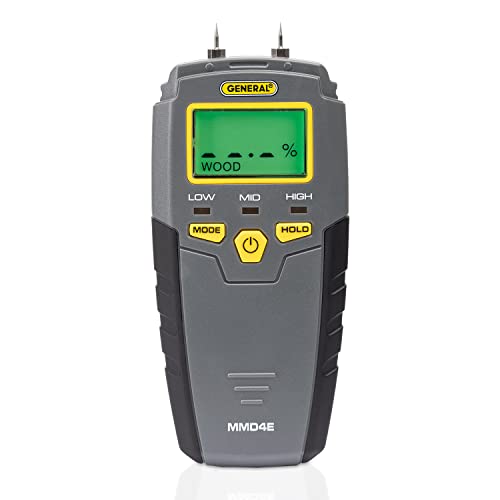 General Tools MMD4E | Best-selling pin meter for drywall/wood. | Amazon — $39.98 |
 Lignomat Mini-Ligno | Trusted by woodworkers; species-calibrated. | Amazon — $83.20 |