Moisture Meter Wood: What Homeowners Need to Know
Using a moisture meter on wood sounds straightforward until the practical questions appear: what reading is too high for hardwood flooring, how do moisture meter wood readings vary by species, when does pin testing matter more than pinless, and what is equilibrium moisture content actually compensating for. This guide answers each of those questions with the threshold numbers wood-flooring contractors, framers, and home inspectors work to, plus the species-correction logic that distinguishes professional readings from rough guesses. Our home inspection tools pillar covers how moisture meters fit alongside thermal imaging and hygrometers in a full inspection toolkit.
Part of our Moisture Meters & Water Damage Detection guide — start there for the full picture →
Why wood moisture content matters
Wood is hygroscopic: it exchanges moisture with the surrounding air until it reaches equilibrium with that air’s temperature and relative humidity. The equilibrium moisture content (EMC) for indoor conditioned space typically falls between 6 and 12 percent depending on climate and HVAC management. Wood installed at a moisture content well above its operating EMC will dry in service, shrink, and potentially cup or split. Wood installed below its operating EMC will absorb moisture, expand, and potentially buckle.
For finished installations (hardwood flooring, cabinetry, trim), the National Wood Flooring Association (NWFA) installation guidelines specify acceptable moisture content ranges and the difference between flooring and subfloor moisture content that should not be exceeded. For framing, the International Residential Code references moisture content thresholds for treated and untreated lumber.
Threshold numbers for hardwood floors
NWFA guidelines for solid hardwood flooring specify a target installed moisture content of 6 to 9 percent in most U.S. climates, with regional variations. Critically, the difference between the flooring moisture content and the subfloor moisture content should not exceed 2 percent for strip flooring under 3 inches wide and 4 percent for plank flooring 3 inches and wider. Exceeding these differences sets up the conditions for cupping (concave deformation) or crowning (convex deformation) after installation.
For prefinished engineered hardwood, manufacturer specifications govern. Typical engineered-wood ranges are 6 to 12 percent, with face-layer and core moisture treated as a single average reading. For installations over concrete subfloors, the concrete moisture is measured separately with a calcium-chloride test or relative-humidity probe rather than a wood moisture meter.
Threshold numbers for framing and lumber storage
Framing lumber kiln-dried to 19 percent moisture content or below is the standard surface-dry (S-DRY) grade; lumber dried to 15 percent or below is kiln-dried (KD) grade. The IRC specifies that wood members installed in dry-service conditions should not exceed 19 percent moisture content at the time of enclosure. Framing inspectors measure exposed wood members before drywall is installed; readings above 19 percent trigger drying time or, in some climates, drying assistance.
Lumber stored for cabinetry or interior trim use should equilibrate to the indoor EMC of the final installation environment before installation, typically 6 to 9 percent. Storing lumber in an unconditioned garage or workshop and then installing it into conditioned space produces dimensional change as the wood dries in service.
Pin meters vs. pinless meters on wood
Pin meters drive two small pins into the wood and measure electrical resistance between them. Lower resistance equals higher moisture content. Pin readings are point-specific: the meter measures the moisture content at the depth and location of the pin tips. Pin meters work well for confirming localized wet zones, comparing readings across small areas, and measuring through finish layers because the pins penetrate the finish to contact the wood substrate.
Pinless meters use dielectric (capacitance) sensing across a sensor pad to measure the average moisture content of the wood within the depth field (typically 3/4 inch). Pinless readings are area-averaged: a small wet pocket smaller than the pad reads diluted. Pinless meters are faster for scanning across large areas, non-destructive, and the right tool for surveying a floor or wall to find suspect areas to confirm with a pin meter. For a deeper comparison, our pinless wood moisture meter explainer covers the pad sensing in more detail.
Species-correction and EMC compensation
Different wood species have different densities, different cell-wall chemistry, and different electrical-resistance and dielectric-constant properties. A meter that reports a raw resistance or dielectric value gives a calibrated moisture-content number only when species correction is applied. Most professional meters include onboard species tables for major hardwoods (oak, maple, cherry, walnut, hickory) and softwoods (pine, fir, spruce, hemlock).
The wood-flooring industry uses the term EMC chart to refer to predictive tables of moisture content for wood species across temperature and relative humidity ranges. Wagner Meters publishes EMC charts; the U.S. Forest Service Forest Products Laboratory publishes the underlying Wood Handbook with EMC data for over 200 species. A meter that defaults to a generic “wood” species setting and is used on exotic hardwood may read several percentage points off the actual value.
Surface conditions that affect readings
Polyurethane, varnish, paint, and wax finishes affect pinless meter readings because the meter cannot distinguish the finish layer from the wood beneath. Pin meters bypass this issue because the pins penetrate the finish to contact the wood. For finished floors, pin meters are the more accurate tool; for unfinished subfloors and lumber, pinless meters are faster and non-destructive.
Engineered wood and laminate flooring present a different challenge: the metallic-content adhesives in some engineered-wood backing layers skew dielectric readings, and the layered construction (face veneer plus core) makes a single moisture-content number physically ambiguous. Manufacturer specifications govern measurement methodology for engineered products.
Common wood-meter mistakes
Five mistakes account for most reading errors. First, failing to select the correct species in the meter firmware. A reading taken with “Douglas Fir” selected on an oak floor reads several percentage points off. Second, reading through a finish layer with a pinless meter and reporting the result as if it were a pin reading. Third, taking a single reading and treating it as definitive; professional practice is multiple readings across an area, with the lowest and highest noted. Fourth, taking pin readings near nails or screws, which short the resistance measurement. Fifth, measuring cold wood right after it has come indoors from outdoor storage; temperature affects both electrical resistance and dielectric constant.
For background on the full how-to, our how to use a moisture meter walks through the workflow in step-by-step detail.
Application-specific wood meter use
Three common applications drive most homeowner and contractor wood-meter purchases. The first is pre-installation hardwood flooring acclimation. Boards are delivered, stickered (stacked with spacers for airflow), and measured daily until they stabilize at the target moisture content for the installation environment. The second is post-flood drying verification. After water-damage restoration, wood subfloor, framing, and bottom plates are measured to confirm drying to a target before reconstruction proceeds.
The third is lumber selection for cabinetry, trim, or hardwood projects. Lumber purchased from a yard is checked at delivery and again during acclimation in the workshop. A homeowner buying $2,000 of cherry boards for a built-in is well served by a $100 meter that prevents a $2,000 mistake.
Care, calibration, and sourcing
Care items extend service life. Replace pin meter pins when they bend or corrode; bent pins skew readings. Keep pinless meter sensor pads clean and free of pencil marks, paint, or adhesive residue. Replace batteries promptly when low; a partially discharged battery introduces noise. Some professional meters (Wagner Orion, Lignomat) offer factory recalibration; consumer-grade meters typically do not.
Sourcing matters for warranty support. Authorized-dealer purchases support warranty claims and factory recalibration; gray-market and counterfeit units do not. Authorized retailers for major brands include direct manufacturer stores, woodworking specialty retailers, and home inspector supply houses.
EMC and the regional climate variation
Equilibrium moisture content varies significantly by climate region. The U.S. Forest Service Forest Products Laboratory Wood Handbook publishes EMC tables showing the predicted moisture content of wood across temperature and relative-humidity combinations. The implications for hardwood floor installation are direct: a Colorado Front Range home in winter (35 percent indoor RH at 70 F) has a target wood EMC of roughly 7 percent, while a Florida coastal home (60 percent indoor RH at 75 F) has a target closer to 11 percent. The same flooring boards installed in these two climates need different starting moisture content to perform correctly in service.
Wagner Meters and other professional meter manufacturers publish EMC reference charts that the installer uses to set acclimation targets. The chart is the link between the installer’s local climate, the species being installed, and the right moisture content for stable installation. Inspectors evaluating a hardwood floor failure often start with the EMC question: were the boards acclimated to the right target for this climate?
Concrete subfloor moisture and why a wood meter does not apply
Concrete subfloors require a separate measurement protocol. ASTM F2170 prescribes the use of in-situ relative-humidity probes inserted into drilled holes in the slab, with readings taken after a 72-hour equilibration period. ASTM F1869 prescribes the calcium-chloride test, which measures moisture vapor emission rate over a 60-to-72-hour period. Both methods are dedicated to concrete and produce results expressed in percent relative humidity (F2170) or pounds per 1,000 square feet per 24 hours (F1869).
A wood moisture meter pressed against a concrete subfloor produces a reading that does not translate to either of these standard methods. The reading reflects the dielectric properties of the concrete-and-moisture combination at the surface, not the conditions deeper in the slab that matter for flooring installation. Wood meter readings on concrete are sometimes used as quick survey indicators but should not substitute for ASTM-compliant testing before flooring installation.
Documenting acclimation for warranty defense
Hardwood flooring manufacturers commonly require installation conditions to fall within published ranges as a condition of warranty coverage. Failed warranty claims often hinge on whether the installer can document that acclimation, moisture-content checks, and installation conditions met the manufacturer’s specifications. A daily log of meter readings during acclimation, with species setting, location, and value recorded, provides this defense.
Manufacturer warranty disputes that go to mediation or litigation rely heavily on documentation contemporaneous to the installation. A reconstructed record assembled after a claim emerges has less evidentiary weight than a log built during the work. For professional installers, this documentation discipline is a routine part of project completion; for homeowners installing their own flooring, the same discipline protects the warranty on the materials.
Reclaimed and salvaged lumber considerations
Reclaimed and salvaged lumber present moisture-measurement challenges that fresh lumber does not. The wood may have been exposed to a wide range of moisture histories, may contain hardware fragments that disrupt pin or pinless readings, and may have density variations across the same board. The species correction in the meter firmware assumes uniform wood; reclaimed material may include species the firmware does not list.
For reclaimed-wood projects, professional practice is to take many readings across each board and across many boards in a lot, treating outliers cautiously and accepting that absolute moisture-content accuracy is harder to achieve. The acclimation principle still applies (let the material equilibrate to the installation environment), but the meter reading is one input rather than the definitive answer.
More Questions About Wood Moisture Meters
What moisture content should deck boards have before staining?
Deck boards are generally ready for stain when they read around 15 percent moisture content or less, though stain manufacturers set their own limits, so check the product label. New pressure-treated lumber often reads much wetter at purchase and may need weeks or a few months of drying before staining. Take readings on several boards in both sunny and shaded areas. Staining wet wood can trap moisture and cause peeling or poor penetration.
Can a wood moisture meter detect rot?
A wood moisture meter cannot detect rot directly, but it identifies the wet conditions that cause rot. Wood decay fungi generally need wood moisture content above roughly 20 percent for extended periods. High readings on sills, rim joists, deck posts or window frames point to areas to probe with an awl or screwdriver; soft, crumbly wood indicates decay. Fixing the moisture source and replacing rotted wood are usually needed, and a contractor should assess structural members.
How long should hardwood flooring acclimate before installation?
Hardwood flooring acclimation time varies, but many manufacturers call for several days in the room where it will be installed, with heating or cooling running at normal living conditions. Rather than counting days, the better standard is moisture content: flooring is ready when its readings stabilize and fall within the manufacturer’s allowed difference from the subfloor. Some engineered flooring needs little or no acclimation. Follow the specific manufacturer’s instructions, since warranties depend on them.
Does a wood moisture meter work on painted or finished wood?
A wood moisture meter can read painted or finished wood, but finishes affect results. Pin meters push through thin finishes and read the wood below, leaving small holes. Pinless meters read through finishes, though thick coatings, metallic paints and surface moisture can skew readings. For finished furniture or flooring, compare readings with an unfinished area or the underside of the piece. Wipe off any surface moisture or condensation before testing.
References
- InterNACHI Moisture Meters for Inspectors — International Association of Certified Home Inspectors
- ASHI Home Inspector Standards — American Society of Home Inspectors
- EPA Mold Cleanup (moisture content context) — U.S. Environmental Protection Agency
Frequently asked questions
What moisture meter reading is too high for hardwood flooring?
NWFA guidelines target 6 to 9 percent moisture content for installed solid hardwood, with the flooring-to-subfloor difference limited to 2 percent for narrow strip and 4 percent for wider plank. Exceeding these triggers cupping or crowning after installation.
Should I use a pin or pinless meter on wood?
Both have roles. Pinless meters are faster for scanning large areas non-destructively. Pin meters are point-specific and read through finishes. Professional practice often uses pinless for survey scanning and pin for confirming localized wet zones.
What is equilibrium moisture content (EMC)?
The moisture content wood reaches when in equilibrium with surrounding air at a given temperature and humidity. Indoor conditioned space typically has an EMC between 6 and 12 percent depending on climate and HVAC management. Wood installed off-EMC changes dimension in service.
Why do I need to select the wood species in the meter?
Different species have different densities and electrical-resistance properties. A reading taken with the wrong species selected can be off by several percentage points. Professional meters include onboard species tables for major hardwoods and softwoods.
What is the moisture content of kiln-dried wood?
Kiln-dried wood for furniture and flooring is typically dried to about 6 to 9 percent moisture content, while kiln-dried framing lumber is commonly dried to 19 percent or less. Moisture content changes after drying as the wood adjusts to surrounding humidity.
Can a wood moisture meter test logs or green timber?
A wood moisture meter can test green timber, but readings above roughly 30 percent are less reliable because they exceed the fiber saturation point. Most meters lose accuracy at very high moisture content. Readings still show drying progress over time.
Do wood moisture meters work on treated lumber?
Wood moisture meters work on treated lumber, but preservatives can make pin meters read higher than the true moisture content. Use the readings to track drying trends, and wait until readings stabilize before staining or sealing treated lumber.
Moisture meters for home inspection
Pin meters read deep but leave marks; pinless meters scan surfaces non-destructively. Many inspectors carry both.
| Product | Why | Buy |
|---|---|---|
 Klein Tools ET140 Pinless | Non-destructive scanning; affordable. | Amazon — $49.22 |
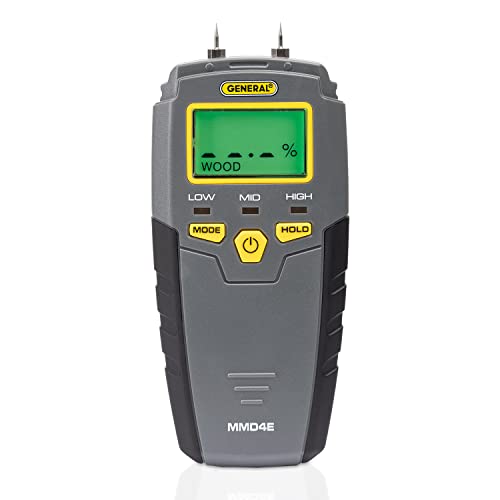 General Tools MMD4E | Best-selling pin meter for drywall/wood. | Amazon — $39.98 |
 Lignomat Mini-Ligno | Trusted by woodworkers; species-calibrated. | Amazon — $83.20 |