How Much Is an Infrared Camera? Price Tiers Explained
“How much is an infrared camera” is a budgeting question, and the honest answer requires breaking the market into four price tiers. A $250 smartphone attachment and a $40,000 commercial inspection camera are both infrared cameras, but they serve completely different jobs. This guide walks through the four tiers, what each one can actually do, and which tier matches which use case. We rely on U.S. Department of Energy and InterNACHI references rather than manufacturer marketing pages because the goal is buying clarity rather than brand promotion.
Part of our Thermal Imaging for Homes guide — start there for the full picture →
How much does an infrared camera cost in 2026?
The short answer: anywhere from $200 to $50,000+, depending on what the camera needs to do. The market breaks into four discrete tiers. Consumer smartphone attachments sit at $200 to $500. Mid-tier handhelds (entry standalone and lower pro models) run $500 to $2,000. Pro inspection handhelds cost $2,000 to $10,000. Commercial and research-grade systems start at $5,000 and climb past $50,000. Buyers should match the tier to the job, not the other way around. For the broader toolkit picture, see our home inspection tools guide.
What does $200-500 buy?
This tier is dominated by smartphone attachments. Seek CompactPRO, FLIR ONE Pro, Hikmicro Mini2, and a handful of newer entrants all sit here. Specs typically include detector resolutions from 160×120 to 256×192, NETD around 70 to 100 mK, and 9 Hz frame rate to stay below U.S. export controls. The camera connects to a phone via Lightning or USB-C and uses the phone for display and storage. Battery life is essentially the phone’s battery life.
Use cases that fit this tier: residential drafts and insulation gaps, basic electrical scan of a panel, HVAC airflow diagnostics. The image quality is enough for diagnosis but not enough for paid professional documentation. The U.S. Department of Energy notes infrared thermography is most useful when interpreted by someone who understands the building envelope; the smartphone tier serves the diagnostic-and-curiosity market well.
What does $500-2,000 buy?
Entry standalone handhelds and the lower end of the pro-handheld category live here. Detector resolutions of 206×156 to 320×240 are common; built-in displays add 2 to 3 inches of screen real estate; batteries last 3 to 6 hours of continuous use. Software ecosystems start mattering — Fluke’s SmartView, FLIR’s Thermal Studio, Hikmicro’s Analyzer all appear at this tier.
Use cases that fit: light professional inspection work, energy assessment as a recurring service, HVAC technician daily use, electrical predictive maintenance. The tier is also the sweet spot for serious DIY homeowners who plan to do annual energy audits.
What does $2,000-10,000 buy?
Mid-tier and upper-tier pro handhelds. Detector resolution of 320×240 is standard at the bottom of the band; 384×288 and 640×480 appear at the top. Autofocus, optical viewfinders, interchangeable lenses, GPS tagging, voice memos, and laser distance measurement become standard features. NETD drops to 50 mK or below on inspection-grade units.
Use cases that fit: full-time home inspection businesses, energy auditing companies, electrical contractors doing predictive maintenance, commercial HVAC service teams. InterNACHI’s infrared-certified inspector standards reference this tier as appropriate for professional report generation.
What does $5,000-50,000+ buy?
Commercial, industrial, and research-grade infrared systems. Detector resolutions of 640×480 are baseline; 1280×1024 appears at the top end. Cooled MWIR detectors (which require liquid nitrogen or Stirling-cycle cooling) start showing up. Specialized lenses for telephoto and microscope work add four-figure costs. Software suites support scientific analysis, time-lapse capture, and integration with building automation.
Use cases that fit: aerospace inspection, electrical substation maintenance, gas leak detection (optical gas imaging), research and development laboratories, military and security applications. Residential and small-commercial buyers should not need to consider this tier.
What about thermal drones?
A thermal-equipped drone is its own category. DJI Mavic 3 Thermal, Autel EVO Max 4T, and similar enterprise drones combine a thermal camera (typically 640×512) with a flight platform and a separate visual camera. Prices range from $5,000 to $20,000+. Use cases include roof surveys on commercial buildings, agricultural monitoring, search-and-rescue, and solar panel inspection. For residential inspectors, a thermal drone is rarely a first purchase.
How much does rental cost?
Rental is the budget-friendly path for one-off use. Home Depot Tool Rental, Sunbelt, United Rentals, and local tool houses stock 320×240 handhelds at $50 to $150 per day and $200 to $450 per week. Monthly rentals run $700 to $1,200. The break-even point against purchase of an entry-tier handheld is roughly four to six rentals.
What hidden costs come with ownership?
The sticker price is not the only cost. Calibration cycles run $300 to $600 every two to three years for inspection-grade units. Software subscriptions are sometimes optional (Fluke SmartView is free; FLIR Thermal Studio has paid tiers). Carrying cases, extra batteries, and tripod adapters add a few hundred dollars to the initial setup. Training to use the camera effectively — InterNACHI’s IR-certification courses, for example — adds another $500 to $1,500.
The Department of Energy’s residential energy assessment guidance treats infrared imaging as one tool in a broader audit kit, alongside blower-door equipment, duct-leakage testing, and combustion analysis. Buyers should plan for the full kit, not just the camera.
How do you choose the right tier?
Start with the job description and work backward. A homeowner answering one question about a cold bedroom buys at the $250 tier or rents at $75 per day. A part-time inspector adding thermal services buys at the $1,500 to $3,500 tier. A full-time inspector or energy auditor buys at the $4,000 to $8,000 tier. A commercial energy services firm or industrial contractor buys at the $10,000+ tier. Brand selection is secondary; the tier is the load-bearing decision.
When does buying beat renting?
Around the fourth to sixth rental, ownership becomes cheaper. For homeowners that means roughly two years of seasonal energy checks. For inspectors, the camera typically pays for itself in the first year through new thermal-included inspection revenue. ASHRAE’s building commissioning guidance contextualizes how thermal imaging fits into broader diagnostic workflows.
What price drops should buyers expect over time?
Detector manufacturing yields improve slowly, which means each price tier delivers more pixels every few years. Consumer-tier resolutions have shifted from 80×60 (2014) to 206×156 (2020) to 256×192 (2024) at roughly the same retail price points. Pro-tier resolutions have shifted from 320×240 to 640×480 as the default mid-range over the same period. The 2026 buyer can expect roughly the same nominal price five years from now but with one resolution tier of additional capability included.
This timing suggests two buying patterns. Buyers with a current need should not delay; the savings from waiting are modest and the deferred work has its own cost. Buyers without a current need should defer; the same money buys more capability in 2028 than 2026. For broader context on the toolkit decision, see the what is a thermal camera primer.
How do refurbished and used markets affect pricing?
A reasonable secondary market exists for pro-handhelds. Three to five year old units typically sell for 40 to 60 percent of original retail. The market is thinner for consumer attachments because their resale value is low relative to a new replacement; most homeowners simply replace rather than resell.
Refurbished units sold directly by manufacturers carry partial warranties (typically 90 days to one year) and are priced at 70 to 85 percent of new retail. This is the most common discount path for budget-conscious professional buyers. Independent eBay and dealer listings can offer steeper discounts but require careful inspection — verify recent calibration, check the detector for stuck pixels, and confirm battery health.
What does the total cost of ownership look like?
Sticker price plus first-year costs typically run 30 to 50 percent above the sticker. For a $3,500 mid-tier camera, expect roughly $800 to $1,500 in first-year ancillary costs: case ($150), spare battery ($200), tripod ($200), emissivity tape ($30), IR-certification training ($500-1,500). Years 2 through 5 typically add $100 to $300 per year in calibration and consumables.
For a $250 consumer attachment, first-year ancillary costs are minimal — perhaps $30 to $50 for emissivity tape and a phone case adapter. The lower-tier cameras carry lower total cost of ownership but also produce less professional output.
What insurance and licensing considerations apply?
Inspectors using thermal imaging as a paid service typically extend their E&O insurance to cover thermal-related liability. This adds modest premium — typically $100 to $300 per year for residential inspectors. Some state inspector licensing rules require disclosure that thermal imaging is an adjunct technology rather than a substitute for visual inspection; InterNACHI’s standards of practice document supports this framing.
For homeowners, no licensing or insurance changes apply to personal use. The cameras are unregulated consumer electronics in residential contexts.
How does pricing compare internationally?
U.S. pricing is generally competitive globally for consumer and entry pro tiers. The U.S. export control regime affects shipment of pro-tier cameras to non-U.S. buyers, which raises foreign pricing for the same equipment. Buyers traveling internationally with their cameras should be aware that customs declarations are required for valuable imaging equipment in some jurisdictions.
European and Asian buyers typically pay 15 to 30 percent more for the same pro-tier U.S. brands due to import tariffs, distributor margins, and VAT. Chinese-brand cameras (Hikmicro, others) are typically priced 10 to 25 percent below U.S. brands worldwide due to direct-from-manufacturer distribution.
How to think about the price-versus-value trade-off
The wrong question is “what does an infrared camera cost.” The right question is “what does the work require, and what is the lowest tier that delivers that work?” A $250 attachment that solves one homeowner question is excellent value. A $40,000 commercial camera that supports a high-revenue inspection business is also excellent value. A $3,500 mid-tier camera bought without a clear use case is poor value because it sits unused.
The Department of Energy’s professional energy assessment guidance contextualizes thermal cameras as one component of a complete diagnostic workflow. Buying the camera in isolation without the supporting tools, training, or job pipeline produces no value. Buying the camera as part of a planned workflow produces strong value across every tier of the market.
What does the resolution-versus-NETD trade-off look like?
Two specs drive image quality: detector resolution (pixel count) and NETD (smallest temperature difference the detector can resolve). Buyers often focus on resolution because the number is easy to compare, but NETD matters at least as much. A 320×240 camera with 50 mK NETD produces clearer building-envelope imagery than a 640×480 camera with 100 mK NETD because the subtle temperature gradients of insulation gaps are within the lower-NETD camera’s sensitivity range.
For typical residential work, prioritize NETD below 70 mK at any given resolution tier. Most pro-handhelds in the $2,500 to $5,000 range achieve 50 mK NETD with 320×240 resolution; this combination is the practical sweet spot for residential inspection.
How does the lens choice affect price and capability?
The fixed lens included with most pro-handhelds offers a 24-degree to 45-degree horizontal field of view. Optional interchangeable lenses extend capability but at $1,000 to $3,000 per lens. A wide-angle lens (55 degrees and above) helps in tight spaces like utility closets and crawl spaces. A telephoto lens (15 degrees and below) helps when measuring distant subjects like rooftop equipment or distribution transformers.
Most residential inspectors stay with the included fixed lens for the first 1 to 2 years and add a specialty lens only when specific job requirements justify the cost. Buyers should resist purchasing optional lenses “for someday” — utilization rates on rarely-used optional lenses are low, and the money sits in the camera bag rather than producing revenue.
More Questions About Infrared Camera Prices
Can an infrared camera see through walls?
No, an infrared camera cannot see through walls. An infrared camera measures heat on the surface it is pointed at, so it only shows patterns on the wall surface that can hint at conditions behind it, such as missing insulation, framing, moisture or warm pipes. Wet areas often appear cooler because of evaporation. Any anomaly should be confirmed with a moisture meter or by a qualified professional. A higher-priced camera produces clearer, more detailed surface images but does not change this basic physics.
Is a smartphone infrared camera accurate enough for home checks?
A smartphone infrared camera attachment is accurate enough for most basic home checks, such as finding drafts, missing insulation, hot outlets and obvious water leaks. Its lower resolution and limited temperature accuracy make it less suitable for professional reports or measurements from a distance. Results depend heavily on technique, including scanning when there is a meaningful temperature difference and avoiding reflective surfaces. For occasional homeowner use, an attachment is often the best value; for repeated paid work, a standalone camera is more practical.
Can an infrared camera detect mold?
No, an infrared camera cannot detect mold itself. It detects temperature differences, and moisture that allows mold to grow often shows up as a cooler area. That makes an infrared camera useful for spotting leaks, condensation and damp insulation where mold may be present. Confirming moisture requires a moisture meter, and confirming mold requires a visual inspection or sampling by a qualified professional. Homeowners concerned about mold-related health symptoms should consult a doctor.
How much does an infrared home inspection cost?
An infrared home inspection typically costs $200 to $500 as a standalone service, or $75 to $200 when added to a general home inspection. Some inspectors include a basic infrared scan in their standard fee. The service usually includes thermal images of anomalies, matching visible photos and recommendations for follow-up. For homeowners with one specific concern, such as a suspected leak or cold room, hiring a professional scan can cost less than buying a camera.
References
- ENERGY STAR: Seal and Insulate — U.S. Environmental Protection Agency (ENERGY STAR)
- Infrared-Certified Inspector Training — InterNACHI
- ASHRAE Standards and Guidelines — ASHRAE
Frequently asked questions
How much is the cheapest infrared camera worth buying?
Smartphone attachments start around $250 and run to $700. The Seek CompactPRO, FLIR ONE Pro, and Hikmicro Mini2 are the most common entry products. They produce diagnostic-quality images good enough to find drafts and insulation gaps, though not professional-report quality.
What does a home inspector typically spend on an infrared camera?
Most working home inspectors buy in the $2,000 to $5,000 range, landing on a 320x240 standalone handheld with reporting software. Inspectors doing commercial work or premium thermal-included inspections often step up to 640x480 units in the $7,000 to $15,000 range.
Why are infrared cameras so expensive?
The detector is the cost driver. Uncooled microbolometer arrays have low manufacturing yields, particularly at higher pixel counts. Each step up in resolution roughly doubles or triples the price. Software, optics, and ruggedization add the remainder.
Is renting an infrared camera a good idea?
For one-off use, yes. Tool rental houses charge $50 to $150 per day and $200 to $450 per week for 320x240 handhelds. Purchase becomes more economical at roughly the fourth to sixth rental, depending on the tier you would otherwise buy.
Do infrared cameras need certification to use?
Infrared cameras do not require certification for personal use. Professionals who sell thermography services often complete Level 1 or Level 2 thermography training, which helps with accurate interpretation. Some inspection associations and insurers expect documented training before thermal findings are included in client reports.
How long does an infrared camera battery last?
Infrared camera batteries typically last two to five hours of continuous use, depending on screen brightness, Wi-Fi use and temperature. Phone-based attachments may run shorter and drain the phone's battery. Cold weather shortens battery life, so a spare battery helps on long exterior scans.
Is an infrared camera the same as a thermal camera?
An infrared camera and a thermal camera are generally the same thing in home inspection use. Both detect infrared radiation to show surface temperature differences. Night-vision cameras that use near-infrared light are different and cannot measure temperature.
Thermal imaging cameras
Infrared cameras reveal hidden moisture, missing insulation, and air leaks. Phone-attachment models are the budget entry point; standalone units have higher resolution.
| Product | Why | Buy |
|---|---|---|
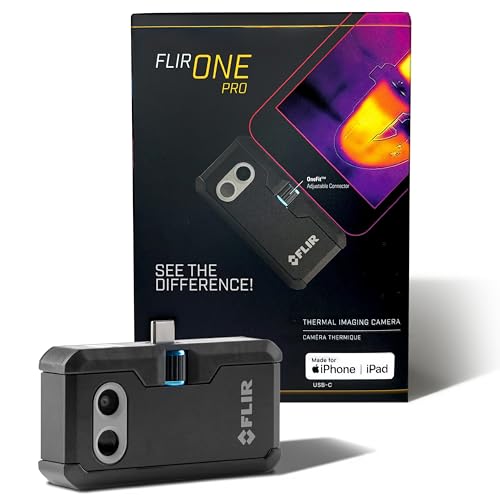 FLIR ONE Pro (phone) | Plugs into iPhone/Android; inspector favorite. | Amazon — $296.65 |
 Topdon TC001 | High-res phone module at a low price. | Amazon — $249.00 |
 FLIR C5 Compact | Standalone pocket camera with Wi-Fi. | Amazon — $593.99 |