Best Infrared Camera in 2026: A Homeowner Buyer Guide
Buying a first infrared camera is mostly about avoiding two mistakes: paying for a big “super resolution” number that is really image processing, and buying a camera whose form factor does not match how it will be used. For most homeowners, the best infrared camera is the one that will actually come out of the drawer when a room feels drafty, a ceiling stain appears or an outlet feels warm. This guide is written for that first purchase. It picks six cameras from current listings, each suited to a different kind of first-time buyer, and then walks through the specs and habits that make a beginner’s scans useful.
Part of our Thermal Imaging for Homes guide — start there for the full picture →
As an Amazon Associate we earn from qualifying purchases.
How we compared: we compared 22 current Amazon infrared camera listings (12 standalone handhelds and 10 phone plug-ins) on what each listing states: native detector resolution, sensitivity, temperature range, phone compatibility, ease-of-use features, battery life and warranty. We did not lab-test or handle any of these cameras. Prices and availability change, so check the current listing before buying.
Quick picks: the best infrared camera for a first-time buyer
| Product | Best for | Key features | Price | Buy |
|---|---|---|---|---|
| TOPDON TC001 Max | Most homeowners |
| $249.00as of Nov 25, 2026 2:58 pm GMT+0000 | Buy now →Check current price |
| TOPDON TC004 Mini | Simple standalone camera |
| $149.99as of Nov 25, 2026 8:43 am GMT+0000 | Buy now →Check current price |
| HSFTOOLS HP96 | Phone-style touchscreen handheld |
| $179.99as of Nov 25, 2026 2:02 am GMT+0000 | Buy now →Check current price |
| FLIR One Pro (USB-C) | Brand-name iPhone option |
| $296.65as of Nov 24, 2026 7:58 pm GMT+0000 | Buy now →Check current price |
| Thermal Master P1 | Pocket plug-in, no account needed |
| $103.20as of Nov 25, 2026 8:43 am GMT+0000 | Buy now →Check current price |
| TOPDON TC001 Mini | Help reading the images |
| $115.89as of Nov 25, 2026 6:14 am GMT+0000 | Buy now →Check current price |
Prices are Amazon’s listed prices as of the time shown and change often; check Amazon for today’s price. As an Amazon Associate we earn from qualifying purchases.
The six picks, compared listing by listing
1. TOPDON TC001 Max — Best First Infrared Camera for Most Homeowners

Dual-lens phone plug-in: 256×192 native thermal detector plus a visible camera, ≤40 mK, −4 to 1022 °F, 33 g.
Check price on Amazon$249.00 as of Nov 25, 2026 2:58 pm GMT+0000 — prices change; see Amazon for current price.| Specification | Details |
|---|---|
| Detector | 256×192 native; TISR to 512×384; 25 Hz; 40 mK or better |
| Lenses | Thermal plus visible-light camera for sharper outlines |
| Compatibility | Android, iPhone and Windows; listing describes USB-C and Lightning adapters; works through most phone cases |
| Measurement | −20 °C to 550 °C (−4 °F to 1022 °F), ±2 °C or ±2% |
| Apps | TopInfrared and TopView: photo, video, 3D temperature views, live graphs |
| Size / power | 7.1 × 4.2 cm, 33 g; no battery or charging needed |
TOPDON TC001 Max — 256×192 native / 512×384, dual lens, ≤40 mK, ±2 °C, iOS/Android/Windows, 33 g
The Only Plug-In Pairing a Native 256×192 Detector With a Visible-Light Lens
Ten of the 22 listings are phone plug-ins, and only two state a native 256×192 detector, the highest native figure on the shelf. This TC001 Max is the only one of those two that also describes a visible-light camera. Blending the two images makes it much easier for a first-time user to tell which stud bay, outlet or ceiling joist a hot or cold area belongs to, the most common point of confusion for beginners.
It is also one of only two listings that mention Lightning-port iPhones. The Thermal Master P1 (320×240 version) says a Lightning adapter is sold separately; the TC001 Max describes USB-C and Lightning adapters as part of its plug-and-play setup. Households with a mix of older and newer phones should confirm exactly what ships in the box.
A phone attachment depends on the phone for screen and power, and the listing states no drop or water rating. For a first camera, though, it puts top-of-shelf detector pixels in a 33 g accessory.
Pros
- Highest native resolution among plug-ins (tied)
- Visible lens helps beginners locate anomalies
- Wide device compatibility per listing
- No battery to charge
Cons
- Uses the phone’s battery and screen
- No durability rating stated
- Adapter contents should be confirmed
Check TOPDON TC001 Max price on Amazon
2. TOPDON TC004 Mini — Best Simple Standalone Starter Camera

Pocket handheld with 128×128 native (240×240 TISR) detector, auto photo on alarm, 15-hour battery, IP54 and 2 m drop.
Check price on Amazon$149.99 as of Nov 25, 2026 8:43 am GMT+0000 — prices change; see Amazon for current price.| Specification | Details |
|---|---|
| Detector | 128×128 native; TISR to 240×240; 25 Hz; 40° × 30° field of view |
| Measurement | −4 °F to 842 °F, ±3.6 °F or 2%; automatic hottest, coldest and center readings |
| Alerts / capture | On-screen warning above a preset level, with automatic photo capture; manual photos |
| Storage | 512 MB, up to 8,000 photos |
| Battery / build | Up to 15 hours; auto-off at 5, 10 or 20 minutes; IP54; 2 m drop |
| Support | Lifetime technical support; electronic manual only; charging cable but no wall adapter |
TOPDON TC004 Mini — 128×128 native / 240×240, 40°×30° FOV, auto photo on alarm, 15 h, IP54, 2 m drop
The Only Listing That Automatically Takes a Photo When an Alarm Trips
Fourteen listings on the shelf mention high or low temperature alarms. The TC004 Mini is the only one that says it saves a photo automatically when the alarm fires. For a beginner sweeping a room, that means the evidence is recorded even if the user is looking at the wall rather than the screen.
It also states the longest battery life of the handhelds on this shelf except the AMPBANK H128, at 15 hours, and the narrowest stated field of view (40° × 30°), which concentrates its 128×128 pixels on whatever is directly in front of it. Simple button controls and five palettes keep the learning curve short.
Limits: 128×128 is entry-level detail, 512 MB of storage is small, and the listing states no thermal sensitivity figure or wireless transfer.
Pros
- Auto photo capture on alarm, unique on the shelf
- 15-hour battery
- IP54 and 2 m drop rating
- No phone needed
Cons
- Entry-level 128×128 native detector
- Only 512 MB storage
- No sensitivity figure or wireless transfer
Check TOPDON TC004 Mini price on Amazon
3. HSFTOOLS HP96 — Best Touchscreen Handheld for Guided Leak and Insulation Checks
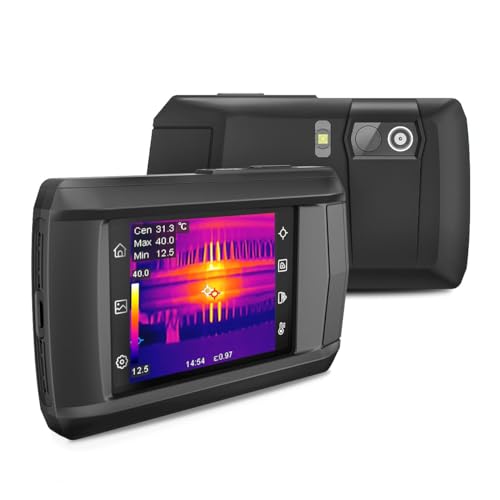
Touchscreen handheld: 96×96 VOx detector (240×240 live), 640×480 visible camera, leak and insulation scene AI.
Check price on Amazon$179.99 as of Nov 25, 2026 2:02 am GMT+0000 — prices change; see Amazon for current price.| Specification | Details |
|---|---|
| Detector | 96×96 VOx; live super resolution to 240×240; 25 Hz; under 50 mK |
| Cameras / modes | 640×480 visible camera; Thermal, Visual, Fusion, PIP and Blending views; 8 palettes |
| Interface | 3.5-inch touchscreen with phone-style controls; LED flashlight; microphones for audio with video |
| Smart features | IntellFault scene detection for water leaks and insulation gaps (firmware update); no moisture readings |
| Measurement | ±2%; adjustable emissivity and distance; alarms |
| Storage / battery / build | About 30,000 images or 20 hours of video; up to 4 hours; IP54; 6.6 ft drop; tripod hole |
HSFTOOLS HP96 — 96×96 VOx / 240×240, <50 mK, touchscreen, 640×480 visible, 5 view modes, leak/insulation AI, 4 h
The Only Touchscreen Camera on the Shelf
Every other handheld on this shelf uses buttons. The HP96 is the only listing with a touchscreen, and it describes phone-style swipes for brightness, palettes and temperature range. For buyers who find menu buttons frustrating, that alone can decide whether a camera gets used.
It is also the only listing that names a VOx detector and one of two handhelds that state a visible-camera resolution (640×480). Its IntellFault feature is one of three on the shelf that flag or explain likely problems, aimed specifically at leaks and insulation gaps. The listing is unusually candid that the camera takes no moisture readings.
The weak points are a small 96×96 native detector, the lowest stated battery life of any handheld here (4 hours), and a smart-detection feature that requires a firmware download.
Pros
- Only touchscreen interface on the shelf
- Visible camera with five blending views
- Leak and insulation scene detection
- Large image and video storage
Cons
- 96×96 native detector
- 4-hour battery, shortest stated
- Smart feature needs a firmware update
Check HSFTOOLS HP96 price on Amazon
4. FLIR One Pro (USB-C) — Best Brand-Name Choice for iPhone Owners
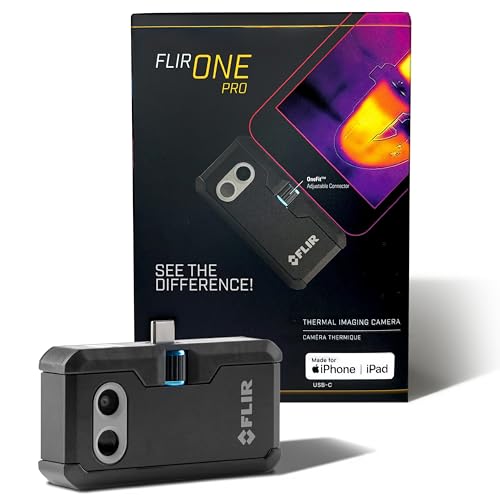
FLIR plug-in for USB-C iPhones: 160×120 native upscaled to 480×360, MSX, inspection guides, 2-10 warranty.
Check price on Amazon$296.65 as of Nov 24, 2026 7:58 pm GMT+0000 — prices change; see Amazon for current price.| Specification | Details |
|---|---|
| Detector | 160×120 native; Vivid IR upscales to 480×360 |
| Compatibility | USB-C iPhones (iPhone 15 and newer) |
| Image blending | MSX merges thermal and visual detail in real time |
| Guidance | Step-by-step inspection guides in the FLIR One app for air leaks, moisture and more |
| Accuracy / durability | ±3 °C or ±5% within stated conditions; rated for a 1.5 m drop |
| Warranty | 2 years parts and labor; 10 years on the detector |
FLIR One Pro — 160×120 native / 480×360, MSX, USB-C iPhone, inspection guides, 1.5 m drop, 2-10 warranty
The Longest Stated Warranty Coverage on the Shelf, Shared Only With the Base FLIR One
Eight listings on this shelf state a warranty term, and six of them state one or two years. The two FLIR One listings carry FLIR’s 2-10 warranty, with 10 years on the detector, by far the longest coverage here. For a first purchase that may sit unused for months and then get pressed into service, that is reassuring.
It is also one of three listings that build inspection guides into the app, which suits someone learning what a missing-insulation pattern or wet ceiling looks like. Compared with the base FLIR One, it has four times the native pixels (160×120 against 80×60).
Against other brands, 160×120 native is mid-pack: the TC001 Max above has 256×192. The listing names only USB-C iPhones, so Android households should choose another camera.
Pros
- 10-year detector coverage
- In-app inspection guides for beginners
- Stated accuracy and drop rating
Cons
- Fewer native pixels than the TC001 Max
- Listing names USB-C iPhones only
- Temperature range not stated
Check FLIR One Pro (USB-C) price on Amazon
5. Thermal Master P1 — Best Pocket Plug-In With No Account Required

USB-C plug-in: 160×120 native (320×240 X³), 0.04 °C NETD, no-signup app, extension cable, 2-year warranty.
Check price on Amazon$103.20 as of Nov 25, 2026 8:43 am GMT+0000 — prices change; see Amazon for current price.| Specification | Details |
|---|---|
| Detector | 160×120 native; X³ enhancement to 320×240; 25 Hz; 0.04 °C sensitivity |
| Measurement | −4 °F to 1112 °F (−20 °C to 600 °C), ±2 °C; adjustable span; built-in calibration function |
| Compatibility | USB-C Android phones, USB-C iPhones, Android tablets and Windows; extended plug fits most cases |
| Accessories | 19-inch extension cable; protective carrying case |
| View / app | 52° × 39° field of view; 1–15x zoom; 7 palettes; app needs no sign-up |
| Build / warranty | IP54; 1 m drop; 2-year warranty; 5–8 hours at 0.32 W draw |
Thermal Master P1 — 160×120 native / 320×240, 0.04 °C, −4 to 1112 °F, IP54, extension cable, 2-yr warranty
The Only Listing That Says Up Front It Cannot See Through Walls
The first line of this listing is a correction most marketing skips: thermal cameras read surface heat, not what is behind a wall. It is the only listing on the shelf that says so. For a first-time buyer, that honesty sets the right expectations, and it matches how professionals use the tool.
It is also one of only two plug-ins with a stated IP54 rating (with the REVASRI), and one of two listings that say their app needs no registration. The 19-inch extension cable lets the camera reach under a sink or into a cabinet while the phone stays outside. Its stated 2-year warranty is longer than every non-FLIR listing that states a term except the RISION, which also states two years.
The native detector is 160×120, half the width of the TC001 Max’s in each direction, and the 1 m drop rating is modest.
Pros
- Clear, honest description of what thermal can and cannot do
- IP54 rating, rare among plug-ins
- No-signup app and extension cable
- 2-year warranty
Cons
- 160×120 native detector
- 1 m drop rating
- Relies on phone power and screen
Check Thermal Master P1 price on Amazon
6. TOPDON TC001 Mini — Best for Help Interpreting Thermal Images

30 g plug-in with 96×96 sensor processed to 384×384, ≤40 mK, isotherms, reports and TopFix AI plain-language tips.
Check price on Amazon$115.89 as of Nov 25, 2026 6:14 am GMT+0000 — prices change; see Amazon for current price.| Specification | Details |
|---|---|
| Detector | 96×96 native; TISR to 384×384; 25 Hz; 40 mK or better |
| Measurement | −4 °F to 1022 °F (−20 °C to 550 °C) |
| Interpretation help | TopFix AI gives plain-language explanations, possible causes and next steps; built-in inspection guides |
| Tools | Hot/cold spots, isotherms, custom points and areas, alarms, thermal reports |
| Compatibility | Compatible iOS, Android and Windows devices; TopView PC software |
| Size / power | 30 g; no battery or charging |
TOPDON TC001 Mini — 96×96 native / 384×384, ≤40 mK, TopFix AI explanations, isotherms, reports, 30 g
The Only Listing With AI That Explains Possible Causes in Plain Language
Three listings on the shelf describe software that helps find problems. The AccuMEMS GT16S draws boxes around suspect areas and the HP96 detects leak and insulation scenes; the TC001 Mini is the only one that describes explanations, possible causes and next steps in plain language. For someone who has never looked at a thermal image, a prompt such as “possible missing insulation, check the attic” is more useful than a rainbow palette.
It also has the largest gap between native and processed resolution on the shelf, four times in each dimension (96×96 to 384×384). That makes images look crisp, but the real detector is the smallest among the plug-ins picked here, so detail at distance is limited.
Like any automated interpretation, the AI suggestions are hypotheses to check, not findings. The listing states no accuracy figure or durability rating.
Pros
- Plain-language AI explanations and next steps
- Inspection guides and report generation
- 40 mK or better sensitivity
Cons
- Small 96×96 native detector
- Large upscaling can overstate image detail
- No accuracy or durability rating stated
Check TOPDON TC001 Mini price on Amazon
Three questions before choosing an infrared camera
Phone attachment or standalone?
Ten of the 22 listings plug into a phone. They are small, light and draw power from the phone, and two of them match the best handhelds for native pixels. Standalone handhelds add their own screen, battery and often ruggedness, which matters in attics, crawlspaces and cold garages. A homeowner who scans a few times a year is usually fine with a plug-in; one who expects to use it weekly, or hand it to family members, may prefer a handheld.
What will be scanned?
Drafts, insulation gaps and wet ceilings sit close to room temperature and need sensitivity and decent native resolution. Electrical panels and heating equipment need a higher temperature range. Most listings here cover −4 °F to at least 842 °F, more than enough for both.
How much help is wanted?
Beginners benefit from aids that tie a thermal image to the real world: visible-light blending (TC001 Max, HP96, FLIR One Pro), inspection guides (FLIR One Pro, TC001 Mini) or automatic flags and explanations (HP96, TC001 Mini). These matter more than a few extra pixels for a first camera.
The specs, in plain terms
- Native resolution is the real number of heat-sensing pixels. Phrases like TISR, X³, Vivid IR and “super resolution” describe processing that enlarges the picture. Compare native numbers: 96×96 and 128×128 are entry level, 160×120 is solid for close-range home use, and 256×192 is the top of this shelf.
- Thermal sensitivity (NETD), given in mK or °C, is the smallest temperature difference the camera can show. Listings here state 40 mK to 60 mK where they state it at all.
- Field of view decides how much wall fits in one frame. A narrower view (the TC004 Mini’s 40° × 30°) shows more detail on a smaller area.
- Emissivity adjustment corrects readings on different materials. Shiny metal and glass reflect heat and fool every camera; drywall, wood and painted surfaces read well.
For a side-by-side of how a spot thermometer differs from an imaging camera, see our guide on how to use an infrared thermometer, and for more models across budgets, browse the thermal camera shop.
A first scan, step by step
- Pick the right day. Insulation and air leaks show best when it is much colder outside than inside, such as a Front Range winter morning. Moisture often shows on any day as a cool patch.
- Let the house settle. Turn off space heaters and keep the furnace running normally; avoid scanning walls in direct sun.
- Start wide, then close in. Sweep each exterior wall and ceiling from the middle of the room, then move closer to anything unusual.
- Capture both images. Use the visible or blended view, or take a phone photo of the same spot, so the image can be located later.
- Confirm before acting. Check suspected moisture with a moisture meter, and look in the attic before assuming insulation is missing.
Attic checks carry their own cautions. ENERGY STAR advises walking only on joists or truss chords to avoid falling through the ceiling, and warns that some attics contain vermiculite insulation, which may contain asbestos and should not be disturbed unless a lab has tested it.
What an infrared camera tells a homeowner
For energy, ENERGY STAR says sealing air leaks and adding insulation can save up to 10 percent on annual energy bills, and suggests a professional energy audit for a more thorough evaluation. A thermal camera shows where to look first: cold strips at the top of walls, dark bands around windows, cold patches at attic hatches.
For moisture, the EPA says the key to mold control is moisture control and that wet materials should be dried within 24 to 48 hours. A cool patch on a ceiling under a bathroom is a reason to check the same day.
Colorado notes
Front Range winters deliver the strong temperature differences infrared scans need, and the region’s dry indoor air speeds evaporation, which makes recent leaks show as noticeably cool areas but also lets them fade quickly. Scan soon after a suspected leak. Older homes in foothill towns such as Lyons often mix additions of different ages and insulation levels; our Lyons thermal imaging inspection page covers local patterns.
When to hand it to a professional
A consumer infrared camera is a screening tool. It cannot see through walls, identify mold or measure moisture content, and false patterns from sun, reflections and air returns trip up beginners regularly. The ASHI Standard of Practice describes home inspections as not technically exhaustive, and thermal imaging is one tool among several in a good inspection.
For a pre-purchase inspection, an insurance claim or a suspected hidden leak, a trained inspector with a professional-grade camera and moisture meters will give a firmer answer. Our infrared scan home inspection guide explains what that service includes, our best thermal imaging roundup covers higher-end cameras, the Fluke thermal imaging camera guide covers a professional brand, and the home inspection tools hub covers the rest of the kit. To book a Front Range inspector who uses thermal imaging, get in touch through our contact page.
More Questions About Infrared Cameras
How much does a good infrared camera for home use cost?
A good infrared camera for home use typically costs about $200 to $500 for a phone attachment or entry-level handheld, while professional cameras used by inspectors often run $1,000 to several thousand dollars. Lower-priced models work well for finding drafts, missing insulation and warm electrical outlets. Higher prices buy more native resolution, better thermal sensitivity, sharper optics and reporting software. For occasional homeowner checks, a mid-range phone attachment is often enough, while frequent use or detailed moisture work justifies a higher-resolution handheld.
Can an infrared camera detect mold behind walls?
An infrared camera cannot detect mold directly, but it can reveal cool, damp areas in walls or ceilings where mold is more likely to grow. Wet materials often appear cooler than surrounding dry areas because of evaporation. Any suspicious pattern needs to be confirmed with a moisture meter, since cold spots can also be missing insulation or air leaks. If moisture is confirmed, a qualified mold professional can assess whether growth is present and recommend testing or remediation.
Can an infrared camera find electrical problems in a house?
Yes, an infrared camera can help find electrical problems by showing abnormally hot breakers, wires, outlets or switches compared with similar components nearby. Loose connections and overloaded circuits often run warmer than they should. Scans are most useful with the circuit under normal load. A homeowner should not remove electrical panel covers to scan inside, because live components are dangerous. Any hot spot found on an outlet, switch plate or panel exterior should be evaluated by a licensed electrician.
Infrared camera vs infrared thermometer: which does a homeowner need?
A homeowner looking for hidden problems usually needs an infrared camera, while an infrared thermometer is enough for spot-checking known items. A thermometer reads one average temperature from a single spot, which is fine for checking vent temperatures, an oven, or a pipe. An infrared camera shows a full heat image, revealing patterns such as missing insulation, water intrusion or a warm circuit that a single-point reading can miss. For energy audits and leak searches, a camera saves a great deal of time.
References
- What to Look For: DIY Checks and Inspections — ENERGY STAR
- Seal and Insulate with ENERGY STAR — ENERGY STAR
- A Brief Guide to Mold, Moisture and Your Home — U.S. Environmental Protection Agency
- ASHI Standard of Practice for Home Inspections — American Society of Home Inspectors
Frequently asked questions
What is the best infrared camera for a first-time buyer?
For most homeowners, the TOPDON TC001 Max is the strongest first camera among current listings: a native 256×192 detector, a visible-light lens that makes images easier to place, and wide phone compatibility. Buyers who want a camera that works without a phone should look at the TOPDON TC004 Mini or HSFTOOLS HP96.
Should a first infrared camera be a phone attachment or a handheld?
Phone attachments are smaller and need no charging, and the best of them match top handhelds for native pixels. Handhelds add their own screen, battery and durability ratings. Occasional home use usually suits a plug-in; frequent use in attics, crawlspaces or cold garages favors a handheld.
Can an infrared camera see through walls?
No. Infrared cameras read surface temperatures. Hidden conditions such as wet insulation, missing insulation or a warm wire can change the surface temperature enough to show up, but the camera never sees behind the wall. Confirm anything suspicious with a moisture meter or a professional inspection.
What resolution does a home infrared camera need?
Look at native detector resolution rather than enhanced or super-resolution figures. For close-range home checks, 160×120 native is a solid baseline; 256×192 adds detail for larger rooms and exterior walls; 96×96 and 128×128 are entry level and work best up close.
When is the best time to use an infrared camera at home?
Insulation gaps and air leaks show best when it is much colder outside than inside, such as a winter morning, with no sun on the walls being scanned. Moisture problems can show any time as cool patches, and they should be checked quickly; the EPA advises drying wet materials within 24 to 48 hours.
Does an infrared camera work through glass?
No, an infrared camera cannot see through ordinary window glass, because glass reflects and blocks most long-wave infrared. The camera will mostly show the glass surface temperature and reflections. Scan from the same side as the object, or open the window if possible.
Can an infrared camera find wall studs?
An infrared camera can often show wall studs on exterior walls, especially in cold weather, because framing conducts heat differently than insulated cavities. The image is useful for spotting gaps in insulation. A stud finder is more precise for drilling or hanging heavy items.
Is certification needed to use an infrared camera at home?
No certification is needed for a homeowner to use an infrared camera. Professionals offering thermal inspections often hold thermography training, such as Level I certification, because interpreting images correctly takes skill. Homeowners should confirm any concerning findings with a moisture meter or a qualified professional.
Thermal imaging cameras
Infrared cameras reveal hidden moisture, missing insulation, and air leaks. Phone-attachment models are the budget entry point; standalone units have higher resolution.
| Product | Why | Buy |
|---|---|---|
| FLIR ONE Pro (phone) | Plugs into iPhone/Android; inspector favorite. | Amazon — $296.65 |
| Topdon TC001 | High-res phone module at a low price. | Amazon — $249.00 |
 FLIR C5 Compact | Standalone pocket camera with Wi-Fi. | Amazon — $593.99 |