How Thermography Works: Infrared Heat Into an Image

Thermography turns heat you cannot see into a picture you can. A thermal camera reads the infrared energy every object radiates and translates it, pixel by pixel, into a temperature map. That map is what lets an inspector spot a stud bay with no insulation, a cold plume of air leaking past a top plate, or an electrical connection running hot before it fails. This page explains the actual mechanism — what the camera detects, how it builds the image, and the two physical facts that decide whether a scan tells you anything at all.
Part of our Thermal Imaging for Homes guide — start there for the full picture →
What is a thermal camera actually detecting?
Every object warmer than absolute zero (-273.15°C) emits electromagnetic radiation, and the warmer it is, the more it emits and the shorter the wavelength. At the temperatures buildings live at — roughly -20°C to +50°C — most of that emitted energy lands in the long-wave infrared band, between about 8 and 14 micrometers, peaking near 9 to 10 micrometers. Your eyes top out around 700 nanometers, so this band is invisible to you. A thermal camera is built specifically to collect it.
That is why “thermal imaging” and “long-wave infrared imaging” mean the same thing in building work. Near-infrared (700 nm–1.4 μm) is what night-vision gear amplifies, and mid-wave infrared (3–8 μm) shows up in some military and lab instruments, but neither matches the emission peak of a wall or an electrical panel. Long-wave infrared does, so that is the band inspection cameras are tuned to. If you want the hardware side of this rather than the physics, our guide to what a thermal imaging camera is covers the equipment categories.
How the camera turns heat into a picture
The process runs in four steps and takes milliseconds:
- Collect. A germanium objective lens — glass blocks long-wave infrared, so the optics are germanium — focuses radiation from the scene onto the detector.
- Convert. The detector, almost always a microbolometer array, turns incoming infrared into an electrical signal, one value per pixel.
- Correct. The processor applies emissivity, atmospheric, and reflected-ambient corrections to convert raw signal into a temperature reading.
- Display. The temperature values are mapped to a false-color palette and drawn on screen.
The microbolometer does the real work. It is a grid of tiny vanadium-oxide or amorphous-silicon resistors; incoming infrared warms each element and changes its resistance, and the camera reads that change as a temperature. Crucially it runs at ambient temperature — no cooling — which is why these cameras can be handheld, battery-powered, and priced for field use. Common detector resolutions run from 80×60 in throwaway consumer units up to 640×480 and beyond in professional bodies.
A second, far more expensive detector class exists: cooled detectors made of indium antimonide or mercury cadmium telluride, held near -200°C by a Stirling-cycle cryocooler. They resolve smaller temperature differences (under 20 mK versus 30–50 mK for a microbolometer) and run at higher frame rates, which matters for research and high-speed industrial measurement. They cost several times more, and nothing about routine building thermography needs them.
Best Thermal Imaging Camera: our top 3 picks
| Product | Best for | Key features | Price | Buy |
|---|---|---|---|---|
| HSFTOOLS HP96 | Guided leak and insulation-gap hunting |
| $179.99as of Nov 25, 2026 10:10 pm GMT+0000 | Buy now →Check current price |
| FLIR One Pro (USB-C) | iPhone owners who want step-by-step help |
| $296.65as of Nov 25, 2026 4:01 pm GMT+0000 | Buy now →Check current price |
| Thermal Master Thor002 | Whole-house audits with documentation |
| $319.20as of Nov 26, 2026 7:27 am GMT+0000 | Buy now →Check current price |
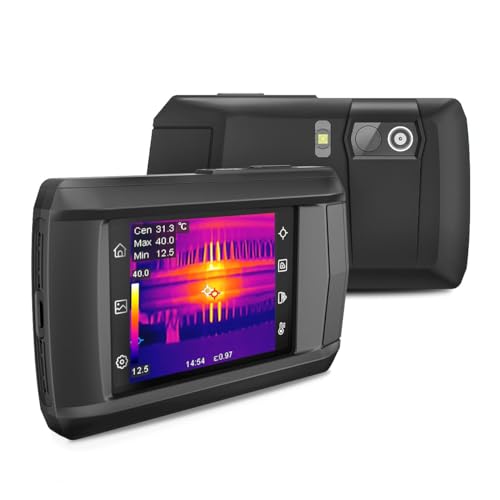
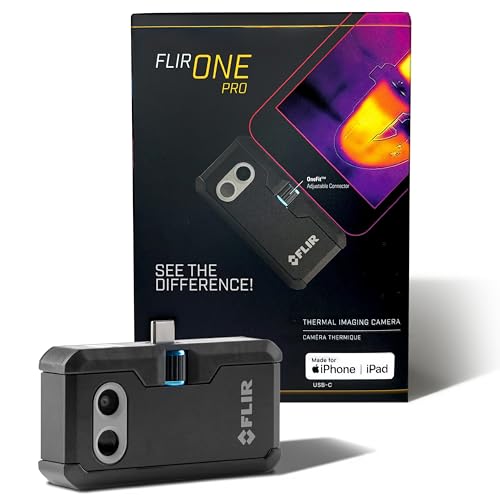

Prices are Amazon’s listed prices as of the time shown and change often; check Amazon for today’s price. As an Amazon Associate we earn from qualifying purchases.
What the spec-sheet numbers actually mean
Two numbers decide image quality, and they only make sense together. Resolution is the detector’s pixel count — how much real thermal detail it captures, not the interpolated on-screen figure. NETD (Noise-Equivalent Temperature Difference) is the smallest temperature difference the detector can pull out of its own noise, quoted in millikelvin; lower is better, with modern microbolometers claiming 30–50 mK.
Neither number saves you alone. A high-resolution sensor with poor NETD produces sharp but noisy images; a very sensitive sensor at low resolution produces smooth but blurry ones. For residential inspection, 320×240 at 50 mK is a sensible working floor, and 640×480 is comfortable — a 640 sensor can resolve a warm bolt or a cold gap at roughly twice the distance a 320 sensor can. If you are weighing what those tiers cost, our breakdown of what a thermal camera costs maps price to resolution.
Emissivity and reflection: the two things that fool the camera
A thermal camera assumes it is looking at a good emitter. Emissivity is how efficiently a surface radiates its own heat, on a 0–1 scale. Matte, non-metallic surfaces — drywall, wood, painted trim — sit around 0.90–0.97 and read accurately. Bare polished metal sits near 0.05–0.10 and radiates almost none of its own temperature, so the camera reads it far too cold unless the operator dials in the right emissivity value.
The same shiny surface causes the second problem: it reflects the infrared of everything around it. A polished duct in a warm room can show the temperature of the ceiling, a nearby heater, or the operator’s own body heat instead of its own. This is why most “the camera is broken” thermal images are really reflection artifacts. A trained thermographer carries an emissivity reference, changes viewing angle to kill reflections, and notes the reflected ambient temperature for correction. It is also why a scan is only as good as the person reading it — the physics is interpretable, not automatic.
Why it can’t see through walls
A thermal camera reads surface temperature and nothing else. It does not penetrate drywall, and it does not “see” the stud, the pipe, or the mold behind it. What it sees is how the back-of-wall condition changes the front surface temperature. In winter, missing insulation lets the interior drywall cool in a rectangle framed by the warmer studs; a gap leaking cold outside air draws a cold streak across the surface; a wet patch reads cool because evaporation carries heat away. The thermographer is inferring the hidden cause from the visible surface pattern. That inference is powerful — it is central to detecting moisture and mold conditions inside walls — but it is inference, not X-ray vision.
When thermography actually works
The whole method depends on a temperature difference across the assembly you are scanning. No gradient, no image. On the Colorado Front Range the strongest signal comes during heating season, roughly October through April, when a 50–70°F indoor-to-outdoor delta drives clear contrast at leaks and insulation gaps. Summer cooling produces a much smaller delta and weaker images. A vacant, unheated house on a mild 70°F spring day shows almost nothing — there is no gradient for the camera to reveal. U.S. Department of Energy guidance on thermographic inspections makes the same point: create or wait for a temperature difference, and scan when it is largest.
What it can and can’t find in a house
Used well, in the right conditions, a thermal scan reliably shows missing or compressed insulation, air leakage at top plates and rim joists and electrical penetrations, hidden moisture, radiant-floor heating loops, and overheating electrical connections behind panel covers — the kind of pre-failure heat OSHA flags in its electrical safety guidance. InterNACHI’s infrared standards and ASHRAE building-envelope guidance define how those findings should be documented — environmental conditions, camera specs, emissivity assumptions, and an interpretation tied to a recommended action.
What it cannot do is just as important. It does not detect mold directly (mold has no distinct thermal signature; the camera finds the moisture mold needs). It does not measure structural strength, see termites, or catch leaks smaller than its resolution and NETD can resolve. It is one instrument in a diagnostic kit — usually paired with a moisture meter to confirm what a cold patch really is. For where it fits alongside the rest of the gear, see our home inspection tools hub.
More Questions About How Thermography Works
What is a blackbody and why does it matter in thermography?
A blackbody is an idealized surface that absorbs all incoming radiation and emits the maximum possible infrared energy for its temperature, which corresponds to an emissivity of 1.0. Real materials emit a fraction of that amount, and emissivity describes the fraction.
Manufacturers calibrate thermal cameras by aiming them at reference blackbody sources held at precise temperatures. That calibration links the detector’s raw signal to real temperatures, and it is why periodic recalibration at an equipped lab keeps measurements traceable over the life of the camera.
What is the difference between qualitative and quantitative thermography?
Qualitative thermography compares patterns: one wall bay colder than its neighbors, one breaker warmer than the rest. It does not require precise temperatures, and most home inspection work falls into this category.
Quantitative thermography reports actual temperature values, which demands correct emissivity, reflected temperature, distance, and atmospheric settings, plus a calibrated camera. Electrical maintenance programs and engineering reports often require quantitative data so readings can be trended over time or compared with equipment limits.
What is thermal bridging and how does it look on a thermal image?
Thermal bridging happens when a more conductive material, such as wood studs, steel framing, or concrete, passes through an insulated assembly and carries heat across it faster than the insulation around it. On a winter interior scan, studs, top plates, and headers show as a regular grid of slightly cooler lines.
That evenly spaced pattern is normal and expected in framed walls. A defect usually looks different: an entire bay that is colder, an irregular cold shape, or a pattern that does not follow the framing layout.
How does a blower door test improve a thermography scan?
A blower door is a calibrated fan mounted in an exterior doorway that depressurizes the house, pulling outdoor air in through every gap. During that pressure difference, air leaks at outlets, top plates, rim joists, and window trim become exaggerated and show clearly as streaks on a thermal image.
Energy auditors often scan before and during depressurization, then compare. Patterns that appear only under pressure are air leakage, while patterns visible in both are more likely missing insulation or thermal bridging.
Frequently asked questions
Can a thermal camera see through walls?
No. It reads surface temperature only. It reveals hidden conditions indirectly — missing insulation, air leaks, and damp areas all leave distinctive surface patterns that a trained operator interprets.
Why does the same surface show two different temperatures?
Almost always emissivity or reflection. Shiny metal radiates little of its own heat and mirrors the infrared of nearby objects, so the camera can read it far too cold until the operator corrects for it.
What's the difference between microbolometer and cooled detectors?
Microbolometers run at room temperature and cover residential, commercial, and routine industrial work. Cooled detectors run near -200°C, resolve smaller differences at higher frame rates, and cost several times more — reserved for research and precision measurement.
Does human body heat work the same way?
The physics is identical, but skin sits around emissivity 0.98 and holds a steady temperature, which makes it an easy target; our note on thermal imaging on the human body covers the specifics.
Who discovered the infrared radiation that thermography relies on?
Astronomer William Herschel identified infrared radiation in 1800 when he measured temperatures beyond the red end of a light spectrum split by a prism. Practical thermal imaging came much later, with military and industrial systems developing through the mid-twentieth century before uncooled handheld cameras became affordable for building work.
Is an infrared thermometer the same as thermography?
No. An infrared thermometer, sometimes called a spot or laser thermometer, reads the average temperature of a single circular area. Thermography captures thousands of temperature points at once and displays them as an image, which reveals patterns such as missing insulation that a single spot reading could easily miss.
What is reflected apparent temperature on a thermal camera?
Reflected apparent temperature is a camera setting that accounts for infrared energy from the surroundings bouncing off the target. It matters most on low-emissivity surfaces such as metal, where reflections make up a large share of the signal. Entering the correct value improves the accuracy of temperature readings.
Can thermography detect heat through a layer of insulation?
No. Thermography reads only the outer surface. Insulation is designed to slow heat flow, so a warm pipe or wire buried in insulation may barely change the surface temperature. That is why thermal images reveal missing insulation well but are poor at showing what lies behind intact insulation.