Best Thermal Imaging Camera: A Plain-Language Buyer’s Guide
The best thermal imaging camera for a homeowner is the one that makes air leaks, missing insulation and hidden water show up clearly enough to act on. That job is different from electrical maintenance or hunting, so this guide ranks cameras by how well each listing supports a do-it-yourself energy audit and leak hunt: sensor resolution, thermal sensitivity, a visible-light camera for context, and software that helps a non-specialist read what the screen shows. A thermal camera sees surface temperature, not moisture or air itself, so every pick here is a way to find suspicious spots faster, not a replacement for confirming them. Below are six picks, each matched to a specific homeowner job, followed by a buying guide.
Part of our Thermal Imaging for Homes guide — start there for the full picture →
As an Amazon Associate we earn from qualifying purchases.
How we compared: we compared 24 current Amazon listings for handheld thermal imagers and phone-attachment thermal cameras on what each listing actually states: native infrared resolution, enhanced or “super resolution” output, thermal sensitivity (NETD), field of view, visible-light camera, battery life, phone compatibility and inspection software. We did not lab-test any of these units or handle them. Several listings are color or packaging variants of the same model, so the 24 listings cover 21 distinct models. Prices and availability change often, so check the current listing before buying.
Quick picks: the best thermal imaging cameras for energy audits and leak hunting
| Pick | Best for | Key spec | Key detail |
|---|---|---|---|
| HSFTOOLS HP96 | Guided leak and insulation-gap hunting | 96×96 native, 240×240 enhanced, <50 mK | Only listing claiming automatic water-leak and insulation-gap scene recognition |
| FLIR One Pro (USB-C) | iPhone owners who want step-by-step help | 160×120 native, 480×360 enhanced | In-app inspection guides; 2-year camera, 10-year detector coverage |
| Thermal Master Thor002 | Whole-house audits with documentation | 256×192 native, 40 mK | 3.5-inch 640×480 screen, 2 MP visible camera, voice notes |
| AccuMEMS GT14S | Tuning contrast on subtle insulation patterns | <50 mK, 50° field of view | Manual level and span; 14-hour stated battery |
| TOPDON TC001 Mini | Beginners on a phone who want plain-language help | 96×96 native, 384×384 enhanced, ≤40 mK | AI explanations of possible causes and next steps |
| TOPDON TC001 (Android) | Android users who want full 256×192 detail | 256×192 native, 512×384 enhanced | Reads up to nine measurement areas at once |
The six picks, compared listing by listing
1. HSFTOOLS HP96 — Best for Guided Leak and Insulation-Gap Hunting
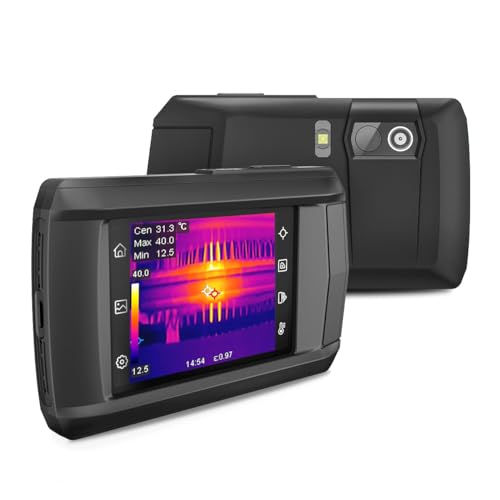
Handheld imager with touchscreen, visible camera and scene detection aimed at water leaks and insulation gaps.
Check price on Amazon$199.99 as of Oct 12, 2026 5:12 am GMT+0000 — prices change; see Amazon for current price.| Specification | Details |
|---|---|
| Infrared sensor | 96×96 VOx detector; live super resolution displays 240×240 |
| Sensitivity / frame rate | Below 50 mK; 25 Hz |
| Visible camera and modes | 640×480 visible camera; thermal, visual, fusion, picture-in-picture and blending views |
| Screen and controls | 3.5-inch touchscreen with phone-style menus; built-in LED flashlight |
| Battery / storage | About 4 hours per charge; roughly 30,000 images or 20 hours of video |
| Durability | IP54; 6.6 ft drop test; standard tripod hole |
HSFTOOLS HP96 — 96×96 VOx (240×240 live SR), <50 mK, 640×480 visible camera, 3.5″ touchscreen, IP54, ~4 h battery
The Only Listing That Claims Automatic Leak and Insulation-Gap Recognition
HSFTOOLS describes a feature called IntellFault: after a firmware update, a “Scene” setting uses a trained model to flag patterns that look like water leaks or insulation gaps. None of the other 23 listings on this shelf claims anything similar. For a homeowner who has never read a thermal image, that kind of prompt can shorten the learning curve, although the listing itself adds a blunt note that the camera takes no moisture readings. Treat a flagged spot as a place to investigate, not a diagnosis.
The HP96 is also one of only 5 of the 24 listings that state a built-in visible-light camera (counting FLIR’s MSX blending), and the only one that describes a touchscreen. Being able to blend a normal photo over the heat map matters during an energy audit, because a blue streak on a plain wall is hard to locate again later; a fused image shows the outlet, window corner or ceiling joint it belongs to.
The trade-offs are real. The native sensor is 96×96, and 6 of the 24 listings state a native resolution below 160×120, the HP96 among them. Its stated run time of about 4 hours is the shortest of the 7 handheld listings here that give a battery figure. It does not state a measurement temperature range in the bullets reviewed.
Pros
- Unique scene detection aimed at leaks and insulation gaps
- Visible camera with five viewing modes for context
- Only touchscreen listing on the shelf
- Large stated image and video storage
Cons
- Native sensor is only 96×96
- About 4 hours of battery per charge
- Scene detection requires a firmware download
- Listing states no moisture readings
2. FLIR One Pro (USB-C) — Best for iPhone Owners Who Want Step-by-Step Help
iPhone 15+ USB-C thermal attachment, 160×120 native, MSX overlay and in-app home inspection guides.
Check price on Amazon| Specification | Details |
|---|---|
| Infrared sensor | 160×120 native; VividIR processing upscales to 480×360 |
| Image overlay | MSX blends visible-camera edges onto the thermal image in real time |
| Compatibility | iPhones with USB-C (iPhone 15 and newer) |
| Accuracy | ±3 °C or ±5% within stated operating and scene conditions |
| Durability | Rated for a 1.5 m drop |
| Warranty | 2 years parts and labor on the camera; 10 years on the detector |
FLIR One Pro 435-0008-03 — 160×120 native (480×360 VividIR), MSX, USB-C iPhone 15+, 1.5 m drop, 2-10 warranty
Built-In Home Inspection Guides From the Only Brand Offering 10-Year Detector Coverage
Three listings on this shelf describe step-by-step inspection guides inside the companion app: the FLIR One Pro, the base FLIR One and the TOPDON TC001 Mini. The FLIR One Pro has the highest native resolution of those three, at 160×120, against 80×60 for the FLIR One and 96×96 for the TC001 Mini. The listing says the guides walk through common faults such as air leaks and moisture buildup, which is exactly the homeowner energy-audit use case.
Only the two FLIR listings state a detector warranty measured in a decade. Every other listing that mentions coverage at all states one or two years. For a camera that may sit in a drawer between winter audits, longer coverage on the most expensive component is a practical advantage.
Two limits are worth weighing. The stated accuracy tolerance, ±3 °C or ±5% under specified conditions, is wider than the ±2 °C or ±2% figures several other listings give, which matters little for finding a draft but more for reading exact temperatures. The listing also does not state a thermal sensitivity (NETD) figure, while 16 of the 24 listings do. It works only with USB-C iPhones, so Android households should look elsewhere.
Pros
- In-app guides for air leaks and moisture
- MSX overlay makes images easy to locate
- 10-year detector coverage stated
- Highest native resolution of the guide-equipped listings
Cons
- USB-C iPhones only
- No NETD figure stated
- Wider stated accuracy tolerance than many rivals
3. Thermal Master Thor002 — Best for Whole-House Audits With Documentation
Handheld 256×192 imager with 40 mK sensitivity, 3.5-inch screen, 2 MP visible camera and Wi-Fi transfer.
Check price on Amazon| Specification | Details |
|---|---|
| Infrared sensor | 256×192 native; enhanced to 512×384 |
| Sensitivity / frame rate | 40 mK; 25 Hz |
| Screen and cameras | 3.5-inch 640×480 IPS display; 2 MP visible-light camera |
| Measurement | -4 °F to 1022 °F, ±3.6 °F; six simultaneous spots; adjustable emissivity |
| Battery / storage | 5000 mAh, up to 10.5 hours, 18 W fast charging; 32 GB storage |
| Extras | Laser pointer, voice notes, Wi-Fi to phone or iPad, USB to PC, IP54, 2 m drop |
Thermal Master Thor002 — 256×192 native (512×384), 40 mK, 3.5″ 640×480 IPS, 2 MP visible, 10.5 h, 32 GB, IP54
The Only Handheld Here Stating Both a 256×192 Sensor and a Sensitivity Figure
Ten of the 24 listings are standalone handheld imagers. Only two of them state a native 256×192 sensor: the Thor002 and the TOPDON TC004. Of those two, only the Thor002 also states a thermal sensitivity figure, 40 mK. For energy-audit work, that combination is what separates a faint cold stripe along a top plate from background noise.
The documentation features fit a room-by-room audit. Voice notes let the user record “north bedroom, exterior wall below window” against each image, and the 2 MP visible camera gives a reference photo. The Thor002 is one of the 5 listings on the shelf with a visible camera, and one of only three handhelds with a 3.5-inch screen.
It carries the heaviest listed weight among these picks, about 3.1 lb. The listing does not name PC software beyond real-time analysis over USB, and it does not state the field of view in degrees, only that the 4.3 mm lens extends detection range.
Pros
- 256×192 native sensor with 40 mK stated
- Visible camera and voice notes for documentation
- Long stated battery with fast charging
- Six measurement spots at once
Cons
- Field of view in degrees not stated
- Bulkier than phone attachments
- PC reporting software not described in detail
4. AccuMEMS GT14S — Best for Tuning Contrast on Subtle Insulation Patterns

Light 240 g handheld with level/span control, thermometer mode, <50 mK sensitivity and up to 14 hours of use.
Check price on Amazon$129.99 as of Oct 12, 2026 5:12 am GMT+0000 — prices change; see Amazon for current price.| Specification | Details |
|---|---|
| Infrared sensor | Native resolution not stated in listing |
| Sensitivity | NETD below 50 mK (differences down to 0.05 °C) |
| Image control | Adjustable level and span; seven color palettes |
| Measurement | -4 °F to 1022 °F; adjustable emissivity and distance; high/low alarms |
| Field of view | 50° |
| Battery / weight / warranty | 2500 mAh, up to 14 hours; 240 g; 1-year warranty |
AccuMEMS GT14S — <50 mK, 50° FOV, level/span, thermometer mode, -4–1022 °F, 14 h, 240 g, 1-yr warranty
Manual Level and Span, Named on Only Two Listings
Insulation voids often show up as a temperature difference of only a few degrees. Automatic scaling stretches the color palette across everything in view, including a hot lamp or a cold window, and the subtle pattern can wash out. Level and span controls let the user narrow the color range around the wall’s own temperatures. Only the two AccuMEMS GT14S listings name both level and span adjustment; two Thermal Master P1 listings mention an adjustable span alone.
The 14-hour stated battery is the second-longest among the handheld listings on this shelf, behind the TOPDON TC004 Mini’s 15 hours, and the 240 g weight is light for a pistol-style imager. A thermometer mode gives point readings for spot checks of supply registers or a water heater line.
The weak spot is that neither GT14S listing states a native infrared resolution, one of only 5 listings out of 24 that omit it. Without that figure, buyers cannot compare detail against the 160×120 or 256×192 sensors elsewhere on this list.
Pros
- Level and span for subtle insulation patterns
- Up to 14 hours stated battery life
- Light 240 g handheld
- Thermometer mode for point checks
Cons
- Native resolution not stated
- No visible-light camera mentioned
- One-year warranty
5. TOPDON TC001 Mini — Best for Phone Beginners Who Want Plain-Language Help
30 g phone attachment, 96×96 sensor shown at 384×384, with AI explanations and built-in inspection guides.
Check price on Amazon| Specification | Details |
|---|---|
| Infrared sensor | 96×96 native; TISR processing outputs 384×384 |
| Sensitivity / frame rate | 40 mK or better; 25 Hz |
| Compatibility | Compatible iOS, Android and Windows devices; no battery or pairing |
| Measurement | -4 °F to 1022 °F; isotherms, custom points and areas, alarms |
| Software | TopFix AI explanations, inspection guides, TopView PC reports |
| Weight | About 30 g |
TOPDON TC001 Mini — 96×96 native (384×384 TISR), ≤40 mK, iOS/Android/Windows, AI explanations, 30 g
The Only Listing Whose App Explains Possible Causes and Next Steps
TOPDON says the TopFix AI feature reads a captured thermal image and returns a plain-language explanation, likely causes and suggested next steps. Other listings mention AI for image sharpening or fusion, and HSFTOOLS describes scene recognition, but the TC001 Mini is the only one describing written explanations. It is also one of the 3 listings with in-app inspection guides.
That support comes on a small sensor. At 96×96, the TC001 Mini is one of 6 listings below 160×120 native, and its 384×384 output is a processed image, not extra detector pixels. For scanning a whole wall for a missing batt from across the room, that is workable; for small details, a 256×192 sensor will show more.
Compared with the 13 other phone-attachment listings on the shelf, its advantage is software rather than hardware. The listing does not state an accuracy tolerance or a drop rating.
Pros
- Written AI explanations of thermal images
- Inspection guides and PC reporting software
- Works across iOS, Android and Windows
- No battery to charge
Cons
- 96×96 native sensor
- Accuracy tolerance not stated
- No drop or IP rating stated
6. TOPDON TC001 (Android) — Best Android Option With Full 256×192 Detail

Android OTG attachment with a native 256×192 sensor, 512×384 output and nine simultaneous measurement areas.
Check price on Amazon$199.99 as of Oct 12, 2026 5:12 am GMT+0000 — prices change; see Amazon for current price.| Specification | Details |
|---|---|
| Infrared sensor | 256×192 native; TISR enhancement to 512×384 |
| Measurement | -4 °F to 1022 °F; ±3.6 °F (2 °C) or 2%; 0.1 °C display resolution |
| Analysis | Point, line and area tools; up to nine areas read at once; waveform graph |
| Image tools | Nine palettes; fusion with the phone’s camera image; image rotation |
| Compatibility | Android phones and tablets with OTG; listing advises confirming TISR support |
| Size / weight | 2.8 × 1.65 × 0.55 in; about 30 g; 19.7 in extension cable |
TOPDON TC001 — 256×192 native (512×384 TISR), -4–1022 °F, ±3.6 °F/2%, 9 measurement areas, Android OTG, 30 g
The Most Simultaneous Measurement Areas Stated on the Shelf
The TC001 lets the user place points, lines and areas, up to three of each, for nine readings at once. The next-highest stated count is the Thor002’s six spots. In an energy audit that means one image can show the warm interior wall, a suspect cold corner and a register at the same time, which makes before-and-after comparisons after air sealing easier.
It is one of 6 listings on the shelf that state a native 256×192 sensor and one of four phone attachments at that resolution. The 19.7-inch extension cable lets the sensor reach into a vanity cabinet or around a water heater while the phone stays in hand.
The listing does not state a thermal sensitivity figure, and it asks buyers to check with customer service whether their Android phone supports the enhancement mode. It does not cover iPhones.
Pros
- Native 256×192 sensor
- Nine measurement areas at once
- Extension cable for tight spaces
- Fusion with the phone camera image
Cons
- Android only
- NETD not stated
- Enhancement depends on phone support
What to look for in a thermal imaging camera for energy audits
Native resolution, not the enhanced number
Most listings lead with a processed output figure such as 240×240, 384×384 or 512×384. The number that limits what the camera can actually distinguish is the native detector resolution. On this shelf, 19 of 24 listings state it, and they range from 80×60 to 256×192. Enhancement makes edges look smoother, but it cannot create detail the detector never measured. For room-scale air-leak hunting, 160×120 native is a comfortable floor; 256×192 makes small features such as a single missing batt between studs easier to read from a distance.
Thermal sensitivity (NETD)
NETD is the smallest temperature difference the sensor can separate from noise, expressed in millikelvin. Lower is better. Sixteen listings state it, and 11 of those claim 40 mK. During a mild Front Range afternoon, the difference between an insulated and an uninsulated stud bay can be small, so a stated sensitivity figure is worth more than another color palette.
Field of view and working distance
A wide field of view, around 50°, captures a whole wall from inside a small bedroom. A narrower view, like the 40° × 30° on the TOPDON TC004 Mini, shows more detail at a distance but requires stepping back. For interior audits in typical rooms, wider is usually easier.
A visible-light reference
A thermal image of a plain wall is hard to place later. A visible camera, blended overlay or picture-in-picture view ties each anomaly to a window, outlet or ceiling line. Five listings on this shelf describe a built-in visible camera, counting FLIR’s MSX blending; several other phone attachments borrow the phone’s own camera for fusion or picture-in-picture.
Phone attachment or standalone handheld
Phone attachments, 14 of the 24 listings here, are pocket-sized and draw power from the phone. They depend on port type (USB-C or Lightning), operating system and sometimes Android OTG support, so confirm compatibility first. Handheld imagers, the other 10, cost more in bulk but free the phone, offer physical buttons that work with gloves on a cold attic hatch, and often add a laser or flashlight.
How to run a homeowner energy audit with a thermal camera
ENERGY STAR lists drafty rooms, uneven temperatures between rooms, high heating or cooling bills and ice dams as common attic-related problems, and cold floors as a common basement or crawlspace problem. A thermal camera speeds up the “where” part of those complaints. Its own DIY checklist suggests visual inspection, a flashlight test, a paper test at doors and windows and a smoke test to find leaks, and a camera adds a fast way to scan many of those spots at once.
- Create a temperature difference. Scan on a cold morning with the heat running, so conditioned air and outdoor air differ sharply. Summer scans with the air conditioning on work in reverse but are usually less clear.
- Depressurize the house. Running bath and kitchen exhaust fans pulls outside air through leaks, which makes cold streaks around outlets, baseboards, top plates and attic hatches easier to see. ENERGY STAR’s smoke-test method uses the same principle.
- Scan systematically. Work each exterior wall, ceiling and floor edge from the same distance, photographing anything that looks like a dark streak, irregular patch or sharp-edged cold rectangle.
- Check ducts. ENERGY STAR says that in a typical house about 20 to 30 percent of the air moving through ducts is lost to leaks, holes and poor connections. Register boots and accessible ducts in attics, crawlspaces and garages are good targets.
- Confirm before fixing. Pull an outlet cover with the power off and look for insulation, as the ENERGY STAR checklist describes, or check attic depth directly.
The payoff can be meaningful. EPA estimates that homeowners can save an average of 15 percent on heating and cooling costs by air sealing and adding insulation in attics, floors over crawl spaces and accessible basement rim joists. For a deeper walkthrough, see our guide to an infrared scan during a home inspection and our overview of handheld thermal imaging.
Finding water leaks: what a thermal camera can and cannot show
Wet drywall and plaster usually read cooler than dry surfaces because evaporation draws heat away. That makes a thermal camera useful for tracing a slow plumbing leak, a failed shower pan or a roof leak spreading across a ceiling. It does not measure moisture. A cool patch can also be a cold-air leak, a missing insulation batt or a metal fastener, so a moisture meter or invasive check is the confirming step.
EPA’s guidance on mold and moisture is direct: the key to mold control is moisture control, water-damaged areas should be dried within 24 to 48 hours, and indoor humidity should ideally stay between 30 and 50 percent. A camera that helps find the edge of a wet area quickly supports that timeline. If staining, odor or growth appears, our home inspection tools hub covers the meters that confirm moisture.
Colorado notes for Front Range homes
Front Range winters give homeowners plenty of cold, clear mornings, which are ideal scan conditions. Large day-night swings also help: scanning a sunny wall in the afternoon mostly shows solar heating, so the most useful exterior scans happen before sunrise.
The dry climate has two effects. Wet materials cool strongly by evaporation, which can make leaks stand out, but surfaces also dry quickly, so a leak that was active yesterday may barely register today. Ice dams, which ENERGY STAR links to attic insulation and air leakage problems, are common on foothills roofs and are a strong hint to scan the ceiling plane below them.
Air sealing has a Colorado-specific caution. ENERGY STAR notes that tightening a home can trap pollutants such as radon and carbon monoxide and can cause combustion appliances to backdraft, so testing by a home energy professional is recommended before major sealing. Many Front Range homes sit over radon-producing geology, so a radon test before and after a tightening project is sensible. Foothills homes in places like Conifer and Morrison also add wood stoves and propane appliances to that combustion-safety check.
Cold batteries drain faster. Keep a phone attachment’s host phone or a handheld in an inside pocket between attic and crawlspace scans.
Limits of DIY thermal imaging vs a professional inspection
A consumer thermal camera can show where to look. It cannot measure air leakage the way a blower-door test does, it cannot see through walls, and its temperature readings depend on emissivity settings and reflective surfaces. Shiny metal, glass and glossy tile reflect heat from elsewhere in the room and can mislead a new user.
ENERGY STAR recommends considering a home energy professional for a comprehensive energy audit that finds hidden air leaks, pinpoints solutions and identifies potential safety issues. A trained inspector combines thermal imaging with moisture meters, attic and crawlspace access and building-science judgment, and writes findings in a form useful in a real estate transaction. For a quick primer on spot-temperature tools that complement a camera, see our digital infrared thermometer guide, and browse our thermal camera shop category for current options.
If a scan shows widespread wet areas, ceiling stains after storms or warm spots near electrical panels, stop and call a professional. Contact us to connect with an inspector who uses thermal imaging as part of a full evaluation.
References
- What to Look For: DIY Checks and Inspections — ENERGY STAR
- Identify the Problems You Want to Fix — ENERGY STAR
- Methodology for Estimated Energy Savings — ENERGY STAR
- Duct Sealing — ENERGY STAR
- A Brief Guide to Mold, Moisture and Your Home — U.S. Environmental Protection Agency
Frequently asked questions
What is the best thermal imaging camera for a home energy audit?
Look for a native sensor of at least 160×120, a stated sensitivity of 50 mK or better and a visible-light reference such as a blended photo. Among current listings, a handheld like the Thermal Master Thor002 combines a 256×192 sensor with 40 mK sensitivity and a visible camera, while phone attachments with inspection guides suit occasional users.
Can a thermal imaging camera find water leaks inside walls?
It can show the surface temperature pattern that wet materials often create, because evaporation makes damp drywall read cooler. It does not measure moisture, and a cold patch can also be an air leak or missing insulation, so confirm with a moisture meter or an inspection opening.
Is a phone thermal camera good enough for finding drafts?
For drafts and missing insulation, a phone attachment with a native 160×120 or 256×192 sensor is usually enough. Check port and operating-system compatibility before buying, and scan on a cold morning with exhaust fans running so leaks show clearly.
What does native resolution mean on a thermal camera listing?
Native resolution is the actual number of infrared detector pixels, such as 160×120 or 256×192. Figures like 384×384 or 512×384 are usually processed super-resolution output. Compare cameras on the native figure, since enhancement smooths the image but cannot add detail the sensor did not measure.
When should a homeowner hire a professional instead of using a DIY thermal camera?
Hire a professional when a scan shows widespread wet areas, recurring ceiling stains, hot spots near electrical equipment or before major air sealing. ENERGY STAR recommends a home energy professional for a comprehensive audit and for checking combustion safety before tightening a home.
Buying or selling on the Front Range and want a thermal scan as part of the inspection? Reach out through our contact page to connect with a vetted local inspector.
Thermal imaging cameras
Infrared cameras reveal hidden moisture, missing insulation, and air leaks. Phone-attachment models are the budget entry point; standalone units have higher resolution.
| Product | Why | Buy |
|---|---|---|
 FLIR ONE Pro (phone) FLIR ONE Pro (phone) | Plugs into iPhone/Android; inspector favorite. | Amazon — $349.00 |
 Topdon TC001 Topdon TC001 | High-res phone module at a low price. | Amazon — $199.99 |
 FLIR C5 Compact FLIR C5 Compact | Standalone pocket camera with Wi-Fi. | Amazon — $611.50 |