Thermal Imaging Camera Near Me: Buy, Rent, or Hire
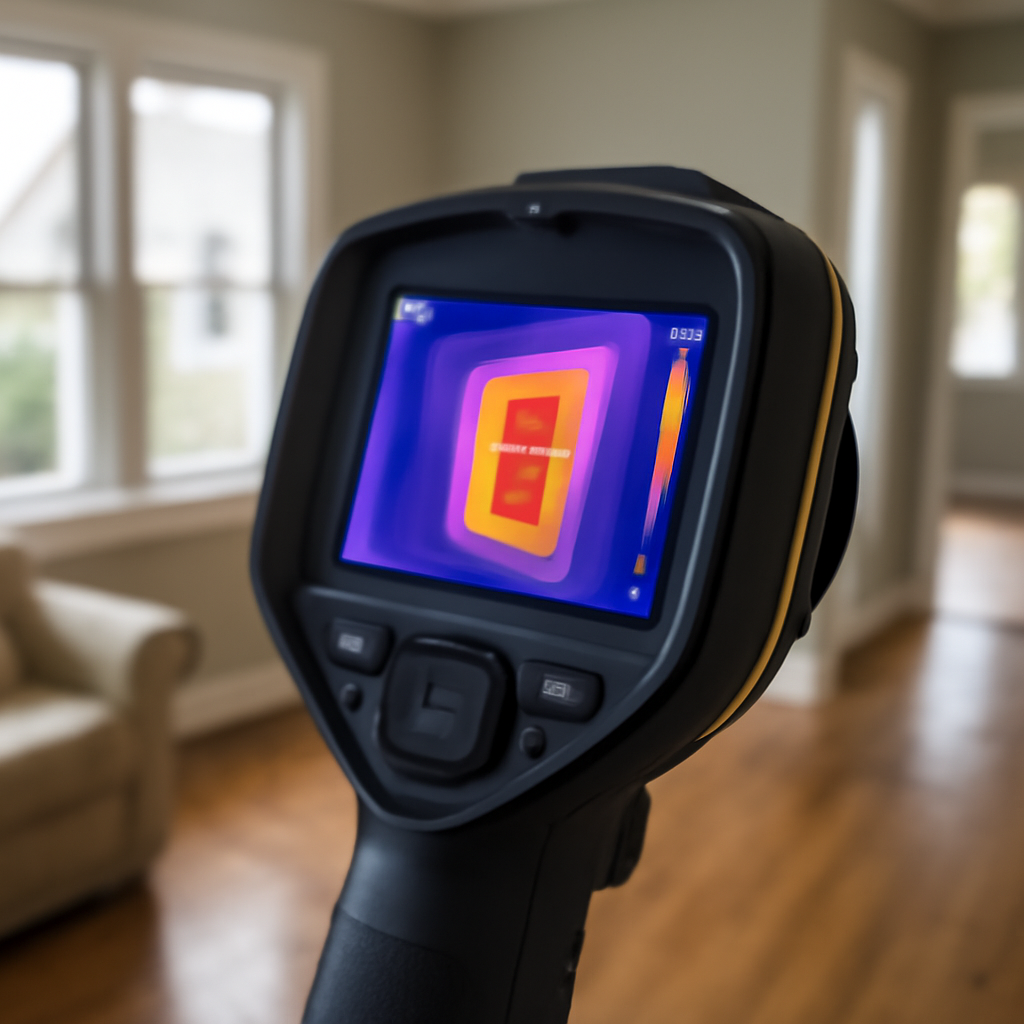
When a problem like a hidden leak, a cold room, or a high energy bill sends someone searching for a thermal imaging camera near me, three very different paths open up: buy a camera, rent one for a weekend, or hire a professional who already owns the gear and knows how to read it. Each route has a different cost, a different learning curve, and a different likelihood of actually solving the problem. This guide compares all three, explains what thermal imaging can and cannot find, and helps you decide which option fits your situation. It draws on trade-body and Department of Energy guidance rather than hands-on testing.
What does a thermal imaging camera near you actually find?
A thermal camera detects infrared radiation and renders surface temperature as a color image. It does not see through walls, and it does not directly detect moisture, mold, or air. Instead, it reveals temperature patterns that a trained eye interprets as clues. A cool streak on a ceiling can suggest evaporative cooling from a leak; a cold band along a wall can point to missing insulation; a hot spot at an electrical panel can flag a loose connection.
The key word is clue. InterNACHI and other inspection bodies teach that thermal anomalies are leads requiring verification, not conclusions. The U.S. Department of Energy promotes infrared scanning specifically for locating air leaks and insulation gaps during energy assessments. Knowing this shapes the buy-rent-hire decision, because interpretation skill, not just the camera, determines whether you get a useful answer. Our explainer on what thermal camera colors mean covers how those patterns are read.
Option one: buying a thermal camera
Buying makes sense if you expect to use the camera repeatedly, for ongoing energy work, rental-property maintenance, or a trade. Prices span a huge range. Smartphone-attachment cameras and entry-level handhelds start low, while professional-grade units with higher resolution and better sensitivity cost considerably more.
What you get for the money
The two specs that matter most are detector resolution, measured in thermal pixels, and NETD, the thermal sensitivity in millikelvin. Budget cameras have lower resolution and higher NETD, producing coarser, noisier images. Higher-end cameras resolve smaller anomalies from a useful distance. A buyer should match the specs to the intended task rather than overpaying for capability they will not use, or underbuying and getting blurry results. Our look at the best thermal imaging cameras for home inspection breaks down the resolution tiers.
The hidden cost of buying
The camera is only part of the equation. Interpreting images correctly takes practice, and a misread image can send a homeowner chasing the wrong problem. Buyers who use the tool rarely may find the cost per use very high once the learning curve is factored in. Buying rewards frequent, repeated use.
Option two: renting a thermal camera
Renting suits a one-time project: a single leak hunt, a seasonal insulation check, or a focused troubleshooting session. Tool-rental outlets and some home-improvement stores rent thermal cameras by the day or week, and the cost is a fraction of buying.
Renting works best when you have a specific, contained task and enough confidence to interpret what you see. The downside mirrors buying: a rented camera still requires the user to read the image correctly, and a weekend is not long enough to develop real interpretation skill. Renters benefit from pairing the camera with a moisture meter, which many of the same outlets also rent. Our guide to moisture meter rental explains how to combine the two for a complete check.
When renting beats buying
If you will use a thermal camera once or twice and the task has strong temperature contrast, renting is usually the smart financial choice. You avoid the purchase cost, the storage, and the eventual obsolescence of owning a depreciating electronic device. The break-even point favors renting until you have several distinct uses in mind.
Option three: hiring a professional
Hiring a professional thermographer or a home inspector who offers thermal imaging is the path most likely to actually solve a problem, because you are buying interpretation along with the camera. A trained inspector knows how to set up the scan, control for confounding factors like sunlight and HVAC operation, and distinguish a real anomaly from a harmless temperature difference.
Professionals typically charge a service fee that varies by region and scope, often bundled into a broader inspection or offered as a standalone scan. While that costs more than a rental, it includes expertise, proper equipment, and usually a documented report. For complex problems, a hidden leak in a finished space, a recurring moisture issue, or anything you need to document for insurance or a sale, the professional route frequently saves money by getting the diagnosis right the first time. Our overview of thermal imaging inspection cost and hiring details what to expect.
What a pro brings that a camera alone does not
Beyond the hardware, a professional brings standardized methodology and verification. They confirm thermal clues with moisture meters, account for environmental conditions, and interpret results against experience. The image is only as valuable as the person reading it, and that is the core argument for hiring when stakes are high.
Comparing the three paths
Think of the decision in terms of frequency, complexity, and stakes. For frequent, repeated use, buying amortizes the cost and is the most economical over time. For a single, well-defined task with strong contrast, renting delivers the capability cheaply. For complex, high-stakes, or documentation-driven problems, hiring a professional buys the interpretation that makes the image meaningful.
Cost ranks rental lowest per use for one-off needs, hiring highest per single event but most reliable, and buying lowest per use only at high frequency. Skill required is highest for buying and renting, since you must interpret images yourself, and lowest for hiring. Reliability of the answer is highest with a professional. Mapping your situation onto these axes usually points to a clear choice.
Smartphone thermal attachments as a fourth option
Beyond standalone cameras, a fourth path has grown popular: thermal attachments that plug into a smartphone. These small modules turn a phone into a basic thermal camera using the phone’s screen and processing, and they sit at the affordable end of the buying option. For a homeowner curious about thermal imaging without committing to a dedicated device, they lower the barrier to entry considerably.
The trade-offs mirror those of any budget camera: resolution and sensitivity are modest, and image quality depends partly on the phone. They suit tasks with strong temperature contrast, finding drafts, spotting missing insulation, checking a warm electrical connection, more than subtle moisture detection. As with every option, the output is a clue to verify, not proof, and pairing the attachment with a moisture meter remains essential. For an occasional user weighing cost against capability, a phone attachment can be a sensible middle ground between renting and buying a full handheld.
Cost comparison across the three paths
Putting rough numbers to the decision clarifies it, even though local prices vary. Buying spans the widest range: smartphone attachments and entry handhelds sit at the low end, while professional cameras with higher resolution and better sensitivity climb steeply. The purchase only makes financial sense when spread across many uses, since a rarely used camera carries a high cost per use once the learning curve is counted.
Renting typically costs a modest daily or weekly fee, far below buying, which makes it the economical choice for a single, well-defined task. Hiring a professional carries the highest per-event cost but bundles in expert interpretation, proper equipment, and usually a documented report, and it most reliably produces a correct answer. The honest way to choose is to weigh how often you will use the tool, how confident you are reading thermal images, and how costly a wrong conclusion would be. When the stakes are high or the problem is hidden and complex, the professional’s interpretation justifies the premium, a theme detailed in our guide to thermal imaging inspection cost and hiring.
What thermal imaging does well, and its limits
Thermal imaging excels at finding air leaks around doors, windows, and penetrations; missing or settled insulation; overheating electrical components; radiant-heat loops; and the cooling signature that can accompany active water intrusion. The Department of Energy specifically recommends infrared scans during energy assessments to target these issues.
Its limits are just as important. It cannot see through walls, cannot confirm moisture by itself, and cannot identify mold. Environmental conditions, sun-warmed surfaces, recent HVAC operation, and differing materials can all create misleading patterns. This is why every credible methodology pairs thermal imaging with confirmation. A cool spot becomes a finding only after a moisture meter verifies water is present, a workflow detailed in our guide to the thermal imaging and moisture meter combination.
Insurance, disputes, and the value of documentation
When a thermal scan supports an insurance claim or a dispute with a seller, builder, or landlord, the documentation behind it becomes as important as the image itself. A casual phone snapshot of a thermal anomaly carries little weight, whereas a professional report that records the conditions, the camera used, the verified moisture readings, and clear annotated images stands up far better to scrutiny.
This is a strong argument for hiring a professional when the stakes extend beyond personal curiosity. An adjuster or an opposing party will question an unsupported thermal picture, and a homeowner without the methodology to defend it may find the evidence dismissed. A documented, verified inspection from a qualified thermographer, by contrast, ties the thermal clue to a confirmed finding and a credible methodology. If a thermal scan might end up in a claim or negotiation, paying for that documentation upfront often proves far cheaper than trying to substantiate a do-it-yourself image after the fact.
If you rent or buy, pair it with a moisture meter
For homeowners who choose the do-it-yourself route, the most important upgrade is not a better camera but a moisture meter to confirm thermal clues. A thermal camera locates suspicious areas quickly; a moisture meter pressed to the surface tells you whether the cool spot is actually wet. Used alone, a camera produces guesses; used together, the pair produces answers.
This combination mirrors what professionals do and dramatically improves the reliability of a DIY scan. Many rental outlets carry both tools, and the added cost is small relative to the value of an accurate diagnosis. The principle holds regardless of camera grade: verification turns a temperature pattern into a fact.
Where to find a camera near you
The local options vary by route. For buying, electrical-supply houses, building-supply retailers, and online marketplaces all stock thermal cameras across the price spectrum, and many home-improvement stores carry entry-level handhelds and smartphone attachments. For renting, tool-rental chains and independent rental yards often list thermal cameras alongside moisture meters, typically by the day or week.
For hiring, the local pool usually consists of home inspectors who offer thermal imaging as an add-on, dedicated infrared-thermography firms, and some HVAC or energy-audit contractors. Searching for a home inspector who advertises infrared services is often the most direct path, since they combine the camera with the interpretation skill that makes it useful. Whichever route you pursue, confirm that the equipment or the professional matches the resolution and methodology your task requires rather than choosing on price alone.
Questions to ask a thermal imaging professional
If you decide to hire, a few questions separate a capable thermographer from someone simply holding a camera. Ask what camera resolution they use, since a higher-resolution unit resolves smaller anomalies and produces clearer documentation. Ask how they control for environmental factors like sunlight, wind, and recent HVAC operation, which can all create misleading patterns.
Ask whether they confirm thermal findings with a moisture meter or other contact method, because a professional who treats the image as proof rather than a clue is cutting corners. Find out whether you receive a written report with images, what training or certification they hold, and whether the scan is standalone or part of a broader inspection. Clear, confident answers signal a professional who understands that interpretation, not just the hardware, delivers the value. Our guide to thermal imaging inspection cost and hiring expands on what to expect.
Avoiding common thermal imaging mistakes
Whether you rent, buy, or hire, certain errors undermine results. Scanning a sun-warmed exterior wall in the afternoon produces heat patterns that have nothing to do with insulation or moisture. Running the HVAC system hard right before a scan can mask or mimic anomalies. Expecting the camera to see through walls leads to disappointment, since it only reads surface temperature.
The most consequential mistake is treating a thermal image as a diagnosis. A cool spot is a question, not an answer, and acting on it without confirmation, tearing into a wall, for instance, risks chasing a thermal bridge or a harmless material difference. The disciplined approach is to scan under stable conditions, mark anomalies, and verify each with a moisture meter before concluding anything. This is true at every price point, which is why the verification step matters as much as the camera itself.
How to choose the right path for your problem
Start with the question you are trying to answer. If you simply want to find drafts before sealing them, a rental or even a budget purchase plus a moisture meter is reasonable. If you have a recurring or hidden moisture problem, water staining with no obvious source, or a finding you must document for insurance or a real estate transaction, hiring a professional is the safer investment.
Consider how often you will use the tool, how comfortable you are interpreting images, and how costly a wrong answer would be. A landlord managing several properties might justify buying; a homeowner with one leak is usually better served renting or hiring. When the consequences of a missed problem are high, the professional’s interpretation is worth the premium. For the full landscape of thermal cameras, moisture meters, and supporting gear, the home inspection tools buyer’s guide ties the options together.
References
- Detecting Air Leaks — U.S. Department of Energy
- Infrared Thermography in Inspections — International Association of Certified Home Inspectors (InterNACHI)
- Home Inspection Standards and Resources — American Society of Home Inspectors (ASHI)
Thermal imaging cameras
Infrared cameras reveal hidden moisture, missing insulation, and air leaks. Phone-attachment models are the budget entry point; standalone units have higher resolution.
| Product | Why | Buy |
|---|---|---|
 FLIR ONE Pro (phone) FLIR ONE Pro (phone) | Plugs into iPhone/Android; inspector favorite. | Amazon — $349.00 |
 Topdon TC001 Topdon TC001 | High-res phone module at a low price. | Amazon — $199.99 |
 FLIR C5 Compact FLIR C5 Compact | Standalone pocket camera with Wi-Fi. | Amazon — $560.00 |