FLIR Camera Boat: Marine Thermal Imaging Overview

FLIR builds thermal-imaging cameras for almost every market — building inspection, electrical, automotive, defense, and marine navigation. The marine product line is one of the most-developed segments, and “FLIR camera boat” searches typically come from boat owners considering a fixed-mount thermal imager for night navigation, dock approaches, and overboard person detection. This short-tail overview summarizes the marine thermal-imaging category, where FLIR fits in the marketplace, and how marine cameras differ technically from the FLIR thermal cameras used in home inspection. Manufacturer specifications change over time and should be verified for any specific model before purchase.
Part of our Thermal Imaging for Homes guide — start there for the full picture →
What a marine FLIR camera does
Marine thermal cameras detect long-wave infrared (LWIR) emissions from objects in the camera’s field of view and convert those emissions into a visible image. Warmer objects (other boats, channel markers, debris, persons in the water) appear brighter than the surrounding sea surface, which usually sits at a relatively uniform temperature. Because the image is built from emitted heat rather than reflected light, marine FLIR works equally well at midnight in pitch dark and in heavy fog or haze where visible-light vision fails. Radar tells you that something is out there; FLIR tells you what it is.
Typical marine use cases include navigating unlit waterways after sunset, detecting floating debris or partially submerged objects ahead of the bow, approaching docks in low visibility, tracking persons overboard, and monitoring vessel traffic in busy harbors. Recreational boaters and commercial operators both use marine FLIR for these tasks. The thermal image supplements, rather than replaces, standard visual lookout and radar.
FLIR marine product tiers
FLIR’s marine product line has historically spanned several tiers. Entry-level fixed-mount cameras provide a single thermal imager in a marinized housing for installation on the cabin roof or radar arch. Mid-tier dual-payload cameras combine thermal with a low-light visible camera, letting the operator switch between sensors as conditions change. Pan-tilt models add motorized rotation so the camera can scan the horizon under operator control or follow a target. Top-tier units include radar-integrated tracking, MFD (multi-function display) integration with major chartplotter brands, and stabilization for rougher water.
Specific model names and feature sets change over product cycles; buyers should verify current model availability and confirm compatibility with their boat’s electronics network (NMEA 2000, Ethernet, video standards) before committing. The marine-thermal category overview at our marine thermal imaging camera guide compares categories.
How marine FLIR differs from home-inspection FLIR
Both marine and building-inspection FLIR cameras detect LWIR emissions from a microbolometer sensor, so the underlying physics is the same. The differences are operational. Marine cameras have ruggedized, waterproof housings designed for installation outdoors with continuous exposure to salt spray and weather. They use higher contrast and gain settings optimized for relatively flat sea-surface backgrounds and warmer-than-water targets. Their software is tuned for navigation rather than diagnostic temperature measurement; many marine models do not output calibrated temperatures at all.
Building-inspection FLIR cameras prioritize calibrated temperature readings, narrow temperature-difference resolution, and visible-light overlay for documenting findings in reports. They are handheld, not fixed-mount, and operate in clean indoor environments most of the time. The two product lines share component technology but address different problems. A marine camera will not produce the diagnostic-grade thermal images a home inspector needs, and a building-inspection camera will not survive a season of saltwater exposure on a radar arch. The cluster guide at FLIR thermal camera boat walks through this distinction in depth.
Mounting and installation
Fixed-mount marine cameras typically install on the highest practical point of the boat — cabin roof, radar arch, or mast — for the widest field of view and best line of sight forward. The mounting position must clear other equipment (radar, GPS antennas, masthead lights) and provide a stable platform. Marine cameras are heavier than they look once you factor in the housing and pan-tilt mechanism if equipped, and the mount needs to handle that mass under heavy seas and high-speed motion.
Power and data cabling runs from the camera back to the helm electronics. Modern marine FLIR units integrate with major MFDs over Ethernet, which simplifies wiring relative to older composite-video standards. Professional installation is the typical path for new mounts; the boat’s electronics dealer or a marine electrician handles the mechanical install, cable routing through waterproof bulkheads, and software integration with the chartplotter.
Bonding and grounding details matter on metal-hulled vessels and on boats with significant electronics-grade copper bonding networks. A camera installed without correct bonding can pick up galvanic-corrosion damage to the housing over time. Discuss bonding strategy with the installer, particularly if the boat has any history of stray-current corrosion issues.
Resolution and detection range
Marine FLIR cameras are specified by sensor resolution (commonly 320 x 240, 640 x 480, or 640 x 512 pixels in older and current models), field of view (in degrees), and a manufacturer-quoted detection range for specific targets. The detection range depends on target size, target-to-water temperature contrast, atmospheric conditions, and sensor resolution; quoted ranges should be taken as best-case rather than typical. Realistic detection of a small floating object at night might be a few hundred meters; detection of another boat or a person at the water’s surface can reach several hundred to a few thousand meters depending on conditions and equipment tier.
Higher resolution gives a sharper image and longer detection range at the cost of price and processing complexity. For typical recreational use within a few miles of shore, mid-resolution cameras are usually sufficient; offshore navigation and commercial applications justify the higher-resolution tiers. Thermal sensitivity (often quoted as NETD, noise-equivalent temperature difference, in millikelvins) is another important spec — lower NETD values mean the camera can resolve smaller temperature differences in the scene, which translates to better contrast against the sea surface on calm nights.
Field of view and pan-tilt tradeoffs
Fixed-field-of-view cameras give a single forward-looking image whose width is set at install. Wider FOV captures more horizon at the cost of detail per pixel; narrower FOV gives more detail at the cost of needing the boat to be pointed at the target. Pan-tilt cameras add motorized rotation that scans across the horizon or tracks a target, eliminating the trade-off but adding cost, complexity, and an additional point of mechanical failure.
For most recreational use, a fixed wide-FOV camera covering the forward arc is adequate. Pan-tilt cameras make more sense on larger vessels with longer dock approaches, on charter and tour boats that benefit from operator-controlled scanning, and on commercial vessels conducting search operations. Stabilization is another upgrade tier on top-end systems; it digitally compensates for vessel roll and pitch so the image stays level even in heavy seas. Without stabilization, a rolling deck produces a rolling thermal image that can disorient the operator.
Integration with chartplotter and radar
Modern marine FLIR cameras integrate with multi-function displays from major marine-electronics brands. Integration typically means the FLIR feed appears as a selectable window or full-screen display on the chartplotter, with controls accessible through the standard MFD interface. Radar-integration features can slew the FLIR camera to a radar target automatically, useful for identifying what radar has detected as a contact.
Compatibility with your existing electronics is the most important pre-purchase question. Different MFD manufacturers support different camera protocols; some FLIR units integrate broadly, others are tied to specific MFD ecosystems. Verify compatibility before purchase, ideally with the dealer who maintains your boat’s electronics package.
Maintenance in the marine environment
Salt spray, UV exposure, and constant temperature cycling are the main marine-environment challenges. Marine FLIR housings are designed for these conditions but still benefit from routine freshwater rinses after offshore use, periodic inspection of cable seals and gland fittings, and lens-cleaning with appropriate marine optical cleaner. The pan-tilt mechanism on motorized cameras needs occasional lubrication per manufacturer schedule. Most marine cameras carry warranties of one to two years on the unit and may include marine-environment exclusions; verify the specific warranty before assuming coverage.
Lens cleanliness affects image quality more than any other maintenance variable. A salt-encrusted or oil-fouled germanium lens reduces effective sensor performance significantly. Use only optical-grade lens cleaner and a microfiber cloth; abrasive cleaners can damage the lens coating that allows infrared transmission. If the lens cover becomes scratched or chipped, replacement is generally required because the damage cannot be polished out.
Safety considerations and limitations
Marine FLIR adds a powerful sensor but does not eliminate the need for standard navigation practice. Thermal images can be misleading in specific conditions: a calm, warm sea surface can show low contrast with floating objects; dense fog or heavy rain attenuates infrared signal at long range; very cold objects (ice floes, partially submerged debris that has matched water temperature) can be hard to distinguish from background. FLIR also does not detect underwater hazards or objects shielded by structure.
The U.S. Coast Guard’s navigation rules require visual lookout regardless of electronic aids. FLIR supplements that lookout and extends its effective range in conditions where unaided vision fails. Operators relying entirely on the camera display rather than maintaining situational awareness through multiple sensors put themselves at risk. Training in interpretation of thermal imagery improves the camera’s practical value substantially.
Comparison with portable handheld thermal cameras
Boaters sometimes consider using a portable handheld thermal camera (the kind used for hunting or general outdoor use) as a lower-cost alternative to a fixed-mount marine FLIR. Handheld units work for occasional handheld scanning from the helm but have several limitations in a marine context: they are not waterproof beyond splash resistance, they lack chartplotter integration, they require an operator’s hand and attention rather than running continuously, and they typically have shorter battery life than continuous-operation marine fixed mounts. For a recreational boater making infrequent night runs, a high-quality handheld can be a useful supplement; for regular night navigation, a fixed-mount system pays back in convenience and integration.
Cost and value tradeoffs
Marine FLIR pricing spans a wide range. Entry-level fixed-mount thermal cameras start around the low single-digit thousands of dollars; mid-tier dual-payload cameras are in the mid-single-digit-thousands range; full-feature pan-tilt cameras with MFD integration and stabilization reach into the tens of thousands. Most recreational buyers settle in the entry-to-mid tier; commercial and offshore-cruising operators justify higher-tier purchases through extended operational hours and longer voyages.
Used marine FLIR cameras circulate on the secondhand market, but verify the unit’s service history, sensor condition, and software-update status before purchase. Older cameras may lack integration with current MFD firmware, which limits practical usefulness even if the thermal sensor itself remains functional. The broader marine and dual-use comparison at FLIR camera marine covers the buyer decision-tree.
References
- Thermal Imaging for Inspectors — International Association of Certified Home Inspectors
- ASHI Standards of Practice — American Society of Home Inspectors
- ENERGY STAR: Seal and Insulate — U.S. Environmental Protection Agency (ENERGY STAR)
- Building Codes and Standards — International Code Council
Frequently asked questions
Is a marine FLIR camera worth the price for recreational boating?
For boaters who frequently navigate at night, in fog, or in unfamiliar waters, the safety value of detecting unlit obstacles, persons in water, and channel features in low visibility typically justifies the cost. For occasional daylight use only, a marine FLIR is harder to justify financially.
Can I use a building-inspection FLIR camera on my boat?
Generally no. Building-inspection FLIR cameras lack the waterproof marinized housing, fixed-mount installation hardware, and software tuning for navigation that marine cameras provide. They also lack the salt-spray resistance needed for permanent outdoor mounting on a vessel.
How does marine FLIR integrate with my chartplotter?
Most modern marine FLIR cameras integrate with multi-function displays from major marine-electronics brands over Ethernet, appearing as a selectable window or full-screen display. Compatibility varies by FLIR model and MFD manufacturer, so verify with the dealer before purchase.
What is the typical detection range of a marine FLIR camera?
Detection range depends on target size, temperature contrast, atmospheric conditions, and sensor resolution. Realistic detection of small floating objects might be a few hundred meters; another boat or person at the water surface can be detected at several hundred to a few thousand meters under good conditions.
Thermal imaging cameras
Infrared cameras reveal hidden moisture, missing insulation, and air leaks. Phone-attachment models are the budget entry point; standalone units have higher resolution.
| Product | Why | Buy |
|---|---|---|
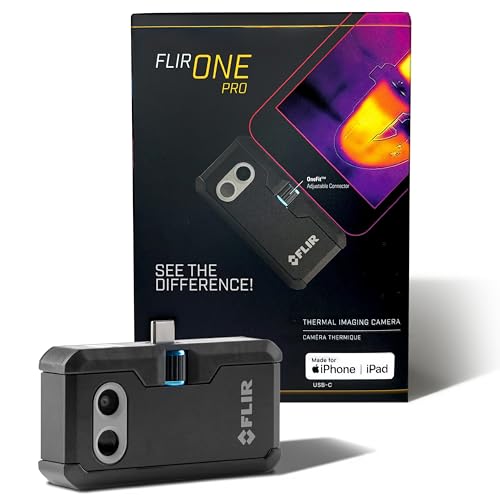 FLIR ONE Pro (phone) | Plugs into iPhone/Android; inspector favorite. | Amazon — $349.00 |
 Topdon TC001 | High-res phone module at a low price. | Amazon — $262.99 |
 FLIR C5 Compact | Standalone pocket camera with Wi-Fi. | Amazon — $649.00 |