How to Choose a Marine Thermal Camera for Your Boat
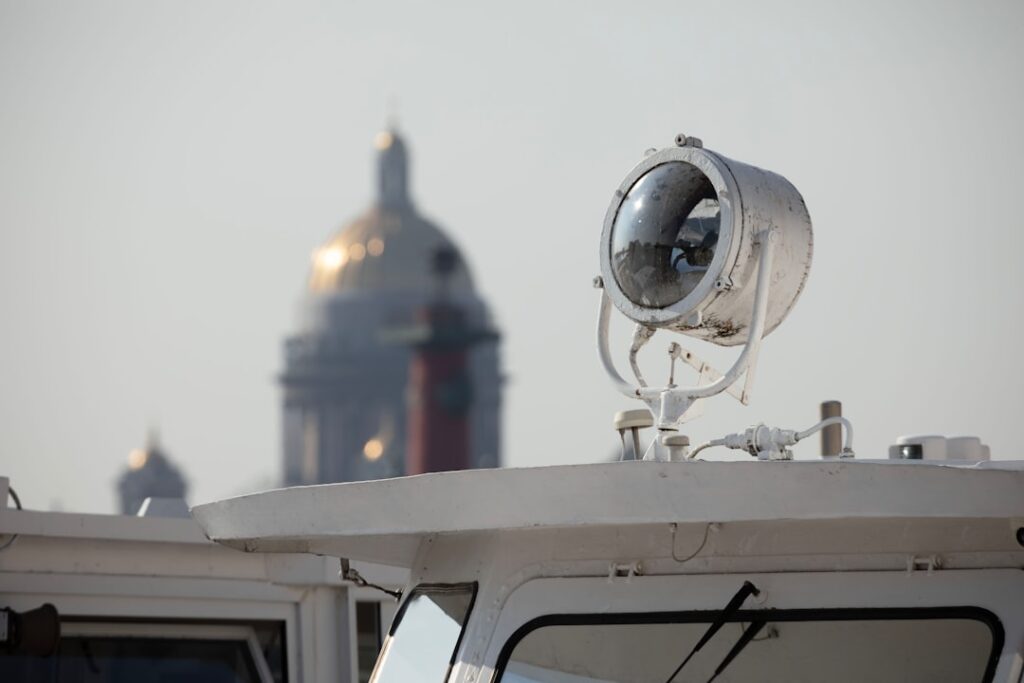
A marine thermal camera is a long-wave infrared (LWIR) imager in a sealed, salt-resistant housing, mounted on a boat to see heat instead of light. It renders the scene from the 8–14 micron radiation that every object emits, so it works in total darkness, through light fog, and against the glare of shore lights that blind a normal camera. If you are trying to decide whether one belongs on your boat and which tier to buy, the deciding factors are sensor resolution, how it talks to your chartplotter, and honest detection range — not the marketing photo of a swimmer glowing white at a mile out.
Part of our Thermal Imaging for Homes guide — start there for the full picture →
What the camera actually shows on the water
Open water is close to an ideal thermal background. Its surface temperature is fairly uniform and its emissivity in the LWIR band sits around 0.96, so warm objects — another hull, a channel marker that soaked up afternoon sun, a person in the water, a log with thermal mass — stand out sharply against a flat, cool sea. That contrast is the whole reason marine thermal earns its keep for running unlit channels after dark, spotting deadhead logs and crab pots, and holding a bearing on a person overboard while you maneuver.
It is a supplement to radar and visual lookout, not a replacement. Radar tells you something metallic is out there at range; thermal tells you whether it is a boat, a buoy, or floating debris once you are within a few hundred to a couple thousand meters. The two are complementary, which is why serious installs run both.
The three tiers, and who each one is for
Marine thermal splits cleanly into three price and capability bands.
- Fixed-mount, single-sensor. One thermal core, usually 320 × 240, bolted forward with no moving parts. Nothing to aim — the boat aims it. This is the right starting point for most coastal cruisers and covers the forward arc where collisions happen. Entry pricing is in the low single-digit thousands.
- Dual-payload. A thermal core plus a low-light visible camera in one housing, often 640 × 480 or 640 × 512 thermal, with pan-and-tilt so you can slew toward a target. You switch or blend the two feeds as conditions change. Mid single-digit thousands.
- Stabilized pan-tilt. Gyro-stabilization that keeps the image level through roll and pitch, plus radar slew that auto-points the camera at a radar contact. This is search-and-rescue, commercial, and large-yacht territory, and it reaches into the tens of thousands.
For a recreational boater running within sight of shore, a fixed 320 × 240 camera covering the bow does the job. Resolution and stabilization start to matter offshore and on any vessel doing long dock approaches or organized searches. The general logic of matching sensor resolution to the job is the same one covered in our guide to the best thermal imaging cameras.
Resolution, sensitivity, and refresh rate
Three specs decide how a marine camera performs, and they interact:
- Sensor resolution is the number of independent thermal pixels. More pixels means smaller objects resolved at longer range. Marine cores span 320 × 240 at entry level up through 640 × 512 on premium units. Doubling linear resolution roughly doubles the range at which you can pick out a small target.
- Thermal sensitivity (NETD), quoted in millikelvins, is how small a temperature difference the camera can resolve. This matters most on calm water where a target barely differs from the sea. Premium marine cores quote NETD below 30 mK; entry cores sit higher, closer to 50 mK.
- Frame rate. Dedicated marine cameras run at 30 or 60 Hz for smooth video during vessel motion. Be wary of imagers limited to roughly 9 Hz — that ceiling exists because U.S. export rules (ITAR) restrict higher frame rates on some thermal cores, and 9 Hz feels laggy when you are moving.
Will it talk to your chartplotter?
This is the question people get wrong. A marine thermal camera is only as useful as its integration with the multi-function display (MFD) you already own. Modern cameras feed video to the MFD over Ethernet rather than legacy composite video, and the thermal image appears as a window or full screen with camera controls built into the plotter interface. Radar-slewing features only work when the camera and radar share a compatible ecosystem.
Compatibility is not universal. Teledyne FLIR now owns Raymarine, so FLIR marine cameras integrate tightly with Raymarine Axiom displays; using the same camera on a Garmin or Simrad system may need a converter, a different control path, or simply may not expose pan-tilt and slew. Verify the exact camera model against your exact MFD before you buy — ideally with the dealer who maintains that electronics package.
Honest detection range
Read every quoted range as a best case in favorable conditions. In practice, a person at the surface might be detected at several hundred meters to a couple thousand, and small floating debris only a few hundred, depending on target size, the temperature difference between target and water, and your sensor resolution. Two conditions collapse those numbers: dense fog and heavy rain scatter the LWIR signal, and high humidity flattens the already-small contrast on warm-water targets. Thermal beats visible light in most weather that matters, but it is not unconditional.
| Spec | Entry (coastal) | Premium (offshore/commercial) |
|---|---|---|
| Resolution | 320 × 240 | 640 × 480 / 640 × 512 |
| NETD | ~50 mK | <30 mK |
| Movement | Fixed mount | Stabilized pan-tilt + radar slew |
| Refresh | 30 Hz | 30–60 Hz |
Mounting and marine survival
Mount the camera at the highest practical point with a clear forward sightline, but clear of the radar beam, GPS antennas, and masthead lights, on a bracket rated for the camera mass plus the dynamic load of a boat pounding through a seaway. Cabling runs through waterproof bulkhead glands to the helm. The lens is germanium, not glass, because germanium is transparent to LWIR and ordinary glass is not — which means it needs an anti-reflective coating you can scratch. Clean it only with an optical-grade cleaner and a microfiber cloth; abrasives strip the coating and permanently degrade the image. Rinse the housing with fresh water after offshore runs and inspect the cable-gland seals seasonally.
It does not replace a lookout
U.S. Coast Guard Navigation Rule 5 requires a proper lookout by sight and hearing at all times, and no electronic aid changes that obligation. Treat thermal as another input, not the primary one. The practical skill is learning to read signatures: a person in cold water throws a strong, distinct contrast; a wooden dock bleeds stored daytime heat differently than a metal pier; a boat at idle looks nothing like one on plane. Run the camera in daylight first so you learn how the display renders scenes you already understand, then work down into darkness.
Marine thermal vs. an inspection thermal camera
The underlying microbolometer sensor is the same one used in building diagnostics, but the two are not interchangeable. A marine camera has a marinized housing for permanent outdoor salt exposure and image processing tuned for water backgrounds and moving targets; it does not produce the calibrated, spot-temperature, visible-light-blended imagery an inspector needs for a report. A building camera, in turn, will not survive being bolted to a radar arch. If you own a boat and also inspect homes, you own two cameras — the differences are laid out in our overview of thermal infrared cameras and the broader home inspection tools guide.
Frequently asked questions
What does a marine thermal camera show that radar does not?
Radar detects reflective, mostly metallic targets at long range and characterizes almost nothing about them. Thermal tells you what a contact actually is once you are within range — a boat versus a buoy versus a floating log — and detects low-radar-return objects like a person in the water. That is why capable installs run both and slew the camera to radar targets.
Why is the lens made of germanium instead of glass?
Ordinary glass blocks long-wave infrared. Germanium is transparent in the 8–14 micron band the sensor uses, so every marine thermal lens is germanium with a soft anti-reflective coating. Clean it only with optical cleaner and a microfiber cloth — abrasives ruin the coating and the image with it.
Can I put my building-inspection thermal camera on the boat?
No. It lacks the waterproof marinized housing, the fixed-mount hardware, and the salt-spray resistance for permanent outdoor mounting, and its image processing is tuned for calibrated indoor readings rather than water backgrounds. It will corrode and it will not integrate with your chartplotter.
How is marine thermal different from marine night vision?
Thermal (LWIR) detects emitted heat and needs no illumination at all. Night vision amplifies reflected light and still needs moonlight, starlight, or an active illuminator, and it is defeated by glare from shore lights. LWIR is the dominant technology for marine navigation for exactly that reason.
Sources: U.S. Department of Energy on thermographic inspection; InterNACHI on thermal imaging; and the U.S. Coast Guard Navigation Rules (Rule 5). Manufacturer specifications change; verify against current model data before purchase.
Thermal imaging cameras
Infrared cameras reveal hidden moisture, missing insulation, and air leaks. Phone-attachment models are the budget entry point; standalone units have higher resolution.
| Product | Why | Buy |
|---|---|---|
 FLIR ONE Pro (phone) FLIR ONE Pro (phone) | Plugs into iPhone/Android; inspector favorite. | Amazon — $349.00 |
 Topdon TC001 Topdon TC001 | High-res phone module at a low price. | Amazon — $199.99 |
 FLIR C5 Compact FLIR C5 Compact | Standalone pocket camera with Wi-Fi. | Amazon — $611.50 |