Best Handheld Thermal Camera: 2026 Buyer’s Guide
A handheld thermal camera is a self-contained tool: its own screen, its own battery, a grip and a trigger, ready to scan an attic hatch or an electrical panel without tying up a phone. That independence is the reason inspectors, HVAC techs and serious DIYers still buy them when cheaper phone plug-ins exist. The trade-offs are size, weight and a wide spread in what the listings actually disclose about sensor resolution, sensitivity and battery life. Below are seven handheld picks, each matched to a specific job, followed by a buying guide aimed at Colorado Front Range homes.
Part of our Thermal Imaging for Homes guide — start there for the full picture →
As an Amazon Associate we earn from qualifying purchases.
How we compared: we compared 21 current Amazon listings, 12 standalone handheld imagers and 9 phone-attached modules for contrast, on what each listing actually states: native sensor resolution, thermal sensitivity, display, battery runtime, storage, laser and light features, ingress and drop ratings and reporting software. We did not lab-test any of these cameras or use them hands-on. Two of the handheld listings describe the same AccuMEMS model under different titles. Prices and availability change often, so check the current listing before buying.
Quick picks: the best handheld thermal cameras by use case
| Pick | Best for | Key spec | Key detail |
|---|---|---|---|
| TOPDON TC004 | Overall handheld for house scans | 256×192 native IR | 3.5-inch display, 64 GB, Wi-Fi, laser pointer |
| TOPDON TC005 | Measuring distance to the target | Laser distance to 4 m | Dual-lens; Wi-Fi app plus PC software |
| HSFTOOLS HP96 | Touchscreen operation | 3.5-inch touchscreen | Scene detection for leaks and insulation gaps |
| FOXWELL RT280 | PC reports with laser targeting | 120×90 native, 2.8-inch LCD | 2D/3D Windows analysis; laser and LED light |
| AMPBANK H128 | All-day battery and wet conditions | Up to 24 hours | Only IP65 rating on the shelf |
| TOPDON TC004 Mini | Compact pocket handheld | 128×128 native IR | Auto-captures a photo when an alarm trips |
| AccuMEMS GT14S | Thermal plus point-and-shoot readings | Thermometer mode | 240 g; up to 14 hours stated |
The seven handheld picks, compared listing by listing
1. TOPDON TC004 — Best Overall Handheld Thermal Camera

3.5-inch handheld with a 256×192 sensor, laser pointer, LED, 64 GB storage and Wi-Fi transfer.
Check price on Amazon$298.99 as of Oct 10, 2026 8:25 pm GMT+0000 — prices change; see Amazon for current price.| Specification | Details |
|---|---|
| Native / enhanced resolution | 256×192 infrared, processed up to 512×384 |
| Display | 3.5-inch screen |
| Targeting / lighting | Red laser pointer marks the measurement area; integrated LED light |
| Storage / transfer | 64 GB internal; Wi-Fi sync to the TopInfrared app for analysis and reports |
| Durability | IP54; 2-meter drop resistance |
| Range / not stated | -4°F to 1,022°F; sensitivity, battery runtime and accuracy not stated in listing |
TOPDON TC004 — 256×192 native / 512×384, 3.5-in display, laser, LED, 64 GB, Wi-Fi, IP54, 2 m drop, -4°F to 1,022°F
One of Only Two Handhelds Here With a 256×192 Native Sensor
Seven of the 12 handheld listings state a native sensor size. Only two reach 256×192: this TC004 and the Thermal Master Thor002. The rest state 128×128, 120×90 or 96×96, and five handhelds do not state a native figure at all. For a handheld, where you often stand back to frame a whole wall or ceiling, the larger sensor means each stud bay or joist space is covered by more real measurements.
The TC004 also packs the most complete feature set among the 3.5-inch handhelds: four handheld listings describe a 3.5-inch screen, three mention Wi-Fi, four a laser, four an LED light, and only the TC004 and TC005 claim 64 GB of storage. Wi-Fi transfer to a phone app shortens the trip from attic photo to emailed report.
What is missing is notable. The listing gives no thermal sensitivity, no battery runtime and no accuracy figure. Its listed weight of about 2.1 lb may include packaging, and the warranty field reads only “1” with no unit. Confirm those details on the manufacturer’s spec sheet before relying on it for professional work.
Pros
- 256×192 native sensor, the largest handheld figure here
- Laser pointer and LED for dark attics and crawl spaces
- 64 GB storage with Wi-Fi transfer
- IP54 and 2-meter drop rating
Cons
- No sensitivity, accuracy or runtime stated
- Warranty field incomplete
- Larger and heavier than pocket handhelds
2. TOPDON TC005 — Best for Measuring Distance to the Target
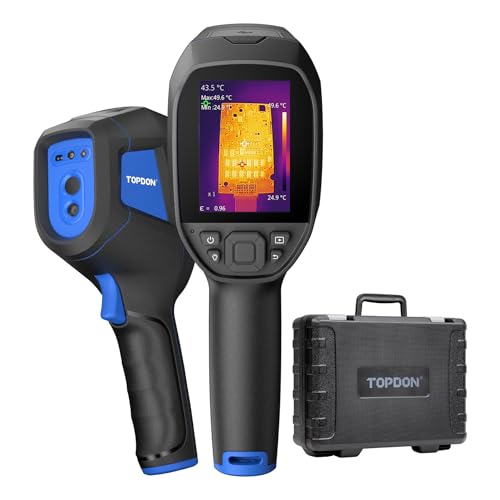
Dual-lens 3.5-inch handheld with laser distance measurement to 4 m, 64 GB, Wi-Fi and PC reporting.
Check price on Amazon$398.00 as of Oct 10, 2026 8:25 pm GMT+0000 — prices change; see Amazon for current price.| Specification | Details |
|---|---|
| Laser | Built-in laser distance measurement up to 4 meters |
| Display / optics | 3.5-inch screen; infrared plus visible-light camera |
| Software | Wi-Fi to the TopInfrared app; USB to TopView PC software for analysis and reports |
| Battery | Up to 8 hours; recharges in about 2 hours |
| Durability / extras | IP54; 2-meter drop; LED light; carrying case |
| Resolution / sensitivity | Not stated in listing; range -4°F to 1,022°F per title |
TOPDON TC005 — dual-lens, 3.5-in display, laser distance to 4 m, 64 GB, Wi-Fi + PC software, 8 h, IP54, 2 m drop
The Only Handheld That Uses Its Laser to Measure Distance
Four handhelds on the shelf include a laser. Three use it as a pointer to show where the camera is aimed. The TC005 is the only one that measures distance with it, up to 4 meters. Distance matters because a thermal camera’s spot reading covers a larger patch of surface the farther away you stand, and many cameras ask you to enter a distance for accurate readings. A measured value removes the guesswork.
It is also one of three handhelds that describe a visible-light camera alongside the thermal sensor, and one of only two (with the TC004) that claim 64 GB of storage. Its stated 2-hour recharge is a figure no other handheld here gives.
The gap is large, though: the listing never states the thermal sensor’s resolution or sensitivity. For a camera presented as a professional tool, that is a key omission. Ask the seller or check TOPDON’s own spec page before choosing it over the TC004.
Pros
- Only handheld with laser distance measurement
- Visible-light camera for context
- App and PC reporting paths
- Fast stated recharge and carrying case
Cons
- Thermal resolution not stated
- Sensitivity and accuracy not stated
- 8-hour runtime is mid-pack
3. HSFTOOLS HP96 — Best Touchscreen Handheld
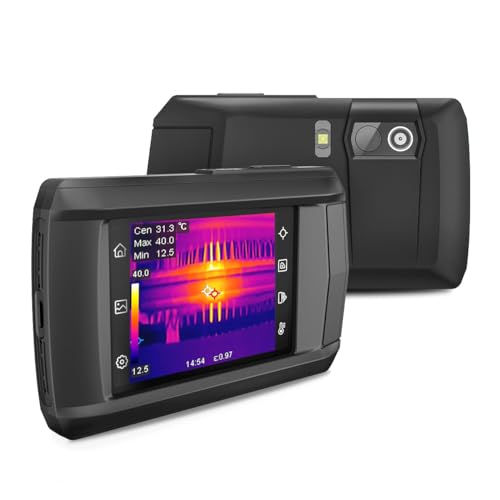
3.5-inch touchscreen handheld, 96×96 VOx sensor, 640×480 visible camera and leak/insulation scene detection.
Check price on Amazon$199.99 as of Oct 10, 2026 8:25 pm GMT+0000 — prices change; see Amazon for current price.| Specification | Details |
|---|---|
| Native / enhanced resolution | 96×96 VOx infrared, live enhancement to 240×240 |
| Display / controls | 3.5-inch touchscreen with a phone-style interface |
| Imaging modes | 640×480 visible camera; thermal, visual, fusion, picture-in-picture and blending modes; 8 palettes |
| Smart features | IntellFault scene detection flags likely water leaks and insulation gaps (firmware update required); no moisture readings |
| Sensitivity / accuracy | Below 50 mK; ±2%; 50° field of view |
| Battery / storage | Up to 4 hours; about 30,000 images or 20 hours of video; IP54; 6.6 ft drop |
HSFTOOLS HP96 — 3.5-in touchscreen, 96×96 VOx / 240×240, 640×480 visible, <50 mK, ±2%, 4 h battery, IP54
The Only Touchscreen Handheld on the Shelf
Every other handheld listing here is button-driven. The HP96 is the only one that describes a touchscreen, with swipe and tap controls for brightness, palettes and temperature span. For anyone used to a phone, that shortens the learning curve considerably. It also records audio through built-in microphones, so narration can go with the video.
Two listings on the shelf describe software that interprets the thermal image: the HP96’s IntellFault scene detection and the TOPDON TC001 Mini phone module. The HSFTOOLS listing is honest that the feature does not measure moisture; it highlights patterns that look like leaks or insulation gaps. Treat those flags as prompts to check with a moisture meter.
The weak points are the 96×96 native sensor, tied with the Holdwell listing for the smallest among handhelds that state one, and a 4-hour battery, the shortest stated runtime among the nine handhelds that give a figure.
Pros
- Only touchscreen handheld here
- 640×480 visible camera with five view modes
- Scene detection for leaks and insulation gaps
- Large storage and audio recording
Cons
- Small 96×96 native sensor
- Shortest stated battery life (4 hours)
- Scene detection needs a firmware update
4. FOXWELL RT280 — Best for PC Reports With Laser Targeting

2.8-inch handheld, 120×90 sensor, Windows 2D/3D analysis software, laser pointer, LED light and IP54.
Check price on Amazon$151.99 as of Oct 10, 2026 8:25 pm GMT+0000 — prices change; see Amazon for current price.| Specification | Details |
|---|---|
| Native / enhanced resolution | 120×90 infrared, enhanced to 240×180 |
| Display / view | 2.8-inch 320×240 LCD; 50°×38° field of view; 25 Hz |
| Software | Windows PC software for point, line and area analysis, 2D/3D views and automatic reports; Mac not supported |
| Storage | 8 GB eMMC; over 20,000 images and videos stated |
| Accuracy / range | ±3.6°F or ±2%; -4°F to 1,022°F; 9 palettes |
| Extras / durability | Laser pointer and LED light; IP54; 6.6 ft drop; battery runtime not stated |
FOXWELL RT280 — 120×90 native / 240×180, 2.8-in LCD, 50°×38°, Windows 2D/3D reports, 8 GB, laser + LED, IP54
Both FOXWELL Handhelds Offer 2D/3D PC Reports; Only the RT280 Adds a Laser and Light
Four handhelds on the shelf mention PC software. The two FOXWELL models describe the most detailed version: point, line and area analysis, 2D and 3D views and automatic report generation. Between them, only the RT280 adds a laser pointer and LED light, which help in a dark mechanical room or crawl space.
It also states its field of view (50°×38°) and a full accuracy figure, neither of which the TC004 or TC005 listings give.
The sensor is modest. At 120×90 native, it has fewer than a quarter of the TC004’s measured pixels. The listing does not state a battery runtime or thermal sensitivity, and its software is Windows-only.
Pros
- Detailed Windows reporting with 2D/3D views
- Laser pointer and LED light
- Full accuracy figure and field of view stated
Cons
- Small 120×90 native sensor
- Battery runtime and sensitivity not stated
- No Mac software
5. AMPBANK H128 — Best Battery Life and Weather Protection

Handheld with up to 24 hours of runtime, IP65, 128×128 sensor at 40 mK and a tripod mount.
Check price on Amazon$199.99 as of Oct 10, 2026 8:25 pm GMT+0000 — prices change; see Amazon for current price.| Specification | Details |
|---|---|
| Native / enhanced resolution | 128×128 infrared, enhanced to 240×240 |
| Sensitivity / refresh | 40 mK; 25 Hz |
| Battery | Up to 24 hours of continuous use; auto shut-down |
| Durability | IP65; survives a 6.56 ft drop; standard tripod mount |
| Accuracy / range | ±3%; 0.1°C resolution; -4°F to 842°F |
| Not stated | Display size, storage and warranty not stated in listing |
AMPBANK H128 — 128×128 native / 240×240, 40 mK, 25 Hz, up to 24 h, IP65, 6.56 ft drop, tripod mount, -4°F to 842°F
The Longest Stated Runtime and the Only IP65 Rating Among These Handhelds
Nine handhelds state a battery runtime, ranging from 4 to 24 hours. The H128’s 24 hours is the longest by a wide margin; the next best are 15 hours (TC004 Mini) and 14 hours (AccuMEMS GT14S). It is also the only handheld rated IP65, which adds protection against water jets, while nine others state IP54.
That combination suits multi-day use away from a charger and exterior scans in damp or dusty conditions, such as a roof deck after rain or a dusty unfinished basement. The tripod mount allows hands-free monitoring of a panel or radiant floor warm-up over time.
Its stated ±3% accuracy is the loosest figure among handhelds that give one, and its 842°F ceiling is lower than most. Display size and storage capacity are not stated.
Pros
- Up to 24 hours of stated runtime
- Only IP65 handheld here
- 40 mK sensitivity stated
- Tripod mount for hands-free monitoring
Cons
- Loosest stated accuracy (±3%)
- Display size and storage not stated
- Lower 842°F ceiling
6. TOPDON TC004 Mini — Best Compact Handheld

Pocket handheld, 128×128 sensor, auto-photo on temperature alarm, 15-hour battery, IP54 and 2 m drop.
Check price on Amazon$159.00 as of Oct 10, 2026 8:25 pm GMT+0000 — prices change; see Amazon for current price.| Specification | Details |
|---|---|
| Native / enhanced resolution | 128×128 infrared, enhanced to 240×240 |
| Field of view / refresh | 40°×30°; 25 Hz |
| Alarms | On-screen warning above a preset temperature, with automatic photo capture |
| Storage | 512 MB eMMC, up to 8,000 photos |
| Battery | Up to 15 hours; auto shut-off at 5, 10 or 20 minutes; cable included, no charger head |
| Accuracy / durability | ±3.6°F or 2%; -4°F to 842°F; IP54; 2-meter drop |
TOPDON TC004 Mini — 128×128 native / 240×240, 40°×30°, auto-photo alarm, 8,000 photos, 15 h, IP54, 2 m drop
The Only Handheld That Captures a Photo Automatically When an Alarm Trips
Most handhelds here offer high and low temperature alarms. The TC004 Mini is the only one whose listing says it also snaps a photo automatically when the preset limit is crossed. That creates a record without a second hand on the trigger, useful when scanning breaker after breaker.
Its 15-hour stated runtime is second only to the H128, and its 40°×30° field of view is narrower than the 50° figures on several competitors, which concentrates the sensor’s pixels on a smaller area at the same distance.
Storage is the smallest stated on the shelf at 512 MB, though 8,000 photos is plenty for a house. There is no laser, no Wi-Fi and no PC software, and no paper manual ships in the box.
Pros
- Auto-photo on alarm, unique on this shelf
- 15-hour stated runtime
- Pocket-sized with IP54 and 2 m drop rating
Cons
- 128×128 native sensor
- No laser, Wi-Fi or PC reporting
- No charger head or paper manual included
7. AccuMEMS GT14S — Best for Thermal Plus Point-and-Shoot Readings

240 g handheld with thermal and thermometer modes, under 50 mK, 50° view and up to 14 hours.
Check price on Amazon$129.99 as of Oct 10, 2026 8:25 pm GMT+0000 — prices change; see Amazon for current price.| Specification | Details |
|---|---|
| Modes | Full-screen thermal with center, hot and cold spots, plus a thermometer mode for single-point readings |
| Sensitivity / view | Below 50 mK (about 0.05°C); 50° field of view |
| Range / settings | -4°F to 1,022°F; adjustable emissivity, distance, level and span |
| Battery / weight | 2,500 mAh, up to 14 hours; 240 g |
| Warranty | 1 year |
| Not stated | Sensor resolution, accuracy and IP rating not stated in listing |
AccuMEMS GT14S — thermal + thermometer modes, <50 mK, 50° view, -4°F to 1,022°F, 14 h, 240 g, 1-yr warranty
The Only Handheld Model Here With a Dedicated Thermometer Mode
Two listings on the shelf describe the GT14S under different titles, and it is the only model offering a separate thermometer mode for quick single-point readings. That is useful when you want a number for one surface, such as a supply register or water heater line, without reading it off a full thermal frame.
The 240 g weight and up to 14 hours of runtime make it one of the lightest stated handhelds with all-day battery.
The listing never gives the sensor resolution, which is the most important spec on a thermal camera, and it omits accuracy and ingress ratings. Pick it for the dual-mode convenience, not for image detail.
Pros
- Thermometer mode alongside thermal imaging
- Light at 240 g with up to 14 hours of use
- Level and span controls for contrast
Cons
- Sensor resolution not stated
- Accuracy and IP rating not stated
- 1-year warranty
Handheld vs phone plug-in: which format fits
Nine of the 21 listings on this shelf are phone plug-ins. They are lighter and use a phone’s large screen, and several state larger native sensors than most of the handhelds. A handheld wins on independence: a dedicated battery, buttons that work with gloves, a lanyard or tripod mount, and in several cases a laser pointer and light. It also keeps your phone free for calls, photos and notes during an inspection.
Homeowners doing a one-time draft hunt often do fine with a plug-in; our guide to whether an iPhone can do thermal imaging covers that route. Anyone scanning several houses a week, working in attics and crawl spaces, or handing the camera to a helper will usually prefer a handheld.
Specs that matter on a handheld thermal camera
Native resolution first
Ignore the enhanced figure and look for the native sensor size. On this shelf, handheld native sensors run from 96×96 (9,216 pixels) to 256×192 (49,152 pixels), a five-fold spread. Five handheld listings do not state a native size at all, which is a reason for caution, not a neutral omission.
Thermal sensitivity
Lower NETD means smaller temperature differences show up. Stated handheld figures range from 40 mK to 60 mK. Many handheld listings do not state one, including the TC004 and TC005.
Battery and charging
A camera that dies halfway through a scan is useless. Stated handheld runtimes range from 4 hours (HP96) to 24 hours (H128). Note whether the box includes a charger head; the TC004 Mini, for example, ships with a cable only.
Display, laser and light
A 3.5-inch screen is easier to read in a bright room than a 2.8-inch one. Laser pointers help match a small hot spot to a real object, and an LED light saves juggling a flashlight in a crawl space.
Durability
Ten of the 12 handhelds state a drop rating, and ten state an ingress rating (nine IP54, one IP65). Inspectors drop tools on ladders and in attics, so a stated rating is worth having.
Thermometer or thermal camera?
A spot infrared thermometer measures one point; a thermal camera shows the pattern across a surface. Both are useful, and some handhelds like the GT14S combine the two. Our how to use an infrared thermometer guide explains emissivity and distance-to-spot, which apply to thermal cameras too, and our infrared thermometer gun guide covers the simpler tool.
How inspectors use a handheld thermal camera in a house
ENERGY STAR points to drafty rooms, uneven temperatures, cold floors, ice dams and high energy bills as signs a home needs air sealing or insulation, and it says sealing and insulating can save up to 10% on annual energy bills. A handheld makes it fast to trace those symptoms to a source:
- Exterior walls and ceilings: missing or slumped insulation shows as irregular cool areas from inside on a cold day.
- Attic hatches, rim joists and top plates: air leakage appears as cool streaks fanning out from a gap.
- Plumbing and roof leaks: damp materials often read cooler as water evaporates. The EPA lists the backs of drywall, pipe chases, ceiling tiles, carpet undersides and humid crawl spaces as common hidden moisture spots.
- Electrical panels: a breaker or lug much warmer than its neighbors under similar load is a flag for an electrician.
- Heating and cooling: radiant floor loops, duct leaks and blocked registers stand out clearly.
Our infrared scan home inspection guide covers how a professional scan is sequenced, and the FLIR infrared camera guide covers the brand most inspectors know.
Colorado notes for Front Range homes
Thermal imaging needs a temperature difference across the wall. Front Range winters supply that most mornings, which makes cold, calm, early-day scans the most productive; afternoon sun on south and west walls can hide what the morning shows. Chinook winds can also change surface temperatures quickly, so scan at a steady time when comparing before and after an insulation job.
The region’s dry air means a persistent cool, damp-looking area is more likely to be a real leak than routine condensation. The EPA recommends keeping indoor humidity below 60 percent, ideally 30 to 50 percent, and drying wet materials within 24 to 48 hours.
Before acting on a thermal scan with air sealing, remember ENERGY STAR’s caution that sealing can trap radon and carbon monoxide and can cause combustion appliances to backdraft. In a region with common elevated radon, test before and after; many foothills homes in places such as Conifer also burn propane or wood, which makes combustion safety checks more important.
Limits of a handheld camera vs a professional inspection
No thermal camera sees through walls or measures moisture content. A handheld shows surface temperature patterns, and the same cool patch can mean water, missing insulation or air leakage. Confirm suspected moisture with a meter, and do not open walls on a thermal image alone.
Electrical findings carry real stakes. The U.S. Fire Administration estimates 24,200 residential building electrical fires in 2021, with an estimated 295 deaths and 900 injuries. A warm breaker is a reason to call a licensed electrician rather than remove the panel cover yourself.
A professional thermographer pairs a higher-grade camera with a documented process, moisture readings and visual inspection, and reports findings in context. For a pre-purchase inspection or a thermal scan you can rely on, contact us and we will connect you with a vetted local inspector. The home inspection tools hub lists the other instruments that support this work.
References
- Seal and Insulate with ENERGY STAR — ENERGY STAR (U.S. EPA)
- Identify the Problems You Want to Fix — ENERGY STAR (U.S. EPA)
- A Brief Guide to Mold, Moisture and Your Home — U.S. Environmental Protection Agency
- Mold Course Chapter 2: Why and Where Mold Grows — U.S. Environmental Protection Agency
- Appliance and Electrical Fire Safety — U.S. Fire Administration
Frequently asked questions
What is the best handheld thermal camera for home inspections?
Among current listings, the TOPDON TC004 states a 256×192 native sensor, the largest among handhelds reviewed, along with a 3.5-inch screen, laser pointer, LED light, 64 GB storage and Wi-Fi transfer. It does not state sensitivity or battery life, so confirm those on the manufacturer's spec sheet.
Is a handheld thermal camera better than a phone attachment?
Not always. Phone attachments are lighter and some state larger native sensors. Handhelds offer their own battery and screen, glove-friendly buttons, and features such as laser pointers, lights and drop ratings. Frequent users and inspectors usually prefer a handheld; occasional homeowners often do fine with a plug-in.
How long does a handheld thermal camera battery last?
Stated runtimes on current handheld listings range from about 4 hours to 24 hours. The AMPBANK H128 states up to 24 hours, the TOPDON TC004 Mini 15 hours and the AccuMEMS GT14S 14 hours. Several listings do not state runtime at all.
What resolution do I need in a handheld thermal camera?
Compare native sensor resolution, not the enhanced figure. For whole-wall and ceiling scans in a house, more native pixels let you stand farther back and still see individual stud bays. Handheld native sensors on current listings range from 96×96 to 256×192.
Can a handheld thermal camera find mold?
No. It can show cool areas that may indicate moisture, which is what mold needs to grow, but it cannot identify mold. Confirm moisture with a meter, and the EPA advises drying wet materials within 24 to 48 hours and fixing the water source.
Need a thermal scan, moisture check or full pre-purchase inspection on the Front Range? Reach out through our contact page to connect with a vetted local inspector.
Thermal imaging cameras
Infrared cameras reveal hidden moisture, missing insulation, and air leaks. Phone-attachment models are the budget entry point; standalone units have higher resolution.
| Product | Why | Buy |
|---|---|---|
 FLIR ONE Pro (phone) FLIR ONE Pro (phone) | Plugs into iPhone/Android; inspector favorite. | Amazon — $349.00 |
 Topdon TC001 Topdon TC001 | High-res phone module at a low price. | Amazon — $199.99 |
 FLIR C5 Compact FLIR C5 Compact | Standalone pocket camera with Wi-Fi. | Amazon — $611.50 |