Engineered Hardwood Flooring: Wear Layers, Moisture and Install
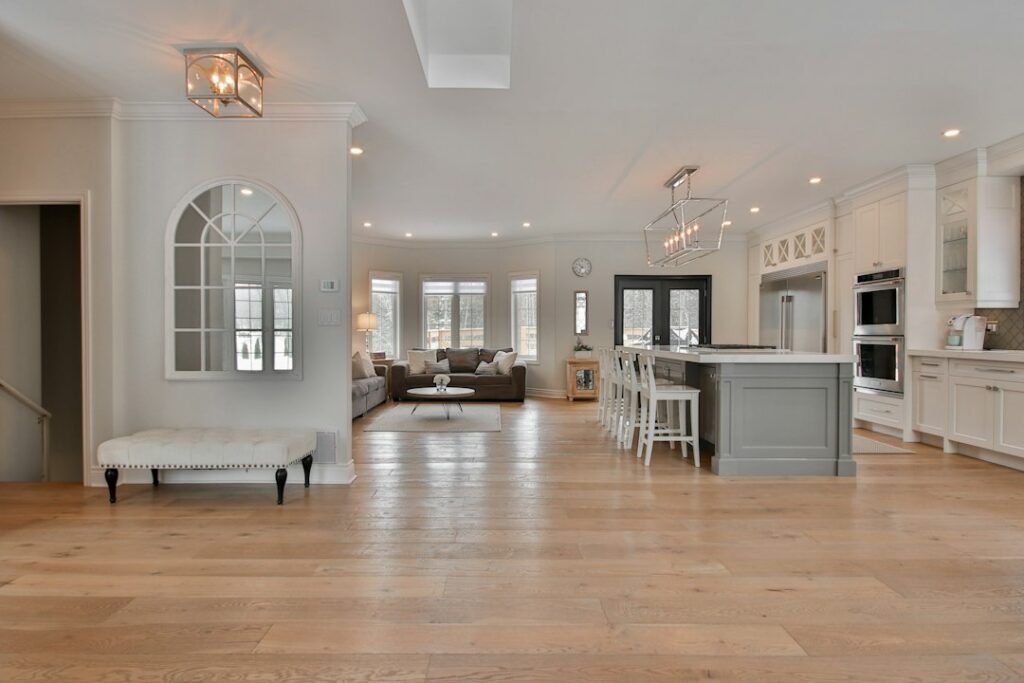
Engineered hardwood looks like solid wood because the surface is solid wood. Underneath, it is a layered product designed to move less with changes in moisture, which lets it go places solid hardwood often cannot, such as over concrete slabs, in some basements and over radiant heat. Engineered hardwood flooring is also widely misunderstood. Some products can be sanded and refinished several times; others barely once. Some float, some are glued and some are nailed. And in Colorado’s dry winters, even engineered planks can shrink enough to show gaps. This guide explains how the product is built, why wear layer thickness matters, the main installation methods, humidity and moisture management, how it compares with solid wood and luxury vinyl, water damage, what inspectors look for, and general cost ranges that vary by species, product and installer.
Part of our Structure & Exterior guide — start there for the full picture →
What Engineered Hardwood Flooring Is
An engineered plank has two main parts: a top layer of real hardwood, called the wear layer or veneer, bonded to a core made of other materials. The core is typically one of the following:
- Multi-ply plywood core. Thin wood plies stacked with the grain in alternating directions and glued together. The cross-grain construction resists expansion and contraction, which is the main stability advantage over solid wood.
- HDF (high-density fiberboard) core. A dense, uniform panel made from wood fibers and resin. HDF cores are common in thinner, click-together products and are generally more vulnerable to swelling if they get wet at the edges.
- Lumber or lamella core. Strips of softwood or hardwood laid side by side under the wear layer, with a backing ply below. Often found in thicker, premium planks.
Some products add a bottom balancing layer to keep the plank flat. Total plank thickness commonly ranges from roughly 3/8 inch to 3/4 inch, with wider planks often coming in thicker constructions.
Because plywood and fiberboard are bonded with resins, formaldehyde emissions are a reasonable question. EPA’s formaldehyde emission standards for composite wood products, implemented under TSCA Title VI, cover hardwood plywood, medium-density fiberboard and particleboard, as well as finished goods containing these products, and require compliant products to be labeled. Buyers can look for TSCA Title VI compliance on the box or spec sheet.
Wear Layer Thickness and Refinishing
The wear layer determines how long the floor can last and whether it can be renewed. A common way to think about it:
| Wear layer (approx.) | Typical refinishing potential |
|---|---|
| Under about 1 mm | Generally should not be sanded; screen-and-recoat only, if the finish allows |
| About 1 to 2 mm | Perhaps one light sanding by a skilled refinisher |
| About 2 to 3 mm | Often one or two sandings |
| About 4 mm and up | Several sandings possible over the life of the floor |
These are rules of thumb; the actual number of sandings depends on how flat the floor is, how deep the damage goes, and how much wood each sanding removes. A drum sander on an uneven floor can cut through a thin veneer in spots, exposing the core, and that damage cannot be repaired by refinishing.
Many engineered floors come with tough factory finishes, often containing aluminum oxide, that resist wear well but are harder to recoat because new finish may not bond without proper abrasion or a bonding product. Before planning a refresh, confirm the wear layer thickness from the manufacturer or by pulling a floor register or transition to look at a plank edge. Our hardwood floor refinishing cost guide compares sanding, screen-and-recoat and replacement, including the specific limits for engineered floors.
Installation Methods: Float, Glue or Nail
Engineered hardwood is versatile in part because it can be installed several ways. The manufacturer’s instructions dictate which methods are approved for each product, and following them is usually a warranty requirement.
Floating
Click-lock or glued-edge planks rest on an underlayment without fastening to the subfloor. Floating is fast and suits concrete slabs and some existing floors. Floating floors need perimeter expansion gaps, can sound hollow underfoot, and feel less solid than fastened floors. Heavy fixed items such as kitchen islands should not pin a floating floor in place.
Glue-Down
Planks are adhered directly to a prepared subfloor, often concrete, with a trowel-applied adhesive. Glue-down floors feel solid and quiet. The tradeoffs are labor, adhesive cost and a messier removal later. Many flooring adhesives also double as moisture barriers on slabs, but only if applied to the manufacturer’s specification. Adhesives can emit VOCs; EPA lists glues and adhesives among VOC sources and recommends increasing ventilation when using products that emit them.
Nail-Down or Staple-Down
Thicker engineered planks can be fastened to a wood subfloor with a flooring nailer or stapler, like traditional solid hardwood. This is common over plywood on upper floors and over crawl spaces. It is not an option directly over concrete without a wood sleeper system or plywood underlayment.
Whatever the method, the subfloor needs to be flat, clean, structurally sound and dry. Soft or delaminated sheathing should be repaired first; the subfloor repair guide covers typical fixes.
Moisture, Humidity and Colorado’s Dry Winters
Engineered wood is more dimensionally stable than solid wood, but it is still wood. It absorbs and releases moisture as indoor humidity changes, and the hardwood wear layer can check or crack if it dries out too far.
Along the Front Range, indoor relative humidity can drop very low in winter, particularly in homes with forced-air heat and no humidification. Many flooring manufacturers specify an indoor humidity range, often somewhere around 30 to 50 or 35 to 55 percent, and may exclude damage caused by conditions outside it. Low humidity can lead to:
- Gaps between planks that open in winter and close in summer.
- Fine cracks or checks in the wear layer, especially on wide planks with face-sawn veneers.
- Edge separation or slight cupping across planks as the top dries faster than the core.
The solution is managing humidity rather than blaming the floor. A hygrometer in the main living area shows actual conditions. A whole-house humidifier can raise winter humidity across a home with forced-air heating, while portable humidifiers help in smaller spaces. Overdoing it creates the opposite problem, condensation on windows and mold risk. EPA’s mold and moisture guide recommends keeping indoor relative humidity below 60 percent, ideally between 30 and 50 percent, which lines up with many flooring specifications.
In summer, or in basements, humidity can run high instead, causing planks to swell and cup. Our guide on how to lower humidity in your house covers dehumidifiers, ventilation and moisture sources.
Acclimation matters too. Manufacturers typically specify how long boxes should sit in the conditioned room before installation and what moisture readings the wood and subfloor should show. A pin or pinless meter from our moisture meter category lets installers and homeowners compare plank and subfloor readings before work starts.
Engineered vs Solid Hardwood vs LVP
Each option has a place. The right choice depends on where the floor goes, how long it needs to last and what the household expects.
| Factor | Engineered hardwood | Solid hardwood | LVP |
|---|---|---|---|
| Surface | Real wood veneer | Real wood throughout | Printed image under a vinyl wear layer |
| Stability with humidity changes | Good | More movement | Not affected by humidity, but moves with temperature |
| Over concrete or basements | Often approved with proper prep | Generally not recommended below grade | Commonly used with vapor control |
| Refinishing | Limited by wear layer | Many sandings over its life | Cannot be refinished |
| Water tolerance | Low to moderate | Low | Planks resist water; subfloor still at risk |
| Feel and sound | Wood feel; varies by install | Solid wood feel | Harder or softer depending on core |
Solid hardwood can be sanded many times and lasts generations when cared for, but it moves more seasonally and is usually kept to above-grade wood subfloors. Engineered wood trades some long-term refinishing potential for stability and installation flexibility. LVP resists spills and is often less expensive, but it is plastic, cannot be refinished and offers a different feel. Our LVP flooring guide covers rigid core products, slab moisture and common problems in more depth.
Water Damage and Engineered Floors
Engineered hardwood tolerates humidity swings better than solid wood, but it does not tolerate standing water well. Leaks from dishwashers, refrigerator ice-maker lines, toilets and pet accidents can cause:
- Swelling at plank edges, particularly with HDF cores.
- Cupping or crowning across planks.
- Delamination of the veneer from the core.
- Dark staining in the wood surface.
- Mold growth on the subfloor or underlayment beneath, which may not be visible from above.
EPA recommends drying water-damaged areas and materials within 24 to 48 hours to help prevent mold growth. Fast cleanup, fans, dehumidifiers and moisture readings across the area all help. Planks that have delaminated or swollen at the edges usually need replacement, which is simpler with click-lock floors and harder with glue-down installs. Our guide to hardwood floor water damage explains how to tell when drying is enough and when boards and subfloor need replacing.
Keeping a few boxes of spare planks from the original install makes later repairs far easier, since stains and finishes can be hard to match years later.
Homeowners insurance policies often treat sudden leaks, such as a burst supply line, differently from slow, long-term seepage. Documenting damage with photos and moisture readings right away, and before removing any flooring, helps with any claim and with deciding whether the subfloor below also needs attention.
Care and Maintenance That Protects the Wear Layer
Because the wear layer is finite, everyday care matters more for engineered floors than for solid wood. Small habits extend the time between refinishing and protect the veneer from damage that cannot be sanded out.
- Grit control. Sand and fine gravel tracked in from Front Range driveways and trails act like sandpaper. Doormats inside and outside entries, plus regular sweeping or vacuuming with a hard-floor setting, reduce surface wear.
- Cleaning products. Use the cleaner the manufacturer recommends. Steam mops, wet mopping and oil soaps can damage some finishes or push moisture into seams, and many warranties exclude damage from them.
- Furniture protection. Felt pads under chairs and tables, and wide casters on rolling chairs, prevent dents and scratches. Desk chair mats help in home offices.
- Sun exposure. Intense high-altitude sunlight can change the color of many wood species over time. Rotating rugs and using window coverings keep fading more even.
- Pets. Trimmed nails reduce scratching, and accidents should be cleaned up quickly before urine soaks into seams.
- Periodic recoat. When the finish starts to look dull in traffic lanes but the wood itself is not damaged, a professional screen-and-recoat can renew protection without consuming much of the wear layer, if the finish type allows it.
Keeping the box label or a product receipt helps later. Knowing the exact product, finish type and wear layer makes future repairs, recoats and insurance claims much easier.
Underlayment and Sound Control
Floating installations over concrete usually call for an underlayment with a vapor retarder, while upstairs floors in condos and townhomes may require an acoustic underlayment to meet homeowner association rules. HOA documents in many Denver-area multifamily buildings specify minimum sound ratings for hard flooring, so checking those rules before buying avoids having to tear out a new floor.
How Much Engineered Hardwood Flooring Costs
The ranges below are general national estimates as of 2026, not quotes. Species, plank width, wear layer, finish and installation method all move the price, and Front Range labor can run toward the upper end.
| Item | Typical range (per sq ft) |
|---|---|
| Entry-level engineered planks, thin wear layer (material) | Roughly $3 to $6 |
| Mid-range to premium planks, thicker wear layer or wide plank (material) | Roughly $6 to $13 or more |
| Installation labor (float, glue or nail) | Roughly $3 to $8 |
| Removal of old flooring, leveling, subfloor repair, moisture barrier | Varies widely by condition |
Glue-down installs over concrete usually cost more in labor and adhesive than floating installs. Stairs, custom trim, transitions and moving furniture are often priced separately. Comparing quotes is easier when each specifies the exact product line, wear layer thickness, installation method and preparation work. A floor that costs more up front but can be sanded two or three times may cost less over 30 years than a cheaper product that must be replaced once the surface wears through.
Choosing a Product for Front Range Homes
For main living areas on wood subfloors, a plywood-core plank with a wear layer thick enough to sand at least once is a common middle ground. For slab-on-grade ranches and basements, products explicitly approved for below-grade installation over concrete narrow the field. Wide planks look attractive but may show seasonal gaps more, so pairing them with winter humidification is sensible in dry climates. Oil finishes are easy to spot-repair but need periodic maintenance; factory urethane and aluminum oxide finishes are low-maintenance but harder to recoat. Asking for the manufacturer’s installation guide and warranty before buying shows what conditions the product expects.
What Inspectors Look for With Engineered Hardwood
During a home inspection, flooring is evaluated as part of the interior. The ASHI Standard of Practice lists walls, ceilings and floors among the interior components inspectors inspect, while noting that inspections are not technically exhaustive and inspectors are not required to report concealed conditions or cosmetic imperfections that do not significantly affect a component’s function. In practice, an inspector may note:
- Cupping, crowning, edge swelling or delamination that suggests past or ongoing moisture.
- Gaps, checking or separated seams that may relate to humidity.
- Soft spots, bounce or noises that hint at subfloor issues.
- Elevated moisture meter readings near kitchens, baths, laundry areas and exterior doors.
- Stains around appliances and fixtures.
Product details such as wear layer thickness or remaining refinishing life generally fall outside a standard inspection, so a flooring contractor may be the right person to evaluate those. Our guide to hiring a home inspector explains what a typical inspection covers and how to ask about moisture testing.
References
- Formaldehyde Emission Standards for Composite Wood Products — U.S. Environmental Protection Agency
- A Brief Guide to Mold, Moisture and Your Home — U.S. Environmental Protection Agency
- Volatile Organic Compounds’ Impact on Indoor Air Quality — U.S. Environmental Protection Agency
- ASHI Standard of Practice for Home Inspections — American Society of Home Inspectors
Frequently asked questions
Can engineered hardwood be refinished?
Often, but it depends on the wear layer. Very thin veneers generally should not be sanded, while thicker wear layers of roughly 2 mm or more may allow one or more sandings. Confirm the wear layer with the manufacturer before planning a refinish.
Is engineered hardwood better than solid hardwood?
Neither is universally better. Engineered hardwood is more stable with humidity changes and can often go over concrete or in basements, while solid hardwood can be sanded many more times over its life. The right choice depends on location and long-term plans.
Why does my engineered hardwood have gaps in winter?
Low indoor humidity, common in Colorado winters, causes wood to shrink. Many manufacturers specify an indoor humidity range, and adding humidification can reduce seasonal gapping and wear-layer checking.
Can engineered hardwood be installed in a basement?
Some products are approved for below-grade installation over concrete, typically floated or glued down with moisture testing and a vapor retarder. Basements with active leaks or high humidity should be fixed first.
Is engineered hardwood waterproof?
No. It handles humidity changes better than solid wood, but standing water can swell edges, delaminate the veneer and damage the subfloor. Spills and leaks should be dried quickly.
Comparing flooring in a Front Range home you are about to buy? Connect with us and we can point you to a local inspector who checks floors for moisture, subfloor movement and past leaks.