Dryer Vent Periscopes: Tight-Space Venting Without Crushed Hose
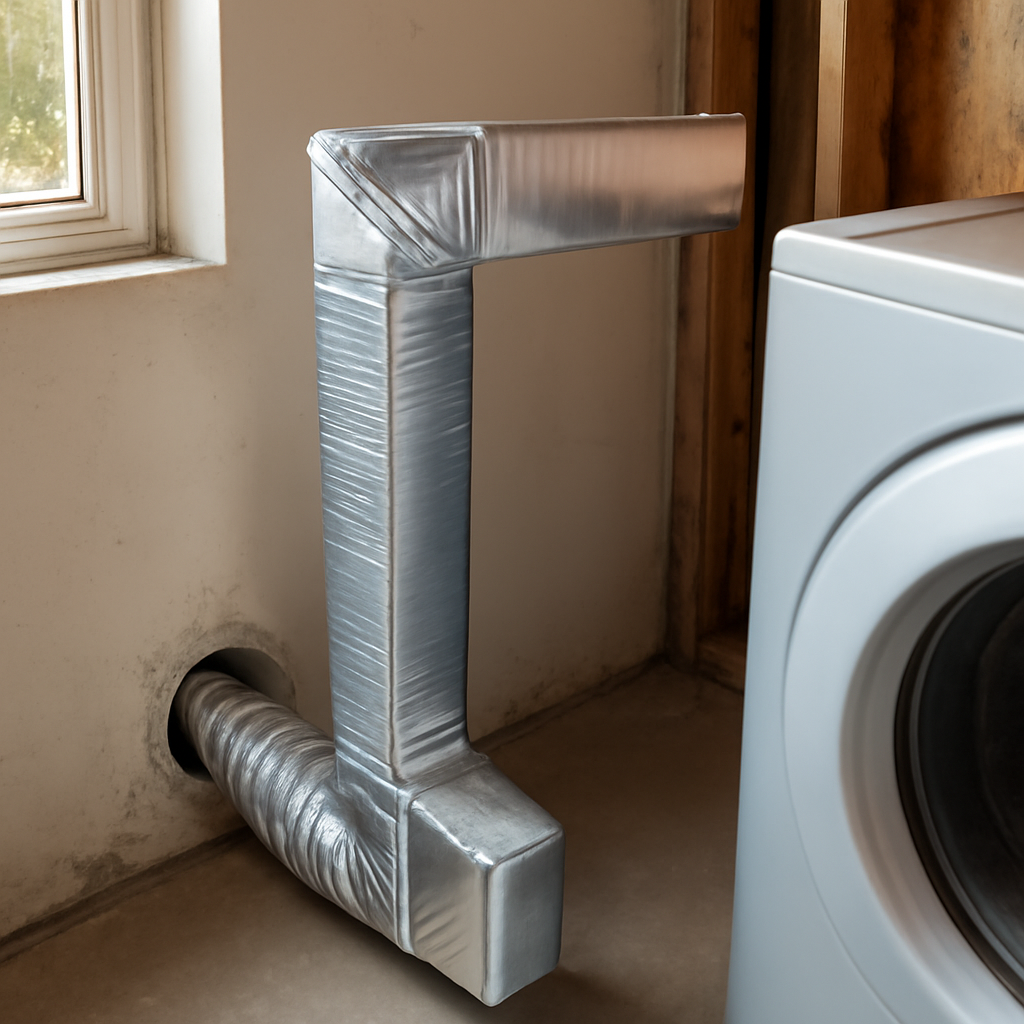
Pushing a dryer back against the wall is where most transition ducts get into trouble. The short connector between the dryer’s exhaust outlet and the wall gets folded, flattened or kinked, and a vent that was fine on installation day becomes a lint trap. A dryer vent periscope is one of the simplest fixes: a slim, flat metal channel that bridges the gap behind the dryer without the bends that crush ordinary hose. This guide explains what a periscope vent is, why it is generally a better choice than accordion foil hose, how to size one to the gap and connect it to a wall box, how to seal the joints, and how it fits into broader dryer vent maintenance. It also covers warning signs, inspection, related problems and typical costs. Manufacturer instructions for the dryer and the vent product, along with local code, govern any specific installation.
Part of our Heating, Cooling & Ventilation guide — start there for the full picture →
What a Dryer Vent Periscope Is
A dryer vent periscope is a short, rectangular or oval duct, usually made of rigid or semi-rigid aluminum, that runs vertically behind the dryer. One end has a round collar that connects to the dryer’s 4-inch exhaust outlet. The other end has a round collar that connects to the duct coming out of the wall. The flat body between them is only a few inches deep, which lets it fit in the narrow space between the back of the dryer and the wall.
The name comes from the shape. Like a periscope, it offsets air vertically while staying slim. Most models are telescoping, so the height can be adjusted to match the vertical distance between the dryer outlet and the wall outlet. Some include a rotating collar or offset so the connection can be lined up even when the wall outlet is not directly above or below the dryer’s exhaust.
Periscopes are especially common in:
- Laundry closets and alcoves where the dryer needs to sit as close to the wall as possible.
- Stacked or side-by-side setups where doors or folding counters limit depth.
- Homes where the wall outlet is high, such as in many split-level and basement laundry rooms along the Front Range, and the duct has to climb from the dryer’s low outlet.
Why a Periscope Beats Crushed Foil Hose
The most common alternative behind a dryer is a flexible accordion hose, sometimes plastic, more often thin foil. These hoses are cheap and easy to install, but they are easily squashed when the dryer is pushed back. Every crushed section reduces airflow and creates ridges where lint collects.
The U.S. Consumer Product Safety Commission’s safety alert on overheated clothes dryers recommends replacing plastic or foil accordion-type ducting with rigid or corrugated semi-rigid metal duct. CPSC notes that most manufacturers specify rigid or corrugated semi-rigid metal duct, which provides maximum airflow, and that flexible plastic or foil duct can more easily trap lint and is more susceptible to kinks or crushing, which can greatly reduce airflow.
A periscope addresses that problem directly. Because the body is formed metal rather than a collapsible hose, it does not fold when the dryer moves back. The interior is smoother than accordion hose, so lint has fewer places to hang up. And because the periscope is designed for a shallow space, the dryer can usually sit closer to the wall than it could with a looped hose.
That does not make every periscope automatically compliant or suitable. The dryer manufacturer’s installation instructions should be checked for allowed transition duct types, and some local codes have specific rules for transition ducts. Our dryer vent hose guide compares foil, semi-rigid and rigid options and explains which are generally discouraged.
Sizing a Periscope to the Gap
Periscopes come in several height ranges, and most telescope within that range. Choosing the right one starts with a few measurements, taken with the dryer pulled out:
- Vertical distance. Measure from the center of the dryer’s exhaust outlet to the center of the wall duct opening, with the dryer at its final height (including any pedestal). The periscope’s adjustable range should cover this distance with some margin.
- Horizontal offset. If the wall outlet is not directly above or below the dryer outlet, note how far it is offset side to side. Some periscopes accommodate small offsets; larger ones may need a different approach.
- Depth. Measure how much space is available between the back of the dryer and the wall. The periscope body plus its collars needs to fit without the dryer pressing on it.
- Outlet location. Some dryers exhaust from the bottom center, others from the side or lower back. A periscope generally works best with a rear outlet that lines up vertically with the wall box or duct.
When the measurements fall between product sizes, choosing the model whose range comfortably includes the needed height is usually better than stretching a shorter one to its limit, where joints may loosen.
Connecting to the Wall Box
Many modern laundry rooms use a recessed dryer vent box: a metal box set into the wall with a 4-inch duct connection inside. The box lets the transition duct turn into the wall without sticking out into the room, which pairs well with a periscope. Our dryer vent box guide explains how recessed boxes work and how they are installed in new and existing walls.
Where there is no box, the periscope connects to a duct elbow or collar that comes out of the wall or floor. The key is that the connection is round-to-round, the same 4-inch diameter at both ends, and fully seated so the joint does not leak lint-laden air into the wall cavity or laundry room.
Typical installation sequence
- Unplug the dryer, or shut off gas at the appliance valve for a gas dryer, before moving it.
- Pull the dryer out and remove the old transition duct.
- Clean lint from the dryer’s exhaust outlet and the wall duct opening.
- Set the periscope height and attach the top or bottom collar to the wall connection.
- Attach the other collar to the dryer’s outlet, then seal both joints.
- Slide the dryer back carefully while watching that the periscope stays aligned.
- Run the dryer and confirm strong airflow at the exterior hood.
Gas dryer connections and any work on the gas line belong with a qualified professional. Our dryer vent installation guide covers the full vent run, including length limits, elbows and exterior terminations.
Sealing Joints: Foil Tape, Not Screws Into the Airflow
How the joints are fastened matters as much as the duct type. A common recommendation from dryer and vent manufacturers is to seal joints with foil tape rated for the purpose, or with clamps, rather than sheet metal screws that protrude into the duct. Screw tips inside the airstream catch lint, and over time a cluster of screw tips can build up a significant blockage. Duct tape (cloth tape) is generally discouraged because its adhesive can fail with heat.
Product instructions vary, so the periscope manufacturer’s directions and the dryer’s installation manual should be followed. If clamps are supplied, they are usually designed to hold the collar on the dryer and wall outlets snugly. Foil tape over the seam can then reduce air leaks.
A few other practices commonly recommended:
- Make sure male ends point in the direction of airflow so lint does not catch on the overlap.
- Do not use the periscope as a support for anything, and keep it clear of laundry and clutter behind the dryer.
- Check the joints any time the dryer is moved for cleaning or service.
Periscopes Compared With Other Tight-Space Options
A periscope is not the only way to get a dryer close to the wall. Each alternative has a place, and the right choice depends on outlet positions, available depth and the dryer manufacturer’s instructions.
Semi-rigid aluminum duct
Semi-rigid aluminum duct holds its shape better than foil hose and is often listed by dryer manufacturers as an acceptable transition duct. It still needs a gentle bend behind the dryer, so it usually requires more depth than a periscope. Pushed too hard, it can also be kinked.
Rigid elbows and short straight sections
Where the dryer outlet and wall outlet line up neatly, a pair of rigid elbows and a short straight piece can create a smooth, durable connection. This approach takes more precise measurement and is less forgiving if the dryer is moved or replaced with a model whose outlet sits elsewhere.
Low-profile close-clearance elbows
Some products are flattened elbows designed to let the dryer sit only a short distance from the wall. They work well when the wall outlet is at roughly the same height as the dryer outlet, while a periscope handles larger vertical differences.
Recessed box plus periscope
Combining a recessed wall box with a periscope is a common way to reach the shallowest setup, since the box absorbs the turn into the wall and the periscope bridges the vertical gap. For tight laundry closets, this pairing often gives the most clearance with the fewest restrictions.
Lint Buildup, Cleaning and Exterior Covers
A periscope reduces crushing, but it does not eliminate lint. Lint still passes the filter, coats duct walls and collects at joints, elbows and the exterior hood. CPSC advises cleaning the lint screen before or after drying each load and cleaning the dryer vent and exhaust duct periodically. CPSC also recommends checking the outside vent while the dryer is operating to confirm exhaust air is escaping, and having a qualified service person clean the interior of the dryer chassis periodically.
The U.S. Fire Administration states that failure to clean was the leading factor contributing to the ignition of clothes dryer fires in homes from 2018 to 2020, citing National Fire Incident Reporting System data. USFA’s clothes dryer fire safety flyer adds practical checks: do not use the dryer without a lint filter, clean the back of the dryer where lint can build up, check the venting system behind the dryer to make sure it is not damaged, crushed or restricted, and make sure the outdoor vent covering opens when the dryer is operating.
Many periscopes can be removed for cleaning by detaching the collars, and their straight, smooth interior is generally easier to brush out than accordion hose. Our dryer vent cleaning guide covers brush kits, professional cleaning and how often to schedule it. At the other end of the run, a stuck damper, packed screen or crushed hood can undo the benefit of a good periscope. The dryer vent cover guide explains louvered, flapper and pest-guard hoods and which designs tend to clog.
Warning Signs of a Restricted Vent
Whatever transition duct is installed, these signs suggest airflow is restricted somewhere:
- Clothes still damp at the end of a normal cycle, or drying that takes longer than it used to. CPSC identifies this as a possible sign that the lint screen or exhaust duct is blocked.
- The laundry room gets unusually hot or humid during drying.
- The top or sides of the dryer feel much hotter than normal.
- A burning smell during or after a cycle.
- Little or no airflow at the exterior hood, or a hood flap that does not open.
- Visible lint around the exterior hood or behind the dryer.
If a burning smell appears, stop the dryer and do not run it again until the cause is found. A dryer that runs but stays cool may have a different problem altogether. Our dryer not heating guide explains how a blocked vent can trip thermal fuses and how heating failures are diagnosed.
Indoor Venting, Moisture and Smoke Alarms
Some owners consider venting a dryer indoors to avoid running a duct at all. For standard vented dryers, that generally creates moisture and lint problems. The EPA’s brief guide to mold and moisture recommends venting appliances that produce moisture, including clothes dryers, to the outside where possible. Our indoor dryer vent guide explains the limits of indoor lint kits and the issues they raise, especially with gas dryers. Ventless condensing and heat pump dryers are designed differently and follow their own instructions.
Because dryer fires start in the laundry area, working smoke alarms nearby are part of a sensible setup. Our smoke detector placement guide covers where alarms are typically installed and why laundry rooms deserve attention. USFA also advises plugging major appliances, including washers and dryers, directly into a wall outlet rather than using an extension cord.
What a Home Inspector Checks
The ASHI Standard of Practice includes clothes dryer exhaust systems among the items an inspector is required to inspect. In practice, the inspection is limited to what is readily accessible. ASHI defines readily accessible as available for visual inspection without requiring moving of personal property, so a dryer pushed against the wall may block a full view of the transition duct. Inspectors commonly note foil or plastic hose where visible, crushed or disconnected ducts, missing or damaged exterior hoods, and heavy lint at the termination.
Buyers who want a closer look at the transition duct can ask the seller to pull the dryer out before the inspection or schedule a dryer vent cleaning that includes an evaluation. Our hiring process section explains how to choose an inspector, and the heating and cooling hub collects related guides on vents, exhaust and airflow.
Typical Costs
Costs vary by product, region and the condition of the existing vent. These are rough, general ranges rather than quotes:
- Periscope vent part: commonly in the range of a few tens of dollars, depending on height range and material.
- Foil tape and clamps: usually a small added cost.
- Professional transition duct replacement: often bundled with a vent cleaning visit, which typically runs in the low hundreds of dollars.
- Recessed dryer vent box installation: generally more, since it involves opening and patching drywall.
- Rerouting a long or damaged vent run: varies widely with length, access and exterior work.
References
- Overheated Clothes Dryers Can Cause Fires (Publication 5022) — U.S. Consumer Product Safety Commission
- Appliance and Electrical Fire Safety — U.S. Fire Administration
- Clothes Dryer Fire Safety Flyer — U.S. Fire Administration
- A Brief Guide to Mold, Moisture and Your Home — U.S. Environmental Protection Agency
- ASHI Standard of Practice for Home Inspections — American Society of Home Inspectors
Frequently asked questions
What is a dryer vent periscope used for?
It connects the dryer's exhaust outlet to the wall duct in a tight space. Its slim, telescoping metal body lets the dryer sit close to the wall without crushing the transition duct the way foil hose often gets crushed.
Is a periscope better than foil dryer hose?
Generally, yes. CPSC recommends replacing plastic or foil accordion ducting with rigid or corrugated semi-rigid metal duct, because flexible foil traps lint more easily and is prone to kinks and crushing. Check the dryer manual for allowed transition ducts.
Should dryer vent joints be screwed together?
Many manufacturers recommend foil tape or clamps instead of screws that stick into the duct, since screw tips catch lint. Follow the periscope and dryer instructions, and avoid cloth duct tape, which can fail with heat.
How often should a periscope dryer vent be cleaned?
Clean the lint screen every load and clean the vent and duct periodically, as CPSC advises. Many households schedule a full vent cleaning about once a year, more often for heavy use or long vent runs.
How much does a dryer vent periscope cost?
The part itself commonly costs a few tens of dollars. Professional installation is often bundled with a vent cleaning, typically in the low hundreds of dollars, while adding a recessed wall box costs more.
Not sure whether the dryer vent in a home you are buying is crushed, disconnected or packed with lint? Contact us and we can connect you with a Front Range inspector.