Best Dryer Vent Cleaning Kits (2026): 6 Picks Compared

The best dryer vent cleaning kit is long enough to reach the full length of your duct, uses rods that will not come apart inside it, and includes a way to clear the lint trap cavity inside the dryer, where lint collects that no rod can reach. Lint is the fuel in most dryer fires, and a clogged vent also makes every load take longer. A good kit and a drill let most homeowners clear a typical run in under an hour. Long runs, roof terminations and crushed or foil ducts are where a kit stops being enough. Below are six picks, matched to different duct layouts, then a buying guide covering how to use them safely and when to call a professional.
Part of our Heating, Cooling & Ventilation guide — start there for the full picture →
As an Amazon Associate we earn from qualifying purchases.
How we compared: we compared 15 current Amazon listings for dryer vent cleaning kits on what each listing states: rod length and type, brush head size and material, how the rods connect, whether a vacuum attachment and adapters are included, drill compatibility and use instructions. Nine are drill-driven rod-and-brush kits, one is a compressed-air jetter, and five are vacuum attachments or hand brushes for the lint trap area. We did not use or test any of them. Prices and availability change often, so check the current listing before buying.
Quick picks: the best dryer vent cleaning kits by use case
| Product | Best for | Key features | Price | Buy |
|---|---|---|---|---|
| Sealegend 58-Piece 35 ft Kit | Best overall: duct plus lint trap |
| $28.99as of Oct 21, 2026 2:53 pm GMT+0000 | Buy now →Check current price |
| Sealegend 40 ft Quick-Snap | Rods that will not unscrew |
| $27.99as of Oct 21, 2026 2:53 pm GMT+0000 | Buy now →Check current price |
| Holikme 60 ft Kit | Long runs and roof vents |
| $41.99as of Oct 21, 2026 2:53 pm GMT+0000 | Buy now →Check current price |
| GASHER 66 ft Air Jetter | Compressed-air cleaning |
| $40.99as of Oct 21, 2026 2:53 pm GMT+0000 | Buy now →Check current price |
| Holikme 40 ft Kit | Two brush sizes |
| $26.99as of Oct 21, 2026 2:53 pm GMT+0000 | Buy now →Check current price |
| Holikme Vacuum and Brush 2-Pack | Lint trap cavity |
| $7.98as of Oct 21, 2026 2:53 pm GMT+0000 | Buy now →Check current price |
Prices are Amazon’s listed prices as of the time shown and change often; check Amazon for today’s price. As an Amazon Associate we earn from qualifying purchases.
The six picks, compared listing by listing
1. Sealegend 58-Piece 35 ft Dryer Vent Cleaner Kit — Best Overall
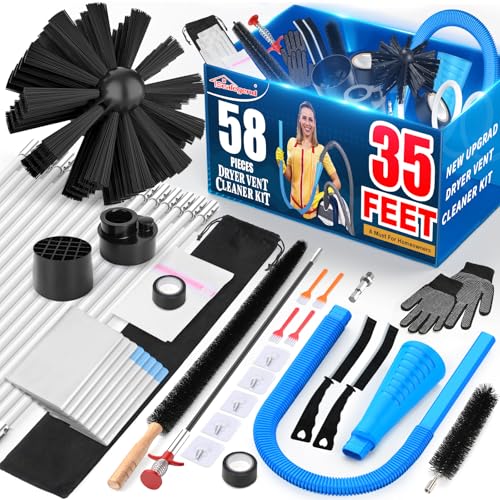
35 ft rod-and-brush kit plus lint trap vacuum attachment and adapters that let dryer, vac or blower air push lint out.
Check price on Amazon$28.99 as of Oct 21, 2026 2:53 pm GMT+0000 — prices change; see Amazon for current price.Why we like it
- Cleans the duct and the lint trap cavity
- Adapters use moving air while the brush spins
- 35 ft reach covers most single-story runs
- Gloves, tape and collection bags included
| Specification | Details |
|---|---|
| Rod length | Flexible nylon rods extend to 35 ft |
| Duct tools | Rotary brush with drill bit; adapters for clothes dryer, shop vacuum or electric blower airflow |
| Lint trap tools | Vacuum attachment, long lint trap brush, multi-use lint brush |
| Extras | Anti-slip gloves, 2 rolls of tape, rod bag, laundry bag, lint collection bag |
| Vacuum fit | Most vacuums; listing excludes some Dyson and Shark models |
| Piece count | 58 |
Sealegend 35 ft 58-piece kit — nylon rods to 35 ft, drill-driven brush, vacuum attachment, lint trap brush, dryer/vac/blower adapters
The Only Kit That Pairs the Brush With Airflow Adapters and a Lint Trap Vacuum
Most kits on the shelf do one job. Nine rod-and-brush kits clean the duct, and five vacuum or brush sets clean around the lint trap. This Sealegend is one of only two listings that include both a 35 ft rod brush and a vacuum attachment for the lint trap cavity; the other is a Holikme 58-piece kit with the same structure. What sets the Sealegend apart is its adapters, which let you run the dryer on air-only, a shop vacuum or a leaf blower while the brush spins, so loosened lint is pushed or pulled out of the duct instead of piling up at a bend.
That two-part approach follows the CPSC’s guidance, which says to clean the lint screen with every load, clean the vent and exhaust duct periodically, and clean behind the dryer where lint builds up. Lint that slips past the screen collects in the trap housing and inside the cabinet; a rod kit alone never touches it.
At 35 ft, the rods cover most laundry rooms on an exterior wall. They will not reach the end of a long run to a roof cap, and the listing does not state the brush diameter. The listing also notes its vacuum attachment does not fit some Dyson and Shark models.
Pros
- Duct brush and lint trap vacuum in one kit
- Adapters move lint out as you brush
- Gloves, tape and bags included
Cons
- Brush diameter not stated
- 35 ft may be short for roof terminations
- Vacuum attachment does not fit every vacuum
Check Sealegend 58-Piece 35 ft Kit price on Amazon
2. Sealegend 40 ft Quick-Snap Kit — Best Rods That Will Not Come Apart

29 snap-together rods reaching 40 ft, auger brush, drill bit and disassembly helper; rods hold in either rotation.
Check price on Amazon$27.99 as of Oct 21, 2026 2:53 pm GMT+0000 — prices change; see Amazon for current price.Why we like it
- Snap joints instead of screw threads
- Rods stay together turning either direction
- Works with a cordless drill
- Disassembly helper for taking rods apart
| Specification | Details |
|---|---|
| Rod length | 29 flexible rods, up to 40 ft |
| Rod connection | Quick-snap joints; listing says they do not separate clockwise or counterclockwise |
| Brush | Synthetic auger-style brush head; diameter not stated |
| Included | Drill bit, collection bag, disassembly helper |
| Lint trap tools | None |
| Weight | About 1 lb |
Sealegend DZ-40FT — 29 quick-snap rods to 40 ft, synthetic auger brush, drill bit, disassembly helper, collection bag
The Only Listing Whose Rods Are Designed Not to Unscrew in Reverse
Threaded rod kits have a known failure mode: run the drill backward, or let a stuck brush twist the rods, and a joint unscrews, leaving a brush and several feet of rod stranded inside the duct. The Holikme listings deal with this by instructing users to always turn clockwise, and one suggests taping each joint. This Sealegend is the only listing that describes snap-together rods it says will not separate in either rotation.
That matters most on a duct with several bends, where the brush can catch and the drill torque reverses through the rod. A disassembly helper is included because snap joints can be stubborn to separate by hand.
It has no vacuum attachment or lint trap brush, and the listing does not give the brush diameter. Ignore its fire statistic claim, which is not sourced; the federal data in the buying guide below is more useful.
Pros
- Snap joints resist separating
- 40 ft reach
- Cordless-drill friendly
Cons
- No lint trap tools
- Brush diameter not stated
- Unsourced fire statistic in listing
Check Sealegend 40 ft Quick-Snap price on Amazon
3. Holikme 60 ft Dryer Vent Cleaner Kit — Best for Long Runs and Roof Vents

60 ft of nylon rods with a 4-inch duct brush, lint brush, drill attachment and gloves; the longest rod kit here.
Check price on Amazon$41.99 as of Oct 21, 2026 2:53 pm GMT+0000 — prices change; see Amazon for current price.Why we like it
- Longest rod kit on the shelf, 60 ft
- Brush sized for 4-inch ducts
- Lint brush and gloves included
- Drill attachment for powered cleaning
| Specification | Details |
|---|---|
| Rod length | 60 ft of flexible nylon rods |
| Brush | Heavy-duty brush for 4-inch pipes; synthetic head |
| Included | Lint brush, drill attachment, protective gloves |
| Rod connection | Threaded, easy-screw handle; rotation direction not stated in this listing |
| Lint trap vacuum | Not included |
| Model | FT-60 |
Holikme FT-60 — 60 ft nylon rods, 4-inch synthetic brush, lint brush, drill attachment, gloves
The Longest Reach Among the Rod-and-Brush Kits
Rod kits on the shelf run from 15 to 60 ft: Holikme sells 15, 30, 35, 40, 42 and 60 ft versions, and Sealegend 35 and 40 ft. The 60 ft Holikme is the longest. That reach matters in homes where the laundry room is on an interior wall or upstairs and the vent runs through a joist bay or up to a roof cap. Cleaning a long run from both ends, when one end is reachable outside, is easier than pushing 60 ft from one side.
This listing is part of Holikme’s newer family of kits sized for 4-inch ducts, the standard dryer exhaust size. It includes a lint brush for the trap area but no vacuum attachment.
Long runs are also exactly where a DIY kit reaches its limits. A duct long enough to need 60 ft of rod may exceed the dryer manufacturer’s maximum length, and roof terminations put the far end out of reach. If you need this kit, consider whether a professional inspection of the run makes sense too.
Pros
- 60 ft reach
- Brush sized for 4-inch ducts
- Lint brush and gloves included
Cons
- No lint trap vacuum
- Long rod strings are harder to control
- Rotation guidance not in this listing
Check Holikme 60 ft Kit price on Amazon
4. GASHER 66 ft Air Jetter — Best Compressed-Air Option

66 ft high-pressure hose with two jet nozzles and a brass ball valve, driven by an air compressor set to 90 PSI or more.
Check price on Amazon$40.99 as of Oct 21, 2026 2:53 pm GMT+0000 — prices change; see Amazon for current price.Why we like it
- Longest reach on the shelf, 66 ft
- Two nozzles, forward and corner jets
- Brass ball valve for control
- Kink-resistant hose for bends
| Specification | Details |
|---|---|
| Method | Compressed air through a jet nozzle |
| Hose length | 66 ft high-pressure hose |
| Nozzles | Pointed nozzle with 1 front and 6 rear jets; corner nozzle with 1 side and 3 rear jets |
| Fittings | 1/4 in NPT brass ball valve, air plug and reducer |
| Requirement | Air compressor set to 90 PSI or higher (not included) |
| Safety note | Listing says to wear a dust mask |
GASHER NH-966 — 66 ft pressure hose, 2 jet nozzles, 1/4 in NPT brass ball valve, needs 90+ PSI compressor
The Only Kit That Uses Air Jets Instead of a Brush
Fourteen of the 15 listings rely on a brush or a vacuum. The GASHER is the only compressed-air jetter: rear-facing jets pull the hose forward through the duct and blast lint back toward the opening as you withdraw it. With 66 ft of hose it has the longest reach of anything on the shelf, and a flexible hose follows bends that can trap a rigid brush.
It requires an air compressor capable of 90 PSI or more, and it is messy: the listing tells users to wear a dust mask, and all that lint has to exit somewhere. Run it from the dryer end with the outside cap open, or from outside with the dryer disconnected and a bag over the opening.
It is the wrong tool for foil or plastic accordion duct, which high-pressure air can tear or blow apart at joints. The CPSC recommends replacing that type of duct with rigid or semi-rigid metal anyway. On smooth rigid metal duct, a jetter can be very effective.
Pros
- 66 ft reach
- Follows bends without a brush catching
- Two nozzle types
Cons
- Needs a 90 PSI compressor
- Messy, mask required
- Can damage foil or plastic duct
Check GASHER 66 ft Air Jetter price on Amazon
5. Holikme 40 ft Kit — Best for Two Brush Sizes

40 ft of flexible rods with a 4-inch duct brush, a 1.5-inch brush for tighter openings and a drill attachment.
Check price on Amazon$26.99 as of Oct 21, 2026 2:53 pm GMT+0000 — prices change; see Amazon for current price.Why we like it
- Only listing stating two brush diameters
- 4-inch head for the duct
- 1.5-inch head for tight openings
- Clear clockwise-only use instructions
| Specification | Details |
|---|---|
| Rod length | Up to 40 ft |
| Brushes | Synthetic heads: 4 in short head and 1.5 in long head |
| Drive | With or without a power drill; drill attachment included |
| Instructions | Turn clockwise only, move in and out slowly, slow down at bends |
| Lint trap vacuum | Not included |
| Weight / model | About 1.7 lb; FT-40 |
Holikme FT-40 — rods to 40 ft, 4 in and 1.5 in synthetic brushes, drill attachment, clockwise-only use
The Only Kit That States Two Brush Diameters
Several listings say their brush suits 4-inch ducts, and the Holikme 30 ft kit says it has two brush heads without giving sizes. This 40 ft kit is the only listing that states both diameters: a 4-inch head that fills a standard dryer duct and a 1.5-inch head for the transition at the back of the dryer, a narrow wall box or the lint trap slot.
Its use instructions are the clearest among the threaded-rod kits: always turn clockwise, move in and out slowly, and slow down at bends and stubborn clogs. Following that is what keeps threaded joints from loosening inside the duct.
At 40 ft, it splits the difference between the 35 ft kits and the 60 ft model. It does not include a lint trap vacuum.
Pros
- Two stated brush sizes
- Clear operating instructions
- 40 ft reach
Cons
- Threaded rods need clockwise-only use
- No lint trap vacuum
- Brush material not detailed beyond synthetic
Check Holikme 40 ft Kit price on Amazon
6. Holikme Vacuum Attachment and Brush 2-Pack — Best for the Lint Trap Cavity

Flexible vacuum hose attachment and extra-long lint brush for the lint trap housing; fits most corded vacuums.
Check price on Amazon$7.98 as of Oct 21, 2026 2:53 pm GMT+0000 — prices change; see Amazon for current price.Why we like it
- Reaches where lint slips past the screen
- Loosen-then-vacuum method spelled out
- Long brush doubles for fridge coils
- Small enough to store in the laundry room
| Specification | Details |
|---|---|
| Contents | Flexible vacuum hose attachment with adapter; extra-long lint brush |
| Use | Lint trap housing, dryer vent opening, behind appliances |
| Vacuum fit | Most vacuums; not Dyson or cordless models |
| Method | Loosen lint with the brush, then vacuum it out |
| Duct rods | None |
| Weight | About 0.66 lb |
Holikme PP-090 2-pack — flexible vacuum hose attachment + long lint brush, fits most corded vacuums
A Lint Trap Tool, Not a Duct Cleaner
Five listings on the shelf are vacuum attachments or hand brushes: this Holikme 2-pack, a single Holikme vacuum attachment, PetOde, SWKTPP and a Holikme stainless-bristle set. None of them cleans the duct run to the outside; they clean the lint trap housing, the opening at the back of the dryer and the space behind and under it. The CPSC notes that lint builds up behind the dryer and recommends having a qualified service person clean the inside of the dryer cabinet periodically.
This 2-pack is the most useful of the five because it includes both a flexible vacuum hose and a long brush, and its listing describes the right technique: loosen lint with the brush, then vacuum. It also reminds users to clean the lint screen after every load.
Pair it with any rod kit above for a complete job. Do not push a stiff stainless-bristle brush into a plastic or foil transition hose, which can tear it.
Pros
- Cleans the lint trap cavity rod kits miss
- Brush and vacuum in one set
- Clear technique described
Cons
- Does not clean the duct run
- Not for Dyson or cordless vacuums
- Short reach
Check Holikme Vacuum and Brush 2-Pack price on Amazon
Why dryer vent cleaning matters
Lint is flammable, and a blocked vent traps heat. The CPSC explains that fires can occur when lint builds up in the dryer or exhaust duct, blocking airflow and causing excessive heat build-up (CPSC: overheated clothes dryers can cause fires). The U.S. Fire Administration reports that failure to clean was the leading factor contributing to ignition in home clothes dryer fires from 2018 to 2020, at 31 percent (USFA appliance and electrical fire safety).
A clogged vent is also expensive. The dryer runs longer for every load, and moisture that cannot leave the duct can condense inside walls, attics or crawl spaces. A dryer vent that has come loose and is dumping humid air into a crawl space or attic can lead to mold; if you suspect that has happened, our guide to mold test kits for home explains when testing helps.
Signs your dryer vent needs cleaning
- Clothes are still damp at the end of a normal cycle, or drying takes longer than it used to. The CPSC lists both as signs the lint screen or exhaust duct may be blocked.
- Little or no air comes out of the outside vent when the dryer runs. The CPSC suggests checking the outside vent while the dryer is operating.
- The outside flap does not open, or lint is visible around the cap.
- The laundry room feels unusually hot or humid, or there is a burning smell.
- The top of the dryer is hot to the touch.
Any burning smell means stop using the dryer until the vent and the dryer itself have been checked.
How to choose a kit
Measure the run
Measure from the back of the dryer to the outside termination, including bends. Choose rods at least a few feet longer than the run. Kits here range from 15 to 66 ft.
Check the duct type
Rigid or semi-rigid metal duct tolerates spinning brushes and air jets. The CPSC recommends replacing plastic or foil accordion-type ducting with rigid or corrugated semi-rigid metal duct, noting that flexible plastic and foil can trap lint more easily and are more susceptible to kinks or crushing that greatly reduce airflow. If your transition hose is foil or plastic, replace it rather than cleaning it.
Consider the rod connection
Threaded rods need clockwise-only rotation and, ideally, tape at each joint. Snap-together rods, like the Sealegend quick-snap, resist separating if the drill reverses.
Plan for the lint trap cavity
A vacuum attachment and long brush handle the lint trap housing. A few kits include them; otherwise add a vacuum set.
How to clean a dryer vent safely
- Unplug an electric dryer. For a gas dryer, also turn off the gas supply valve and handle the gas connector carefully; if it is old, kinked or not a flexible appliance connector rated for the job, have it replaced by a professional.
- Pull the dryer out and disconnect the transition duct from the dryer outlet. The CPSC notes that removing a blockage may require disconnecting the exhaust duct.
- Vacuum the dryer outlet and lint trap housing.
- Feed the brush into the duct, drill on low speed and turning clockwise, moving in and out slowly. Slow down at bends.
- Clean from the outside end as well if you can reach it, removing the vent cap or flap.
- Vacuum up the loosened lint at both ends.
- Reconnect the duct to the dryer and the outside vent before using the dryer again, as the CPSC reminds. Check that the outside flap opens freely when the dryer runs.
Wear gloves and a dust mask. If a brush gets stuck, stop the drill, and do not force it; you may need to open the duct.
How often to clean
Clean the lint screen before or after every load, per the CPSC. Clean the vent and duct periodically; once a year is a common starting point for an average household, more often for large families, pet hair, long runs or if you notice longer drying times. The USFA’s clothes dryer fire safety flyer adds: never use the dryer without a lint filter, clean the back of the dryer where lint builds up, check that the venting is not damaged, crushed or restricted, and make sure the outdoor vent covering opens when the dryer runs.
Front Range notes
Colorado’s dry air means lint is often fluffier and more static-charged, and it clings to duct walls. Many Front Range homes built from the 1970s through the 1990s put laundry in basements or interior closets, with long vent runs through floor joists. Townhomes and condos frequently vent through the roof, where the far end is unreachable without a ladder and roof access; that is a professional job. Snow and ice can also block low wall vents in winter, so check the outside termination after storms.
Indoor air quality is a related concern if lint or moisture has been escaping into the house. Our air quality test kit guide covers what home tests can and cannot tell you.
When to call a professional
Call a dryer vent professional or a qualified appliance technician if:
- The vent runs to the roof or is longer than your kit can reach.
- The duct is crushed, disconnected, foil or plastic, or routed through an attic or crawl space you cannot inspect.
- A brush or rod is stuck inside the duct.
- You smell burning, see scorching, or the dryer shuts off on overheat.
- The dryer cabinet itself needs cleaning; the CPSC suggests periodic cleaning of the dryer chassis interior by a qualified service person.
The USFA also recommends having your dryer installed and serviced by a professional. Our hiring process guide explains how to vet contractors. If you are buying a home, an inspector can check the dryer vent material, routing and termination. Our guides to professional dryer vent cleaning and rigid metal dryer duct cover when a kit is not enough and what the duct itself should be made of. Contact us to connect with a vetted Front Range home inspector.
Frequently asked questions
Do dryer vent cleaning kits really work?
Yes, on rigid or semi-rigid metal ducts of a length the rods can reach. A drill-driven brush loosens lint along the duct walls, and a vacuum or airflow pushes it out. They are less suited to roof vents, very long runs, and foil or plastic ducts, which should be replaced instead.
How often should I clean my dryer vent?
Clean the lint screen with every load, as the CPSC advises, and clean the vent and duct periodically. Once a year is a common starting point, more often for large households or pets, or whenever drying takes longer than normal or clothes stay damp.
What length dryer vent cleaning kit do I need?
Measure from the back of the dryer to the outside termination, including bends, and choose rods a few feet longer. Kits we compared range from 15 to 66 feet. Runs that exceed your kit, or that end on the roof, are usually a job for a professional.
Can I use a drill with a dryer vent brush?
Most rod kits are designed for a drill. Use low speed and turn clockwise only with threaded rods so joints do not unscrew inside the duct. Snap-together rods resist separating in either direction. Stop and do not force a brush that gets stuck.
Is a clogged dryer vent a fire hazard?
Yes. The CPSC says lint buildup can block airflow and cause excessive heat that leads to fires, and the USFA reports failure to clean was the leading contributing factor in home clothes dryer fires from 2018 to 2020. Clean regularly and replace foil or plastic ducting.
References
- Overheated Clothes Dryers Can Cause Fires (Publication 5022) — U.S. Consumer Product Safety Commission
- Appliance and Electrical Fire Safety — U.S. Fire Administration
- Clothes Dryer Fire Safety flyer — U.S. Fire Administration