Best Dryer Vent Hoses (2026): 5 Picks Compared for Safety

The best dryer vent hose is the shortest all-metal connector that reaches from your dryer to the wall, holds its shape when you push the dryer back, and does not trap lint in deep accordion folds. That usually means semi-rigid aluminum. The dryer vent hose, also called the transition duct, is the one piece of the exhaust system homeowners replace themselves, and it is where inspectors most often find problems: crushed foil, plastic hoses, tape instead of clamps and lint packed into every ridge. Below are five picks from the current shelf, then a buying guide on materials, length, the UL 2158A standard and how to install a hose so it stays safe.
Part of our Heating, Cooling & Ventilation guide — start there for the full picture →
As an Amazon Associate we earn from qualifying purchases.
How we compared: a search for dryer vent hoses returned 14 current Amazon listings, and 3 were cleaning tools, so we compared the 11 actual hoses and connector kits on what each listing states: material and layers, stated temperature range, length, flexibility, clamps and fittings, and certifications. We did not install, crush-test or heat-test any of them. Prices and availability change often, so check the current listing before buying.
Quick picks: the best dryer vent hoses by use case
| Product | Best for | Key features | Price | Buy |
|---|---|---|---|---|
| Eastman ArmorFlex 8 ft | Best overall: semi-rigid metal |
| $15.32as of Oct 21, 2026 3:58 pm GMT+0000 | Buy now →Check current price |
| Jeevony DV180 Magnetic Kit | Easy disconnect for cleaning |
| $39.98as of Oct 21, 2026 3:58 pm GMT+0000 | Buy now →Check current price |
| Steelsoft 3 ft Heavy Duty | Short all-aluminum foil hose |
| $8.99as of Oct 21, 2026 3:58 pm GMT+0000 | Buy now →Check current price |
| Nightyling 8 ft Kit | Tight spaces with an elbow |
| $28.99as of Oct 21, 2026 3:58 pm GMT+0000 | Buy now →Check current price |
| HOOMESUN 3 ft 6-Layer | Foil hose with sealing tape |
| $8.99as of Oct 21, 2026 3:58 pm GMT+0000 | Buy now →Check current price |
Prices are Amazon’s listed prices as of the time shown and change often; check Amazon for today’s price. As an Amazon Associate we earn from qualifying purchases.
The five picks, compared listing by listing
1. Eastman ArmorFlex 8 ft — Best Overall Dryer Vent Hose

Semi-rigid aluminum transition duct rated from -22 to 482°F, Fire Class 0, bends to 90 degrees and holds its shape.
Check price on Amazon$15.32 as of Oct 21, 2026 3:58 pm GMT+0000 — prices change; see Amazon for current price.Why we like it
- Only semi-rigid aluminum duct on the shelf
- Highest stated temperature rating, 482°F
- Holds its shape instead of crushing
- Stainless steel clamps included
| Specification | Details |
|---|---|
| Material | Semi-rigid aluminum (ArmorFlex construction) |
| Temperature range | -22 to 482°F |
| Fire rating stated | Fire Class 0; listing says it will not spread flame or smoke |
| Length / diameter | 8 ft; 4 in |
| Flexibility | Bends to 90 degrees; holds shape |
| Clamps / warranty | 2 stainless steel clamps; 1-year limited |
Eastman ArmorFlex 69028 — 4 in x 8 ft semi-rigid aluminum, -22 to 482°F, Fire Class 0, 90° bends, 2 stainless clamps
The Only Semi-Rigid Metal Duct Among the 11 Hoses
The CPSC recommends replacing plastic or foil accordion-type ducting with rigid or corrugated semi-rigid metal duct, noting that most manufacturers specify one of those because they provide maximum airflow, while flexible plastic or foil traps lint more easily and is more susceptible to kinks and crushing. Ten of the 11 hoses on this shelf are foil accordion designs, several with plastic layers. The Eastman ArmorFlex is the only semi-rigid aluminum duct, and its listing notes that dryer manufacturers recommend semi-rigid over traditional foil.
It also states the widest temperature range, up to 482°F, and a Fire Class 0 classification, meaning it is described as not spreading flame or smoke. The Nightyling kit is next at 300°F, and the foil hoses range from 185°F to 248°F. Semi-rigid duct holds its shape, so pushing the dryer back toward the wall bends it rather than flattening it.
Two caveats. The listing does not name UL 2158A, the standard for clothes dryer transition ducts, and no listing on the shelf does. And 8 ft is longer than most transition runs need; cut it to the shortest length that reaches without stretching, since extra length adds airflow resistance and lint traps.
Pros
- Semi-rigid aluminum, the CPSC-recommended type
- Highest stated temperature rating
- Resists kinking and crushing
- Stainless clamps included
Cons
- UL 2158A not named
- Stiffer to fit in very tight spaces
- 8 ft usually needs trimming
Check Eastman ArmorFlex 8 ft price on Amazon
2. Jeevony DV180 Magnetic Dryer Vent Coupling Kit — Best for Easy Disconnect

Magnetic wall coupling with a sealed joint, 2.6 ft aluminum foil hose and stainless clamps; covers 0 to 8 in offsets.
Check price on Amazon$39.98 as of Oct 21, 2026 3:58 pm GMT+0000 — prices change; see Amazon for current price.Why we like it
- Magnets self-align for quick reconnection
- Makes routine vent cleaning easier
- Built-in seal ring at the wall
- Short hose limits lint-trapping length
| Specification | Details |
|---|---|
| Design | Magnetic quick-connect coupling: wall assembly plus dryer adapter |
| Hose | 2.6 ft of 4 in aluminum foil hose, described as zero flame spread |
| Seal | Built-in seal ring and recessed wall assembly |
| Offset covered | 0 to 8 in center to center |
| Included | Wall assembly, dryer adapter, hose, 2 stainless clamps, anchors and screws |
| Housing / warranty | Aluminum alloy shell; 1-year |
Jeevony DV180 — magnetic wall coupling, aluminum alloy shell, seal ring, 2.6 ft 4 in foil hose, 0–8 in offset, 1-yr
The Only Kit Built Around Disconnecting the Dryer for Cleaning
The hardest part of maintaining a dryer vent is getting behind the dryer to disconnect it. The CPSC says removing a blockage may require disconnecting the exhaust duct, and the USFA advises cleaning the back of the dryer where lint builds up. The Jeevony DV180 is the only listing designed around that job: a magnetic coupling at the wall lets the dryer pull away and reconnect in seconds, with a seal ring to keep the joint tight.
Its short hose is a quiet advantage. At 2.6 ft, it is the shortest length on the shelf, and the listing gives the offset it covers, 0 to 8 in between the dryer outlet and the wall outlet. The shorter the transition, the less foil there is to sag and collect lint. The hose is aluminum foil, which the listing describes as zero flame spread, with no plastic layer.
The trade-off is that the hose is still foil accordion, not semi-rigid. If your dryer sits a few inches from a wall outlet that lines up closely, this is a practical setup. If the offset is larger or the path has a turn, the semi-rigid Eastman is the better hose, though you could pair it with a coupling.
Pros
- Fast disconnect for cleaning
- Sealed wall connection
- Shortest hose on the shelf
- Aluminum hose with no plastic layer
Cons
- Still a foil accordion hose
- Limited to 8 in of offset
- Requires mounting a wall assembly
Check Jeevony DV180 Magnetic Kit price on Amazon
3. Steelsoft Heavy Duty 3 ft — Best Short All-Aluminum Foil Hose

3 ft extra-thick aluminum foil hose with wire helix, rated to 215°F, collared ends and two tool-free key clamps.
Check price on Amazon$8.99 as of Oct 21, 2026 3:58 pm GMT+0000 — prices change; see Amazon for current price.Why we like it
- Aluminum only, no PVC or PET layer
- Short 3 ft length for tight installs
- Tool-free key clamps
- Collared ends slide on cleanly
| Specification | Details |
|---|---|
| Material | Extra-thick aluminum foil over wire helix; described as twice as thick as typical 3-ply hose |
| Temperature | Up to 215°F |
| Length / diameter | 3 ft; 4 in |
| Design | Narrow accordion spacing for a larger inside diameter |
| Clamps | 2 tool-free key hose clamps |
| Warranty | 1 year |
Steelsoft 3 ft — 4 in extra-thick aluminum foil, wire helix, 215°F, collared ends, 2 tool-free clamps, 1-yr
An All-Metal Foil Hose When Semi-Rigid Will Not Fit
Five of the foil hoses on the shelf include a plastic layer, PVC, PET film or both: TEAIERXY, Hon&Guan, LHHXX33, Ventyxa and HOOMESUN. Steelsoft’s three listings, in 3, 4 and 6 ft lengths, describe all-aluminum construction and explicitly contrast it with PVC hose, which they say can soften and smell in hot, moist air. For a homeowner who needs a foil connector because a semi-rigid duct will not make the bend, an all-metal foil hose is the better choice.
The 3 ft length keeps the run short, and the listing says narrower accordion spacing gives a larger inside diameter with less pressure drop. The tool-free key clamps are easier to tighten than worm-screw clamps in the cramped space behind a dryer.
It is still foil accordion, the type the CPSC says can trap lint and crush more easily than semi-rigid metal. Its 215°F rating is lower than the Eastman’s 482°F. Treat it as a transition connector only, never as a run through a wall or ceiling.
Pros
- All-aluminum, no plastic layer
- Short length limits lint traps
- Tool-free clamps
Cons
- Foil accordion, can crush
- Lower temperature rating than semi-rigid
- UL 2158A not named
Check Steelsoft 3 ft Heavy Duty price on Amazon
4. Nightyling 8 ft Dryer Vent Kit — Best for Tight Spaces
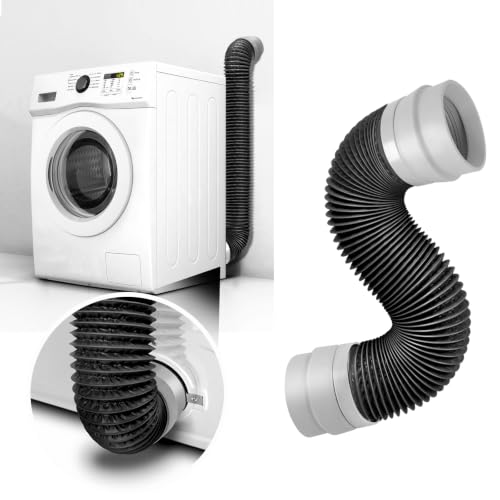
8 ft multi-layer hose kit with a 90-degree elbow, dryer connector and silicone sleeve, rated from -22 to 300°F.
Check price on Amazon$28.99 as of Oct 21, 2026 3:58 pm GMT+0000 — prices change; see Amazon for current price.Why we like it
- Includes a 90-degree elbow for tight installs
- Second-highest stated heat rating, 300°F
- Silicone sleeve aims to stop loosening
- Kit format with connector included
| Specification | Details |
|---|---|
| Hose | Multi-layer flexible hose; layer materials not detailed in listing |
| Temperature | -22 to 300°F |
| Length / diameter | 8 ft; 4 in |
| Fittings | 90 degree elbow, dryer vent connector, silicone sleeve |
| Install | Four-step installation described |
| Warranty | 1 year |
Nightyling 8 ft kit — 4 in multi-layer hose, -22 to 300°F, 90° elbow, dryer connector, silicone sleeve, 1-yr
The Only Hose Kit With a 90-Degree Elbow
Pushing a dryer close to the wall usually forces the hose into a sharp bend right at the dryer outlet, which is where foil kinks. The Nightyling is the only listing that includes a 90-degree elbow fitting, which turns the air at the outlet so the hose can run parallel to the wall instead of folding. It also includes a dryer connector and a silicone sleeve the listing says resists loosening from heat and vibration.
Its 300°F upper rating is second only to the Eastman. The weak point is disclosure: the listing calls the hose multi-layer and puncture-resistant but does not say what the layers are made of. Before installing, check whether there is a plastic layer.
At 8 ft, trim it to the shortest workable length. The elbow is the main reason to buy it; you can also pair a standalone metal elbow with a semi-rigid duct.
Pros
- 90-degree elbow prevents outlet kinks
- 300°F rating
- Connector and sleeve included
Cons
- Hose materials not specified
- Long length needs trimming
- Patent claim is not a safety certification
Check Nightyling 8 ft Kit price on Amazon
5. HOOMESUN 3 ft 6-Layer Hose — Best Foil Hose With Sealing Tape
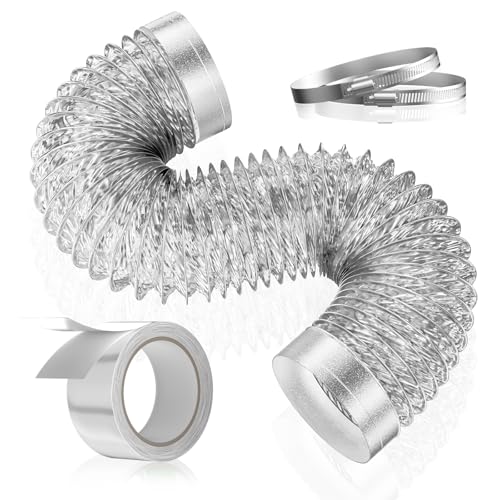
3 ft, 6-layer aluminum foil and PET hose rated to 248°F, with two stainless clamps and a roll of aluminum foil tape.
Check price on Amazon$8.99 as of Oct 21, 2026 3:58 pm GMT+0000 — prices change; see Amazon for current price.Why we like it
- Only listing that includes foil tape
- Higher heat rating than most foil hoses, 248°F
- Stainless clamps included
- Short 3 ft length
| Specification | Details |
|---|---|
| Material | 6 layers of aluminum foil and PET |
| Temperature | Up to 248°F |
| Length / diameter | 3 ft; 4 in |
| Design | Narrow wire spacing; wrap-around ends |
| Included | 2 heavy-duty stainless clamps; 1 roll of aluminum foil tape |
| Weight | About 0.6 lb |
HOOMESUN ZH107 — 4 in x 3 ft, 6-layer aluminum foil + PET, 248°F, 2 stainless clamps, foil tape
The Highest Heat Rating Among the Foil Accordion Hoses, Plus Tape
Among the foil accordion hoses that state a temperature, ratings run from 185°F (LHHXX33) to 215°F (Steelsoft, Ventyxa) to 248°F for this HOOMESUN. It is also the only listing that includes a roll of aluminum foil tape, which is the right material for sealing a joint or wrapping a clamp seam. Never use cloth duct tape on a dryer vent; it dries out and fails in heat.
The short length, stainless clamps and wrap-around ends make it a reasonable transition connector. The caveat is the PET layer: polyester film is a plastic, and the CPSC recommends moving away from plastic and foil flexible duct toward rigid or semi-rigid metal. That makes this a lower choice than the all-aluminum Steelsoft or the semi-rigid Eastman.
Use the tape on joints, never screws: screws that poke into the duct catch lint.
Pros
- Foil tape included
- 248°F rating
- Stainless clamps
Cons
- Includes a PET plastic layer
- Foil accordion, can crush
- UL 2158A not named
Check HOOMESUN 3 ft 6-Layer price on Amazon
Hoses we did not rank
Four foil hoses on the shelf include an outer PVC layer, and several are marketed primarily for grow tents, carbon filters and HVAC ventilation rather than dryers: Hon&Guan (16 ft, black PVC, sold as a noise-reducing grow-room duct), TEAIERXY (8 ft, PVC and foil, insulated), LHHXX33 (8 ft, PVC and foil, rated only to 185°F) and Ventyxa (8 ft, 6-ply with a PVC layer). Plastic-covered flexible duct is exactly the type the CPSC recommends replacing, and dryer manufacturers generally prohibit plastic transition ducts. The shelf also returned three lint cleaning tools, which are covered in our dryer vent cleaning kit roundup.
Rigid, semi-rigid, foil and plastic: what to use
The CPSC’s guidance is straightforward: replace plastic or foil accordion-type ducting with rigid or corrugated semi-rigid metal duct, because flexible plastic or foil can more easily trap lint and is more susceptible to kinks or crushing, which can greatly reduce airflow (CPSC: overheated clothes dryers can cause fires).
- Rigid metal duct: smooth-wall galvanized or aluminum pipe. The best choice for the run inside walls, floors and ceilings; it has the least resistance and collects the least lint.
- Semi-rigid metal: corrugated aluminum that bends by hand and holds its shape. The best transition connector between dryer and wall.
- Foil accordion: very flexible, but easy to crush and full of lint-catching ridges. If you use one, keep it short, all-metal and fully extended, and never conceal it in a wall.
- Plastic or vinyl: do not use for a dryer.
Our dryer vent hose guide covers these materials in more depth.
What UL 2158A means
UL 2158A is the safety standard for clothes dryer transition ducts, the connector between the dryer and the wall. Many dryer manufacturers’ installation instructions call for a transition duct that meets it when a flexible connector is used. None of the 11 hoses on this shelf names UL 2158A in its listing, and the Eastman’s Fire Class 0 claim is not the same thing. Check the packaging or the duct itself for a UL 2158A listing mark, and read your dryer’s installation manual for the specific transition duct it allows.
Length, bends and airflow
Every foot of duct and every bend adds resistance. Dryer manufacturers publish a maximum total vent length for each dryer model, with each elbow counting as several feet of straight pipe. Keep the transition duct as short as possible, ideally just long enough to pull the dryer out for cleaning, and avoid sagging loops where lint and condensation collect. The USFA advises checking the venting system behind the dryer to make sure it is not damaged, crushed or restricted (USFA clothes dryer fire safety flyer).
How to install a dryer vent hose
- Unplug the dryer; for a gas dryer, also shut off the gas valve and avoid stressing the gas connector.
- Remove the old hose and vacuum the dryer outlet and wall opening.
- Cut the new duct to length. Semi-rigid aluminum cuts with tin snips.
- Slide each end over the outlet collar and secure it with a metal clamp. Seal seams with foil tape, not cloth duct tape, and do not use screws that protrude into the airflow.
- Push the dryer back slowly, watching that the duct bends rather than crushes. An elbow at the outlet helps when space is tight.
- Run the dryer and confirm strong airflow at the outside vent; the CPSC suggests checking the outside vent while the dryer runs.
Washer connections live in the same space. While the dryer is pulled out, check your washer hoses for bulges or cracks.
Why this matters: lint and fire
The USFA reports that failure to clean was the leading factor contributing to ignition in home clothes dryer fires from 2018 to 2020, at 31 percent (USFA appliance and electrical fire safety). A crushed or sagging transition hose makes that worse by slowing airflow and trapping lint right behind the dryer. Clean the lint screen with every load, as the CPSC advises, and inspect the transition duct whenever you pull the dryer out.
How to check the hose you already have
Before buying anything, pull the dryer out and look at what is there. A quick check takes five minutes and tells you whether you need a new hose, a cleaning or a professional:
- Material: white or clear vinyl, or any hose with a plastic outer skin, should be replaced. Thin silver foil that tears when you press it should be replaced too.
- Shape: look for flattened sections, sharp kinks at the dryer outlet and sagging loops on the floor. Any of those restricts airflow.
- Connections: both ends should be held by metal clamps or foil tape. Loose ends, cloth duct tape or a hose simply pushed over the collar can let lint and hot, humid air escape into the laundry room.
- Lint: squeeze the hose gently. If it feels packed or crunchy, or lint falls out when you disconnect it, the whole vent run probably needs cleaning, not just the connector.
- Length: if the hose is much longer than the gap between dryer and wall, shorten or replace it.
- Wall connection: the hose should attach to a rigid metal duct at the wall, not disappear into the wall as foil or plastic.
Gas dryers deserve one more check: the flexible gas connector behind the dryer should not be kinked, corroded or pinched by the vent hose. If it is, have it replaced by a qualified technician rather than straightening it.
Diameter and fittings
Every hose on this shelf is 4 inches in diameter, which matches the outlet on nearly all residential dryers. Do not neck down to a smaller duct or use a reducer, which restricts airflow. Clamps matter as much as the hose: stainless worm-gear clamps, like those included with the Eastman and HOOMESUN, or tool-free key clamps, like Steelsoft’s, both hold well. The fitting at the wall should be a metal collar or a sealed coupling like the Jeevony; a hose stuffed into a hole in the drywall is a red flag.
Front Range notes
Many Front Range laundry rooms are in basements or interior closets with long vent runs, which leaves less length budget for a long transition hose. Colorado’s dry air makes lint fluffy and clingy. Cold winter exterior walls can cause condensation inside long or sagging ducts, so keep runs short and sloped slightly toward the outside where possible. Inspectors in older Denver-area homes still regularly find white vinyl dryer hoses; if you see one, replace it.
When to call a professional
Call a professional if the vent run inside the wall is foil or plastic, if the duct is disconnected inside a wall, attic or crawl space, if the total run exceeds what your dryer allows, or if you smell burning or the dryer is overheating. The USFA recommends having dryers installed and serviced by a professional, and gas dryers need correct gas connections. Our heating and cooling hiring guide covers choosing a contractor for venting work. If you are buying a home, an inspector checks dryer vent material, routing and termination. Contact us to connect with a vetted Front Range inspector.
Frequently asked questions
What type of dryer vent hose is safest?
Rigid or semi-rigid metal duct. The CPSC recommends replacing plastic or foil accordion ducting with rigid or corrugated semi-rigid metal, because flexible plastic and foil trap lint more easily and are more likely to kink or crush. Use semi-rigid aluminum for the short connector behind the dryer.
Are foil dryer vent hoses safe?
Foil accordion hoses are common but not ideal. They crush easily and their ridges trap lint. If you use one, keep it short, all-metal with no plastic layer, fully extended and visible, and never run it inside a wall. Semi-rigid aluminum is the better choice.
How long can a dryer vent hose be?
As short as possible. The transition duct behind the dryer should only be long enough to pull the dryer out for cleaning. Dryer manufacturers set a maximum total vent length, with each bend counting as extra length, so check your dryer's installation manual.
What is UL 2158A?
UL 2158A is the safety standard for clothes dryer transition ducts. Many dryer installation instructions call for a flexible connector that meets it. None of the hoses we compared named UL 2158A in the listing, so check the packaging or the duct itself for the mark.
Can I use a plastic dryer vent hose?
No. Plastic or vinyl dryer hoses are the type the CPSC recommends replacing, and dryer manufacturers generally prohibit them. Replace any white vinyl hose with semi-rigid or rigid metal duct.
References
- Overheated Clothes Dryers Can Cause Fires (Publication 5022) — U.S. Consumer Product Safety Commission
- Clothes Dryer Fire Safety flyer — U.S. Fire Administration
- Appliance and Electrical Fire Safety — U.S. Fire Administration