Deck Ledger Boards: Attachment, Flashing and Collapse Risk
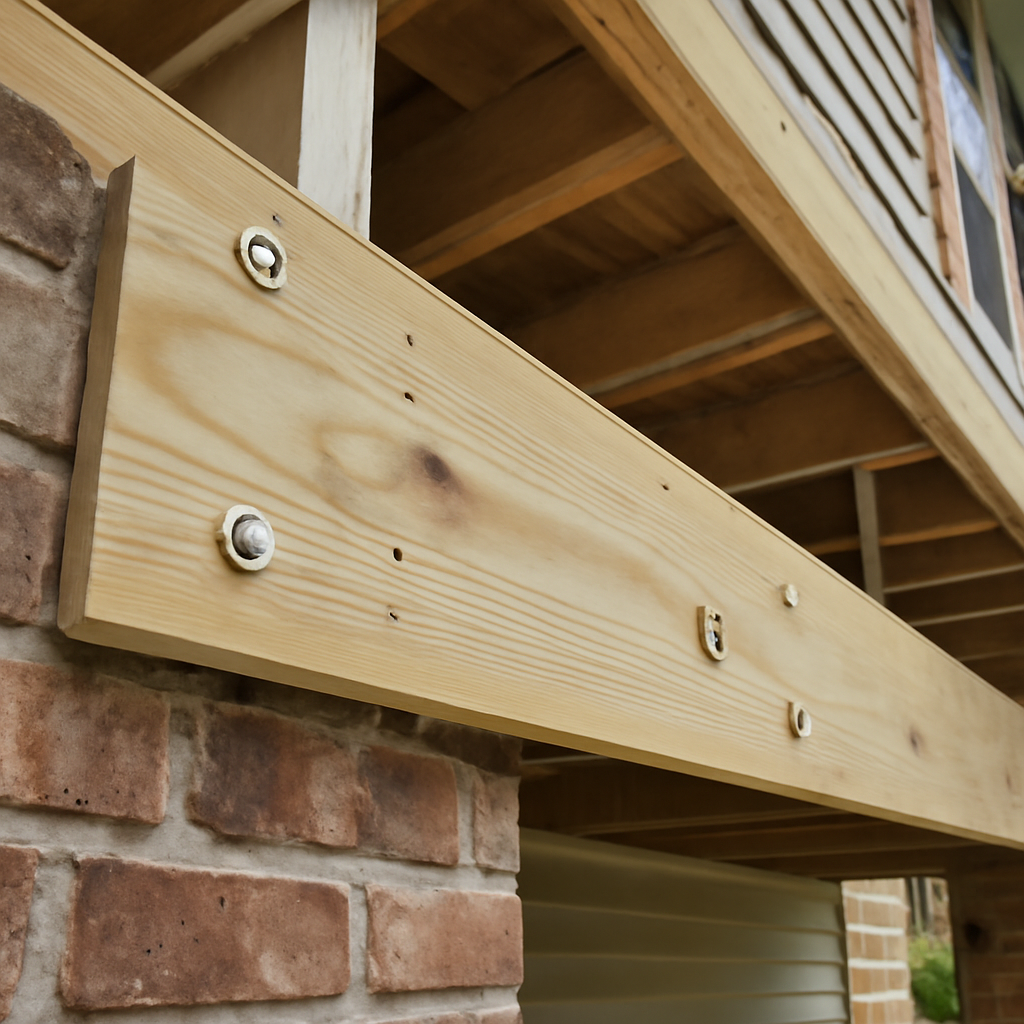
A deck can look solid from the yard and still be hanging by a thread at the house. The connection that matters most is the ledger board: the horizontal framing member bolted to the house that carries one end of every deck joist. If that connection is undersized, nailed instead of bolted, poorly flashed or fastened into rotted framing, the deck can pull away from the house, sometimes all at once and with people on it. Home inspection groups consistently identify ledger detachment as one of the most likely causes of deck collapse. This guide explains how a ledger board should be attached, why flashing matters so much, what rot and corrosion look like, how lateral load connectors fit in, what inspectors and permit officials look for, and what repairs typically cost on the Front Range.
Part of our Structure & Exterior guide — start there for the full picture →
Building or repairing a deck? Talk to a local deck builder.
📞 Call (888) 268-1507What a Ledger Board Does
Most attached decks are supported in two places: a beam on posts and footings away from the house, and a ledger board fastened to the house. The ledger is usually a pressure-treated board of the same depth as the deck joists, fastened through the house’s exterior sheathing into the band joist (also called the rim joist or rim board) that sits on top of the foundation. The deck joists then hang from the ledger in metal joist hangers.
That means roughly half the weight of the deck, plus everyone and everything on it, passes through the ledger fasteners into the house framing. The American Society of Home Inspectors (ASHI) puts it plainly: most decks rely on the attachment of a deck ledger to the house to provide support, and many, if not most, deck collapses occur when this support fails. In an ASHI column on deck inspection, ledger detachment is described as one of the most likely causes of a deck collapse.
Two kinds of loads
ASHI explains that two primary forces act on a deck. Gravity loads push straight down. Lateral loads push the deck side to side and front to back, for example when people move in unison or when the deck sways. Each needs its own connection: bolts or structural screws help the ledger resist vertical loads, while lateral load connectors help the ledger resist the deck pulling away from the house. ASHI notes that both systems should be installed, and that this is not always well communicated in deck construction standards.
Bolts and Screws, Not Nails
Nails alone are a classic ledger defect. Nails can withdraw over time as wood shrinks, swells and moves, and they offer little resistance to the ledger pulling straight out from the wall. Modern practice calls for the ledger to be attached with through-bolts, lag screws or approved structural screws, sized and spaced according to the deck span, joist spacing and the code or prescriptive guide in use.
ASHI points to the American Wood Council’s DCA 6 prescriptive deck guide and the International Residential Code as the places where fastener spacing tables are found. ASHI’s guidance also highlights details that help prevent the ledger and band joist from splitting under load:
- Fasteners staggered vertically along the ledger rather than in a single line.
- Minimum distances between fasteners and the top and bottom edges of the ledger and band joist.
- Adequate band joist material behind the ledger; ASHI’s examples assume at least a 2×8 dimension lumber band board or at least a 1-inch-thick engineered rim board.
What a ledger cannot be fastened to
A ledger must bear on solid structural framing. Common problems inspectors find include ledgers attached:
- Through siding, brick veneer or stucco without proper framing behind them. Brick veneer is a facing, not a structural wall, and generally cannot carry a ledger.
- To cantilevered floor framing, such as a bay window or overhang, that was not designed for the extra load.
- To a band joist that is rotted, split or thinner than expected.
- To a house whose floor framing runs parallel to the band joist, which changes how fasteners and lateral connectors must be installed.
Where a solid attachment is not possible, a freestanding deck with its own beam and footings near the house is a common alternative. Our deck footings guide covers frost depth and footing sizing.
Fastener corrosion
Pressure-treated lumber can be corrosive to ordinary steel. Ledger bolts, washers, hangers and connectors should be hot-dip galvanized, stainless steel or otherwise rated for contact with treated wood, as specified by the hardware manufacturer. Rusted bolts or hangers, especially near the ledger where water collects, are a serious finding. Corrosion-resistant screws matter for decking too; see our deck screws guide.
Flashing: The Real Weak Point
A ledger connection rarely fails because a bolt snaps. It fails because water rots the wood the bolts are in. In an ASHI interview, deck expert Bruce Barker called flashing the number one issue, explaining that if the connection at the house is not properly flashed, water gets in and rots the wood, and that bolts and screws in rotted wood will not hold. ASHI’s deck column makes the same point: if the band joist or rim joist fails from water damage, it does not matter how many fasteners were used.
Proper ledger flashing creates a path for water that runs down the house wall to pass over the ledger rather than behind it. Typical elements include:
- Removing siding where the ledger will go, so the ledger bears against sheathing instead of siding.
- Self-adhered membrane on the sheathing behind the ledger, lapped correctly with the house wrap above it.
- Cap flashing (often Z-flashing) over the top of the ledger, tucked up behind the house wrap and siding and extending out over the ledger face.
- Shingle-fashion laps throughout, so each upper layer overlaps the one below.
ASHI notes that installing washers or spacers to create a drainage gap between the ledger and sheathing is a debated practice, with some professionals favoring a drainage space and others favoring direct contact. ASHI also warns that the door above a deck is often improperly flashed, and that combined flashing failures create a significant risk factor for collapse. Our deck flashing guide covers materials and common mistakes in more detail.
Why flashing is so hard to inspect
Most of the flashing is hidden behind the ledger, the siding and the decking. ASHI acknowledges that important flashing components are usually concealed and that the effects of poor flashing can take a long time to show. ASHI suggests inspectors consider a concealed-flashing disclaimer in deck reports. Signs that water has been getting in can include stains on the foundation below the ledger, soft or darkened band joist visible from the basement, rust streaks from bolts, and stains or mold on the inside of the rim in an unfinished basement.
Rot, Age and Older Decks
Many Front Range homes have decks built in the 1980s, 1990s and early 2000s, before detailed deck provisions were common in residential codes. In ASHI’s interview, Barker noted that the International Residential Code had little on decks until around 2009, and that ledger attachment requirements improved through the 2009, 2012 and 2015 code updates. He also noted that decks more than 15 or 20 years old have often deteriorated and may not have been built well to begin with.
Warning signs on an older ledger include:
- A visible gap between the ledger and the house, or a ledger that has pulled away at one end.
- Nails only, with no bolts or structural screws visible.
- Soft, crumbly or punky wood when the ledger or band joist is probed with an awl or screwdriver.
- Rusted or missing hangers, or hangers missing nails.
- Water stains, efflorescence or mold on the foundation or rim directly below or behind the ledger.
- Decking that dips toward the house, or a deck that sways noticeably when walked on.
- No visible flashing over the top of the ledger.
If rot has reached the band joist, repairs extend into the house framing. Our wood rot repair guide explains how far damage typically spreads and how it is addressed.
Lateral Load Connectors and Bracing
Even a well-bolted ledger can be pulled loose over time if the deck moves. ASHI explains that lack of proper bracing lets a deck move, which stresses the ledger fasteners and can cause them to withdraw, and that a deck can collapse when the band joist and ledger detach from the house as a unit. Lateral load connectors, such as hold-down tension devices that tie deck joists back to the house floor framing, are designed to resist that pull. ASHI notes that these connectors, like all manufactured products, should be installed according to the manufacturer’s instructions using approved fasteners.
Diagonal bracing on tall posts, solid blocking between joists and good post-to-beam connections all help reduce movement. Our guide to deck blocking explains how blocking stiffens the frame, and our deck joist guide covers spans and spacing.
Is overcrowding the cause of collapses?
Deck collapses are sometimes blamed on too many people. ASHI’s deck column calls this a false explanation in most cases, noting that people standing at a normal comfortable distance apart are very unlikely to exceed a deck’s design live load of 40 pounds per square foot. ASHI attributes collapses far more often to poor construction and maintenance, although lateral movement such as people dancing in unison can loosen connections.
Front Range Conditions That Stress Ledgers
Colorado’s climate adds a few twists to the ledger story:
- Snow sitting on the deck. Snow that drifts against the house wall or slides off the roof onto the deck adds weight right at the ledger end, and meltwater runs along the wall toward the flashing. Shoveling with plastic tools, rather than chipping ice, helps protect both the decking and the flashing.
- Freeze-thaw cycles. Water trapped behind a ledger or in bolt holes freezes and expands on cold nights, which can loosen fasteners and open checks in the wood over many winters.
- Strong sun and dry air. High-altitude sun dries and checks exposed lumber, and large swings between wet and dry conditions accelerate splitting around fasteners. Sealing or staining the ledger face along with the rest of the deck helps.
- Walkout lots. Many foothill and suburban homes have decks one full story or more above grade off the main level. Higher decks mean longer posts, more potential sway and more serious consequences if something fails.
Hot tubs and heavy loads
A filled hot tub, a large masonry grill or heavy planters can concentrate far more weight than a typical deck is designed for. Prescriptive deck guides generally do not cover hot tubs, and adding one to an existing deck usually calls for an engineer or a separate structural support system beneath the tub. If a deck already holds a hot tub, ask the seller whether the framing was designed or reinforced for it and whether permits were issued.
Permits, Inspections and What Inspectors Check
Most Colorado jurisdictions require a building permit for new attached decks and for significant deck repairs, and permit inspections typically include the footings, framing and ledger attachment before decking covers them. Barker observed in the ASHI interview that many backyard decks are built without permits and never inspected, so the homeowner may not know how theirs was built.
During a standard home inspection, the ASHI Standard of Practice requires inspectors to inspect attached and adjacent decks, balconies, stoops, steps, porches and their associated railings. That is a visual review of readily accessible parts. ASHI also publishes a separate Residential Deck Inspection Standard for more detailed deck inspections. It lists items such as ledger flashing, the deck ledger board, the fasteners attaching it to the building, the building rim joist or rim board where the ledger attaches, lateral load connectors and the building foundation at the attachment point. A dedicated deck inspection may be worth considering on an older or elevated deck.
Guards and stairs fail too. ASHI identifies stairs, guards and handrails as frequent primary causes of deck failures, and our deck railing guide covers post attachment and height. For the full exterior picture, see our structure and exterior inspections hub.
Ledger Board Repair and Replacement Costs
Costs depend heavily on how much hidden damage there is. As a rough 2026 guide, not a quote:
- Adding bolts or structural screws to a sound, nailed ledger: often a few hundred dollars to around a thousand, depending on length and access.
- Adding lateral load connectors: commonly a few hundred dollars, more if a finished basement ceiling must be opened.
- Retrofitting flashing: typically requires removing decking boards near the house and sometimes the ledger itself, so costs vary widely.
- Full ledger replacement with new flashing: often in the low thousands for a typical deck, as joists must be temporarily supported.
- Band joist or house framing repairs: can add substantially and may require an engineer or permit.
- Converting to a freestanding deck: adding a beam and footings near the house can cost more but removes the ledger load from the house.
Licensed, insured deck contractors familiar with current local code are the usual choice, and an engineer may be needed for elevated, cantilevered or unusual decks. Get written quotes that describe the fasteners, flashing method and any permit.
Quick checks homeowners can do
From below the deck, look at where the ledger meets the house. Can you see bolt heads or structural screw heads in a staggered pattern? Is there metal flashing over the top edge? Are the hangers intact and fully nailed? Is the wood firm? Anything that looks off is a reason to stop using the deck for large gatherings until a professional has looked at it.
Buying a home with an older deck? Our guide to hiring a home inspector explains what a standard inspection covers and when to add a specialist.
More Questions About Deck Ledger Boards
What size should a deck ledger board be?
A deck ledger board should be at least as deep as the deck joists it supports, commonly 2×8, 2×10 or 2×12 pressure-treated lumber. Using a ledger smaller than the joists limits fastening and hanger options.
The ledger must also be attached to a solid house rim joist or band of adequate size, usually at least a 2-inch nominal member. Many builders use ground-contact rated lumber for ledgers because they stay damp and are difficult to replace. The local building department’s approved plan or deck guide sets specific requirements.
How far apart should deck ledger bolts be spaced?
Deck ledger bolt spacing depends on joist span and fastener type, with code tables often calling for fasteners roughly every 12 to 18 inches, staggered between the top and bottom of the ledger. Longer joist spans require closer spacing.
Fasteners are usually half-inch through-bolts or lag screws, or approved structural screws with their own spacing rules. Staggering prevents splitting and spreads the load. Keep fasteners a minimum distance from board edges and ends as specified in the deck guide. Inspectors routinely check ledger fastening during a framing inspection.
How long does a deck ledger board last?
A well-flashed deck ledger board typically lasts as long as the rest of the deck framing, often 20 to 30 years or more. A poorly flashed ledger can rot within a decade.
Ledger lifespan depends mostly on keeping water away from it and from the house rim joist behind it. Rust on fasteners, soft wood, water stains inside the basement and peeling siding nearby are signs of trouble. When a deck is resurfaced, the ledger and flashing should be checked while boards are off.
Can a deck ledger be replaced without rebuilding the whole deck?
A deck ledger can often be replaced without rebuilding the whole deck by shoring the joists temporarily and removing the old ledger. Some contractors instead convert the deck to freestanding by adding a beam and posts near the house.
Replacing a ledger also gives the chance to install proper flashing and check the house rim joist for rot. If the house framing is damaged, that repair comes first. Ledger replacement is structural work that typically requires a permit and is best left to an experienced contractor.
Is a ledger board required for every deck?
A ledger board is not required for every deck, because a freestanding deck supported by its own beams and posts near the house avoids attaching to the home entirely. Freestanding designs are common where the house cannot safely take a ledger.
Situations favoring freestanding decks include brick or stone veneer, cantilevered floors, houses without accessible rim joists, and homes where flashing would be difficult. Freestanding decks need extra footings and lateral bracing. Some decks are still connected to the house only for stability, not for carrying load.
References
- Decks — American Society of Home Inspectors
- Why Deck Safety Should Be Top of Mind — American Society of Home Inspectors
- Residential Deck Inspection Standard — American Society of Home Inspectors
- ASHI Standard of Practice for Home Inspections — American Society of Home Inspectors
Frequently asked questions
What is a deck ledger board?
It is the board fastened to the house that supports the house end of the deck joists. It is typically bolted or screwed through the sheathing into the house band joist, with joist hangers attaching the deck joists to it.
Can a deck ledger be attached with nails?
Nails alone are considered a defect in modern practice because they can withdraw over time. Ledgers are generally attached with through-bolts, lag screws or approved structural screws sized and spaced per the local code or a prescriptive guide such as DCA 6.
Why do deck ledgers fail?
The most common reason is water. Poor or missing flashing lets water rot the ledger and house band joist, and fasteners in rotted wood cannot hold. Nailed-only attachments, corroded hardware and missing lateral connectors also contribute.
Does a home inspection check the deck ledger?
A standard inspection includes a visual look at attached decks and their railings, including visible ledger fasteners and signs of rot or separation. Hidden flashing usually cannot be seen, and a dedicated deck inspection is more detailed.
How much does it cost to fix a deck ledger?
As a rough 2026 range, adding bolts or connectors to a sound ledger may cost a few hundred to around a thousand dollars, while full ledger replacement with flashing often runs into the low thousands. Rotted house framing adds more.
Can a deck ledger be attached to a cantilevered floor?
A deck ledger generally should not be attached to a cantilevered floor overhang, because the cantilevered joists are not designed for the added deck load. Codes and deck guides typically prohibit it unless engineered. A freestanding beam near the house is the usual solution.
What type of lumber should a deck ledger be?
A deck ledger should be pressure-treated lumber, and many builders choose ground-contact rated lumber because ledgers stay damp near the house. Check the lumber tag for the treatment use category and use fasteners rated for that treatment.
Can a deck ledger be attached to a manufactured home?
Attaching a deck ledger to a manufactured or mobile home is usually not recommended, since the home's frame and rim are not designed for deck loads. Freestanding decks are the standard approach for manufactured homes. Check local codes and manufacturer guidance before attaching anything structural.
Worried the deck on a home you are buying is only nailed to the house? Send us a note and we will help you schedule a Front Range inspector who looks closely at ledgers, flashing and railings.