Cost of Thermal Imaging Camera: Total Cost of Ownership
Most buyers shopping for a thermal imager focus on the sticker price and stop there. That misses roughly 30 to 50 percent of what the tool actually costs over its working life. The true cost of thermal imaging camera ownership extends across five-plus years and includes batteries that lose capacity, annual calibration that some employers require, software subscriptions that lock in over time, and replacement parts that age out of stock. This guide walks through total cost of ownership tier by tier — entry, mid, and professional — so a buyer can compare apples to apples instead of price tag to price tag.
Part of our Thermal Imaging for Homes guide — start there for the full picture →
Sticker price is roughly half the story
A 2026 entry-level thermal imager sits between $200 and $500. A mid-tier handheld lands at $1,000 to $3,500. Professional-grade tools run $5,000 to $15,000. Those numbers are the most-quoted, most-compared, and most-misleading figures in the conversation, because the operating costs that follow purchase are absent from the comparison.
The honest five-year cost of a $3,500 mid-tier camera, accounting for battery replacement, calibration, software, and accessories, lands closer to $5,500 to $7,000. The honest five-year cost of a $250 phone-attached imager lands closer to $400 to $600. The ratios differ because the operating-cost categories scale differently across the tiers. For a tier-by-tier comparison of upfront pricing, see the thermal imaging camera cost tier guide.
Battery costs across five years
Most professional thermal cameras run on a proprietary lithium-ion pack. FLIR E-series, Fluke Ti-series, Hikmicro M-series, and Testo handhelds all use brand-specific packs that lose 30 to 40 percent of their capacity after 500 charge cycles. A working inspector who scans daily hits that cycle count in roughly 18 to 24 months. Replacement packs cost $150 to $400 depending on brand and capacity.
Over five years, expect two to three battery purchases on a daily-use professional camera, totaling $400 to $1,000. Phone-attached cameras (FLIR One, Topdon TC, Seek CompactPro) draw power from the host phone and have no internal battery, which removes this cost entirely but ages the host phone faster. Drone-mounted thermal payloads share batteries with the drone itself, where TB30 and TB55 packs run $300 to $600 each and the fleet needs four to six at all times.
Calibration: annual, biennial, or never
Manufacturers recommend annual or biennial calibration to maintain published accuracy specifications. FLIR’s recommended interval is 12 to 24 months depending on usage and the warranty service contract. Recalibration through the manufacturer costs $200 to $600 for handhelds and $500 to $1,500 for professional drones and high-end industrial cameras. Calibration is mandatory for inspectors who certify their reports under standards like ASNT Level I or III, and is often required by insurance carriers in legal-proceedings contexts.
Some employers and inspection workflows can operate with non-calibrated cameras for qualitative work — finding hot spots, comparing relative temperatures, flagging anomalies. Quantitative work that requires absolute temperature accuracy (heat-loss audits, electrical load reports, court-admissible documentation) demands a current calibration certificate. Over five years, expect $400 to $1,500 in calibration costs for a mid-tier handheld and $1,500 to $5,000 for a professional radiometric system.
Software subscriptions
Modern thermal cameras pair with desktop or cloud software for image management, reporting, and analysis. FLIR Tools is free at the entry tier; FLIR Thermal Studio Professional subscriptions run $199 to $599 annually. FLIR Inspection Route software for industrial work runs $1,200 to $2,400 annually. Hikmicro and Testo offer comparable tiered subscriptions.
For drone thermal work, post-flight analysis software adds another line item. DJI Thermal Analysis Tool is free and covers basic point-and-area measurement. Pix4Dmapper, used for stitching aerial thermal surveys, runs $3,000 to $4,500 per year. Most residential inspectors stick to the free tools; commercial and utility-scale operators absorb the subscription cost as overhead. The FLIR camera cost overview walks through brand-specific software pricing.
Replacement parts and accessories
Lenses crack, screens chip, USB ports wear out. Replacement parts for professional cameras are available through authorized service centers; entry-level cameras are often considered disposable, with no parts catalog at all. FLIR’s authorized service network charges $200 to $500 for screen replacements, $300 to $600 for lens replacements, and $400 to $1,000 for sensor module repairs.
Accessories add up faster than buyers expect. A hard-shell Pelican-style case runs $80 to $200. A lens cleaning kit and protective filters add $50 to $150. A tripod mount for time-lapse or stationary scans runs $100 to $300. A telephoto lens for long-range work on a professional FLIR or Fluke handheld runs $1,500 to $4,000 — sometimes more than the camera itself. Most accessories are one-time purchases, but consumables like lens wipes, screen protectors, and SD cards repeat annually.
Total cost of ownership at the entry tier
An entry-tier phone-attached imager — FLIR One Pro, Topdon TC001, Seek CompactPro — costs $250 to $500 at purchase. Operating costs across five years are minimal: no internal battery to replace, no calibration (these cameras are not used for certified work), and free or low-cost mobile apps. Total five-year cost: $400 to $750, including a replacement phone tribute (the imager accelerates host-phone wear by 10 to 20 percent) and a basic case.
This tier suits homeowners, hobbyists, and educational inspectors who scan a few times a month. The cost ratio of total to sticker is roughly 1.5 to 1.
Total cost of ownership at the mid tier
A mid-tier handheld — FLIR C5, Hikmicro Eco, Fluke PTi120 — costs $700 to $2,500 at purchase. Operating costs across five years include two battery replacements ($300 to $600 total), two to three calibrations ($600 to $1,500), software subscriptions if used ($600 to $1,800), a hard case and accessories ($200 to $400), and occasional repair ($300 to $700 in expected-value terms).
Total five-year cost: $2,400 to $6,500, depending on usage intensity and whether calibration is treated as mandatory or optional. The cost ratio of total to sticker is roughly 2.5 to 3.5 to 1. This tier is where most working inspectors operate.
Total cost of ownership at the professional tier
A professional-tier camera — FLIR T-series, Fluke Ti480, Testo 883 — costs $5,000 to $15,000. Operating costs across five years are substantial: three to four battery replacements ($800 to $1,600), three to five calibrations ($1,500 to $4,500), enterprise software subscriptions ($1,500 to $3,000), telephoto or macro lenses ($1,500 to $4,000), Pelican case and field accessories ($500 to $800), and repair contingency ($1,000 to $2,000).
Total five-year cost: $11,000 to $30,000. The cost ratio of total to sticker is roughly 2 to 2.5 to 1, slightly better than mid-tier because the proportionally larger initial purchase makes the operating costs a smaller percentage. This tier is appropriate for full-time inspectors, electrical preventive-maintenance programs, and industrial thermography practices.
Rental versus purchase
An overlooked alternative is rental. Rental houses like ThermalStar, BigRentz, and several regional inspection-tool rental companies offer mid-tier cameras for $80 to $200 per day, $250 to $600 per week. For an inspector who needs thermal only on a handful of inspections per year, rental is the lower-total-cost path. Rental also eliminates battery and calibration management — the rental house handles those.
The break-even point against purchase is typically around 20 to 40 days of use per year. Above that threshold, ownership wins. Below it, rental is more economical. For a deeper look at how rental compares to purchase channels, the FLIR camera prices article covers rental, refurbished, and refurb pricing.
Resale value and depreciation
Thermal cameras hold value better than most electronics. A used FLIR E-series camera sold three years after purchase typically retains 50 to 70 percent of its original MSRP, compared to 25 to 40 percent for general-purpose laptops or tablets of similar age. The strong resale market reflects sustained demand from inspectors entering the trade and businesses scaling up their tool kits.
Drone-mounted thermal payloads depreciate faster than handhelds because the technology generation cycle is shorter. A two-year-old Zenmuse H20T retains roughly 60 to 70 percent of original MSRP; a four-year-old M2EA retains 30 to 45 percent because the M3T has effectively replaced it in the lineup. Buyers planning to upgrade within three years should factor depreciation into the total cost of ownership calculation. Selling a used camera through B&H Photo’s used department or eBay typically nets 80 to 90 percent of market value after fees.
Hidden insurance and warranty costs
Several insurance and warranty line items appear after purchase. FLIR’s Care Plus extended warranty adds two years of coverage beyond the standard two-year warranty at a cost of $400 to $1,200 depending on camera tier. DJI Care Enterprise for drone-mounted payloads runs $500 to $2,500 per year and covers accidental damage including water and crash repair. General liability insurance riders for thermography work add $200 to $500 per year on top of base business insurance.
Errors-and-omissions insurance for inspectors who include thermal findings in their reports adds another $300 to $1,000 per year of coverage. These insurance line items rarely appear in the buyer’s initial cost calculation but become annual fixed costs once the camera enters working service. Over five years, expect $1,500 to $5,000 in cumulative insurance and warranty costs for a working professional camera.
What buyers underestimate most
Two costs surprise buyers most often. The first is battery replacement — most owners assume the original pack will last the camera’s working life. It does not. The second is software subscription drift — the entry-level free software is often inadequate for any serious reporting work, and the paid tier becomes a recurring annual line item.
A practical buying habit is to multiply the sticker price by 2x to 3x to get a realistic five-year cost envelope, then choose the tier that fits both the upfront capital and the ongoing operating budget. Stretching to a higher initial tier sometimes saves money because the proportionally-smaller operating costs absorb less of the lifetime spend.
Training and certification costs that come with the camera
Operating a thermal camera professionally requires training that adds line items to the total cost. ASNT (American Society for Nondestructive Testing) Level I infrared training runs $1,200 to $2,500 and is the entry credential for industrial thermography. Level III certification, required for some utility and insurance work, adds another $2,500 to $5,000. InterNACHI’s infrared certification course runs $300 to $700 and is appropriate for residential inspectors. Building Performance Institute (BPI) and RESNET energy audit certifications cost $1,500 to $3,500 and include thermography modules.
Annual continuing education to maintain these credentials runs $200 to $1,000. Many manufacturers offer free or low-cost training as a sales incentive when purchasing a new camera — FLIR’s online ITC (Infrared Training Center) modules run $200 to $800 per course and produce industry-recognized certificates. Buyers who skip training to save money usually pay for it later through misinterpreted images, missed defects, or rejected inspection reports.
More Questions About Thermal Imaging Camera Costs
What resolution thermal camera does a home inspection need?
Most home inspection work can be done with a thermal camera of about 160 x 120 pixels or higher, though many professionals prefer 320 x 240 for clearer images and better detail. Low-resolution cameras can miss small temperature differences from a distance.
Higher resolution makes it easier to spot moisture patterns, missing insulation and electrical hot spots in report photos. Thermal sensitivity, focus and image quality also matter. For homeowners finding drafts, entry-level devices may be enough, but professional inspectors usually need clearer images that hold up in client reports.
Are smartphone thermal cameras good enough for finding leaks?
Smartphone thermal cameras can help homeowners find obvious leaks, drafts and missing insulation, but they are usually less precise than dedicated handheld units. They work best for simple checks rather than professional reporting.
Thermal cameras show temperature differences, not water directly, so a cool spot must be confirmed with a moisture meter. Phone attachments may have lower resolution, smaller batteries and less rugged construction. For occasional household use, they can be a cost-effective tool when expectations stay realistic.
Is a cheap thermal camera worth buying for a homeowner?
A cheap thermal camera can be worth buying for a homeowner who wants to find drafts, cold spots, insulation gaps or overheated outlets. It is less useful for diagnosing complex moisture or electrical problems.
Entry-level cameras often have lower resolution and fewer adjustment options, which can make results harder to interpret. Homeowners should still verify suspected leaks with a moisture meter and call a licensed electrician for electrical hot spots. Renting a better camera for one project, or hiring an inspector with thermal imaging, can be a reasonable alternative.
Can a thermal camera see through walls?
No, a thermal camera cannot see through walls. It detects surface temperature differences that may suggest moisture, missing insulation, framing, ducts or air leaks behind the surface.
Interpreting thermal images requires context, because sunlight, HVAC airflow, furniture and recent weather can create misleading patterns. A wet spot behind drywall may appear cooler due to evaporation, but it needs confirmation with a moisture meter or inspection opening. Thermal imaging narrows the search but does not provide x-ray vision, which is why inspectors pair it with moisture meters.
References
- ENERGY STAR: Seal and Insulate — U.S. Environmental Protection Agency (ENERGY STAR)
- Building Energy Standards Bookstore — ASHRAE
- Infrared Thermography Standards — InterNACHI
- Home Inspector Education — ASHI
Frequently asked questions
Why does the cost of a thermal imaging camera vary so much?
Sensor resolution and thermal sensitivity (NETD) drive most of the price spread. A 160x120 sensor at $700 versus a 640x512 sensor at $7,000 represents a 17-fold pixel-count difference, which is why pricing is non-linear across the tiers.
Do thermal cameras need annual calibration?
Manufacturers recommend 12 to 24 month calibration intervals. Whether it is mandatory depends on use case: legal-proceedings work and certified energy audits require current calibration; hobbyist and educational work can operate without it.
How much do thermal camera batteries cost to replace?
Replacement packs for professional handhelds run $150 to $400. Most users need two to three replacements over a five-year working life. Phone-attached imagers have no internal battery and avoid this cost entirely.
Is renting a thermal camera better than buying?
For infrequent users — fewer than 20 to 40 days per year — rental is the lower-total-cost path. Above that threshold, ownership wins, though the break-even depends on tier and how calibration and software costs are absorbed.
How much does a thermal imaging inspection cost?
A thermal imaging inspection typically costs about $100 to $300 as an add-on, or more as a standalone visit depending on home size and scope. Results are most useful when conditions allow a clear temperature difference, such as during heating or cooling seasons.
What temperature difference is needed for thermal imaging?
Thermal imaging works best when there is a meaningful temperature difference between inside and outside, often around 18 degrees Fahrenheit or more for insulation and air leakage scans. Moisture checks can still work with less difference, but results depend on conditions.
Is certification required to use a thermal camera?
Certification is not required to buy or use a thermal camera, but professional inspectors often complete thermography training to interpret images correctly. Training helps avoid false conclusions about moisture, insulation and electrical issues. Clients may value certified thermographers for detailed reports.
Thermal imaging cameras
Infrared cameras reveal hidden moisture, missing insulation, and air leaks. Phone-attachment models are the budget entry point; standalone units have higher resolution.
| Product | Why | Buy |
|---|---|---|
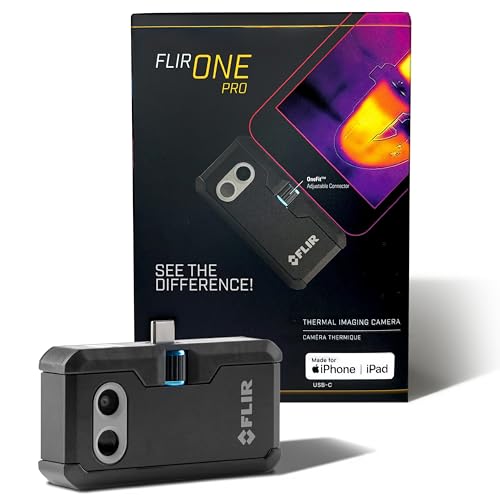 FLIR ONE Pro (phone) | Plugs into iPhone/Android; inspector favorite. | Amazon — $296.65 |
 Topdon TC001 | High-res phone module at a low price. | Amazon — $249.00 |
 FLIR C5 Compact | Standalone pocket camera with Wi-Fi. | Amazon — $593.99 |