Black Mold on a Petri Dish: What the Colonies Really Mean
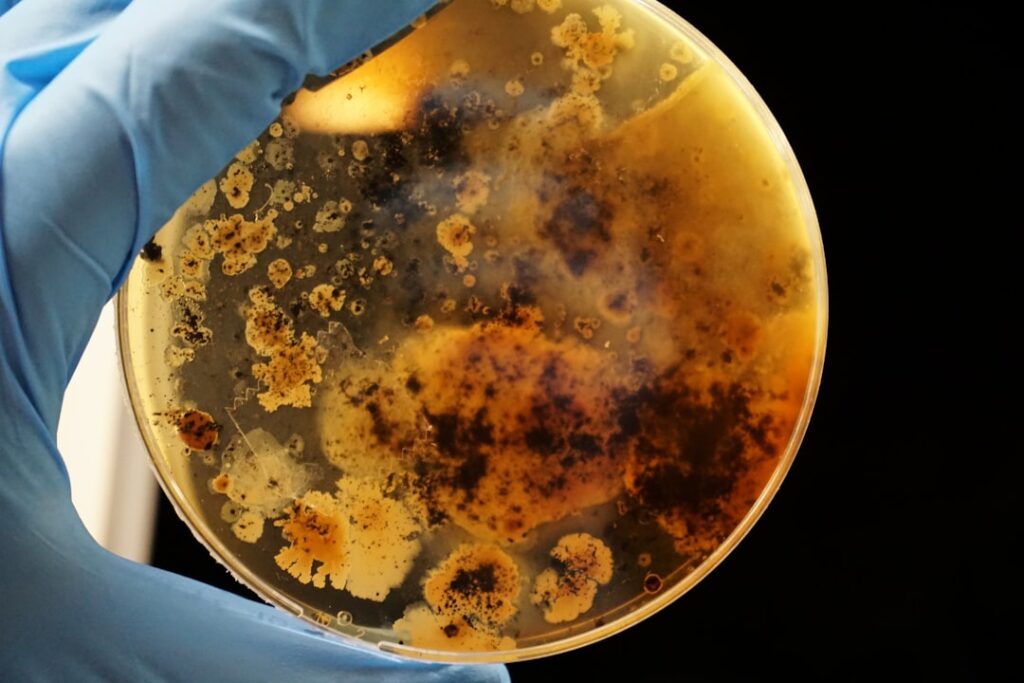
Do-it-yourself mold kits are simple: open a small dish of nutrient gel, leave it in a room for a set time, close it and wait. A few days later, fuzzy spots appear. When some of them are dark, it is tempting to assume that the house has a “black mold” problem. That conclusion is rarely supported by the plate. Finding black mold on petri dish media mostly confirms something every building already has, which is airborne mold spores. This guide explains which molds tend to grow dark on a plate, why settle-plate kits are hard to interpret, what a professional laboratory does differently, and what to do next. It draws on EPA and CDC mold guidance and is educational only. Lab identification requires a qualified laboratory, and health concerns belong with a physician.
Part of our Black Mold & Your Health guide — start there for the full picture →
Is this mold, asbestos, or water damage? Get a free instant screen
Upload a clear photo of the suspect area. You'll get an instant AI screening opinion and what to do next. This is screening guidance, not a professional determination.
Screening guidance only. AI can be wrong. Confirm asbestos, mold type, or lead with lab testing or a licensed professional before acting.
What Black Mold on a Petri Dish Actually Means
A settle plate works by letting airborne particles fall onto a growth medium. Mold spores that land and are still viable can germinate, and over several days each one may grow into a visible colony. Dark colonies on that plate mean that some viable spores of dark-pigmented molds settled during the exposure window. That is the full extent of what the plate shows on its own.
The EPA mold course explains that mold spores are ubiquitous, found both indoors and outdoors, and that they cannot be eliminated from indoor environments. It also notes that the number of spores in indoor and outdoor air fluctuates from season to season, day to day and even hour to hour. A dish left open in almost any home will grow something. Seeing growth, including dark growth, is the expected result rather than a warning sign in itself.
What the plate does not show is just as important:
- It does not show where mold is growing. Spores can drift in from outdoors, from a basement, or from a single moldy item.
- It does not show how much mold is present in the building. Colony counts depend on exposure time, air movement, the medium and incubation conditions.
- It does not identify the species. Color and texture point to possibilities, not confirmed names.
- It does not measure health risk. The CDC says the health effects of mold differ from person to person, so sampling and culturing cannot tell whether someone might become sick.
For a visual reference to what common molds look like on plates, see our petri dish mold identification chart and the companion petri dish mold identification photos.
Which Molds Grow Black on a Plate
“Black mold” is a description, not a species. The EPA mold course states that molds come in many colors including white, and that “black mold” is not a species or specific kind of mold, and neither is “toxic mold.” It adds that the media sometimes use those terms for molds that may produce mycotoxins or for a specific mold, Stachybotrys chartarum. On a culture plate, a wide range of fungi can produce dark colonies. The groups below are commonly discussed; each identification is a possibility that only a lab can confirm.
- Aspergillus niger and related species: often grow quickly into colonies that look like black pepper or soot sitting on a pale or yellowish base. The dark color comes from the spore heads.
- Cladosporium: frequently olive-green to brown-black and velvety, often with a darker underside. The CDC lists Cladosporium among the most common indoor molds, and it is also very common outdoors. Our Cladosporium mold guide covers it in more depth.
- Alternaria: often dark gray to black and woolly, sometimes with a lighter margin. It is commonly associated with outdoor air and damp areas.
- Rhizopus and Mucor: fast, tall, gray-white fuzz with tiny dark spore sacs. These can spread across an entire plate and crowd out slower growers.
- Black yeasts such as Aureobasidium: can start pale and pinkish, then turn shiny or slimy black.
- Stachybotrys: the mold most people mean by “toxic black mold.” It tends to grow slowly on standard general-purpose media and is often outcompeted by faster molds, so it may be underrepresented or absent on a typical settle plate even where it is growing in a building. Our Stachybotrys guide explains where it typically grows.
That last point surprises many people. A plate full of black colonies does not mean Stachybotrys is present, and a plate with no black colonies does not rule it out. The visual answer and the building answer can point in opposite directions. Our guide to what black mold looks like in a petri dish walks through the visual cues in more detail.
Black Colony Look-Alike Table
The table below summarizes common dark colony appearances and what they might suggest. Treat the middle column as a list of possibilities, not a diagnosis.
| Black colony look | Possible genera (not confirmed) | What it means for the home |
|---|---|---|
| Powdery black dots on a pale or yellow base | Often Aspergillus niger group | Common in air and dust; says little on its own |
| Velvety olive-green to black, darker underneath | Often Cladosporium | Very common indoors and outdoors; compare with outdoor air |
| Woolly dark gray to black, lighter edge | Possibly Alternaria | Common outdoors; may reflect outdoor air or damp spots |
| Tall gray fuzz with tiny black dots, fills the plate | Possibly Rhizopus or Mucor | Fast growers that can hide other molds; plate hard to read |
| Shiny or slimy black, yeast-like | Possibly black yeasts such as Aureobasidium | Often linked to wet surfaces like window frames; check for condensation |
| Slow, flat, sooty black growth after a long incubation | Possibly Stachybotrys or another slow grower | Cannot be confirmed by sight; look for long-wet building materials |
| Many mixed colonies of all colors | Normal mix of airborne fungi | Expected result; not evidence of a problem by itself |
No row says “the house has a mold problem,” because the plate cannot say that. Only an inspection of the building, especially for moisture, can. For broader naming help, see our names of mold guide.
Why DIY Settle-Plate Kits Mislead
Settle plates are a long-standing teaching tool, and they are good at one thing: showing that air contains living spores. They are poorly suited to answering whether a particular home has a problem. Several limitations stack up.
Everything grows
Because spores are always present, nearly every plate grows colonies. A dish with ten colonies and a dish with forty may both reflect ordinary conditions. The CDC notes that there are no set standards for what is and is not an acceptable quantity of different kinds of mold in a home. Without a standard, there is no number that turns a plate from “fine” into “problem.”
No baseline
Professional air sampling usually includes an outdoor sample collected at the same time, so the indoor result can be compared with the local background. A single indoor plate has no comparison point. Outdoor spore levels can vary widely, and along the Colorado Front Range they can shift with wind, dry spells, snowmelt and the growing season. Without a matched outdoor reference, an indoor plate cannot show whether indoor air is unusual.
No quantification
A settle plate relies on spores falling by gravity. Small, light spores may stay suspended and never land, while heavy ones settle quickly. Results swing with how long the dish is open, whether a fan or furnace is running, and whether anyone walks past. That makes the colony count an unreliable stand-in for the concentration of spores in the air.
Selective growth
The medium and the incubation temperature favor some molds over others. Fast growers can cover the plate within days and mask slower ones. Dead spores and fragments, which the EPA mold course notes can still cause allergic reactions, do not grow at all, so the plate misses part of the picture.
Identification by eye
Many kits encourage users to compare colonies to a photo card. As the table above shows, many molds look alike, and the same mold can look different depending on the medium and age. Some kits offer optional lab identification for a fee, which helps with naming the colony but still does not fix the sampling limitations.
What EPA says about sampling
The EPA’s position is direct. Its Mold Testing or Sampling page says that in most cases, if visible mold growth is present, sampling is unnecessary. It notes that since no EPA or other federal limits have been set for mold or mold spores, sampling cannot be used to check a building’s compliance with federal mold standards. It also recommends that sampling be conducted by professionals with specific experience in designing sampling protocols, sampling methods and interpreting results. The CDC goes further and states that it does not recommend mold testing, emphasizing that no matter what type of mold is present, it needs to be removed.
Homeowners who still want to experiment can find options in our mold test kit category, ideally treating the result as a curiosity rather than a diagnosis. Our mold petri dish guide covers how these kits are used.
What a Lab Does Differently
A professional mold assessment is built around the building, not the plate. Sampling, when used, is one tool within that process. Common approaches include the following, described in general terms since methods vary by lab and consultant.
- Culture (viable) sampling: air is drawn through a sampler at a known flow rate onto a growth medium, or surfaces are swabbed and cultured. The lab grows the colonies under controlled conditions and identifies them, often to genus and sometimes to species. Because air volume is measured, results can be reported per volume of air, unlike a settle plate.
- Spore trap (non-viable) sampling: air is pulled through a cassette that captures particles on a sticky surface. An analyst counts and categorizes spores under a microscope. This captures dead and living spores alike and is a common method for indoor and outdoor air comparisons. Our guide to air sampling for mold explains how it works.
- Surface sampling: tape lifts, swabs or bulk samples taken from a suspected growth area. The EPA notes surface sampling may be useful to determine if an area has been adequately cleaned or remediated.
- Outdoor comparison: indoor results are compared with outdoor samples collected at the same time to see whether indoor types or levels look different from the local background.
- Accepted methods: the EPA says sample analysis should follow methods recommended by professional organizations such as the American Industrial Hygiene Association.
Labs also control variables that a kitchen counter cannot. Incubation temperature, the type of medium, how long plates are held before reading and how colonies are counted are all standardized, so results from one visit can be compared with a later visit, such as a clearance check after remediation. Chain-of-custody paperwork records when and where each sample was taken, which matters for real-estate or insurance documentation.
Most importantly, a qualified assessor interprets the results alongside a visual inspection and moisture readings. A lab number without that context is easy to misread in either direction. Our mold testing cost guide covers what to expect when hiring a professional.
Next Steps After Seeing Black Colonies
Seeing dark growth on a plate is a reasonable prompt to look around the home, not a reason to panic. A practical sequence:
- Close and discard the dish safely. Keep the lid on, seal it in a bag and throw it away. Do not open a grown plate to sniff or touch it.
- Look for moisture first. Check under sinks, around tubs and showers, window sills, the basement, the attic and around the water heater and furnace. Look for stains, peeling paint, warped materials and musty smells.
- Check humidity. The EPA Brief Guide recommends keeping indoor humidity below 60 percent, ideally between 30 and 50 percent. Front Range homes are often dry, so elevated readings usually point to a specific source such as a leak, a humidifier or poor bathroom ventilation.
- Clean visible growth and fix the source. The CDC says that if mold is growing, it needs to be cleaned up and the moisture problem fixed, and that the type of mold does not need to be known to do so.
- Size the job. The EPA Brief Guide suggests homeowners can usually handle a moldy area under about 10 square feet; larger areas or significant water damage warrant professional guidance.
- Consider a professional assessment for musty odors without visible growth, after a leak or flood, before buying a home, or when someone in the household has health concerns.
- Talk to a physician about symptoms. The plate cannot tell anyone whether symptoms are mold-related.
More context on how inspections and testing fit together is available on the mold inspection pillar page and the black mold hub. For the wider set of identification resources, our mold identification chart compares common household molds by color and location.
Reading a Plate You Have Already Grown
Many people arrive at this question with a grown plate already sitting on the counter. It is still possible to get some value from it, as long as the limits stay in view. A few observations are reasonable to make; others are best left alone.
Observations that are reasonable
- Relative differences between rooms tested the same way. If two plates were opened for the same length of time, in similar conditions, on the same day, and one grew far more colonies than the other, that difference may hint at a room worth inspecting more closely. It is a weak signal, but it can help prioritize where to look for moisture.
- A single dominant colony type. A plate overrun by one kind of colony, compared with a mixed plate from elsewhere in the house, can be a prompt to look for a nearby growth site. It is not proof of one.
- Timing relative to events. A plate opened right after a leak, a flood cleanup or demolition will reflect that disturbance. That context helps explain a heavy plate.
Conclusions to avoid
- “The black colonies are Stachybotrys.” Visual identification of a colony is unreliable, and Stachybotrys is often underrepresented on fast general-purpose media.
- “This many colonies is dangerous.” There are no federal limits for mold or mold spores, as the EPA notes, and the CDC says there are no set standards for an acceptable quantity in a home.
- “No black colonies means no mold problem.” Hidden growth behind walls or under flooring may release few spores into the room during a short exposure window.
- “The plate explains my symptoms.” The EPA mold course points out that headaches, breathing difficulty, skin irritation and other symptoms associated with mold may also be caused by exposures or conditions unrelated to mold growth. A physician is the right person to sort that out.
Handled that way, a settle plate becomes a nudge to inspect rather than a verdict. That is roughly the role federal guidance assigns to sampling in general: secondary to finding and fixing moisture.
Hidden Mold and Front Range Homes
The places where mold tends to hide in Colorado homes are rarely the places where a settle plate sits. Common trouble spots along the Front Range include finished basements with slow foundation seepage, crawlspaces, the area under a leaking ice-maker line, bathroom ceilings beneath a poorly vented fan, attic sheathing near a bath fan that vents into the attic, and window frames where winter condensation forms on cold glass. Evaporative coolers and whole-house humidifiers can also add moisture that the dry outdoor air would otherwise prevent.
A plate on a kitchen counter may grow a typical mix of airborne fungi while a damp wall cavity in the basement goes unnoticed. That is why professionals start with a moisture survey: moisture meters, a look at stains and materials, and sometimes infrared imaging to find cool, damp areas. Sampling, if it happens at all, is targeted to answer a specific question raised by that inspection.
For homeowners, the equivalent is a slow walk-through with a flashlight and a nose for musty odors, paying attention to anything that has been wet for more than a day or two. The EPA Brief Guide notes that if wet or damp materials are dried within 24 to 48 hours after a leak or spill, in most cases mold will not grow. Anything that stayed wet longer is a better lead than any plate.
References
- Mold Testing or Sampling — U.S. Environmental Protection Agency
- Mold Course Chapter 1: Introduction to Molds — U.S. Environmental Protection Agency
- Mold — Centers for Disease Control and Prevention
- A Brief Guide to Mold, Moisture and Your Home — U.S. Environmental Protection Agency
Frequently asked questions
Does black mold on a petri dish mean I have toxic black mold?
No. Many molds grow dark on a plate, including Aspergillus, Cladosporium and Alternaria. The EPA notes that black mold is not a species or specific kind of mold, and Stachybotrys often grows slowly on standard media, so a plate cannot confirm or rule it out.
Is it normal for a settle plate to grow mold?
Yes. The EPA mold course says mold spores are found both indoors and outdoors and cannot be eliminated from indoor environments, so nearly every exposed plate grows colonies.
Are DIY petri dish mold tests accurate?
They show that viable spores are present but cannot measure concentration, locate a source or provide an outdoor baseline. The EPA says sampling should be designed and interpreted by experienced professionals, and the CDC does not recommend mold testing.
What does a lab do differently from a home kit?
Labs use measured air volumes, controlled culture conditions or spore-trap microscopy, outdoor comparison samples and accepted analytical methods, and a qualified assessor interprets results alongside a moisture inspection.
What should I do after seeing black colonies on a plate?
Seal and discard the plate, then look for moisture sources and visible growth. Clean small areas, fix the water problem and consider a professional assessment for hidden mold, larger areas or health concerns.
Not sure what your settle plate is telling you? Send us a message and we can help connect you with an independent Front Range inspector who starts with moisture readings, not colony colors.
DIY mold test kits
A test kit can confirm whether a suspect patch is mold and (with lab analysis) what type — though visible mold over ~10 sq ft generally warrants a professional.
| Product | Why | Buy |
|---|---|---|
 DIY Mold Test (lab included) DIY Mold Test (lab included) | Surface + air-sampling options. | Amazon — $49.99 |
 Healthful Home 5-Minute Mold Test Healthful Home 5-Minute Mold Test | Rapid screening strips. | Amazon — $35.47 |
 Mold Test Plates (DIY petri dishes) Mold Test Plates (DIY petri dishes) | Settle-plate style sampling you culture at home. | Amazon — $22.99 |