Black Mold Dust: What Homeowners Need to Know
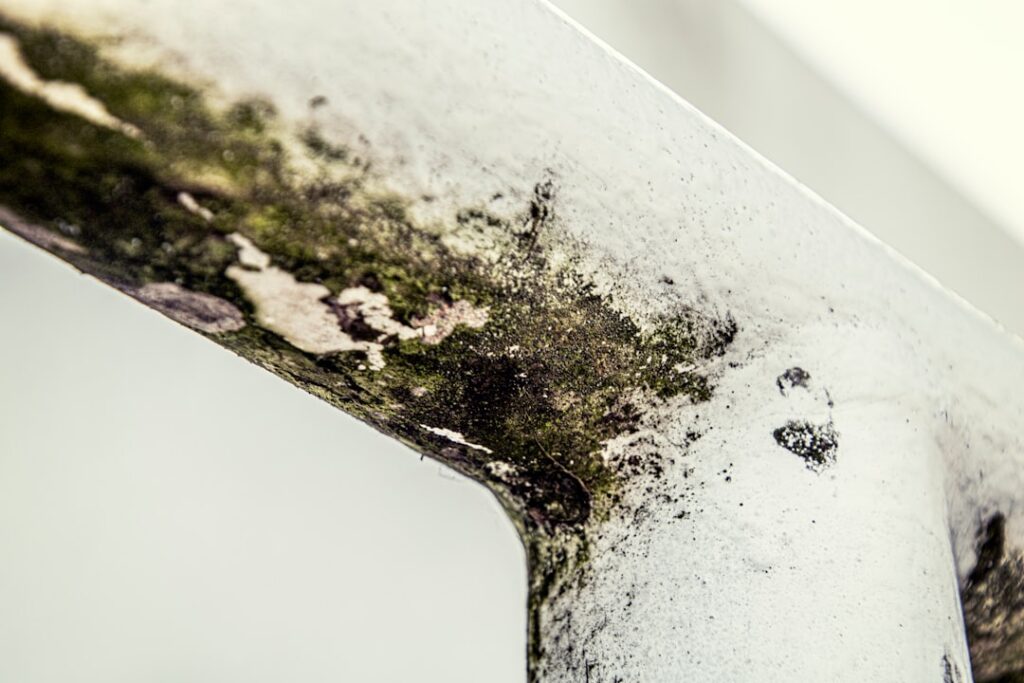
Homeowners sometimes find a dark, powdery residue on attic surfaces, behind furniture in damp basements, or settled on items stored near visible mold growth. The question that follows is whether that residue is dangerous and how to clean it up. This guide summarizes EPA, CDC, and NIEHS guidance on residential mold for homeowners current as of 2026. It is not medical advice. Anyone experiencing respiratory symptoms or other health concerns that may relate to mold exposure should consult a physician. The home-side conversation that follows covers what black mold dust actually is, the cleanup hierarchy EPA endorses, and when the situation belongs to a professional rather than a homeowner with a dust mask.
Part of our Black Mold & Your Health guide — start there for the full picture →
Is this mold, asbestos, or water damage? Get a free instant screen
Upload a clear photo of the suspect area. You'll get an instant AI screening opinion and what to do next. This is screening guidance, not a professional determination.
Screening guidance only. AI can be wrong. Confirm asbestos, mold type, or lead with lab testing or a licensed professional before acting.
What black mold dust actually is
“Black mold dust” is informal language for several things people see and reasonably ask about. It refers to settled mold spores that have accumulated on horizontal surfaces, dried colony fragments that have flaked off active or previously active growth, and mixed organic dust containing both mold material and other particulates. The visible color is usually dark gray, black, brown, or greenish-black depending on the species present and the substrate it came from.
The dust itself is not different in nature from the active colony. It is the same biological material — spores and hyphal fragments — in a settled, dried form. Disturbing it (sweeping, vacuuming with a non-HEPA vacuum, brushing, blowing compressed air) re-suspends the particles into the air, which is the inhalation exposure pathway EPA and CDC guidance address when discussing mold cleanup safely.
Where homeowners typically find black mold dust
The locations cluster around active or recently active mold growth and around HVAC airflow.
Attics with previous moisture problems
Attic sheathing that experienced past condensation or roof leaks often shows dark patches with surrounding dust on stored items, on the top side of ceiling insulation, and on framing surfaces. The colony may now be dry and dormant — moisture has stopped — but the deposited material remains.
Basements with active or past humidity issues
Stored cardboard boxes, fabric furniture, and items pushed against finished walls collect mold dust over months of high humidity. Even after a dehumidifier has dried the space, the residue stays on surfaces.
Around HVAC vents
If contamination has reached the air-handling system or supply ductwork, dark dust accumulates on supply register slats, on adjacent ceiling surfaces, and on horizontal furniture surfaces near vents. This is one of the more concerning patterns because the airflow distributes the material throughout the conditioned space.
Behind and under furniture in poorly ventilated rooms
Cool exterior walls behind bookcases and beds, where airflow is restricted, develop both colonies and downstream dust deposits. Moving furniture during a deep clean often reveals the pattern.
Is black mold dust dangerous?
CDC guidance recognizes that inhalation of mold spores — whether airborne from an active colony or re-suspended from settled dust — can cause respiratory irritation in healthy people, asthma exacerbation in people with asthma, allergic reactions in sensitized individuals, and serious infections in immune-compromised people. The relevant safety implication for homeowners is that dust disturbance during cleanup is a higher-exposure activity than just being in a room with deposited dust.
The honest answer is: the dust is the same material the active colony was releasing into the air during its growth phase. Whether settled or airborne, controlled cleanup with appropriate protective equipment and source moisture correction is the EPA-endorsed approach. The mold inspection and testing pillar covers professional assessment for situations where the dust extent or hidden source is unclear.
When dust signals something bigger
Visible dust spread over a wide area, dust on HVAC components, dust accompanied by a strong musty smell from no visible source, or dust in a home with an immune-compromised occupant all push the situation toward professional remediation. A homeowner cleaning visible dust without finding the source colony is treating a symptom, not the cause.
The EPA cleanup hierarchy applied to dust
EPA’s residential mold guidance scales the response by affected area and substrate type. For mold dust specifically, the same logic applies: hard non-porous surfaces are cleanable, porous materials with significant contamination usually are not, and source moisture correction is required regardless.
Hard, non-porous surfaces (cleanable)
Glass, sealed concrete, metal, glazed tile, sealed wood, and similar surfaces can be wet-wiped with soap and water and then dried thoroughly. HEPA vacuuming before wet cleaning reduces the airborne re-suspension during wet wipe-down. EPA does not require bleach for residential mold cleanup; plain detergent is adequate for most surfaces.
Semi-porous surfaces (case-by-case)
Unsealed wood, concrete with surface texture, painted drywall in good condition. These can sometimes be cleaned with HEPA vacuuming followed by careful wet-wiping, but visible staining may remain even when the material is no longer actively contaminated. Removal is often easier than cleaning.
Porous materials with dust contamination
Carpet, carpet pad, drywall paper face, fabric upholstery, mattresses, paper-faced insulation, ceiling tiles, and similar materials generally cannot be reliably cleaned of embedded mold dust. EPA guidance endorses removal and replacement for these substrates. Trying to clean rather than replace is usually false economy — the dust embedded in fiber is not effectively reachable.
Safe DIY cleanup of small dust areas
For small areas — under 10 square feet of dust on hard surfaces — homeowner cleanup is reasonable. The protective measures below reduce inhalation and prevent re-deposition elsewhere in the house.
Personal protective equipment
An N-95 respirator (not a surgical mask), eye protection without ventilation holes, disposable gloves, and clothing the homeowner is willing to wash or discard. OSHA guidance on respiratory protection applies more strictly to occupational settings but the residential-cleanup principle is the same: filter the air before it reaches the lungs.
HEPA vacuum before wet cleaning
A vacuum with a true HEPA filter and sealed body captures the dust without re-emitting fine particles. Standard household vacuums without HEPA filtration can make the air worse by exhausting fine particles back into the room. Many rental centers and equipment yards rent HEPA vacuums for under fifty dollars per day.
Contain the work area
Close doors to adjacent rooms, turn off the HVAC system to prevent distribution, and consider a plastic sheet barrier if the dust is concentrated. Open a window in the work area for ventilation while wearing the respirator.
Wet-wipe with detergent
After HEPA vacuuming, wipe hard surfaces with soap and water, changing rinse water frequently. EPA does not endorse bleach for residential mold cleanup. Dry the surfaces fully before considering the area finished.
Bag and dispose
Disposable wipes, vacuum bags, gloves, and any disposable PPE go into a sealed plastic bag and out of the house. Do not store contaminated cleaning materials inside.
When to hire a remediation contractor
Several conditions push beyond reasonable DIY scope, in line with EPA residential guidance and IICRC S520 professional standards.
Affected area greater than 10 square feet
The EPA threshold is not a regulation but a guidance line. Larger areas mean larger spore disturbance during cleanup, longer work time at exposure, and higher likelihood of hidden contamination.
HVAC contamination
Dust on supply registers, in the air handler, or distributed by airflow throughout the house indicates the system has been part of the spread. Cleaning the system safely requires professional duct cleaning equipment and containment.
Sewage-related water damage
“Category 3” water per IICRC terminology is a remediation-contractor-only situation regardless of mold-dust quantity.
Immune-compromised occupants
Households with members on chemotherapy, post-transplant, with HIV/AIDS, with cystic fibrosis, or with other immune-compromising conditions warrant professional remediation rather than family DIY work. The medical risk profile shifts the cost-benefit. Our health issues from black mold guide covers the sensitivity factor.
Hidden source not yet identified
If the dust is visible but the colony source is not, finding the source via moisture-meter survey, infrared thermography, or limited investigative cuts is itself a professional task. Cleaning the dust without finding the source guarantees the problem returns.
After cleanup: verifying the work
The verification questions are simple and do not require lab work in most residential cases. Has the moisture source been fixed? Does the cleaned surface stay visually clean over a 30-day window? Has any musty smell dissipated? Does indoor relative humidity stay in the 40-50 percent range? If post-cleanup verification clearance testing was specified by contract — typical for larger projects — the third-party industrial hygienist performs that testing per the project scope.
Homeowners sometimes ask whether they should air-test before and after cleanup. The realistic answer, covered in our black mold in air guide, is that air sampling has specific use cases but is not required by EPA guidance for visible-growth cleanup. Visual confirmation, smell, and moisture-meter readings are the standard residential verification.
Cleaning patterns by location
Different rooms have different dust-cleanup considerations because the surrounding context affects safe approach.
Attic dust cleanup
Attics often present the largest area of accumulated mold dust because past condensation or roof leaks can leave material on the underside of sheathing, on stored items, and on insulation. The space is typically poorly ventilated and dusty even without mold. PPE matters more here than in finished living spaces. Source repair — fixing the roof leak, redirecting the bathroom fan exhaust, improving attic ventilation — must precede the cleanup or recurrence is guaranteed.
Basement dust cleanup
Basements with humidity-driven mold often have dust spread across stored items rather than concentrated on a single colony. Removal of unsalvageable items (cardboard, fabric) is often the largest part of the work. Hard surfaces — sealed concrete floor, painted block walls — clean with HEPA vacuuming and detergent wipe.
HVAC and supply register area cleanup
When dust has accumulated around supply registers, the cleaning extends to professional duct cleaning. Wiping the visible register slats and ceiling area near the vent without addressing the source inside the duct produces only temporary improvement. The home inspection tools pillar covers borescope inspection useful for duct interior assessment.
Cabinet and toe-kick cleanup
Dust under sinks and inside cabinet bases often indicates an upstream leak. Cleaning the cabinet without finding and stopping the leak produces recurrence within weeks. Pull all items, inspect with a flashlight, check plumbing connections, look for water staining on cabinet sides and base.
References
- Mold cleanup in your home — U.S. Environmental Protection Agency
- Basic facts about mold and dampness — Centers for Disease Control and Prevention
- Mold and indoor air quality — Occupational Safety and Health Administration
Frequently asked questions
Is black mold dust as dangerous as active mold?
It is the same biological material in a settled, dried form. Disturbing settled dust re-suspends spores into the air, which is the inhalation exposure pathway. EPA guidance treats dust cleanup with the same PPE and containment principles as cleaning active growth.
Can a regular vacuum clean up mold dust safely?
No. Standard household vacuums without HEPA filtration can exhaust fine spore particles back into room air, making the situation worse. Use a HEPA-filtered vacuum or one rented from an equipment yard for mold cleanup work.
How do I know if dust I see is mold or just regular household dust?
Mold dust is usually associated with a visible colony source nearby, a musty smell, dark color, and a damp or previously damp location. When the source is unclear, professional assessment with moisture readings and possibly surface or air sampling is the next step.
Front Range homeowners noticing widespread mold dust without an obvious source can connect with a vetted local inspector through our contact page for source-finding before cleanup.