Black Mold in Air: Airborne Spores and Sampling for Homeowners
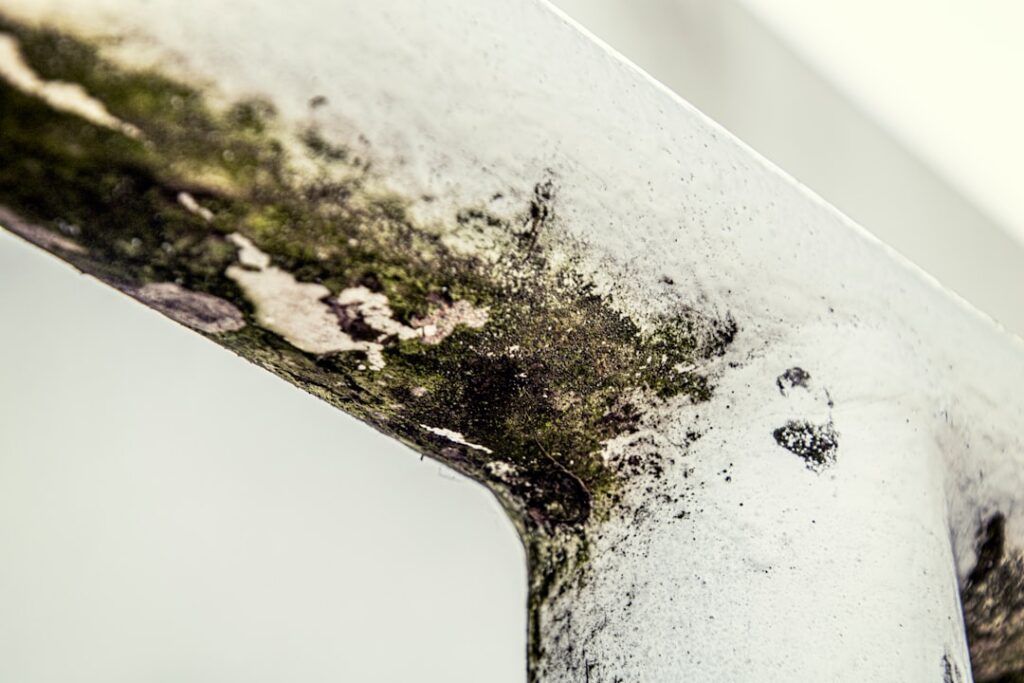
Black mold in air refers to airborne spores released from Stachybotrys chartarum and other indoor mold colonies into the breathable indoor environment. These spores are the principal route by which mold reaches occupants’ airways, and air sampling is the methodology used to characterize how much of them are present at a given moment. This guide summarizes EPA, CDC, and NIEHS guidance on residential mold from a homeowner’s perspective. It is not medical advice. If anyone in the household has respiratory symptoms they believe may relate to mold exposure, consult a physician — diagnosis and treatment of mold-related illness require professional medical evaluation. The focus here is the airborne side of the indoor mold question: what is actually in the air, how it gets there, when air testing helps, and when it doesn’t.
Part of our Black Mold & Your Health guide — start there for the full picture →
Is this mold, asbestos, or water damage? Get a free instant screen
Upload a clear photo of the suspect area. You'll get an instant AI screening opinion and what to do next. This is screening guidance, not a professional determination.
Screening guidance only. AI can be wrong. Confirm asbestos, mold type, or lead with lab testing or a licensed professional before acting.
What “black mold in air” actually means
Mold reproduces by releasing spores — small, durable reproductive cells in the 2 to 20 micron size range — into the surrounding air. Stachybotrys chartarum spores are roughly 7 to 12 microns long, oval, and dark-pigmented (the dark color is the basis for “black mold” in popular use). Stachybotrys spores tend to clump and are released in slimy masses that do not aerosolize easily until disturbed, dried, or fragmented. Other indoor genera — Aspergillus, Penicillium, Cladosporium, Alternaria — are typically more abundant in routine air samples because their spores release more readily.
Airborne spore concentration in residential indoor environments is rarely zero. Outdoor air, which infiltrates indoors continuously, carries baseline fungal spore loads. An indoor environment with concentrations roughly comparable to or lower than the outdoor air around it is in normal operating range. An indoor environment with concentrations significantly above the outdoor reference, especially with a fungal community profile dominated by species rare outdoors, suggests an indoor source. The CDC and EPA both note that interpreting air samples requires this indoor-outdoor comparison rather than absolute thresholds.
How spores get into indoor air
Direct release from active colonies
An actively growing colony produces and releases new spores continuously. Mature Stachybotrys colonies release fewer spores than mature Aspergillus or Penicillium colonies under quiescent conditions, but their spore biomass increases substantially when the substrate dries (the dried mass fragments more easily) or when the colony is physically disturbed during construction, demolition, or remediation work.
Disturbance-driven aerosolization
Vacuuming carpet that contains settled spores re-aerosolizes them. Foot traffic on contaminated flooring lifts particulate. Pulling back drywall, removing baseboard, or cutting into contaminated wall cavities generates burst events that produce orders-of-magnitude higher concentrations than baseline. This is why EPA-recommended remediation procedures emphasize containment of the work zone and respiratory protection for workers — the disturbance phase is when the highest exposures occur.
HVAC distribution
Forced-air HVAC systems with returns near mold reservoirs (basements, crawlspaces, contaminated cavities with breach to return-air pathway) pull spores into the air-handler and distribute them throughout the conditioned space. A colony in a single basement utility room can produce elevated airborne counts in bedrooms upstairs through this pathway. Cooling coils with their own surface mold growth (a common finding in inadequately maintained systems) are themselves emitting sources.
Outdoor air infiltration
Baseline indoor mold spore concentration tracks outdoor concentration with a lag and a dilution factor. During high-spore outdoor periods — typically summer and early fall for many U.S. regions — indoor counts rise even without indoor sources. This is normal and not, by itself, evidence of indoor contamination.
Air sampling methodology
Spore-trap sampling
The most common residential air-sampling method uses a calibrated pump to draw a measured volume of air through a sticky-surface cassette over a fixed duration (typically 5 to 15 minutes at 5 to 15 liters per minute). The cassette traps airborne particles, which a laboratory then microscopically counts and identifies by genus. Results report spores per cubic meter of air, broken down by genus.
Indoor versus outdoor reference
A proper residential air sampling protocol includes at least one outdoor reference sample on the same day, at the same time of day, under similar weather conditions. Interpretation compares indoor genus profiles to outdoor profiles. Genera abundant indoors but rare outdoors suggest indoor sources. Genera abundant outdoors at the same time indicate normal infiltration.
Multiple-room sampling
A complete protocol samples multiple representative indoor locations: a basement, a ground-floor common area, a bedroom, and at least one suspected-source area. The pattern across rooms helps identify reservoir locations and HVAC distribution patterns.
Limitations
Air sampling is a snapshot. Spore concentration fluctuates with occupant activity, HVAC cycling, weather, and time of day. A single sample captures one moment; chronic exposure assessment requires interpretation that accounts for this variability. Air sampling also under-detects Stachybotrys specifically because Stachybotrys spores aerosolize less readily than other indoor mold genera; surface or bulk sampling is more sensitive for Stachybotrys identification.
When air testing actually helps homeowners
Air sampling produces useful information in specific scenarios:
- Post-remediation verification: confirming that a remediated space has returned to spore counts comparable to outdoor reference. This is the most clearly useful application.
- Suspected hidden source: investigating elevated symptom complaints in occupants when no visible colony has been found. Air sampling in suspected rooms can support source-localization decisions.
- HVAC contamination assessment: sampling supply registers and return air to characterize whether the system is a distribution pathway.
- Pre-purchase due diligence: in a real estate transaction where prior mold history is documented and the buyer wants to verify current conditions before closing.
When air testing doesn’t help and often misleads
Air sampling is less useful in scenarios where homeowners often reach for it:
- Confirming whether a visible patch is “really mold”: visible mold should be remediated regardless of species. A surface tape lift or bulk sample identifies it more reliably and cheaply than air sampling.
- Diagnosing occupant illness: air spore counts do not predict individual health outcomes. Physicians use patient history and clinical findings, not environmental sampling, for diagnosis.
- “Reassurance” sampling when no symptoms or visible mold are present: normal indoor air contains background spore loads, and a result showing detectable mold is often misinterpreted as evidence of a problem when it is actually normal.
- Quantifying mycotoxin exposure: standard spore-trap air sampling does not measure mycotoxins. Specialized sampling exists but is technically demanding and rarely useful for residential decision-making.
What the count numbers mean in context
Public-health agencies have not established residential air-quality standards for fungal spores comparable to standards for radon or carbon monoxide. Practitioner experience treats roughly the following ranges as orienting (not regulatory):
- <500 spores/m³ total: typical indoor air in dry-climate regions during winter; not concerning in isolation.
- 500–1,500 spores/m³ total: typical indoor air in many U.S. regions during shoulder seasons; indoor profile should resemble outdoor profile.
- 1,500–5,000 spores/m³ total: elevated; investigation warranted, especially if indoor profile diverges from outdoor.
- >5,000 spores/m³ total: substantially elevated; indoor source typically present.
- Stachybotrys detection in air at any concentration: warrants attention because Stachybotrys aerosolizes poorly, so detection often indicates significant biomass present.
These ranges are heuristics, not regulatory thresholds. Interpretation always includes indoor-outdoor comparison and genus profile, not just totals.
What homeowners should do before paying for air testing
The cost-effective sequence is to address the moisture story first. Visible visual inspection, moisture-meter survey of suspect walls and floors, and HVAC component inspection cost less than air sampling and usually identify the source if there is one. Air sampling adds value after visible inspection has localized suspected sources or after remediation has been completed for clearance verification. The mold inspection hub sequences these steps for the typical residential workflow.
Front Range air-sampling realities
Colorado’s semi-arid climate produces relatively low outdoor fungal spore counts compared to humid regions. This means indoor counts that would be unremarkable in Houston can read as elevated in Denver if the indoor-outdoor ratio is what’s evaluated. Front Range air sampling interpretation should account for this baseline. The same dry climate makes Stachybotrys detection particularly meaningful because regional outdoor air rarely contributes Stachybotrys, so indoor detection almost always indicates indoor source. A basement-specific danger walkthrough picks up the typical Front Range scenario.
What to ask before hiring an air-sampling provider
- What protocol do you use, and does it include outdoor reference samples on the same day?
- How many indoor locations will you sample?
- Which AIHA-accredited laboratory analyzes the cassettes?
- What is the report format, and will it include indoor-outdoor comparison and genus profile?
- Are you separately licensed as a mold assessor in jurisdictions that require it?
- Do you have a conflict of interest with remediation contractors? (A provider who also performs remediation has a structural incentive to find problems.)
How indoor air spore concentrations actually fluctuate
Even in a stable building, indoor airborne mold spore concentrations fluctuate by factors of 2–10× over the course of a day depending on occupant activity, HVAC cycling, outdoor weather, and disturbance events. Morning samples often differ from afternoon samples. Samples taken with the HVAC blower running differ from samples with it off. Samples after vacuuming differ from samples before. A single-point air sample is therefore a snapshot of one moment in this fluctuating curve. Multiple-time-point sampling (morning and afternoon, or before and after HVAC operation) captures more of the actual indoor-air variability and supports better-grounded conclusions. For most residential investigations, a single sample is the practical compromise between cost and information, with the understanding that the result is one slice of a moving picture.
What occupant respiratory symptoms imply about air sampling
Occupants in a damp, mold-burdened home often have respiratory symptoms that correlate poorly with the spore counts captured in any specific air sample. Sensitized occupants react to spore loads well below what unsensitized occupants notice. Some occupants react to non-spore biomass fragments and microbial volatile organic compounds (mVOCs) that standard spore-trap sampling does not quantify. Conversely, some homes show elevated air spore counts in samples with no occupant complaint, often because the occupants are not sensitized or the affected room is rarely used. The implication is that air sampling and occupant symptom assessment provide complementary but non-redundant information; neither replaces the other.
What modern remediation clearance protocols include
Post-remediation verification, when performed properly, follows a structured protocol. Visual inspection confirms substrate removal and surface cleanliness. Moisture-meter survey confirms the affected cavity is dry. Air sampling captures airborne spore concentration in the remediated space and a comparison location, with outdoor reference. The protocol expects the remediated space to show spore counts comparable to non-affected indoor locations and to outdoor reference. Genus profile in the remediated space should match the outdoor and non-affected indoor profiles. When all three converge, the cleanup is verified.
References
- EPA Mold Testing or Sampling — U.S. Environmental Protection Agency
- CDC About Mold — Centers for Disease Control and Prevention
- NIEHS Mold Health Topic — National Institute of Environmental Health Sciences
- American Lung Association Mold and Dampness — American Lung Association
Frequently asked questions
Can you test the air for black mold?
Yes, through spore-trap air sampling. Results are most useful for post-remediation verification and source-localization investigations. Air sampling under-detects Stachybotrys specifically because its spores aerosolize less readily than other indoor genera.
What is a normal level of mold spores in indoor air?
No regulatory threshold exists. Practitioners use indoor-outdoor comparison rather than absolute numbers. Indoor profiles resembling outdoor profiles in the same time window are typically considered normal.
Do I need air testing if I can see black mold on the wall?
Usually not as a first step. Visible mold should be remediated regardless of species. Surface or bulk sampling identifies it more reliably than air sampling, which under-detects Stachybotrys.
When is air testing most worth the cost?
Post-remediation clearance verification provides the clearest value. Pre-purchase due diligence and hidden-source investigation in homes with symptomatic occupants are also reasonable applications.
Front Range homeowners considering air sampling as part of mold investigation can reach out through our contact page for a connection to a vetted local inspector before scheduling work.