Best Wine Fridges (2026): 6 Freestanding Picks Compared
The best wine fridge is the one that holds the bottles you actually keep, at a steady temperature, in the spot where you plan to put it. That last part trips up more buyers than bottle count. Most of the wine coolers sold on Amazon are freestanding units that breathe out of the back, which means they need open air around them and should not be slid into a cabinet opening. A true built-in or under-counter wine refrigerator vents through a front grille and is a different purchase, often tied into a kitchen remodel. This roundup sticks to the freestanding and countertop shelf, with one front-vented model noted, and compares six picks by the job each does best, followed by a buying guide on cooling type, placement and electrical use.
Part of our Home Electrical guide — start there for the full picture →
As an Amazon Associate we earn from qualifying purchases.
How we compared: we compared 11 current Amazon listings for wine fridges and wine coolers, from 8 to 52 bottles, on what each listing states: bottle capacity, cooling type, temperature range, door glass, shelving, controls, noise and warranty. We set aside three listings that are can-capacity beverage refrigerators rather than wine coolers. We did not lab-test or use any of these units hands-on. Prices and availability change often, so check the current listing before buying.
Quick picks: the best wine fridges by use case
| Product | Best for | Key features | Price | Buy |
|---|---|---|---|---|
| Ivation 18-Bottle | Best overall for most collections |
| $237.99as of Nov 28, 2026 12:27 pm GMT+0000 | Buy now →Check current price |
| Ca'Lefort 52-Bottle Dual Zone | Best for under-counter installs |
| $683.98as of Nov 28, 2026 12:27 pm GMT+0000 | Buy now →Check current price |
| Hamilton Beach HBWF4303 | Best large freestanding |
| — | Buy now →Check current price |
| BLACK+DECKER BD61536 | Best simple dial control |
| $259.99as of Nov 28, 2026 12:27 pm GMT+0000 | Buy now →Check current price |
| Icyglee 25-Bottle | Best quiet pick |
| $219.99as of Nov 28, 2026 12:27 pm GMT+0000 | Buy now →Check current price |
| Cuisinart CWC-800CEN | Best small countertop cellar |
| $169.95as of Nov 28, 2026 12:27 pm GMT+0000 | Buy now →Check current price |
Prices are Amazon’s listed prices as of the time shown and change often; check Amazon for today’s price. As an Amazon Associate we earn from qualifying purchases.
The six picks, compared listing by listing
1. Ivation IVFWCC181LB 18-Bottle — Best Overall Wine Fridge for Most Collections
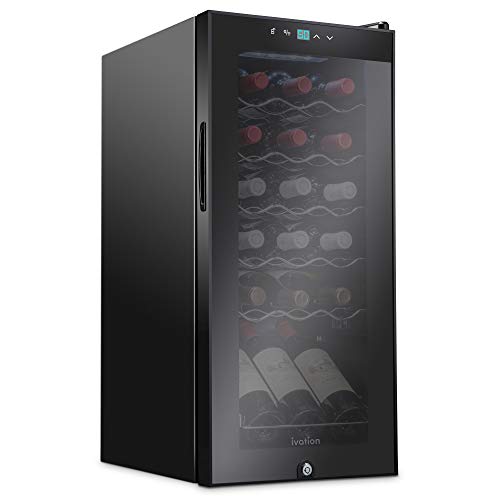
18-bottle compressor wine cooler with a circulation fan, UV-resistant double-pane door, 41 to 64 F range, settings lock.
Check price on Amazon$237.99 as of Nov 28, 2026 12:27 pm GMT+0000 — prices change; see Amazon for current price.Why we like it
- Compressor cooling with a built-in circulation fan
- Covers sparkling through red at 41 to 64 F
- Lock button keeps settings from being changed
- Slim 13.6 in width for 18 bottles
| Specification | Details |
|---|---|
| Capacity | 18 standard bottles |
| Cooling | Compressor with built-in fan for even temperature |
| Temperature range | 41 to 64 F, digital touch controls and LCD readout |
| Door | UV-resistant double-paned glass |
| Size / weight | About 30.3 x 17.7 x 13.6 in; 43 lb |
| Warranty | 1-year limited |
Ivation IVFWCC181LB — 18 bottles, compressor + fan, 41–64 F, UV double-pane door, settings lock, 13.6 in wide, 1-yr warranty
One of Only Three Listings That Describe a Circulation Fan
Nine of the 11 wine-cooler listings use a compressor, and only three say they add a fan to move air through the cabinet: the two Ivation models and the Ca’Lefort dual-zone unit. A fan matters because a still cabinet stratifies, with the bottom bottles colder than the top. For an 18-bottle cooler that may be holding both whites and reds, even air is the difference between a set temperature and a real one.
The Ivation also describes a lock button that locks in the temperature settings once they are set, which keeps curious kids and guests from changing them. The title says the unit comes with a lock, but the feature text describes this settings lock rather than a keyed door lock, so do not count on it to secure the bottles.
At about 13.6 inches wide it fits beside a kitchen island or in a dining-room corner where a 17.5-inch, 25-bottle unit would crowd the space. Its dimensions match the ROVSUN 18-bottle listing almost exactly, which suggests a shared cabinet. What it does not state: noise level, energy use or any safety certification.
Pros
- Compressor plus circulation fan
- Full 41 to 64 F range
- Settings lock and bright LCD
- Narrow cabinet for its capacity
Cons
- Lock is for settings, not a door lock
- No noise or energy figures stated
- Freestanding only; needs rear clearance
Check Ivation 18-Bottle price on Amazon
2. Ca’Lefort 52-Bottle Dual Zone — Best for Under-Counter Installs
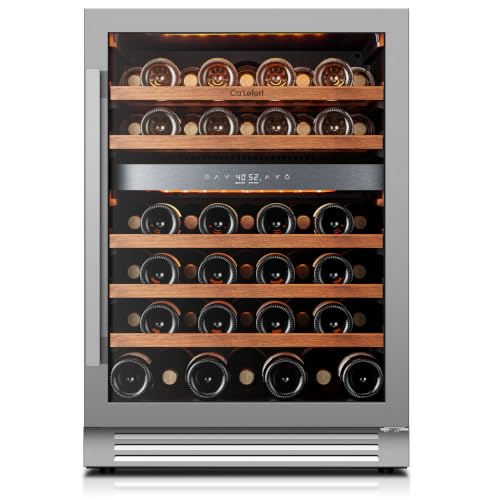
24 in, 52-bottle dual-zone wine cooler with front ventilation for built-in use, wood shelves and tiered warranty.
Check price on Amazon$683.98 as of Nov 28, 2026 12:27 pm GMT+0000 — prices change; see Amazon for current price.Why we like it
- Only listing with a front ventilation grille
- Only dual-zone cooler on the shelf
- Largest capacity at 52 bottles
- Separate parts and compressor coverage
| Specification | Details |
|---|---|
| Capacity | 52 standard 750 ml bottles; 5.7 cu ft |
| Cooling | Compressor with fan-assisted air circulation; automatic defrost |
| Zones / range | Dual zone; 40 to 64 F per feature text (title says 40 to 65 F) |
| Installation | Built-in, under-counter or freestanding, with front ventilation |
| Shelves / lighting | Sapele wood shelves; amber, blue and white LED |
| Warranty | 1 year unit, 2 years parts, 3 years compressor |
Ca’Lefort 24 in dual zone — 52 bottles, 5.7 cu ft, compressor + fan, front-vented for built-in, wood shelves, 1/2/3-yr warranty
The Only Front-Vented, Dual-Zone Cooler Here
Two listings say their coolers can go under a counter: this Ca’Lefort and the EUHOMY 25-bottle. Only the Ca’Lefort describes a front ventilation grille, which is what makes a wine refrigerator safe to install flush in a cabinet run. A rear-venting freestanding cooler pushed into a 24-inch opening recirculates its own hot air, works harder and can fail early. If you plan a built-in look, this is the only listing on the shelf that describes the hardware for it.
It is also the only dual-zone listing and, at 52 bottles in 5.7 cubic feet, the largest. Two zones let reds sit warmer than whites and sparkling in the same cabinet. The listing gives a single 40 to 64 F range in the feature text without breaking it down by zone, so confirm each zone’s limits in the manual.
Its warranty is the most detailed on the shelf: one year on the complete unit, two on parts and three on the compressor. The listing also advises letting the unit stand for 24 hours after delivery before switching it on, the only listing to say so. It does not state a weight, which will be substantial, or a noise level.
Pros
- Front ventilation for built-in use
- Dual temperature zones
- 52-bottle capacity
- 3-year compressor coverage
Cons
- Per-zone temperature ranges not stated
- Weight and noise level not stated
- 24 in width needs a full cabinet bay
Check Ca'Lefort 52-Bottle Dual Zone price on Amazon
3. Hamilton Beach HBWF4303 — Best Large Freestanding Wine Fridge

43-bottle freestanding compressor wine cooler with curved wire shelves, double-pane UV glass and a digital display.
Check price on AmazonWhy we like it
- 43 bottles, second most on the shelf
- Double-pane tinted glass for UV protection
- Digital thermostat with temperature display
- Leveling legs for uneven floors
| Specification | Details |
|---|---|
| Capacity | Up to 43 bottles |
| Cooling | Compressor |
| Temperature range | 40 to 61 F, electronic thermostat with digital display |
| Door | Stainless frame and handle; double-pane tinted glass |
| Size / weight | About 34.3 x 22.3 x 19.5 in; 49 lb |
| Warranty | 1 year |
Hamilton Beach HBWF4303 — 43 bottles, compressor, 40–61 F digital, double-pane tinted UV glass, curved wire shelves, 49 lb
The Most Bottles in a Freestanding-Only Cabinet
Excluding the front-vented Ca’Lefort, capacities on this shelf top out at 25 or 26 bottles for every other listing except this one. The Hamilton Beach holds up to 43 on curved wire shelves, a meaningful step for someone whose collection has outgrown a 25-bottle cooler but who does not want a built-in project. At about 19.5 inches wide and 22.3 inches deep it still fits a dining room or basement bar wall.
The temperature range tops out at 61 F, lower than the 64 F on most compressor rivals. That is fine for serving temperatures and whites, but some red-wine drinkers prefer to store a little warmer. Like every bottle count here, 43 assumes slim Bordeaux-style bottles; wider Burgundy and Champagne bottles cut real capacity.
The listing states no fan, noise level or energy use, and names no safety certification. Blue interior LEDs are decorative; the listing notes they generate no heat.
Pros
- 43-bottle capacity
- Double-pane tinted UV glass
- Digital thermostat and display
- Leveling legs
Cons
- Range stops at 61 F
- No fan or noise level stated
- Freestanding only
Check Hamilton Beach HBWF4303 price on Amazon
4. BLACK+DECKER BD61536 — Best Wine Fridge With Simple Dial Control

26-bottle compressor wine fridge with mechanical 40 to 64 F control, flat back, four racks and a magnum compartment.
Check price on Amazon$259.99 as of Nov 28, 2026 12:27 pm GMT+0000 — prices change; see Amazon for current price.Why we like it
- Only mechanical temperature control on the shelf
- Bottom compartment fits magnums
- Flat back design and leveling legs
- Most bottles among the 25-bottle class
| Specification | Details |
|---|---|
| Capacity | 26 bottles |
| Cooling | Compressor |
| Temperature control | Mechanical, 40 to 64 F |
| Shelving | 4 chrome wine racks, 1 flat shelf, bottom compartment for magnums |
| Size / weight | About 17.5 x 19.7 x 31.5 in; 48.5 lb |
| Warranty | 1 year |
BLACK+DECKER BD61536 — 26 bottles, compressor, mechanical 40–64 F control, flat back, magnum compartment, 48.5 lb, 1-yr
The Only Dial Control in a Field of Touchpads
Every other listing on the shelf that describes its controls uses a digital touchpad or electronic thermostat. This BLACK+DECKER is the only one with a mechanical temperature control. A dial has no display, so you will want a separate thermometer in the cabinet, but it also has no electronic control board to fail and it returns to the same setting after a power outage without reprogramming.
It belongs to a crowded class: three listings sit at 25 or 26 bottles in nearly identical 17.5-inch-wide cabinets (this one, the Icyglee and the EUHOMY), and this one and the EUHOMY describe the same layout of four racks plus a flat shelf. The BLACK+DECKER adds a flat back, useful when the unit sits against a wall, and a bottom compartment sized for magnums or smaller bottles.
It does not mention UV-protective glass; the door is described as clear double-pane glass. If the cooler will sit in a sunny room, that matters, because light degrades wine over time.
Pros
- Simple mechanical control
- Magnum-friendly bottom compartment
- Flat back for wall placement
- Compressor cooling
Cons
- No temperature display
- UV protection not mentioned
- No fan or noise figure stated
Check BLACK+DECKER BD61536 price on Amazon
5. Icyglee FWC009 25-Bottle — Best Quiet Wine Fridge

25-bottle compressor wine fridge rated below 36 dB, with R600A refrigerant, double-pane UV glass and an ETL certificate.
Check price on Amazon$219.99 as of Nov 28, 2026 12:27 pm GMT+0000 — prices change; see Amazon for current price.Why we like it
- Only wine cooler that states a noise level
- Only wine cooler that names an ETL certificate
- Names its R600A refrigerant
- Adjustable shelves for 25 bottles
| Specification | Details |
|---|---|
| Capacity | 25 standard bottles |
| Cooling | R600A compressor; low-vibration design per listing |
| Temperature range | About 40 to 64 F, digital control |
| Noise | Below 36 dB as listed |
| Door / certification | Double-pane thermopane glass with UV shielding; ETL certificate named |
| Size / weight / warranty | About 17.5 x 18.9 x 31.3 in; 52.9 lb; 1 year |
Icyglee FWC009 — 25 bottles, R600A compressor, ~40–64 F digital, below 36 dB, UV double-pane door, ETL named, 52.9 lb
The Only Wine Cooler Listing With a Noise Figure and a Safety Mark
Wine coolers often sit in living spaces: a dining room, an open kitchen, a basement media room. Of the 11 wine-cooler listings here, this Icyglee is the only one that states a noise level, below 36 dB, and the only one that names a safety listing, an ETL certificate. The others may carry marks on their rating plates, but their listings do not say so.
It is also the only wine cooler listing that names its refrigerant, R600A. ENERGY STAR identifies R-600a as a lower global-warming-potential refrigerant for refrigeration products. Its part number nearly matches the EUHOMY 25-bottle listing, and the two share almost the same dimensions, so they appear to be close relatives; the Icyglee is the one with the more complete listing.
The title gives 41 to 64 F while the feature text says 40 to 64 F. The listing describes 12 months of product support rather than spelling out warranty terms in the features, though the manufacturer field lists a 1-year warranty.
Pros
- Below 36 dB stated
- ETL certificate named
- R600A refrigerant named
- UV-shielding double-pane door
Cons
- Heavy at 52.9 lb
- Minor range inconsistency in listing
- No fan described
Check Icyglee 25-Bottle price on Amazon
6. Cuisinart CWC-800CEN — Best Small Countertop Wine Cellar
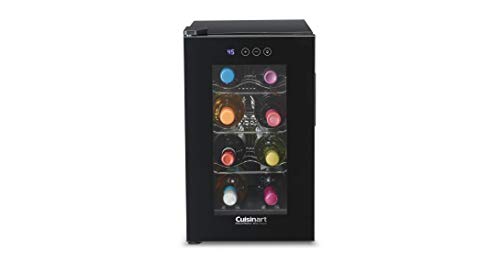
8-bottle thermoelectric wine cellar with touchscreen controls, LED temperature display and a 3-year limited warranty.
Check price on Amazon$169.95 as of Nov 28, 2026 12:27 pm GMT+0000 — prices change; see Amazon for current price.Why we like it
- Longest whole-unit warranty: 3 years
- Thermoelectric cooling, no compressor
- Touchscreen with LED temperature display
- Fits a counter or bar top
| Specification | Details |
|---|---|
| Capacity | 8 bottles |
| Cooling | Thermoelectric |
| Temperature range | Not stated in listing |
| Controls | Touchscreen for temperature and interior light; LED display |
| Size / weight | About 22.5 x 19 x 12 in; 26 lb |
| Warranty | Limited 3-year |
Cuisinart CWC-800CEN — 8 bottles, thermoelectric, touchscreen + LED display, ~22.5 x 19 x 12 in, 26 lb, 3-yr limited warranty
The Longest Whole-Unit Warranty on the Shelf
Every other wine-cooler listing gives a 1-year warranty on the complete unit, including the Ca’Lefort, whose longer coverage applies only to parts and the compressor. The Cuisinart lists a limited 3-year warranty. For a small appliance, that is the clearest signal on the shelf that the maker expects it to last.
Only two of the 11 listings use thermoelectric cooling: this Cuisinart and the BLACK+DECKER BD60026, also 8 bottles. Thermoelectric units have no compressor, so they run with less noise and vibration, but they can only cool to a fixed number of degrees below room temperature. In a warm kitchen they may not reach white-wine temperatures, and in a cold basement they cannot warm bottles at all. The BLACK+DECKER thermoelectric listing gives a 46 to 65 F range; the Cuisinart does not state one.
The Cuisinart listing is brief. It does not describe the door glass, UV protection or shelf layout, so check the manual before buying for a sunny room.
Pros
- 3-year limited warranty
- Quiet thermoelectric cooling
- Counter-friendly size
- Touchscreen with display
Cons
- Temperature range not stated
- Only 8 bottles
- Performance depends on room temperature
Check Cuisinart CWC-800CEN price on Amazon
How to read wine fridge specs
Bottle count is a best case
Bottle capacity on these listings assumes standard 750 ml Bordeaux-shape bottles laid on wire racks. Pinot noir, Champagne and other wide-shouldered bottles take more room, so plan on fitting fewer. If your collection leans that way, favor adjustable or removable racks, which most listings here describe, or a flat shelf and bottom compartment like the BLACK+DECKER 26-bottle.
Compressor versus thermoelectric
Nine of the 11 listings use a compressor, which cools regardless of room temperature and is the practical choice for anything above about 12 bottles or any room that gets warm. The two thermoelectric listings are both 8-bottle countertop cellars; they are quieter and vibration-free but depend on the room staying moderate. Compressor coolers vary in noise, and only one listing here puts a number on it.
Temperature range and zones
Most compressor listings here run from about 40 or 41 F up to 64 F, which covers sparkling, white and red serving and storage temperatures in one cabinet if you pick a middle setting. Single-zone coolers hold one setting throughout, ideally with a fan to keep it even. A dual-zone cooler, like the Ca’Lefort, lets reds and whites sit at different temperatures.
Glass, light and vibration
Light and vibration are the two enemies of long-term storage that a cooler can control. Look for double-pane glass described as UV-protective or tinted, which several listings here mention, and keep the cooler out of direct sun. Several listings advertise low vibration; none quantifies it.
Placement, ventilation and Front Range conditions
Where a wine fridge sits determines how well it works. ENERGY STAR advises keeping refrigerators and coolers away from heat sources such as ovens, dishwashers and direct sunlight, and leaving a few inches between the wall and the unit so air can circulate. For a freestanding wine cooler that rejects heat out the back, this is not optional. Do not slide a rear-venting unit into a cabinet opening; only a front-vented model, like the Ca’Lefort, is designed for that.
- Basements are the most common Front Range spot for a wine cooler, and a cool basement helps efficiency. Damp basements are another matter: condensation on glass doors and rusting racks point to humidity worth fixing, and the EPA notes that the key to mold control is moisture control. Our guide to basement humidity covers targets and fixes.
- Garages are a poor fit. None of these listings states an ambient operating range or a garage-ready rating, and a Colorado garage can swing from below freezing in January to well above 90 F in July. A compressor cooler cannot warm bottles in a freezing garage, and a thermoelectric unit cannot keep up in a hot one.
- Dry air is a mild concern for corks during long storage in Colorado’s low humidity, but for bottles you will drink within a year or two, temperature stability matters far more.
Electrical safety for wine coolers
A wine cooler is a small refrigerator that runs around the clock, and it should be plugged in like one. The U.S. Fire Administration advises plugging major appliances such as refrigerators directly into a wall outlet and never using an extension cord with them, because the cord can overheat and start a fire. It also advises against overloading outlets and power strips, and says to replace an appliance with a cracked or damaged cord.
- Use a grounded three-prong receptacle. If the only outlet in a dining room or older basement is two-prong, do not force an adapter; our guide to two-prong outlets explains the options.
- Basement and wet-bar receptacles may need GFCI protection under local code; our kitchen GFCI outlet guide covers where it applies.
- A cooler that runs constantly, ices up or will not hold temperature usually has a door-seal or airflow problem before a mechanical one; see our guide to a refrigerator not cooling for the same diagnostic steps.
Energy use and ENERGY STAR
ENERGY STAR certifies coolers, the category that includes wine coolers and beverage centers, in both compact and built-in forms, and says certified coolers are up to 20 percent more efficient than models that only meet the federal minimum standard. None of the 11 listings here claims ENERGY STAR certification, and none of the wine-cooler listings states a daily energy figure. Check the yellow EnergyGuide label or the ENERGY STAR product finder before buying if efficiency is a priority, and remember that placement, door seals and room temperature affect real energy use as much as the model does.
When to call a pro
A built-in wine refrigerator is a cabinetry and electrical project: it needs a front-vented unit, a properly sized opening and usually a dedicated, accessible receptacle. If you are adding one during a remodel, or buying a home with a finished basement bar, have the circuits and receptacles checked. Our electrical inspection hub explains what inspectors look for. Front Range buyers can get in touch here to connect with a vetted local inspector.
Frequently asked questions
What size wine fridge should I buy?
Buy for roughly one and a half times the bottles you usually keep, since listed capacities assume slim Bordeaux bottles and wider bottles take more room. An 18 to 26 bottle compressor cooler suits most households. Choose 8 bottles only for a countertop or bar top, and 40 bottles or more if your collection is growing.
Is a compressor or thermoelectric wine fridge better?
A compressor wine fridge is better for most homes because it cools regardless of room temperature and handles larger capacities. Thermoelectric coolers are quieter and vibration-free but can only cool a limited amount below room temperature, so they struggle in warm kitchens and cannot warm bottles in cold rooms. Both thermoelectric listings compared here hold 8 bottles.
Can a freestanding wine fridge be installed under a counter?
Only if the manufacturer says it is front-vented and approved for built-in use. Most freestanding wine coolers vent heat out the back and need open space around them. ENERGY STAR advises leaving a few inches between the wall and a refrigerator or cooler so air can circulate. Of the listings compared here, only one describes a front ventilation grille.
Can a wine fridge go in the garage?
Generally no, unless the manual gives an ambient operating range that covers your garage. None of the wine cooler listings compared here states one. Colorado garages can drop below freezing in winter and get hot in summer, which strains compressor units and overwhelms thermoelectric ones.
Should a wine fridge be plugged into an extension cord?
No. The U.S. Fire Administration advises plugging major appliances such as refrigerators directly into a wall outlet and never using an extension cord with them, because the cord can overheat and start a fire. Use a grounded three-prong receptacle and avoid power strips.
Are wine fridges noisy?
Compressor wine fridges produce a low hum similar to a kitchen refrigerator, while thermoelectric models are usually quieter but less powerful. Noise ratings in decibels are often listed and help when the unit will sit in a living area or bedroom.
Do wine fridges control humidity?
Some wine fridges include features to help retain humidity, but most do not actively control it. Keeping the unit closed and storing bottles on their side so corks stay moist matters more than precise humidity in short-term storage.
How much electricity does a wine fridge use?
A typical freestanding wine fridge uses roughly 100 to 300 kilowatt-hours a year, depending on size, cooling type and room temperature. ENERGY STAR labels or the yellow EnergyGuide label show estimated annual use, which helps compare models.
More Questions About Wine Fridges
What temperature should a wine fridge be set to?
For long-term storage of both red and white wine, a wine fridge is typically set around 55 degrees Fahrenheit, which is often cited as an ideal cellar temperature.
For serving, many people keep whites cooler, around 45 to 50 degrees, and reds a little warmer, closer to 60 to 65 degrees. Dual-zone units allow both at once. Steady temperature matters more than hitting an exact number, since frequent swings can push wine past the cork.
How long do wine fridges last?
Compressor wine fridges typically last about 10 years or more with good ventilation, while thermoelectric models often have a shorter life.
Lifespan depends on ambient temperature, how often the door is opened, and whether the unit has the clearance its manual calls for. Cleaning the condenser area and door seal once or twice a year helps. A fridge that runs constantly or cannot hold temperature is often near the end of its life.
Can a regular refrigerator be used to store wine?
A regular refrigerator works for keeping wine chilled for days or a few weeks, but it is generally too cold and too dry for long-term storage.
Most kitchen refrigerators run around 35 to 38 degrees, which slows aging and can dry out corks over months. Frequent door opening and compressor vibration also add stress. For bottles meant to be kept for months or years, a dedicated wine fridge or cool, dark cellar space is better.
Do wine fridges need to be level?
Yes, a wine fridge should be level so the door seals properly, the compressor runs smoothly and condensate drains correctly.
Most models have adjustable front feet. Check with a level side to side and front to back; some manufacturers recommend a slight backward tilt so the door swings closed on its own. A unit that is not level may hum louder, vibrate more and leak cold air through a gap in the door seal.
References
- Refrigerators and Coolers Buying Guidance — ENERGY STAR
- Appliance and Electrical Fire Safety — U.S. Fire Administration
- A Brief Guide to Mold, Moisture and Your Home — U.S. Environmental Protection Agency