Best Whole House Fans (2026): 6 Picks Compared by Home Size

The best whole house fan for a Front Range home is the one sized to your square footage and matched to the attic venting you actually have. These fans pull cool evening air in through open windows and push hot indoor air up into the attic, where it leaves through roof and soffit vents. In a climate with dry air and nights that often drop well below daytime highs, that can carry much of the cooling load for part of the summer. Get the sizing, venting or window routine wrong, though, and the fan becomes a loud, drafty hole in the ceiling. Below are six picks matched to specific homes, followed by a buying guide on CFM, net free vent area, dampers and safety.
Part of our Crawl Space & Attic Guide guide — start there for the full picture →
As an Amazon Associate we earn from qualifying purchases.
How we compared: we compared 10 current Amazon listings for whole house fans on what each listing states: airflow in CFM on high and low, motor type and wattage, stated coverage area, required attic venting, damper insulation, controls and warranty. We did not lab-test these fans or install them, and we did no hands-on handling. Seven of the 10 listings are QuietCool models from two product lines, so several picks below compare sizes within one brand. Prices and availability change often, so check the live listing before buying.
Quick picks: the best whole house fans by home size and setup
| Product | Best for | Key features | Price | Buy |
|---|---|---|---|---|
| QuietCool ES-4700 RF | Most average-size homes |
| $1,349.00as of Oct 19, 2026 11:14 pm GMT+0000 | Buy now →Check current price |
| QuietCool ES-7000 RF | Large homes up to about 3440 sq ft |
| $1,799.00as of Oct 20, 2026 1:02 am GMT+0000 | Buy now →Check current price |
| QuietCool CL-2250 RF | Small homes and upper floors |
| $849.00as of Oct 20, 2026 1:02 am GMT+0000 | Buy now →Check current price |
| Centric Air QA-Deluxe 5500 | Hardwired wall switch and timer |
| $1,058.00as of Oct 19, 2026 8:59 pm GMT+0000 | Buy now →Check current price |
| AC Infinity CLOUDWAY T12 | App control and automation |
| $549.00as of Oct 19, 2026 11:27 pm GMT+0000 | Buy now →Check current price |
| Air King 9166 | No attic work at all |
| $220.33as of Oct 19, 2026 11:27 pm GMT+0000 | Buy now →Check current price |
Prices are Amazon’s listed prices as of the time shown and change often; check Amazon for today’s price. As an Amazon Associate we earn from qualifying purchases.
The six picks, compared listing by listing
1. QuietCool ES-4700 RF — Best Whole House Fan for Most Homes

ECM whole house fan rated 4195 CFM on high and 2304 CFM on low, with a 75-watt low setting and R5 dampers.
Check price on Amazon$1,349.00 as of Oct 19, 2026 11:14 pm GMT+0000 — prices change; see Amazon for current price.Why we like it
- Lowest stated low-speed wattage on the shelf
- Sized for homes up to about 2,100 sq ft
- R5 insulated damper doors for winter
- Wireless glass switch with 12-hour countdown timer
- States its exact attic venting requirement
| Specification | Details |
|---|---|
| Airflow | 4,195 CFM on high; 2,304 CFM on low |
| Motor / power | ECM motor; 415 W on high, 75 W on low |
| Coverage stated | Homes up to about 2,098 sq ft |
| Ceiling cutout | About 14 x 30 in for the intake grille; fits 16 or 24 in on-center framing |
| Attic venting required | 5.6 sq ft of net free vent area |
| Controls / warranty | RF wireless switch, up to 12-hour timer; 10-year manufacturer warranty |
QuietCool ES-4700 RF — 4195/2304 CFM, ECM 415/75 W, R5 dampers, 5.6 sq ft NFA, RF timer, 10-yr warranty
The Most Efficient Low Speed on the Shelf
Only three of the 10 listings name an electronically commutated motor: the two QuietCool Energy Saver models and the much smaller AC Infinity unit. Among the fans that can move air for a whole average-size house, the ES-4700 lists the lowest low-speed draw at 75 watts while still moving 2,304 CFM. That is the setting most owners run for hours overnight, so the low-speed number matters more than the high-speed peak. By comparison, the Classic CL-4700 next to it on the shelf moves a similar 4,415 CFM on high but lists 415 watts on low, more than five times as much.
The trade-off is a wide gap between speeds. High is 4,195 CFM and low drops to 2,304, so low feels gentle while high does the quick purge at sunset. Classic PSC models keep their two speeds closer together. For a home that wants a fast flush and then a quiet all-night trickle, the wider spread suits the job.
The listing does not state a decibel rating, and it does not say whether the 75-watt figure was measured with any particular amount of attic venting in place. It also lists a 65-pound weight, so plan for a two-person install in the attic.
Pros
- 75 W low setting for overnight running
- Clear net free vent area requirement
- R5 dampers help in heating season
- No joist cutting on standard framing
Cons
- No noise rating stated in listing
- Large gap between high and low speed
- 65 lb motor head to hang in the attic
Check QuietCool ES-4700 RF price on Amazon
2. QuietCool ES-7000 RF — Best for Large Homes

Largest Energy Saver model listed: 6878 CFM on high, 164 W on low, sized for homes up to about 3440 sq ft.
Check price on Amazon$1,799.00 as of Oct 20, 2026 1:02 am GMT+0000 — prices change; see Amazon for current price.Why we like it
- Close to the highest airflow on the shelf
- ECM motor drops to 164 W on low
- Covers homes up to about 3,440 sq ft
- Same wireless timer and R5 damper box
| Specification | Details |
|---|---|
| Airflow | 6,878 CFM on high; 4,304 CFM on low |
| Motor / power | ECM motor; 727 W on high, 164 W on low |
| Coverage stated | Homes up to about 3,440 sq ft |
| Ceiling cutout | About 14 x 36 in |
| Attic venting required | 9.18 sq ft of net free vent area |
| Size / warranty | About 40 x 41 x 28 in; 10-year manufacturer warranty |
QuietCool ES-7000 RF — 6878/4304 CFM, ECM 727/164 W, 9.18 sq ft NFA, 14 x 36 in cutout, 10-yr warranty
Big-House Airflow at Well Under Half the Classic Wattage
Two listings on the shelf top 6,800 CFM: this ES-7000 and the Classic CL-7000. Their high-speed airflow is almost identical, 6,878 versus 6,924 CFM. The difference is power draw. The Classic lists 1,147 watts on high and 794 on low; the Energy Saver lists 727 and 164. On a summer of long evening runs, that low-speed gap is the reason to pay attention to motor type rather than airflow alone.
The catch with any fan this size is attic venting. The ES-7000 asks for 9.18 square feet of net free vent area, the second-largest requirement among the seven QuietCool listings. Many ranch and two-story homes along the Front Range were built with venting sized for a passive attic, not a fan pushing several thousand CFM into it, so this pick often comes with a venting upgrade.
The listing does not state the unit’s weight, and like the rest of the QuietCool line it gives no sound rating. Its stated coverage applies to the conditioned floor area being cooled, not to the attic itself.
Pros
- Large-home airflow from a single fan
- Low speed draws far less than the Classic equivalent
- Wireless switch with countdown timer
Cons
- Needs over 9 sq ft of attic vent area
- Largest ceiling cutout of the picks
- Weight and noise level not stated
Check QuietCool ES-7000 RF price on Amazon
3. QuietCool CL-2250 RF — Best for Small Homes and Upper Floors
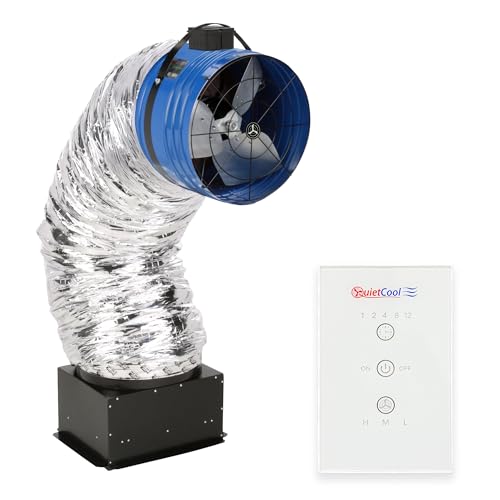
Smallest QuietCool on the shelf: 2465 CFM, a 14 x 18 in ceiling cutout and 3.29 sq ft of required attic venting.
Check price on Amazon$849.00 as of Oct 20, 2026 1:02 am GMT+0000 — prices change; see Amazon for current price.Why we like it
- Smallest ceiling cutout of any attic-mounted pick
- Lowest venting requirement in the QuietCool line
- Rated for up to about 1,235 sq ft
- Fits older homes with modest attic vents
| Specification | Details |
|---|---|
| Airflow | 2,465 CFM on high; 1,910 CFM on low |
| Motor / power | PSC motor; 250 W on high, 201 W on low |
| Coverage stated | Up to about 1,235 sq ft (listing also mentions large bedrooms) |
| Ceiling cutout | About 14 x 18 in |
| Attic venting required | 3.29 sq ft of net free vent area |
| Weight / warranty | 47 lb; 10-year manufacturer warranty |
QuietCool CL-2250 RF — 2465/1910 CFM, PSC 250/201 W, 14 x 18 in cutout, 3.29 sq ft NFA, 47 lb, 10-yr warranty
The Lowest Attic-Vent Requirement on the Shelf
All seven QuietCool listings state a required net free vent area, and the CL-2250 asks for the least: 3.29 square feet. For a 1960s or 1970s brick ranch with a few small roof vents, or a top-floor bedroom suite in a larger house, that can be the difference between a fan that works with existing venting and one that needs new roof penetrations first.
It is a Classic PSC model, so its two speeds sit close together (2,465 and 1,910 CFM) and low speed still draws 201 watts. That is more than double the ES-4700’s low setting while moving less air. For a small home that runs the fan a few hours a night, the simpler motor is a reasonable trade for the smaller footprint.
The listing describes coverage both as small homes up to about 1,235 square feet and as large bedrooms, which suggests it is also sold as a zone fan. It does not state a noise rating.
Pros
- Smallest cutout and venting requirement
- Lighter than the larger QuietCool heads
- Same R5 dampers and wireless timer
Cons
- PSC motor draws 201 W even on low
- Too small for most whole homes over 1,300 sq ft
- No sound rating stated
Check QuietCool CL-2250 RF price on Amazon
4. Centric Air QA-Deluxe 5500 — Best With a Hardwired Wall Switch and Timer

Two-speed whole house fan with a low-voltage wall switch and timer, R-5 damper and a stated Title 24 airflow figure.
Check price on Amazon$1,058.00 as of Oct 19, 2026 8:59 pm GMT+0000 — prices change; see Amazon for current price.Why we like it
- Only listing that quotes a California Title 24 airflow
- Low-voltage plug-and-play wall switch and timer
- Gives coverage for one- and two-story homes
- Assembled in the USA, per the listing
| Specification | Details |
|---|---|
| Airflow | Up to 5,500 CFM; 3,945 CFM under the California Title 24 test standard |
| Coverage stated | Up to 3,400 sq ft (two-story) or 2,400 sq ft (one-story) |
| Controls | Two-speed wall switch with timer; low-voltage wiring |
| Damper | R-5 insulated damper with heavy-duty fan guard |
| Size / fit | About 28.5 x 14 x 14 in; fits 16 to 24 in on-center joists; 55 lb |
| Warranty | 10-year motor, 3-year parts |
Centric Air QA-Deluxe 5500 — 5500 max / 3945 Title 24 CFM, 2-speed wall switch + timer, R-5 damper, 55 lb, 10/3-yr warranty
The Only Listing With a Second, Standardized Airflow Number
Every other fan here gives one airflow figure per speed. Centric Air gives two: a 5,500 CFM maximum and a 3,945 CFM figure under California’s Title 24 test standard. The gap between them, about 28 percent, is a useful reminder that a headline CFM number can be measured under friendlier conditions than a fan sees once it is installed against a damper and grille. None of the QuietCool listings say which test condition their figures reflect.
The other draw is the control. QuietCool ships a wireless glass switch; Centric Air ships a wired two-speed wall switch with a timer, described as low-voltage plug and play. Some owners prefer a fixed switch that never needs a battery and cannot be misplaced.
The listing does not state wattage for either speed or the motor type, so you cannot compare its running cost against the ECM models. It also does not state a required net free vent area, which you will need from the installation manual before buying.
Pros
- Standardized Title 24 airflow stated
- Wired wall switch with built-in timer
- One- and two-story coverage figures
- R-5 insulated damper
Cons
- No wattage or motor type in listing
- Attic venting requirement not stated
- Parts warranty shorter than motor warranty
Check Centric Air QA-Deluxe 5500 price on Amazon
5. AC Infinity CLOUDWAY T12 — Best for App Control and Automation

Ceiling-mount 12 in attic vent fan with an EC motor, Wi-Fi app and temperature, humidity and VPD programming.
Check price on Amazon$549.00 as of Oct 19, 2026 11:27 pm GMT+0000 — prices change; see Amazon for current price.Why we like it
- Only Wi-Fi app control on the shelf
- Programs by temperature, humidity and schedule
- Only listing that states a noise level
- Compact enough for a single zone
| Specification | Details |
|---|---|
| Airflow | 1,250 CFM |
| Motor | PWM-controlled EC motor; dual ball bearings |
| Noise stated | 62 dBA |
| Controls | Wi-Fi app; temperature, humidity and VPD triggers, timers, cycles, schedules, minimum speed |
| Size | 12 in duct; about 12.3 x 17.7 x 14.1 in |
| Coverage / warranty | Not stated in listing |
AC Infinity CLOUDWAY T12 (AC-CRT12) — 1250 CFM, EC motor, 62 dBA, 12 in duct, Wi-Fi temperature/humidity programming
The Only Fan Here That Runs Itself on Sensor Triggers
Every other fan on the shelf is a switch plus a timer. The CLOUDWAY T12 is the only listing with app control and sensor-based programming: it can start, stop or change speed based on temperature and humidity, run cycles and schedules, and hold a minimum speed. It is also the only one of the 10 listings to state a noise level, 62 dBA.
Be realistic about scale. At 1,250 CFM it moves about half the air of the smallest QuietCool on the shelf and roughly a fifth of the mid-size models. Using QuietCool’s own coverage figures, which work out to about 2 CFM per square foot, that suggests a zone of a few hundred square feet rather than a whole house. It suits a hot upstairs bonus room or a single bedroom wing.
The listing does not give a coverage area, a damper insulation value, wattage, a venting requirement or a warranty term. Treat it as a smart zone fan and confirm damper details before installing it through a ceiling.
Pros
- Wi-Fi app with sensor-based automation
- EC motor with variable speed
- Noise level stated
Cons
- 1,250 CFM is zone-scale, not whole-house
- No damper, venting or coverage details
- Warranty not stated
Check AC Infinity CLOUDWAY T12 price on Amazon
6. Air King 9166 — Best Option With No Attic Work

20 in, 1/6 HP, three-speed whole house window fan with powder-coated steel blades and a Storm Guard feature.
Check price on Amazon$220.33 as of Oct 19, 2026 11:27 pm GMT+0000 — prices change; see Amazon for current price.Why we like it
- No ceiling cutout or attic access needed
- Three speeds for intake or exhaust
- Storm Guard lets the window close behind it
- Steel blades and grille, ABS body
| Specification | Details |
|---|---|
| Type | 20 in window fan for whole-house circulation or exhaust |
| Motor | 1/6 HP, permanently lubricated; 3 speeds |
| Construction | Powder-coated steel blades and grille; ABS body |
| Size / weight | About 26.25 x 26.75 x 11.25 in; 33.5 lb |
| Airflow / coverage | Not stated in listing |
| Warranty | 1-year limited |
Air King 9166 — 20 in window fan, 1/6 HP, 3 speeds, steel blades, Storm Guard, 33.5 lb, 1-yr warranty
The Only Pick That Needs No Ceiling Opening at All
Nine of the 10 listings are attic-mounted fans that require cutting into a ceiling and venting the attic. The Air King is the exception: it sits in a window and either pulls outdoor air in or exhausts indoor air, using the same open-window principle as a ceiling fan without touching the attic. For renters, homes with no accessible attic, or owners who want to test the cooling strategy before committing, it is the practical starting point.
It is also the weakest on paper. The listing states no CFM figure and no coverage area, and its 1-year warranty is the shortest on the shelf. Exhausting through one window while opening others across the house is how it gets whole-house airflow, so results depend on layout.
A window fan also leaves no ceiling penetration to air-seal for winter, which removes one of the main energy drawbacks of a permanent whole house fan.
Pros
- No attic venting or ceiling work
- Can intake or exhaust
- Nothing to seal off in winter
Cons
- Airflow not stated in listing
- Occupies a window while installed
- Shortest warranty of the picks
Check Air King 9166 price on Amazon
How a whole house fan cools, and when it does not
A whole house fan is not an air conditioner. It replaces warm indoor air with cooler outdoor air, and it only helps when the outdoor air is actually cooler than the air inside. The EPA describes opening windows and running window or attic fans, when weather permits, as a way to increase the outdoor ventilation rate in a home, which also dilutes indoor pollutants.
The usual routine is simple. Once the outdoor temperature drops below indoor temperature in the evening, open windows in the rooms you want cooled, then run the fan on high for a fast flush. Drop to low once the house has turned over its air, and let it run overnight to pre-cool the structure. In the morning, close the windows, turn the fan off and keep blinds drawn to hold the cool in. Interior walls, floors and furniture store that coolness well into the afternoon.
It works poorly in muggy climates and on nights that stay warm. That is why the Front Range is a better fit than many regions: dry air and large day-to-night temperature swings mean evening air is often well below indoor temperature for much of June through September.
The specs that matter: CFM, home size and net free vent area
Sizing airflow to your home
QuietCool’s coverage figures work out to almost exactly 2 CFM per square foot of living area: 4,415 CFM for about 2,210 square feet, 6,924 CFM for about 3,470 square feet, and so on. Many installers size somewhat higher for faster air changes. Measure the conditioned floor area you want cooled, not the attic footprint, and remember that finished basements usually sit outside the airflow path.
Attic venting is the real limit
Every cubic foot the fan pushes into the attic has to leave through the attic vents. All seven QuietCool listings state a required net free vent area, and the ratio is consistent: about 1 square foot of net free area for every 750 CFM of fan capacity. The CL-2250 needs 3.29 square feet; the CL-7000 needs 9.24. Net free area is the open area of a vent after screens and louvers, which is usually much less than its overall size, so check the rating stamped on each vent.
Too little venting pressurizes the attic. Air then pushes back into the house through gaps around lights and the attic hatch, and the fan moves far less air than its rating. ENERGY STAR notes that blocked soffit vents are a common mistake when insulation is added, and that rafter vents keep the path from soffit to ridge or gable open. Its guidance on attic ventilation is worth reading before you add fan capacity.
Motor type and watts
PSC motors are simple and proven but run at fixed speeds with similar wattage on high and low. ECM and EC motors draw far less at low speed. Since a whole house fan spends most of its hours on low, the low-speed wattage is the efficiency number to compare.
Dampers and winter heat loss
A whole house fan is a hole in your ceiling the other eight months of the year. Eight of the 10 listings mention R-5 insulated damper doors. That is a meaningful improvement over an uninsulated louver, but it is still far less insulation than the attic floor around it. In Colorado, many owners add a fitted insulated cover over the grille or in the attic for the heating season.
Safety: open windows, combustion appliances and radon
Never run a whole house fan with the windows closed. With no open windows, the fan pulls replacement air from anywhere it can, and one of the easiest paths is down a chimney or water heater flue. The EPA lists back-drafting from furnaces, gas water heaters, wood stoves and fireplaces among the indoor sources of carbon monoxide. A good rule is to open enough window area to at least match the fan’s requirement, and to include windows on the same level as any gas appliance or fireplace. The included window locks on the QuietCool models are meant to secure partly open windows during operation.
Negative pressure also pulls air through the foundation. The CDC notes that radon enters homes through small cracks and holes, and that sealing foundation openings makes a mitigation system more effective. Opening enough windows keeps the house close to neutral pressure. If your home has a radon mitigation system, the vent fan and sealed sump lid should stay in operation regardless of the whole house fan.
Wildfire smoke is the other Front Range caution. The EPA notes that smoke particles enter a home through open windows and mechanical ventilation. On smoke days, keep the fan off and the windows closed.
Finally, the fan motor needs its own properly sized circuit, and an attic installation means working near wiring, insulation and sometimes ductwork. Many owners hire an electrician for the circuit even when they hang the fan themselves.
How Front Range homeowners use a whole house fan
Along the Front Range, a typical summer day can climb into the 90s and then fall into the 50s or 60s overnight, especially near the foothills. That pattern is ideal: a two-hour high-speed run after sunset flushes the heat, and low speed overnight drops the house well below what an air conditioner would hold for the same cost. Many homes in Boulder, Jefferson and Douglas counties use a whole house fan for most of the season and run central air only during heat waves.
Altitude matters slightly too. Thinner air at 5,000 to 6,500 feet carries a little less heat per cubic foot, so expect slightly less cooling from a given CFM than a sea-level spec sheet implies. Size at the upper end if you are between models.
Wind and hail affect the attic side. Adding roof vents to meet a large net free area requirement means new roof penetrations, and vents rated for hail and wind-driven snow are worth the extra cost. If your home has a crawl space rather than a basement, the fan’s pull can also draw air up from below; our crawl space guide covers air sealing and moisture control there.
Whole house fan vs attic fan vs ceiling fan
These three are often confused. A whole house fan pulls air from living spaces into the attic and needs open windows. An attic fan only exhausts attic air; it does not cool rooms directly. Our solar attic fan guide and the guide to attic fan thermostats cover that category. A ceiling fan moves air within a room to create a breeze and does not exchange any air at all; see our notes on ceiling fan direction for summer and winter settings. For a deeper look at installation, see our whole house fan overview.
When to call a professional or an inspector
A whole house fan touches three systems at once: framing, electrical and attic ventilation. Call a pro if you need new roof vents to meet the fan’s net free area, if the attic has knob-and-tube wiring or vermiculite insulation, if gas appliances are in the conditioned space and you are not sure about make-up air, or if the attic shows signs of moisture or mold.
A home inspection is a good way to check an existing fan. Inspectors look at damper operation, attic vent area, insulation gaps around the grille and whether the fan has a dedicated circuit. For broader context on the building envelope, see our crawl space and insulation hub. If you are in the Denver metro or anywhere along the Front Range and want an inspector to look at attic venting before you buy a fan, reach out through our contact page.
Frequently asked questions
What size whole house fan do I need?
Start with the conditioned floor area you want to cool. QuietCool's coverage figures work out to about 2 CFM per square foot, so a 2,000 sq ft home points to a fan near 4,000 CFM. Then confirm the attic has enough net free vent area for that fan; QuietCool asks for about 1 sq ft per 750 CFM.
Do whole house fans work in Colorado?
Yes, they suit the Front Range well. Dry air and large day-to-night temperature swings mean evening air is often much cooler than indoor air in summer. Run the fan on high after sunset, drop to low overnight, then close up the house in the morning.
Can a whole house fan cause carbon monoxide problems?
It can if it runs with too few windows open. The fan then pulls replacement air down chimneys and appliance flues, and the EPA lists back-drafting from furnaces, water heaters and fireplaces as a CO source. Always open enough windows before turning it on and keep working CO alarms.
How much attic venting does a whole house fan need?
It depends on the fan. On this shelf, QuietCool requirements range from 3.29 sq ft of net free area for a 2,465 CFM model to 9.24 sq ft for a 6,924 CFM model. Net free area is the open area after screens and louvers, so check the rating on each vent rather than its outside size.
Is a whole house fan better than air conditioning?
It is cheaper to run but only works when outdoor air is cooler than indoor air. Low-speed draw on the ECM models here is 75 to 164 watts. Many Front Range homes use the fan most of the summer and keep central air for heat waves and wildfire smoke days, when windows should stay closed.
References
- Improving Indoor Air Quality — U.S. Environmental Protection Agency
- Carbon Monoxide’s Impact on Indoor Air Quality — U.S. Environmental Protection Agency
- About Attic Ventilation — ENERGY STAR
- Reducing Radon Levels in Your Home — Centers for Disease Control and Prevention
- Wildfires and Indoor Air Quality — U.S. Environmental Protection Agency