Best Solar Attic Fans (2026): 7 Roof and Gable Fans Compared

The best solar attic fan does the same job as a wired attic ventilator without a circuit or an electric bill: a small photovoltaic panel spins a DC fan that pushes hot air out of the attic while the sun is up. On the Front Range, where summer sun is strong, that is an appealing match, since the fan runs hardest exactly when the roof is hottest. The trade-offs are real, though. A solar fan stops at dusk unless it has an AC adapter, it has to survive Colorado hail and wind on the roof, and like any powered attic fan it can pull conditioned air out of the house if the attic lacks intake vents or the ceiling below is leaky. Seven picks follow, then a buying guide on panel size, controls, hybrid power and when a fan helps at all.
Part of our Crawl Space & Attic Guide guide — start there for the full picture →
As an Amazon Associate we earn from qualifying purchases.
How we compared: we compared 15 current Amazon listings returned for solar attic fans on what each listing states: airflow, solar panel wattage, mounting type, thermostat and humidistat controls, AC or hybrid power options, weather and hail claims, and warranty. One listing is a small greenhouse and coop fan rather than an attic fan, and one gable listing never describes its solar panel, so 13 listings are clear solar attic fans. We did not lab-test or handle any of them. Prices and availability change often, so check the current listing before buying.
Quick picks: the best solar attic fans by need
| Product | Best for | Key features | Price | Buy |
|---|---|---|---|---|
| OmniPV OP-SAF-50 | Best overall solar attic fan |
| $350.00as of Nov 13, 2026 8:47 am GMT+0000 | Buy now →Check current price |
| Remington Solar Builder 40W | Humidity control plus night run |
| $489.00as of Nov 13, 2026 8:47 am GMT+0000 | Buy now →Check current price |
| iLiving ILG8SF301 | Longest warranty |
| $344.99as of Nov 13, 2026 8:47 am GMT+0000 | Buy now →Check current price |
| Quietcool AFG SLR SMT-50W | Gable-mount solar with app |
| $359.00as of Nov 13, 2026 8:47 am GMT+0000 | Buy now →Check current price |
| DC HOUSE 32W | Simple sunrise-to-dusk fan |
| $149.99as of Nov 13, 2026 8:47 am GMT+0000 | Buy now →Check current price |
| Hon and Guan PN131 | Automatic solar-to-AC switching |
| $299.99as of Nov 13, 2026 8:47 am GMT+0000 | Buy now →Check current price |
| VEVOR 35W JBSF-320E | Metal and masonry roofs |
| — | Buy now →Check current price |
Prices are Amazon’s listed prices as of the time shown and change often; check Amazon for today’s price. As an Amazon Associate we earn from qualifying purchases.
The seven picks, compared listing by listing
1. OmniPV OP-SAF-50 — Best Overall Solar Attic Fan

Hybrid solar roof fan with a 50 W panel, up to 2,850 CFM, adjustable thermostat, AC adapter and cable tie-downs.
Check price on Amazon$350.00 as of Nov 13, 2026 8:47 am GMT+0000 — prices change; see Amazon for current price.Why we like it
- Highest stated airflow on the solar shelf
- Adjustable thermostat, or run continuously
- AC adapter included for night or cloudy days
- Steel cables tie the fan to roof framing
| Specification | Details |
|---|---|
| Airflow / panel | Up to 2,850 CFM; 50 W solar panel |
| Controls | Thermostat adjustable 50°F to 104°F, or thermostat off for continuous running; wall switch |
| Power options | Solar plus included 12 V 2 A AC adapter |
| Panel adjustment | -45° to +45° horizontal; 0° to 60° vertical |
| Build / mounting | Aluminum alloy body; bendable 1 mm plate, 8 screws, two 6.5 ft steel cables |
| Motor | Rare-earth brushless DC; listing says it starts on as little as 1 W of solar |
OmniPV OP-SAF-50 — roof mount, 2,850 CFM, 50 W panel, 50–104°F thermostat, AC adapter included, aluminum body, cable tie-downs
The Only Listing That Describes Tying the Fan to Roof Framing
Wind is a real concern for anything mounted on a Front Range roof. The OmniPV is the only listing on the shelf that includes steel cables to fasten the fan body to roof beams or columns, which the listing says improves wind resistance. That, plus a bendable aluminum plate meant to seal against wavy or metal roofing, makes it the most installation-aware listing here.
It also states the highest airflow on the shelf, 2,850 CFM, and ties for the largest panel at 50 W with the Quietcool. Four listings include an AC adapter in the box, and this is one of them, so the fan can keep venting moisture at night or during a run of cloudy days. Its thermostat is adjustable, and it can be switched off entirely for continuous running.
The listing does not mention a humidistat or a hail rating, and its “cool and dehumidify up to 4,000 sq ft” phrasing overstates what any attic fan does for the living space below.
Pros
- Highest stated CFM
- Hybrid power included
- Wind tie-down cables
- Wide panel adjustment
Cons
- No humidistat
- No hail claim
- Coverage language overstated
Check OmniPV OP-SAF-50 price on Amazon
2. Remington Solar Builder Series 40W — Best for Humidity Control and Night Operation

40 W solar roof fan with a built-in humidistat and thermostat, a 110V adapter for night running and 22.5-inch flashing.
Check price on Amazon$489.00 as of Nov 13, 2026 8:47 am GMT+0000 — prices change; see Amazon for current price.Why we like it
- Built-in humidistat and thermostat
- 110V adapter included for night operation
- Large 22.5 x 22.5 inch steel flashing
- Limited lifetime warranty on the fan
| Specification | Details |
|---|---|
| Panel | 40 W |
| Controls | Built-in humidistat and thermostat |
| Power options | Solar plus included 110V adapter; surge protector required to keep warranty |
| Flashing | 22.5 x 22.5 inch heavy steel |
| Motor / weather | Brushless motor; hail and weather resistant; Texas Windstorm document |
| Airflow | Not stated in listing |
Remington Solar Builder Series 40W — roof mount, humidistat + thermostat, 110V adapter included, 22.5 in flashing, lifetime fan warranty
The Only Listing With Both a Humidistat and an Included AC Adapter
Four listings on the shelf describe a humidistat: three Remington models and the Quietcool. Four include an AC adapter in the box. The Remington Builder 40W is the only listing that does both. That combination lets the fan respond to attic moisture rather than just heat, and keep running after dark when moisture, not heat, is the issue.
All three Remington listings mention a Texas Windstorm document and a limited lifetime or 15-year fan warranty, and they ship with 22.5-inch steel flashing, larger than most roof fans describe. The listing also says the adapter requires a surge protector to keep its one-year adapter warranty valid.
The big omission: no airflow figure at all. That makes it impossible to compare its output with the OmniPV or DC HOUSE. A humidistat running the fan at night through an adapter also uses grid power, so the fan is no longer free to run.
Pros
- Humidistat plus included adapter
- Large steel flashing
- Long fan warranty
Cons
- No CFM stated
- Adapter warranty needs a surge protector
- Night running uses grid power
Check Remington Solar Builder 40W price on Amazon
3. iLiving ILG8SF301 — Best Warranty
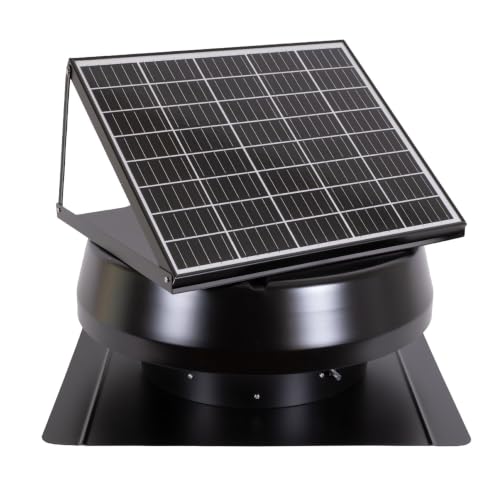
40 W hybrid-ready solar roof fan with a 50–122°F smart thermostat, IP68 brushless motor and 15-year limited warranty.
Check price on Amazon$344.99 as of Nov 13, 2026 8:47 am GMT+0000 — prices change; see Amazon for current price.Why we like it
- 15-year limited manufacturer warranty
- IP68 waterproof brushless motor
- Thermostat can be enabled or disabled
- Panel tilts to four set angles
| Specification | Details |
|---|---|
| Airflow / panel | 1,150 CFM; 40 W panel; 14-inch blade |
| Coverage claimed | Up to 2,900 sq ft |
| Controls | Smart thermostat 50°F to 122°F with enable/disable |
| Power options | Solar; day/night AC/DC adapter sold separately (ILG8SF304) |
| Panel adjustment | 0°, 15°, 30° or 45° |
| Motor / warranty | IP68 brushless; 15-year limited |
iLiving ILG8SF301 — roof mount, 1,150 CFM, 40 W panel, 50–122°F thermostat, IP68 brushless, adapter optional, 15-yr warranty
One of the Longest Stated Warranties on a Rooftop Fan
A roof-mounted fan is hard to reach and costly to replace, so warranty length matters more than usual. The iLiving lists a 15-year limited manufacturer warranty, matched on the shelf only by the Remington Round Series and exceeded only by the limited lifetime fan warranties on the Remington 30W and 40W. Most listings state one year or nothing.
It also names an IP68 waterproof rating for its brushless motor, a thermostat that can be switched off, and a panel that tilts to set angles for better sun exposure. Its 2,900 sq ft coverage claim is the most generous relative to airflow on the shelf, though.
At 1,150 CFM it moves less air than most picks, and the AC adapter is an extra purchase. There is no humidistat.
Pros
- 15-year warranty
- IP68 motor rating
- Thermostat can be bypassed
Cons
- Lower airflow at 1,150 CFM
- Adapter sold separately
- Coverage claim is optimistic
Check iLiving ILG8SF301 price on Amazon
4. Quietcool AFG SLR SMT-50W — Best Gable-Mount Solar Fan With App Control

Solar gable attic fan with a 50 W panel, app-set thermostat and humidistat, fire-safety shutoff and vent covers.
Check price on Amazon$359.00 as of Nov 13, 2026 8:47 am GMT+0000 — prices change; see Amazon for current price.Why we like it
- Gable mount, no roof penetration for the fan
- App-set thermostat and humidistat
- Fire-safety shutoff and vent covers
- 50 W panel, tied for largest
| Specification | Details |
|---|---|
| Mounting | Behind a gable vent; tabs with anti-vibration pads |
| Panel | 50 W solar |
| Airflow | Up to 1,780 CFM per title; bullets give different figures (see below) |
| Motor | Three-speed ECM |
| Controls / safety | Smart app with thermostat and humidistat; fire-safety shutoff; vent covers |
| Connection | 20 ft cord |
Quietcool AFG SLR SMT-50W — gable mount, 50 W panel, up to 1,780 CFM (title), ECM, app thermostat + humidistat, fire shutoff
The Only Solar Listing With a Fire-Safety Shutoff and Vent Covers
No other listing on the solar shelf mentions a fire-safety shutoff or vent covers. The Quietcool has both, plus the app-set thermostat and humidistat found on its line-powered siblings. Mounting behind a gable vent also means the fan itself does not need a hole in the roof; only the panel needs a sunny spot.
Gable-mount solar fans are a minority on this shelf. Most listings are roof-mount units with the panel built onto the fan housing.
The listing has a clear inconsistency. The title says up to 1,780 CFM from the 50 W panel, but the bullets repeat the line-powered ES-3.0’s figures of 2,801 CFM at 142 W and 1,337 CFM at 23 W, and the model field names the ES-3.0. A 50 W panel cannot supply 142 W, so trust the 1,780 CFM title figure and confirm on the product page before buying.
Pros
- Fire shutoff and vent covers
- Thermostat and humidistat
- No roof hole for the fan
Cons
- Listing mixes in line-powered specs
- Panel placement still needs planning
- App needed for settings
Check Quietcool AFG SLR SMT-50W price on Amazon
5. DC HOUSE 32W — Best Simple Sunrise-to-Dusk Fan
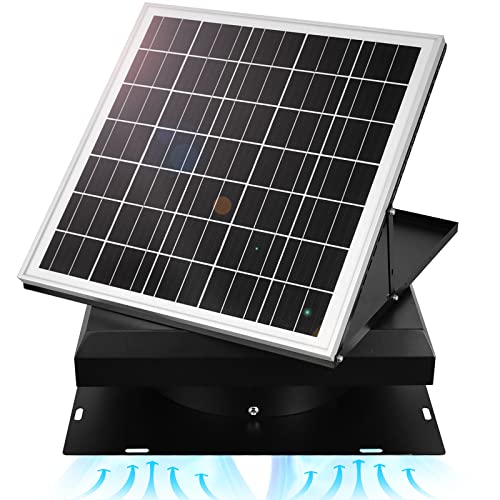
32 W solar roof fan rated 2,400–2,500 CFM, with an IP68 copper brushless motor, 43 dB rating and metal shell.
Check price on Amazon$149.99 as of Nov 13, 2026 8:47 am GMT+0000 — prices change; see Amazon for current price.Why we like it
- High airflow for a 32 W panel
- States a noise figure, 43 dB
- IP68 all-copper brushless motor
- Metal shell with hail resistance claimed
| Specification | Details |
|---|---|
| Airflow / panel | 2,500 CFM in title, up to 2,400 CFM in bullets; 32 W panel |
| Coverage claimed | Up to 3,000 sq ft |
| Operation | Runs automatically in daylight, off at night; no thermostat mentioned |
| Motor / blades | All-copper brushless, IP68; 9-inch aluminum blades |
| Noise | 43 dB stated |
| Housing / service | High-strength metal, hail and weather resistant; one-year service |
DC HOUSE 32W — roof mount, 2,400–2,500 CFM, 32 W panel, daylight-only, IP68 copper brushless, 43 dB, metal shell
The Most Airflow Per Panel Watt Among Fans That State Both
Dividing stated CFM by panel wattage, the DC HOUSE 32W claims about 75 to 78 CFM per panel watt, the highest ratio on the shelf; the VEVOR 35W and PEAKROCK are next at roughly 67 to 69, and the OmniPV 50W about 57. Panel wattage is a rough proxy for how much power the fan can draw in full sun, so a high ratio suggests an efficient fan and blade design, if the CFM claim holds.
It is one of only a few listings that state a noise level, 43 dB, and its metal housing and hail-resistance claim suit Front Range roofs. It runs from sunrise to dusk with no settings to manage.
That simplicity has a cost: there is no thermostat, so it runs whenever the sun is out, including on cool spring and winter days when the attic does not need cooling. The title and bullets disagree on airflow, and service is one year.
Pros
- High CFM per panel watt
- Stated noise figure
- Metal, hail-resistant housing
Cons
- No thermostat, runs all daylight
- Airflow stated two ways
- One-year service only
Check DC HOUSE 32W price on Amazon
6. Hon&Guan PN131 — Best for Automatic Solar-to-AC Switching
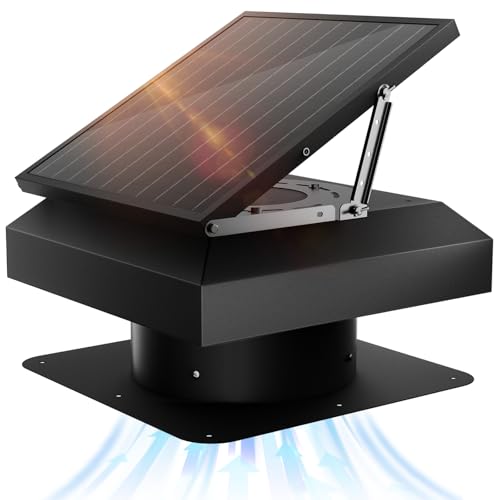
40 W solar roof fan rated 2,000 CFM that switches between solar and an included adapter, with a 68–113°F thermostat.
Check price on Amazon$299.99 as of Nov 13, 2026 8:47 am GMT+0000 — prices change; see Amazon for current price.Why we like it
- Prioritizes solar, falls back to mains automatically
- Adjustable thermostat, 68°F to 113°F
- Speed knob with four levels in performance mode
- Lists cable lengths and connector types
| Specification | Details |
|---|---|
| Airflow / panel | 2,000 CFM; 40 W panel; 12-inch blade |
| Coverage claimed | Up to 2,500 sq ft |
| Power options | Solar with included AC/DC adapter; auto-switching; no battery |
| Modes | Energy-saving mode (airflow follows sunlight) and performance mode (speed 1–4, adapter required) |
| Thermostat | Auto-start at a set 68°F to 113°F, can be disabled |
| Cables | Adapter 16.4 ft; panel 9.8 ft; fan 9.8 ft |
Hon&Guan PN131 — roof mount, 2,000 CFM, 40 W panel, solar/AC auto-switch, 68–113°F thermostat, MPPT, 4-speed mode
The Only Listing That Describes Automatic Switching Between Solar and Grid Power
Several listings include or offer an AC adapter, but the Hon&Guan is the only one that describes how the two power sources interact: solar is used first on sunny days, mains power supplements it, and at night or on cloudy days the fan switches to household power automatically. That is a more predictable arrangement than an adapter that simply runs the fan at night.
It also offers a performance mode with a four-step speed knob, which requires the adapter, and it lists every cable length and connector type, which helps plan the install. Its panel adjusts up to 70 degrees.
The trade-off is the same as any hybrid: once the adapter is in use, the fan draws grid power. The listing has no humidistat, and the brand is not widely known.
Pros
- Clear solar-first auto-switching
- Adjustable thermostat and speed
- Installation details spelled out
Cons
- No humidistat
- Uses grid power when switched
- No warranty term stated
Check Hon and Guan PN131 price on Amazon
7. VEVOR 35W JBSF-320E — Best for Metal and Masonry Roofs

35 W solar roof fan rated 2,400 CFM with an MPPT controller, a thermostat that starts above 79°F and an angled panel.
Check price on AmazonWhy we like it
- States compatibility with metal and masonry roofs
- MPPT controller to maximize panel output
- Thermostat starts the fan above 79°F
- Panel angle adjusts for sun exposure
| Specification | Details |
|---|---|
| Airflow / panel | Up to 2,400 CFM; 35 W panel with MPPT controller |
| Controls | Built-in thermostat, starts above 26°C (79°F) |
| Roof types | Metal and masonry |
| Weather | Panel designed to withstand hail, lightning and weathering per listing |
| Weight | 22.5 lb |
| Adapter / remote | None included |
VEVOR 35W JBSF-320E — roof mount, 2,400 CFM, 35 W panel with MPPT, starts above 79°F, metal and masonry roofs
The Only Listing That Names Metal and Masonry Roof Compatibility
Most roof-mount listings on the shelf do not say which roofing materials they suit. The VEVOR states it works on metal and masonry roofs, and the OmniPV describes a bendable plate for wavy or metal roofs. For Front Range homes with standing-seam metal or concrete tile, that is a useful starting point, though flashing details always need checking.
Two listings name an MPPT controller, this VEVOR and the Hon&Guan. MPPT, maximum power point tracking, adjusts the electrical load to get the most power from the panel as sunlight changes. Its thermostat starts the fan only once the attic passes 79°F, so it does not run on cool sunny days.
The thermostat set point is fixed, there is no adapter for night running, and the listing does not state noise, motor rating or warranty.
Pros
- Metal and masonry roof compatibility
- MPPT controller
- Runs only when the attic is warm
Cons
- Fixed thermostat set point
- No night or cloudy-day option
- Warranty not stated
Check VEVOR 35W JBSF-320E price on Amazon
Solar vs wired attic fans
A solar attic fan uses the same ventilation idea as a wired one, but its power supply rises and falls with the sun. That is a natural fit for summer attic heat, which peaks in the same hours. It also means no new circuit, no attic outlet and no running cost, and, for the roof-mount models, a single roof penetration with the panel built in.
The limits follow from the panel. Output drops on cloudy days and stops at night unless the fan has an AC adapter. Panels on this shelf range from about 20 W to 50 W, so a solar fan typically moves less air than the largest wired gable fans. For a comparison with line-powered models, see our separate best attic fan roundup and the attic fan guide; for solar specifics, our solar attic fan guide covers installation in more depth.
The same caution applies: intake venting and air sealing
ENERGY STAR’s warning about attic fans does not depend on the power source. It explains that attic fans are meant to draw cooler outside air through soffit and gable vents, but if soffits are blocked and the attic is not well sealed from the house, the fan pulls cool conditioned air up out of the house instead. That wastes energy and makes the air conditioner work harder.
It also creates negative pressure in the house. The EPA lists back-drafting from furnaces, gas water heaters, wood stoves and fireplaces among the sources of indoor carbon monoxide. A solar fan’s modest airflow lowers the risk compared with a large wired fan, but it does not remove it, especially in a small, tight house with natural-draft gas appliances. Seal the ceiling, confirm the soffits are open, and keep a working CO alarm.
ENERGY STAR estimates homeowners can save an average of 15 percent on heating and cooling costs by air sealing and adding insulation in attics and over crawl spaces and basements, and its air-sealing project guide lists signs of leakage such as uneven room temperatures, ice dams and dust in rooms below the attic. That work usually pays back before a fan does. Our insulation and air sealing resources cover the basics.
Panel size, CFM and controls
Panel wattage. Larger panels can drive the fan harder and keep it turning in weaker light. On this shelf, 50 W is the largest, offered by the OmniPV and the Quietcool.
CFM. Stated airflow ranges from about 1,150 to 2,850 CFM. Some listings disagree with themselves on the figure, and the Remington models do not state it at all.
Thermostat. Ten of the 15 listings mention one. Without it, a solar fan runs every sunny hour, including cool days when the attic does not need help. An adjustable thermostat, as on the OmniPV, iLiving and Hon&Guan, is best. Our attic fan thermostat guide covers set points.
Humidistat. Four listings include one. It matters most with an AC adapter, since moisture problems often occur at night or in shoulder seasons.
Hybrid power. Four listings include an AC adapter; others sell one separately. Hybrid operation trades some of the “free” appeal for longer run time.
Hail, wind and snow on Front Range roofs
Colorado’s Front Range sees frequent summer hail, strong downslope winds and heavy spring snow. A rooftop fan has to survive all three. Eight of the 15 listings make some hail-resistance claim, though none cites a recognized impact standard, so treat the claims as general. Look for a metal housing, a panel with a sturdy frame, and secure fastening. The OmniPV’s tie-down cables and the Remington models’ Texas Windstorm documentation are the most specific wind-related details on the shelf.
In winter, snow can cover a panel for days, which simply stops the fan. That is usually harmless, since attic cooling is not needed. ENERGY STAR notes that natural winter ventilation keeps the attic cold and reduces ice dams, so a solar fan pausing under snow is not a problem.
Installation and roofing
Roof-mount solar fans require cutting a hole in the roof deck, sealing the flashing under the upper shingle courses and fastening the unit securely. Done poorly, that creates a leak right over the insulation. Many roofing warranties also have conditions about penetrations, so check yours. Gable-mount solar fans, like the Quietcool, avoid a new roof hole for the fan but still need the panel mounted where it gets sun. For a south- or west-facing roof plane, an adjustable panel helps on gable or low-slope installs.
When to call a pro
A roofer or experienced installer should handle roof penetrations, especially on tile, metal or older shingle roofs. An inspector or energy auditor can confirm whether the attic has open soffits, a sealed ceiling and properly venting gas appliances before a fan goes in. If you are on the Front Range and want an attic, roof and ventilation check as part of a purchase or sale, get in touch through our contact page to connect with a vetted local inspector.
Frequently asked questions
Do solar attic fans really work?
They move hot air out of an attic while the sun is up, which is when attics are hottest. Whether that helps depends on the attic. ENERGY STAR notes that without open soffit vents and a well-sealed ceiling, attic fans pull conditioned air out of the house instead, so air sealing and venting come first.
Do solar attic fans work at night?
Only with an AC adapter. Four listings on our shelf include one and others sell one separately. Without it, the fan stops at dusk and on heavily overcast days, which is usually fine for heat but limits moisture removal.
How many CFM should a solar attic fan be?
Listings we compared range from about 1,150 to 2,850 CFM. Larger attics need more airflow, but any fan also needs enough soffit or gable intake to replace the air it exhausts. A strong fan with poor intake pulls air from the house.
Can a solar attic fan cause back-drafting?
It can contribute if it depressurizes the house by pulling air through ceiling leaks. The EPA lists back-drafting from furnaces and gas water heaters as a carbon monoxide source. Seal the ceiling, keep soffits open and keep a working CO alarm.
Will a solar attic fan survive Colorado hail?
Many listings claim hail resistance, but none we compared cites a recognized impact standard. Choose a metal housing and well-framed panel, fasten it securely, and check the warranty terms for hail damage.
Do solar attic fans need a thermostat?
A thermostat is optional on a solar attic fan, but it lets the fan run only when the attic is hot instead of whenever the sun shines. Many fans run on sunlight alone. A humidistat option can help in damp climates by running the fan when attic humidity is high.
How many solar attic fans does a house need?
Most homes need one solar attic fan for a typical attic, while larger attics or complex rooflines may need two. Sizing depends on attic square footage and intake vent area. Adding fans without enough soffit intake can depressurize the attic, so balance ventilation first.
Can a solar attic fan leak?
A solar attic fan can leak if flashing is installed incorrectly, sealant fails or the housing is damaged by hail or debris. Proper integration with shingles is key. Inspect the fan after severe storms and during roof inspections, and look for stains on attic sheathing around it.
More Questions About Solar Attic Fans
How much does it cost to install a solar attic fan?
Installing a solar attic fan typically costs a few hundred dollars in labor on top of the fan, with roof-mounted units costing more than gable-mount units because of roofing and flashing work, according to industry estimates.
Costs rise on steep or tile roofs, when a new roof opening must be cut, or when the fan needs a remote solar panel placed on a sunnier roof slope. Gable-mount fans installed behind an existing gable vent are often the easiest DIY option. The federal residential clean energy credit (25D) ended for work completed after December 31, 2025, so check utility or state rebates instead.
How long do solar attic fans last?
Solar attic fans commonly last around 10 to 20 years, with the fan motor and any battery or thermostat parts more likely to fail than the solar panel itself. Warranty length is a reasonable indicator of expected life.
Brushless DC motors tend to last longer than brushed motors. Hail, high heat and dust on the panel shorten performance. A quiet attic on a sunny afternoon is the easiest sign a fan has stopped. Replacing the motor or panel is often possible without replacing the roof flashing, which saves money if the housing is still sound.
Do solar attic fans help with ice dams?
Solar attic fans have limited effect on ice dams, because they run mostly on sunny days and move little air on short winter days with snow-covered panels. Ice dams are mainly caused by warm air and heat leaking from the house into the attic.
The more effective fixes are sealing attic air leaks around lights, ducts, plumbing and the attic hatch, adding insulation to recommended levels, and keeping balanced soffit and ridge ventilation. Exhaust fans can even worsen heat loss if they pull conditioned air through unsealed gaps. A home energy auditor or roofer can identify the specific causes.
Will a solar attic fan lower my cooling bill?
A solar attic fan may lower cooling costs slightly in homes with ductwork or poor insulation in the attic, but in a well-insulated, air-sealed attic the savings are usually small. Results vary widely by climate and home.
Because solar fans use no grid electricity, any reduction in attic temperature comes without added power costs, which is their main advantage over wired fans. Sealing attic air leaks and adding insulation typically deliver larger and more reliable savings. A fan in a leaky attic can pull cooled indoor air upward, offsetting savings.
References
- About Attic Ventilation — ENERGY STAR (U.S. EPA)
- Attic Air Sealing Project — ENERGY STAR (U.S. EPA)
- Rule Your Attic! For Comfort and Savings — ENERGY STAR (U.S. EPA)
- Carbon Monoxide’s Impact on Indoor Air Quality — U.S. Environmental Protection Agency