Best Emergency Radio (2026): 7 NOAA Weather Radios Compared
The best emergency radio is the one that still works when the power, the internet and the cell network do not. A good unit receives NOAA Weather Radio broadcasts, keeps itself running with a hand crank, solar panel or spare batteries, and can top up a phone for a call or a text. The best ones also wake you up when a warning is issued for your county. Most listings promise all of that in similar words, so this guide sorts current radios by the features that actually differ: automatic alerts versus manual listening, power sources, battery size, phone charging and how rugged the case is.
Part of our Home Electrical guide — start there for the full picture →
As an Amazon Associate we earn from qualifying purchases.
How we compared: we compared 15 current Amazon listings for emergency and NOAA weather radios on what each listing states: bands received, whether alerts are automatic or require manual tuning, SAME county programming, power sources, internal battery capacity, phone-charging output, lights, water resistance, weight and warranty. We did not test reception or use any of these radios hands-on. Two listings from different brands share the same model number, so the 15 listings cover 14 distinct designs. Prices and availability change, so check the current listing before you buy.
Quick picks: the best emergency radios by job
| Product | Best for | Key features | Price | Buy |
|---|---|---|---|---|
| Midland ER310PRO | All-around crank and solar radio |
| $99.99as of Oct 21, 2026 7:04 pm GMT+0000 | Buy now →Check current price |
| Midland WR400 | Bedside alert radio |
| $89.00as of Oct 21, 2026 7:04 pm GMT+0000 | Buy now →Check current price |
| Raynic CR1009PRO | Most ways to power it |
| $35.99as of Oct 21, 2026 7:04 pm GMT+0000 | Buy now →Check current price |
| OnLyee CR1030 | Big battery and splash resistance |
| $49.99as of Oct 21, 2026 7:04 pm GMT+0000 | Buy now →Check current price |
| yesiwtc 090S | Built-in phone cables |
| $24.95as of Oct 21, 2026 7:04 pm GMT+0000 | Buy now →Check current price |
| PRUNUS J161 | Simple AA battery radio |
| $11.99as of Oct 21, 2026 7:04 pm GMT+0000 | Buy now →Check current price |
| Emgykit 086S | Pocket hand-crank radio |
| $19.99as of Oct 21, 2026 7:04 pm GMT+0000 | Buy now →Check current price |
Prices are Amazon’s listed prices as of the time shown and change often; check Amazon for today’s price. As an Amazon Associate we earn from qualifying purchases.
The 7 picks, compared listing by listing
1. Midland ER310PRO — Best All-Around Crank and Solar Radio
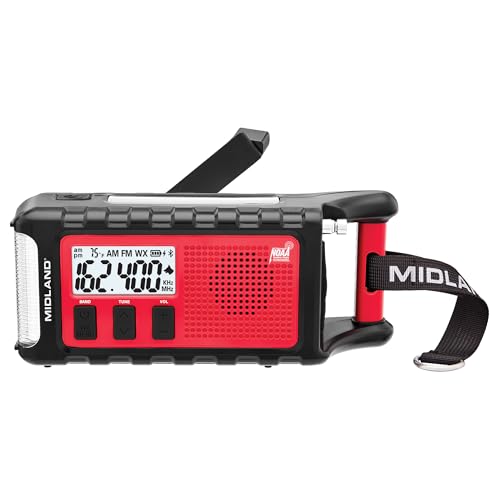
Crank and solar AM/FM/NOAA radio with weather scan and alert, 10,000 mAh power bank, Bluetooth and SOS flashlight.
Check price on Amazon$99.99 as of Oct 21, 2026 7:04 pm GMT+0000 — prices change; see Amazon for current price.Why we like it
- NOAA weather scan locks onto the strongest channel
- 10,000 mAh battery; 200 hours of radio listed
- Only listing with Bluetooth streaming
- 130-lumen flashlight with Morse SOS beacon
| Specification | Details |
|---|---|
| Bands | AM, FM and NOAA weather (scans 7 WX channels) |
| Alerts | Weather scan + alert described; SAME county coding not stated |
| Power | Internal lithium-ion battery recharged by solar panel or hand crank; USB charging cable included |
| Battery / output | 10,000 mAh power bank; up to 200 hours of radio use claimed |
| Extras | Bluetooth audio, 130-lumen CREE LED, SOS beacon, ultrasonic dog siren |
| Water rating / warranty | Not stated in listing |
Midland ER310PRO — AM/FM/NOAA scan + alert, 10,000 mAh, crank + solar, Bluetooth, 130 lm CREE LED, SOS + dog siren
The Only Crank Radio Here With Bluetooth and a 10,000 mAh Bank
Twelve of the 15 listings are hand-crank radios, and most of them also have a solar panel. Among those 12, the internal batteries range from 2,000 mAh on the pocket models to 12,000 mAh on two listings that share one model number. The ER310PRO sits near the top at 10,000 mAh, which Midland says delivers up to 200 hours of radio listening, and it is the only radio on the shelf with Bluetooth streaming. That sounds like a luxury, but it turns the radio into something you use on the patio in July, which is the surest way to know it works in January.
Midland describes a weather scan that steps through the seven NOAA weather channels and locks onto the strongest, plus an alert function. Five listings on the shelf describe some form of automatic alerting; this is the only one of them that also has a crank, a solar panel and a large power bank. The SOS flashlight beacon flashes Morse code, and the ultrasonic dog siren is meant to help search teams locate someone.
The listing does not say whether the alert uses SAME county coding, so expect broader alerts than a programmed tabletop unit. It also does not state a water-resistance rating or a warranty term. Midland’s older ER310, also on the shelf, has a near-empty listing, so the PRO is the version with documented specs.
Pros
- Weather scan plus alert on a crank radio
- Large 10,000 mAh power bank
- Bluetooth makes it an everyday radio
- Bright CREE flashlight with SOS
Cons
- SAME county coding not stated
- No water rating in listing
- Warranty not stated
Check Midland ER310PRO price on Amazon
2. Midland WR400 Weather Radio Deluxe — Best Bedside Alert Radio
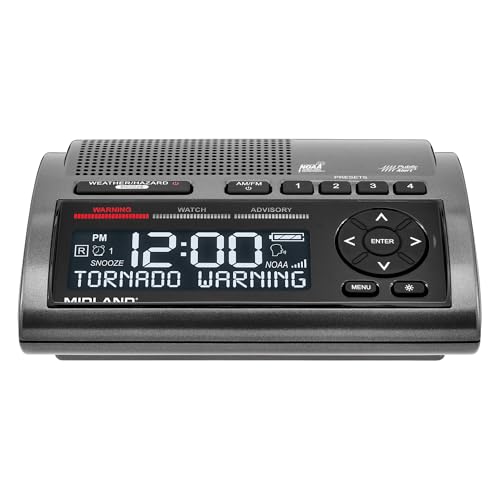
Tabletop NOAA alert radio with SAME programming for 25 counties, siren, voice and LED alerts, alarm clock and AA backup.
Check price on Amazon$89.00 as of Oct 21, 2026 7:04 pm GMT+0000 — prices change; see Amazon for current price.Why we like it
- SAME coding for up to 25 counties
- Choice of 85 dB siren, voice or LED flasher
- Switches from AM/FM to alerts automatically
- Four AA batteries keep it alert in outages
| Specification | Details |
|---|---|
| Alerts | NOAA Weather Scan + Alert; S.A.M.E. programming for up to 25 counties; 80 alert types |
| Alert modes | 85 dB siren, voice alert, visual LED flasher |
| Bands | NOAA weather, AM and FM; listing says it scans 10 WX channels |
| Backup power | Four AA batteries (not included) |
| Extras | Alarm clock with snooze; USB output for device charging; AMBER alerts via NOAA |
| Crank / solar | None |
Midland WR400 — tabletop NOAA alert, SAME 25 counties, 80 alerts, siren/voice/LED, alarm clock, USB out, 4xAA backup
One of Only Two SAME Radios on the Shelf
Only two of the 15 listings support SAME (Specific Area Message Encoding): this WR400 and Midland’s simpler WR120B. SAME lets you enter county codes so the radio sounds only for warnings that affect the counties you choose. That is the difference between a radio that wakes you for every alert across the forecast area and one that wakes you for a tornado warning in Arapahoe or Douglas County. The WR400 accepts up to 25 counties and 80 alert types, enough to cover home, work and a parent’s house across the metro.
It is built to sit on a nightstand. It doubles as an alarm clock, and the listing says it automatically switches from AM/FM to an alert when one is issued. You can choose a siren, a voice announcement or a flashing LED, which helps in a bedroom shared with someone who is hard of hearing. Four AA batteries keep it on watch through an outage, and a USB output can charge a phone.
It is not a go-bag radio: there is no crank, no solar panel and no internal power bank, and its listing does not state an AC adapter detail. The listing also says it scans 10 weather channels, while NOAA broadcasts use seven, so treat that number loosely. Pair it with a crank radio from this list for outages.
Pros
- SAME county programming
- Three alert modes, including voice
- Alarm clock and USB output
- AA backup during outages
Cons
- No crank, solar or internal battery
- AA batteries not included
- Channel count in listing is inconsistent
Check Midland WR400 price on Amazon
3. Raynic CR1009PRO — Best for the Most Ways to Power It

AM/FM/SW/NOAA radio with standby auto alert, six charging options including AC, LCD display and headphone jack.
Check price on Amazon$35.99 as of Oct 21, 2026 7:04 pm GMT+0000 — prices change; see Amazon for current price.Why we like it
- Six power options, including AC and AAA
- Auto-scans for alerts in standby mode
- Adds a shortwave band
- Backlit LCD with digital tuning
| Specification | Details |
|---|---|
| Bands | AM, FM, shortwave and NOAA weather |
| Alerts | Auto-scans for emergency and weather alerts when on or in standby |
| Power | Built-in battery, AC adapter, 5V USB input, hand crank, solar, 3 AAA (not included) |
| Battery | 5,000 mAh / 18,500 mWh |
| Extras | 3W flashlight, 2.5W reading lamp, SOS alarm with red light, headphone jack |
| Water rating / weight / warranty | IPX3; about 1 to 1.2 lb; 1 year |
Raynic CR1009PRO — AM/FM/SW/NOAA, standby auto alert, 6-way power incl. AC, 5,000 mAh, LCD, headphone jack, IPX3
The Only Crank Radio That Lists Six Power Sources and Standby Alerts
Raynic counts six ways to power the CR1009PRO: its built-in rechargeable battery, an AC adapter, a 5V USB input, the hand crank, the solar panel and three AAA batteries. No other listing on the shelf lists that many. The AC option matters more than it sounds, because it means the radio can live plugged in on a shelf, stay charged and stay in standby, rather than sitting dead in a drawer until the night you need it.
Standby is where the other advantage comes in. Raynic says the PRO auto-scans for alerts when it is on or in standby and sounds a warning. Its sibling CR1009 (non-PRO) listing, also on the shelf, says the opposite: that model must be powered on and manually tuned. That distinction is easy to miss, and it is the main reason to choose the PRO. It is also one of two radios here with a shortwave band (both Raynic), useful for long-distance news if regional stations go down.
Its weaknesses are moderate. IPX3 water resistance covers light spray, not heavy rain; two other listings claim IPX6. The listing does not say whether its alert uses SAME county coding. And the AAA batteries are not included, so add a pack to your kit.
Pros
- Six power sources, including AC
- Standby auto alert
- Shortwave band and LCD display
- Headphone jack
Cons
- Only IPX3 water resistance
- SAME not stated
- AAA batteries not included
Check Raynic CR1009PRO price on Amazon
4. OnLyee CR1030 — Best Big Battery and Splash Resistance

AM/FM/NOAA crank radio with a 12,000 mAh battery, large solar panel, Type-C input, 5W flashlight and IPX6 rating.
Check price on Amazon$49.99 as of Oct 21, 2026 7:04 pm GMT+0000 — prices change; see Amazon for current price.Why we like it
- 12,000 mAh battery, tied for largest here
- IPX6 water resistance for rain and splashes
- Large 8,500 mm² solar panel
- 3-year manufacturer warranty
| Specification | Details |
|---|---|
| Bands | AM, FM and 7 NOAA weather channels |
| Alerts | Manual; must be powered on and tuned to a NOAA station |
| Power | 12,000 mAh rechargeable battery; solar, hand crank and Type-C input |
| Lights / alarm | 5W flashlight, 12-LED reading lamp, 120 dB SOS alarm |
| Water rating | IPX6 |
| Weight / warranty | 1.59 lb; 3-year manufacturer |
OnLyee CR1030 — AM/FM/NOAA, 12,000 mAh, solar + crank + Type-C, 5W light, 120 dB SOS, IPX6, 3-yr warranty
The Largest Battery Paired With the Strongest Stated Water Rating
Two listings on the shelf claim a 12,000 mAh battery, and both carry the model number CR1030: this OnLyee and a Mesqool-branded listing. Four listings state an IPX rating, and the highest stated is IPX6, claimed by this OnLyee and the 10,000 mAh Leaton. OnLyee is the only listing that pairs the largest battery with IPX6. For a radio that may ride in a truck, a deck box or a go-bag during a spring hailstorm, that pairing is the point.
A big battery is what you lean on to charge a phone; cranking a phone back to life by hand takes a long time on any radio. The listing pairs that capacity with an oversized solar panel and a Type-C input. It also offers a 3-year manufacturer warranty, one of the longer terms on the shelf; only FosPower’s limited lifetime warranty is longer.
Be clear about the alert behavior. The listing says the radio must be powered on and tuned to a NOAA station to receive broadcasts, so it will not wake you for a warning. It is a listening radio and a power bank, best paired with a SAME alert radio at home.
Pros
- 12,000 mAh battery
- IPX6 splash resistance
- Large solar panel and Type-C input
- 3-year warranty
Cons
- No automatic alerts
- Heavier than pocket models at 1.59 lb
- Same model number sold under another brand
Check OnLyee CR1030 price on Amazon
5. yesiwtc Hand Crank Radio 090S — Best Built-In Phone Charging Cables
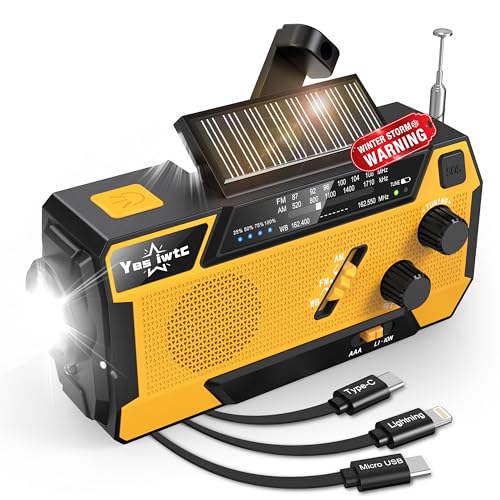
AM/FM/NOAA crank radio with Lightning, USB-C and Micro USB cables built in, four power sources and a 7400 mWh battery.
Check price on Amazon$24.95 as of Oct 21, 2026 7:04 pm GMT+0000 — prices change; see Amazon for current price.Why we like it
- Three charging cables built into the radio
- Four power sources, including AAA backup
- 3-mode flashlight and 6-LED reading light
- 18-month replacement warranty
| Specification | Details |
|---|---|
| Bands | AM, FM and NOAA weather |
| Alerts | Not described as automatic |
| Power | USB-C charging, hand crank, solar panel, AAA batteries |
| Battery | 7,400 mWh (2,000 mAh) |
| Phone charging | Built-in Lightning, USB-C and Micro USB cables |
| Size / warranty | About 6.5 x 2.9 x 1.9 in; 18-month replacement |
yesiwtc 090S — AM/FM/NOAA, 2,000 mAh, crank + solar + USB-C + AAA, 3 built-in cables, SOS alarm, 18-mo warranty
The Only Radio With Charging Cables Built In
Every crank radio on the shelf can charge a phone, but every other one assumes you will have the right cable when the power goes out. This yesiwtc is the only listing with cables built into the radio, one each for Lightning, USB-C and Micro USB. In a household with mixed phones, an old tablet and a headlamp, that removes the most common failure point in an outage kit: the missing cord.
It also lists four power sources: USB-C (the main way to charge it), the hand crank, the solar panel and AAA batteries as a fallback. Only three listings on the shelf mention AAA backup. The flashlight has three brightness modes, and a 6-LED reading light handles a dark kitchen.
The battery is small. At 2,000 mAh it sits with the pocket models, so expect a partial phone top-up rather than full charges. The listing does not describe automatic alerts or a water rating.
Pros
- Built-in Lightning, USB-C and Micro USB
- AAA battery fallback
- 18-month replacement warranty
Cons
- Small 2,000 mAh battery
- No automatic alerts described
- No water rating stated
Check yesiwtc 090S price on Amazon
6. PRUNUS J161 — Best Simple AA Battery Radio

Pocket AM/FM/NOAA radio that runs on 2 AA batteries, with three controls, a headphone jack and a 0.24 lb body.
Check price on Amazon$11.99 as of Oct 21, 2026 7:04 pm GMT+0000 — prices change; see Amazon for current price.Why we like it
- Runs on two standard AA batteries
- Lightest listing on the shelf
- Three simple controls, no menus
- Headphone jack for quiet listening
| Specification | Details |
|---|---|
| Bands | AM 520–1710 kHz, FM 87–108 MHz, 7 NOAA weather channels |
| Alerts | No automatic NOAA alert notification (stated in listing) |
| Power | 2 AA batteries only |
| Controls | Power/volume, tuning and band selector |
| Size / weight | 4.7 x 2.8 x 1.2 in; 0.24 lb without batteries |
| Phone charging / crank / solar | None |
PRUNUS J161 — AM/FM/NOAA, 2xAA, 3 analog controls, headphone jack, 0.24 lb, no crank, no phone charging
The Only Radio Here That Runs Purely on AA Batteries
Three listings on the shelf have no crank: two Midland tabletop alert radios and this PRUNUS. The PRUNUS is the only one of the 15 that runs solely on replaceable AA batteries, with no internal rechargeable pack. That has a real advantage: lithium packs inside crank radios slowly self-discharge in a drawer, while a radio that takes fresh AAs from the same pack as your flashlights is ready the moment you load it. CDC’s outage checklist calls for extra batteries in common sizes such as AA and AAA.
It is also the simplest radio on the shelf. Three controls, analog tuning and no screen make it easy for an older relative or a child to use in the dark. The headphone jack lets one person listen while others sleep. At 0.24 pounds before batteries, it is the lightest listing here.
The trade-offs are clear in the listing. It does not support automatic NOAA alerts, cannot charge a phone and has no light. It is a listening radio for outages and storms, not a power bank or alarm.
Pros
- Runs on common AA batteries
- Lightest and simplest radio here
- Headphone jack
Cons
- No automatic alerts
- No phone charging or light
- No crank or solar backup
Check PRUNUS J161 price on Amazon
7. Emgykit Hand Crank Radio 086S — Best Pocket Hand-Crank Radio

0.51 lb AM/FM/NOAA crank radio with solar and Type-C charging, 140-lumen 3-LED flashlight and SOS siren.
Check price on Amazon$19.99 as of Oct 21, 2026 7:04 pm GMT+0000 — prices change; see Amazon for current price.Why we like it
- Pocket size: 5.1 x 2.1 x 2.4 in, 0.51 lb
- Crank, solar and Type-C charging
- 140-lumen 3-LED flashlight
- SOS siren above 80 dB
| Specification | Details |
|---|---|
| Bands | AM, FM and NOAA weather |
| Alerts | Not described as automatic |
| Power | Hand crank, solar panel, Type-C charging |
| Battery | 2,000 mAh / 7,400 mWh; can charge a phone |
| Light / alarm | 3W 3-LED flashlight, 140 lm; SOS siren louder than 80 dB |
| Weight / warranty | 0.51 lb; 1 year |
Emgykit 086S — AM/FM/NOAA, 2,000 mAh, crank + solar + Type-C, 140 lm 3-LED light, SOS siren, 0.51 lb
The Brightest Stated Light Among the Pocket Crank Radios
Four crank radios on the shelf weigh about half a pound: iRonsnow, RunningSnail, this Emgykit and, a little heavier, FosPower. Among the pocket-size models, Emgykit lists the brightest flashlight, a 3W, 3-LED light rated at 140 lumens; the iRonsnow and RunningSnail listings describe 1W lights. In an outage, the light is often the feature you use most.
It charges by hand crank, solar panel or Type-C, and its 2,000 mAh battery can top up a phone. The SOS siren, held for three seconds, sounds above 80 decibels. It is small enough to keep in a glovebox, a backpack or the drawer next to the first aid kit.
Small means compromises. The battery is the smallest class on the shelf, the listing does not describe automatic alerts or water resistance, and a pocket speaker will not fill a room. Treat it as the car or go-bag radio, with a larger unit at home.
Pros
- Pocket size and weight
- Brightest stated light among pocket models
- Three charging methods
Cons
- Small 2,000 mAh battery
- No automatic alerts described
- No water rating stated
Check Emgykit 086S price on Amazon
Automatic alerts vs manual listening: the spec that matters most
NOAA Weather Radio is one of the channels the federal alert system uses. FEMA describes its Integrated Public Alert and Warning System as delivering authenticated emergency information to the public through Wireless Emergency Alerts on phones, the Emergency Alert System on broadcast media, and NOAA Weather Radio. A weather radio is how you receive that third channel when the others fail.
Radios on the shelf fall into three groups:
- SAME alert radios (Midland WR400 and WR120B). You program county codes, and the radio stays silent until a warning for those counties is issued, then sounds a siren, voice or light. These belong on a nightstand.
- Scan-and-alert crank radios (Midland ER310PRO and ER310, Raynic CR1009PRO). Their listings describe automatic alerts, but none of the three states SAME coding, so expect less targeted alerts.
- Manual listening radios (most crank models, plus the PRUNUS). You must turn them on and tune to a NOAA station. Several listings, including OnLyee, Leaton, the non-PRO Raynic and PRUNUS, say so outright.
For most homes, the best setup is one alert radio that stays powered at home and one crank or battery radio for outages, the car and the go-bag. CDC’s preparedness guidance also suggests signing up for local emergency alerts and turning on Wireless Emergency Alerts on your phone, and knowing the difference between a watch and a warning.
Power sources, batteries and phone charging
Hand crank and solar
Twelve of the 15 listings have a hand crank, and most add a small solar panel. Both are backups for the internal battery, not fast chargers. One listing (Leaton) gives a useful reality check: about one minute of steady cranking for 15 to 20 minutes of radio listening. Charging a phone by crank alone takes far longer.
Internal battery size
Batteries on the shelf range from 2,000 mAh (pocket models) to 12,000 mAh. Larger packs mean more phone charging and longer listening, at the cost of weight. Leaton’s listing also notes that a 10,000 mAh cell delivers only about one to one and a half phone charges after conversion losses, so treat any capacity number as an upper bound.
Replaceable batteries
AA or AAA backup lets you keep a radio going indefinitely with spares. CDC’s power-outage checklist calls for a battery-powered or hand-crank NOAA weather radio with USB ports, plus extra batteries in common sizes such as AA and AAA. Leaton also advises recharging a stored radio every three to six months; set a reminder.
Water resistance and lights
Only four listings state an IPX rating, from IPX3 (light spray) to IPX6 (strong water jets). Most radios include a flashlight and an SOS alarm, but brightness varies widely; if the radio is your primary outage light, choose one with a stated lumen figure or pair it with a dedicated flashlight such as those in our best rechargeable flashlight roundup.
How an emergency radio fits a Front Range outage plan
Colorado outages come from several directions: spring snowstorms that drop heavy wet snow on power lines, summer thunderstorms and hail, high-wind events along the foothills, and utility shutoffs during extreme fire weather. In each case, a radio delivers the forecast, road closures and evacuation orders when phone networks are overloaded. CDC’s winter-storm guidance lists a battery-powered radio with extra batteries among the supplies to keep in your car, and advises listening to forecasts regularly before a storm.
A radio is one piece of outage prep. CDC’s outage checklist also includes emergency lighting, power banks and car chargers, a generator with outdoor-rated extension cords, battery-backup smoke and CO alarms, and warm blankets. Our guides to the best portable power stations, the best portable generators and how to stay warm without power cover the rest, and our sibling guide to the best first aid kits covers the medical side.
Generator and CO safety during outages
Outages raise the risk of carbon monoxide poisoning, because people run generators, grills and fuel-burning heaters to cope. CDC’s preparedness guidance says to check the batteries in CO detectors at least once a month and to learn how to use a portable generator safely. CDC’s carbon monoxide page is specific: never use a generator inside your home or garage, even with doors and windows open; operate it outdoors more than 20 feet from windows, doors and vents; and use a battery-powered or battery-backup CO detector in the home while it runs. A weather radio that announces the storm is only half the plan; working CO alarms are the other half.
When to bring in a professional
If outages are frequent or long where you live, the next step is often a permanent solution: a transfer switch or interlock kit for a portable generator, a standby generator or a battery backup system. Those involve your electrical panel and usually a permit, so they belong with a licensed electrician. If you are buying a home and want to know the condition of the panel, the service entrance and any existing generator hookup, an inspection is the place to start. The electrical systems hiring guide explains what an inspector checks, and you can reach out through our contact page to connect with a vetted Front Range inspector.
Frequently asked questions
What is the best type of emergency radio for a home?
Most homes do best with two: a SAME alert radio that stays powered at home and sounds only for warnings in your counties, and a hand-crank or battery radio for outages, the car and a go-bag. Among current listings, Midland's WR400 and WR120B are the SAME models.
Do hand-crank radios alert you automatically?
Most do not. Many crank radio listings say you must turn the radio on and tune to a NOAA station to hear broadcasts. A few, such as the Midland ER310PRO and Raynic CR1009PRO, describe automatic alerts, but neither listing states SAME county coding.
What does SAME mean on a weather radio?
SAME stands for Specific Area Message Encoding. You enter codes for the counties you care about, and the radio sounds only when a warning is issued for those areas. It cuts false alarms from warnings elsewhere in the broadcast area.
Can an emergency radio charge my phone?
Most crank radios have a USB output and an internal battery that can top up a phone. Battery sizes range from about 2,000 to 12,000 mAh, and real-world output is lower than the rated capacity. Cranking alone charges a phone very slowly.
How do I keep an emergency radio ready?
Store it charged, and recharge or test it every few months. Keep spare AA or AAA batteries if it accepts them, and keep the charging cable with it. Using the radio occasionally, even just to check the NOAA channel, is the best way to know it works.
References
- Power Sources — Centers for Disease Control and Prevention
- Integrated Public Alert and Warning System: Public — Federal Emergency Management Agency
- Preparing for a Winter Storm — Centers for Disease Control and Prevention
- Stay Informed — Centers for Disease Control and Prevention
- Stay Healthy — Centers for Disease Control and Prevention
- Carbon Monoxide Poisoning Basics — Centers for Disease Control and Prevention