Best Cleaner for Mold: A 2026 Buyer’s Guide

The best cleaner for mold on a hard surface is the one whose label matches the job: a registered mold-control spray for countertops and tile, a bleach spray for stained grout, a stain cleaner for a patio slab. The wrong choice either damages the surface or leaves dead mold and stains behind while the moisture that caused them keeps coming. Federal guidance is blunt that cleaning is only half the fix, and that most hard surfaces come clean with detergent and water. The products below earn their place when a surface needs more than that: stubborn staining, a disinfecting step, or a label-backed mold claim. Below are six picks for general hard-surface cleaning, each matched to a specific job, followed by a buying guide.
Part of our Mold Removal & Remediation guide — start there for the full picture →
As an Amazon Associate we earn from qualifying purchases.
How we compared: we compared 15 current Amazon listings for mold cleaners, removers and stain sprays on what each listing actually states: whether it claims to kill mold or only remove stains, whether it names bleach or states it is bleach-free, whether it says it is EPA-registered, which surfaces it is labeled for, and what dwell time and safety directions it gives. Several listings are multipacks or larger sizes of the same formula, so the 15 listings cover 11 distinct products. We did not lab-test any of these cleaners or use them hands-on. Prices and availability change often, so check the current listing and the product label before buying.
Is this mold, asbestos, or water damage? Get a free instant screen
Upload a clear photo of the suspect area. You'll get an instant AI screening opinion and what to do next. This is screening guidance, not a professional determination.
Screening guidance only. AI can be wrong. Confirm asbestos, mold type, or lead with lab testing or a licensed professional before acting.
Quick picks: the best cleaners for mold on hard surfaces
| Pick | Best for | Key spec | Key detail |
|---|---|---|---|
| Moldex 5010 Mold Killer | Everyday hard-surface mold cleaning | EPA-registered, bleach-free | Kills mold, cleans and disinfects hard, nonporous surfaces |
| Clorox Plus Tilex Mold and Mildew Remover | Bleach-based stain and mold removal | Clorox bleach formula | Claims 99.9% of mold and mildew killed; avoid prolonged metal contact |
| Mold Armor FG593AM | Kill-then-maintain routines | 10-minute dwell, rinse within 15 | 7-day reapplication schedule; names Aspergillus niger |
| Concrobium Mold Control | Mixed materials and low-odor jobs | EPA-registered; no bleach, ammonia or VOCs | Leaves a film the listing says helps prevent regrowth |
| Moldex 395196 Surface Stain Cleaner | Indoor and outdoor hard-surface staining | Bleach-powered | Spray-and-rinse for tile, siding, decks and fences |
| Alien Power Mold and Mildew Remover | Mixing fresh batches from concentrate | 3 x 1 oz packets make 72 oz | Oxygen-based formula; reusable 24 oz bottle |
The six picks, compared listing by listing
1. Moldex 5010 Mold Killer — Best Overall Hard-Surface Mold Cleaner

EPA-registered, bleach-free spray that kills mold and cleans and disinfects hard, nonporous surfaces as directed.
Check price on Amazon$8.97 as of Oct 10, 2026 8:22 pm GMT+0000 — prices change; see Amazon for current price.| Specification | Details |
|---|---|
| Claim type | Kills mold and helps control mold and mildew, used as directed |
| Registration stated | Listing describes the formula as EPA-registered |
| Bleach | Bleach-free; non-acid cleaning; deodorizes |
| Surfaces | Hard, nonporous surfaces |
| Format / size | Ready-to-use 32 fl oz trigger spray |
| Model | 5010; dwell time not stated in listing |
Moldex 5010 — 32 oz ready-to-use, EPA-registered per listing, bleach-free, kills mold + cleans + disinfects hard nonporous surfaces
One of Only Two Listings That State EPA Registration, and the Only One That Also Disinfects
Of the 11 distinct products on this shelf, only two say in their listings that they are registered with the EPA: this Moldex 5010 and Concrobium Mold Control. The Moldex is the only one of that pair that also describes itself as a disinfectant cleaner, so one product covers the kill claim, the cleaning step and the disinfecting step on a countertop, tub surround or plastic bin. Registration matters because the EPA reviews and approves the label language on a registered pesticide product, including directions for use and safety measures, and following those directions is required by law.
The Moldex is also one of only two products on the shelf that state they are bleach-free (Concrobium is the other), while three products, Clorox Plus Tilex, Scrubbing Bubbles Foaming Bleach and the Moldex 395196 stain cleaner, name bleach in their listings. For a small bathroom or a laundry room without a window, a bleach-free option sidesteps the chlorine fumes and the risk of accidentally mixing bleach with an ammonia cleaner.
What the listing leaves out is worth knowing. It does not give a contact time, does not name its active ingredient and does not promise stain removal. A product that kills mold does not necessarily lift the dark pigment mold leaves behind, so a bleach or stain product may still be needed afterward on grout.
Pros
- States EPA registration for its mold claim
- Kills, cleans and disinfects in one product
- Bleach-free, so fewer fumes and no chlorine mixing risk
- Ready to use; no dilution
Cons
- Limited to hard, nonporous surfaces
- Dwell time and active ingredient not stated in listing
- No stain-removal claim
2. Clorox Plus Tilex Mold and Mildew Remover — Best Bleach-Based Cleaner

Bleach spray that the listing says kills 99.9% of mold and mildew and lifts stains on hard, nonporous surfaces.
Check price on Amazon| Specification | Details |
|---|---|
| Claim type | Kills mold and mildew (listing cites 99.9%); removes mold and mildew stains |
| Active approach | Clorox bleach |
| Surfaces | Hard, nonporous surfaces indoors and out: shower walls, sinks, counters, tub and tile, cement pools, glazed pool tile, vinyl and plastic patio furniture |
| Cautions in listing | Avoid prolonged contact with metal and old porcelain |
| Format / size | 32 fl oz spray; no scrubbing required per listing |
| Registration stated | Not stated in listing |
Clorox Plus Tilex — 32 oz bleach spray, kills 99.9% mold/mildew per listing, stain removal, hard nonporous indoor/outdoor
The Only Bleach Product Here That Makes Both a Kill Claim and a Stain Claim
Three products on this shelf are built around bleach. Scrubbing Bubbles Foaming Bleach talks about eliminating mold and mildew stains and soap scum, and the Moldex 395196 talks about stains and discoloration. Clorox Plus Tilex is the only one of the three whose listing claims to kill mold and mildew as well as remove the stains, which is why it is the bleach pick for a general cleaning cabinet. The same formula also appears on the shelf as a 3-pack.
Bleach has a narrow lane. The EPA says chemical biocides such as chlorine bleach are not recommended as a routine part of mold cleanup, and that dead mold can still cause allergic reactions, so it must be removed, not just killed. Where bleach does earn its keep is on hard, glazed surfaces with dark staining. The listing itself warns against long contact with metal and older porcelain, which rules out bare chrome trim and vintage tubs for long soaks.
Safety is the trade-off. The EPA and CDC both warn never to mix bleach with ammonia, and the CDC adds other cleaners to that list, because the combination gives off a poisonous gas. Ventilate, wear gloves and goggles, and rinse the surface before switching to any other product.
Pros
- Claims both mold kill and stain removal
- Works on outdoor pool tile and patio furniture too
- No-scrub application per listing
Cons
- Bleach fumes need strong ventilation
- Must never be mixed with ammonia or other cleaners
- Not for prolonged contact with metal or old porcelain
- EPA registration not stated in listing
3. Mold Armor FG593AM Mold Kill and Control — Best for a Kill-Then-Maintain Routine
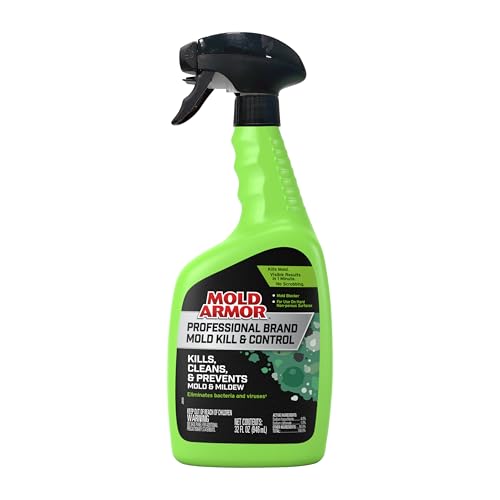
Hard-surface spray that kills and cleans mold and mildew with a 10-minute dwell and a weekly prevention step.
Check price on Amazon$22.98 as of Oct 10, 2026 8:22 pm GMT+0000 — prices change; see Amazon for current price.| Specification | Details |
|---|---|
| Claim type | Kills, cleans and helps prevent mold and mildew; also lists bacteria and viruses |
| Organism named | Aspergillus niger |
| Directions in listing | Spot test; apply, wait 10 minutes, rinse or wipe within 15 minutes; rinse food-contact surfaces with drinking water |
| Prevention step | Wet the surface, let it air dry, repeat every 7 days |
| Surfaces | Hard, non-porous: laminate, linoleum, sealed grout, stainless steel, plastic |
| Model / registration | FG593AM; EPA registration not stated in listing |
Mold Armor FG593AM — 32 oz, kill + clean + prevent, 10-min dwell, 7-day reapply, names Aspergillus niger, hard non-porous only
The Only Spray Here That Spells Out a Dwell Time and a Prevention Schedule
Most sprays on this shelf say little more than “spray and rinse.” The Mold Armor listing is the only spray that gives a timed procedure: 10 minutes on the stain, then rinse within 15 minutes, with a separate maintenance step of wetting the surface and letting it air dry every 7 days. It is also the only listing that names a specific organism it was tested against, Aspergillus niger. The CDC lists Aspergillus among the most common indoor molds.
Three products on the shelf make a prevention or inhibition claim: this one, Concrobium and Moldex 5010. Mold Armor is the only one of the three that turns that claim into a calendar, which suits a basement utility sink, a garbage can or a shower stall that keeps getting damp. It also lists sealed grout explicitly, while unsealed, porous grout is outside its stated use.
Two cautions. The listing does not state an EPA registration, even though it makes kill claims, so confirm the registration number on the bottle’s label. And the 15-minute rinse window means it is a spray to stay with, not one to leave while running other errands.
Pros
- Clear 10-minute dwell and 15-minute rinse window
- Weekly prevention routine spelled out
- Names a specific mold species and sealed grout
Cons
- EPA registration not stated in listing
- Hard, non-porous surfaces only
- Active ingredient not stated in listing
- Must be rinsed on time and from food-contact surfaces
4. Concrobium Mold Control — Best Bleach-Free, Low-Odor Option

EPA-registered mold control spray with no bleach, ammonia or VOCs, labeled for drywall, wood, tile and concrete.
Check price on Amazon$12.81 as of Oct 10, 2026 8:22 pm GMT+0000 — prices change; see Amazon for current price.| Specification | Details |
|---|---|
| Claim type | Eliminates existing mold and leaves a film that helps prevent regrowth |
| Registration stated | Registered with the EPA for mold control when used as directed |
| Chemistry | No bleach, no ammonia, no VOCs; odorless |
| Surfaces | Drywall, wood, tile, grout, concrete, fabric and other building materials |
| Format / size | Ready-to-use 32 oz trigger spray |
| Model | 25326CAL; stain removal not claimed in listing |
Concrobium Mold Control — 32 oz, EPA-registered per listing, no bleach/ammonia/VOCs, odorless, preventive film
The Only Registered Product Here Labeled for Drywall and Wood
Moldex 5010 and Mold Armor both limit themselves to hard, nonporous surfaces. Concrobium is the only product on the shelf that pairs an EPA registration statement with a surface list that includes drywall, wood, concrete and fabric. It is also the only listing that states it contains no ammonia, which takes the bleach-and-ammonia mixing hazard off the table for this product.
That broader surface list needs context. The EPA notes that porous materials such as ceiling tiles and carpet may have to be thrown away when they become moldy, because mold can fill the crevices in those materials. A spray can treat surface growth on sound drywall or framing; it cannot rescue saturated, crumbling board. For that line, see our guide to whether you can kill mold on drywall, and for lumber, how to clean mold off wood.
Concrobium does not claim to remove stains, so dark marks on grout or wood may remain after treatment. Its value is control and prevention on materials the bleach sprays are not labeled for.
Pros
- States EPA registration for mold control
- No bleach, ammonia or VOCs; odorless
- Labeled for drywall, wood and concrete as well as tile
- Preventive film per listing
Cons
- No stain-removal claim
- Dwell time not stated in listing
- Cannot fix materials that are water-damaged through
5. Moldex 395196 Surface Stain Cleaner with Bleach — Best for Indoor and Outdoor Staining

Bleach-powered spray-and-rinse stain cleaner for tile, grout, tubs, siding, decks and fences.
Check price on Amazon$8.99 as of Oct 10, 2026 8:22 pm GMT+0000 — prices change; see Amazon for current price.| Specification | Details |
|---|---|
| Claim type | Removes stains and discoloration; no kill claim in the feature text |
| Active approach | Bleach-powered |
| Surfaces | Hard, non-porous: tile, grout, tubs, showers, siding, decks, fences |
| Application | Spray and rinse; listing says no heavy scrubbing or pressure washing needed |
| Outdoor note | Designed for use around patios, walkways and landscaping when applied as directed |
| Model / size | 395196; 32 fl oz |
Moldex 395196 — 32 oz bleach-powered stain cleaner, spray and rinse, tile/grout/tub plus siding, decks and fences
The Only Bleach Product Here With Directions for Use Around Landscaping
Of the three bleach-based products on the shelf, the Moldex 395196 is the only one whose listing addresses spraying near plants, patios and walkways. That makes it the general-purpose pick for the same mildew film on a north-facing fence or a shaded patio that also turns up on bathroom grout. Clorox Plus Tilex lists outdoor pool tile and patio furniture; Scrubbing Bubbles is bathroom-only.
Read the claim carefully. The feature text describes removing stains from dirt, grime and outdoor buildup, and the “mold and mildew” wording sits in the product title. It does not claim to kill mold. Treat it as a stain remover for surfaces that have already been cleaned and dried.
The same bleach cautions apply as with Tilex: ventilate, never mix with ammonia cleaners, and protect skin and eyes. Moisture control still governs whether the stain comes back.
Pros
- Covers bathroom tile and exterior siding, decks and fences
- Addresses use around landscaping
- Spray-and-rinse, no pressure washer
Cons
- No mold-kill claim in the listing text
- Bleach fumes and mixing hazards
- Hard, non-porous surfaces only
6. Alien Power Mold and Mildew Remover — Best Concentrate for Fresh Batches

Three 1 oz concentrate packets plus a 24 oz bottle; oxygen-based stain remover mixed fresh at home.
Check price on Amazon$59.99 as of Oct 10, 2026 8:22 pm GMT+0000 — prices change; see Amazon for current price.| Specification | Details |
|---|---|
| Claim type | Removes mold and mildew stains, soap scum, hard water marks; no kill claim |
| Format | Three 1 oz concentrate packets, each mixed with water in the included 24 oz spray bottle (72 oz total) |
| Chemistry | Described as oxygen-powered; activates when mixed |
| Surfaces | Tile, tubs, grout, caulking, stucco, brick, vinyl siding, decks, gutters |
| Safety in listing | Use in a well-ventilated area; follow label directions; keep from children |
| Model | 4304 |
Alien Power 4304 — 3 x 1 oz concentrate packets, 24 oz refillable bottle, oxygen-based, stain removal indoors and out
The Only Concentrate on the Shelf
Every other product on this shelf ships ready to use. Alien Power is the only one sold as dry concentrate packets that are mixed with water in a reusable bottle, which means less shipped water and the ability to mix one bottle only when needed. It is also the only listing that describes its chemistry as oxygen-based, a different approach from the three bleach products.
It is one of only two products on the shelf whose listing tells buyers to ventilate (RMR-86 is the other), and one of three that mention caulking. The listing frames it as a targeted stain remover for heavy jobs rather than a daily wipe-down, which is the honest framing: it is not marketed as a mold killer, and the listing does not mention EPA registration.
The listing’s “penetrates porous surfaces” language deserves skepticism for mold. A cleaner may lighten a stain in rough masonry, but the EPA’s point stands that mold in porous materials can be difficult or impossible to remove completely.
Pros
- Concentrate packets make 72 oz from one bottle
- Oxygen-based rather than chlorine bleach
- Listing tells users to ventilate
Cons
- Stain remover only; no kill claim
- Must be mixed before use
- Active ingredient and dwell time not stated in listing
Kill claims vs stain claims: reading the shelf
Mold cleaners split into two groups, and the bottle front does not always make the difference obvious. Of the 11 products here, three make a direct claim to kill mold (Moldex 5010, Clorox Plus Tilex and Mold Armor), and Concrobium says it eliminates mold and helps prevent regrowth. The rest, including 30 SECONDS Pro, RMR-86, Alien Power, the Moldex 395196 and the two cleaning gels, describe removing stains or discoloration.
A stain claim is not a lesser product; it is a different job. The EPA notes that mold may cause staining and cosmetic damage that cannot always be fully restored, and stain removers exist to fix the appearance. A product that legally claims to kill or control mold is a pesticide, and the EPA reviews the label directions and safety language for registered pesticides. Only two products here state that registration in their listings. When a listing makes a kill claim but does not mention registration, check the back label for an EPA registration number before relying on that claim.
Killing mold is not the goal in itself. The EPA says killing mold is not enough because dead mold can still cause allergic reactions, so it has to be removed. For more on the bleach question, see our guide to a bleach solution for mold; for gentler chemistry, compare hydrogen peroxide for mold and other natural mold killer options.
Matching the cleaner to the surface
Tile, glazed ceramic, glass, laminate and plastic. Every product on this list works here. The EPA’s own baseline is to scrub mold off hard surfaces with detergent and water and dry completely. A registered spray like Moldex 5010 adds a disinfecting step; a bleach spray handles dark staining.
Grout and caulk. Sealed grout is within Mold Armor’s stated use. Unsealed grout is porous, and staining often sits below the surface. Caulk that stays black after cleaning usually needs to be cut out and replaced; the EPA also says not to paint or caulk over moldy surfaces.
Painted walls and drywall. Only Concrobium among the registered products lists drywall. Use the gentlest effective approach on paint, and remember the EPA’s caution that porous materials may need to be removed. Our guide to telling mold vs mildew on walls helps decide whether a spot is a surface film or something deeper.
Wood. Finished wood can be cleaned; bare, water-damaged wood may need sanding or replacement. Structural framing with growth belongs in a professional evaluation.
Metal fixtures and old porcelain. Bleach products need care here. The Tilex listing warns against prolonged contact with metal and old porcelain.
Exterior siding, decks and fences. The Moldex 395196, Alien Power, 30 SECONDS Pro and RMR-86 listings all name exterior surfaces. Protect plants and follow label directions on runoff.
How to use a mold cleaner safely
Federal guidance on household mold cleanup is consistent. Before opening any bottle:
- Fix the water first. The EPA states that the key to mold control is moisture control, and that leaks should be fixed as soon as possible and wet items dried completely. Cleaning a wall that is still wet from a plumbing leak guarantees regrowth.
- Check the size. The EPA says a moldy area of less than about 10 square feet, roughly a 3-by-3-foot patch, can usually be handled by a homeowner. Beyond that, or after significant water damage or sewage contamination, bring in a professional.
- Protect yourself. The EPA recommends an N-95 respirator, goggles without vent holes and long gloves; when using bleach or a strong cleaner, it recommends gloves made of natural rubber, neoprene, nitrile, polyurethane or PVC. The CDC adds rubber boots.
- Ventilate. If disinfectants or biocides are used, the EPA says to ventilate and exhaust the air outdoors. The CDC says to open windows and doors.
- Never mix products. Never combine bleach with ammonia; the CDC also warns against mixing bleach with other cleaners because the result is a poisonous gas. Rinse thoroughly between products.
- Follow the label. Dwell times, rinse windows and surface limits on the label are how the product was designed to work. Mold Armor’s 10-minute dwell and 15-minute rinse are an example.
- Dry and monitor. After cleaning, dry the surface completely and watch for return. The EPA notes a background level of mold spores always remains, and they will not grow if the moisture problem has been resolved.
Ready-to-use vs concentrate vs gel
Ten of the 11 products ship ready to use, most in 32-ounce trigger bottles, which suits spot jobs. Alien Power is the only concentrate. Two products, ACTIVE and Vigorder, are thick gels meant for washer gaskets, caulk and grout lines, where a runny spray drips off before it works. Those gels are covered in our shower-specific roundup; for general hard-surface cleaning, a spray reaches more area faster.
Larger sizes exist on the shelf too: RMR-86 comes in a 2-pack and a gallon, and 30 SECONDS Pro in a 2-pack. Bulk sizes make sense for exterior stain work on siding or decks. Indoors, needing a gallon of mold cleaner is itself a sign the area may exceed the EPA’s 10-square-foot DIY threshold.
Colorado notes for Front Range homes
The Front Range’s dry air is an advantage after cleanup, because surfaces dry quickly once the water source is fixed. The EPA advises drying water-damaged areas within 24 to 48 hours to prevent mold growth and keeping indoor humidity below 60 percent, ideally 30 to 50 percent; the CDC says no higher than 50 percent. Most Colorado homes sit well under that for much of the year, which means recurring mold here usually points to a specific moisture source rather than general humidity: a slow drain leak, a bathroom fan that does not vent outdoors, a swamp cooler, condensation on cold basement walls or a winter ice dam.
That is why a cleaner that keeps “failing” in a Denver or Colorado Springs home deserves a closer look at the cause. Basement finishes over damp foundation walls and attic sheathing above poorly vented bathrooms are common places for growth that no spray will fix. Mold under carpet pad or behind drywall needs material removal, not a stronger chemical.
When a cleaner is not enough
DIY cleaners are built for small, visible, surface growth on materials that can be cleaned. Call for professional help when:
- Growth covers more than about 10 square feet, or there was significant water damage.
- Water came from sewage or other contaminated sources.
- A musty odor persists with no visible source, suggesting hidden mold inside walls or ductwork; the EPA cautions against running an HVAC system suspected of contamination.
- Mold returns quickly to the same spot after cleaning, signaling an unresolved moisture source.
- Anyone in the home has asthma, mold allergies, a weakened immune system or chronic lung disease; the CDC notes these groups can have more severe reactions.
The CDC does not recommend routine mold testing, since there are no set standards for acceptable levels; a visual inspection and moisture investigation are more useful. For finding local help, see our guide to mold cleaners near me, and for the bigger picture, our mold inspection hub.
References
- A Brief Guide to Mold, Moisture and Your Home — U.S. Environmental Protection Agency
- Mold Cleanup in Your Home — U.S. Environmental Protection Agency
- What Are the Basic Mold Cleanup Steps? — U.S. Environmental Protection Agency
- Mold: What to Know — Centers for Disease Control and Prevention
- About Pesticide Registration — U.S. Environmental Protection Agency
Frequently asked questions
What is the best cleaner for mold on hard surfaces?
For most hard, nonporous surfaces, a product whose listing states EPA registration for mold, such as Moldex 5010, covers killing, cleaning and disinfecting in one step. A bleach spray like Clorox Plus Tilex handles dark staining on tile and grout. The EPA notes detergent and water also remove mold from hard surfaces when followed by thorough drying.
Is bleach the best thing to clean mold with?
Not usually. The EPA says biocides such as chlorine bleach are not recommended as a routine part of mold cleanup, and dead mold still has to be removed. Bleach is useful for stains on hard, glazed surfaces. Never mix it with ammonia or other cleaners, and ventilate well.
Does a mold cleaner fix the problem permanently?
No. Cleaners treat the growth you can see, but the EPA says the key to mold control is moisture control. If the leak, condensation or humidity source is not fixed, mold returns. Dry wet materials within 24 to 48 hours and keep indoor humidity below 60 percent.
Can I use a mold cleaner on drywall?
Only for light surface growth on sound drywall, and only with a product labeled for it; Concrobium is the only registered product in this roundup that lists drywall. Drywall that is soft, stained through or repeatedly wet usually needs to be cut out and replaced, since mold in porous materials may be impossible to remove completely.
When should I hire a professional instead of using a cleaner?
The EPA suggests professional help when mold covers more than about 10 square feet, after major water damage or sewage contamination, or when HVAC contamination is suspected. Persistent musty odors and quick regrowth also point to a hidden moisture problem that an inspection can trace.
Seeing mold come back after every cleaning in a Front Range home? Reach out through our contact page to connect with a vetted local inspector who can trace the moisture source.
Mold removal & cleanup picks
For a small, contained patch (under ~10 sq ft) these EPA-friendly removers handle surface mold. Larger or recurring growth warrants a professional assessment first.
| Product | Why | Buy |
|---|---|---|
 RMR-86 Instant Mold Stain Remover RMR-86 Instant Mold Stain Remover | Fast-acting on stains; ventilate and wear PPE. | Amazon |
 Concrobium Mold Control Concrobium Mold Control | No-bleach formula that also helps prevent regrowth. | Amazon — $12.81 |
 Mold Armor Mold & Mildew Remover Mold Armor Mold & Mildew Remover | Widely stocked bathroom/surface remover. | Amazon — $22.98 |