Thermal Anemometers: What Homeowners Should Know
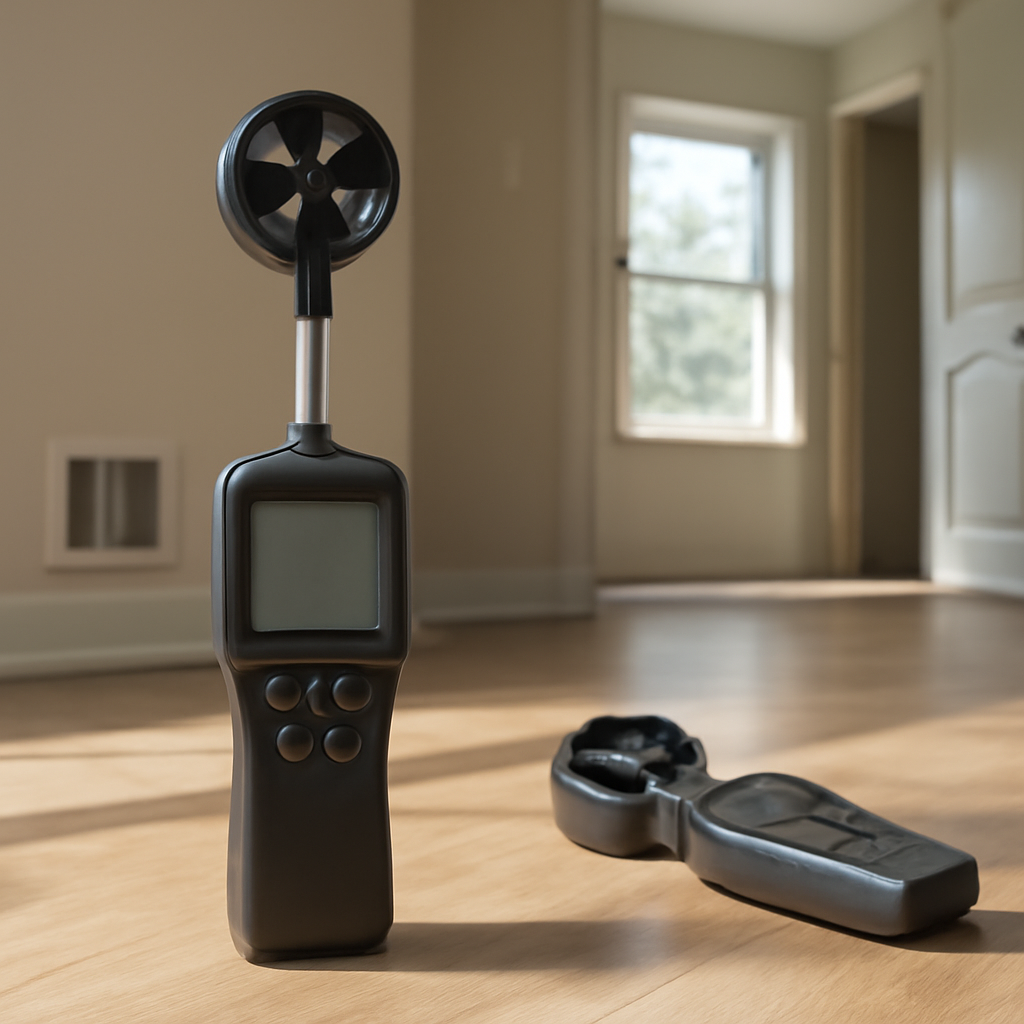
Thermal anemometers measure how fast air moves, and that single capability makes them quietly useful for diagnosing HVAC performance, ventilation problems, and energy loss in a home. They are less famous than thermal cameras, but they answer questions a temperature image cannot. This overview summarizes manufacturer specifications and trade-body guidance current as of 2026, and explains where these meters fit alongside the rest of an inspector’s kit, covered in our home inspection tools guide.
Part of our Thermal Imaging for Homes guide — start there for the full picture →
What a thermal anemometer is
A thermal anemometer, also called a hot-wire anemometer, measures air velocity using a heated sensing element. Air flowing past the element carries away heat; the instrument measures how much electrical power is needed to keep the element at a set temperature, and converts that into an airflow reading. Faster air removes more heat, so the relationship between power and velocity gives the measurement.
The hot-wire design excels at low air speeds, the range that matters most for indoor ventilation and HVAC diagnostics. Many models also report air temperature and compute volumetric flow (CFM or cubic meters per hour) when the duct or grille area is entered. ASHRAE’s standards for ventilation rely on knowing actual airflow, which is exactly what these meters provide.
Two sub-types exist within the thermal category. The classic hot-wire uses an extremely fine heated filament that responds quickly and reads very low velocities, but is fragile. A hot-film or thermistor-based sensor uses a more rugged heated element that trades a little low-speed sensitivity for durability, which suits field work where the probe takes knocks. For most building diagnostics either type works, but a buyer who plans to push a probe into dusty returns and gritty registers may favor the sturdier hot-film design.
It is worth distinguishing the thermal anemometer from the temperature-sensing tools it is sometimes confused with. A thermal anemometer measures air speed, not surface temperature, so it answers a different question than a thermal imaging camera, which maps heat across a surface. The two are complementary in building work: the camera shows where heat is moving abnormally, and the anemometer quantifies how much air is actually flowing. Using the right instrument for each question keeps a diagnosis grounded in real measurement rather than assumption.
Key specifications that matter
Comparing thermal anemometers means reading a few specifications carefully.
- Velocity range: typically from near 0 up to about 20 to 30 meters per second; the low end is where hot-wire designs shine.
- Accuracy: commonly stated as a percentage of reading plus a fixed term, for example ±3% of reading ±0.1 m/s. Tighter accuracy costs more.
- Probe type and length: a slim telescoping probe reaches into ducts and diffusers; probe diameter affects which grilles it fits.
- Temperature measurement: most report air temperature alongside velocity.
- Volumetric flow calculation: the ability to enter duct dimensions and read CFM directly.
- Resolution and logging: finer resolution and data logging help on diagnostic jobs.
Accuracy and low-speed performance are the specs that separate a diagnostic instrument from a novelty. A meter accurate to ±3% of reading at low velocity gives numbers an inspector can trust against a design target.
Home-inspection and HVAC use cases
Airflow measurement turns vague complaints into numbers. An inspector or HVAC technician can use a thermal anemometer in several concrete ways.
Measuring airflow at supply and return registers reveals whether rooms receive their designed air volume, which explains hot and cold spots. Checking exhaust fan performance in a bathroom or kitchen confirms whether the fan actually moves the rated air, a frequent failure that leaves moisture behind and feeds mold. Verifying that a range hood or dryer vent draws properly catches blockages. And measuring air velocity at a window, door, or outlet quantifies drafts that drive up heating bills.
The DOE treats ventilation and air movement as central to home energy performance, and ASHRAE publishes the airflow rates that ventilation systems should meet. A thermal anemometer is how those targets get checked in the field. Inspectors documenting energy and comfort issues often pair it with thermal imaging, an instrument covered in our overview of the thermal image scope.
Turning airflow numbers into a diagnosis
A reading alone means little until it is compared to a target. ASHRAE’s residential ventilation guidance and a system’s design specifications give the benchmarks: a bathroom exhaust fan is commonly expected to move on the order of 50 to 80 CFM, a kitchen range hood considerably more, and a supply register a share of the system’s total proportional to the room. When a thermal anemometer shows a bathroom fan moving a fraction of its rating, the cause is usually a clogged duct, a crushed flex run, an undersized fan, or a long, restrictive vent path. That measured shortfall explains lingering bathroom moisture and the mold that follows, and it points the homeowner to a specific repair rather than a guess.
The same logic applies to comfort complaints. A bedroom that never warms often turns out to receive far less supply air than the floor plan implies, which an anemometer reveals in minutes. Quantifying the deficit converts a subjective grievance into a number a contractor can act on, whether by balancing dampers, sealing leaks, or correcting a duct restriction.
The moisture and ventilation connection
Airflow ties directly to moisture problems, which is why this instrument belongs in a home-diagnostics kit even though it never touches water. Bathrooms and kitchens generate large amounts of humidity, and the exhaust fans meant to remove it frequently underperform. When a fan cannot move its rated air, that moisture stays indoors, condenses on cool surfaces, and feeds mold growth in exactly the spots homeowners later struggle to clean. Measuring fan performance is therefore a preventive step: confirm the fan actually exhausts to the rated volume and vents to the exterior rather than into an attic, and a recurring moisture source disappears.
Pricing tiers
Thermal anemometers span a wide price range. Basic handheld units with a fixed or short probe and modest accuracy sell for roughly $50 to $150, adequate for spot checks. Mid-tier instruments with telescoping probes, volumetric flow calculation, and ±3% accuracy commonly run $200 to $500. Professional and reference-grade meters with logging, tighter accuracy, and interchangeable probes climb past $700.
For a home inspector adding airflow to a report, a mid-tier meter with CFM calculation usually hits the sweet spot. A homeowner checking a single weak bathroom fan can get a useful answer from a basic unit.
How they compare to vane anemometers
The main alternative is a vane anemometer, which uses a spinning propeller to measure airflow. The two suit different jobs. A vane anemometer, with a larger rotating head, performs well at higher velocities and across a wide opening such as a supply grille, where it averages the flow over the vane’s area. A thermal hot-wire probe, being small, reads velocity at a precise point and handles very low speeds better, which suits duct interiors and small diffusers.
A second comparison is the vane-and-hood capture system used by balancing technicians, which places a fabric hood over a register to read total CFM directly. That is more accurate for whole-register flow but bulkier and far more expensive. For most inspection work, a thermal anemometer with manual area entry is the practical middle ground. Buyers weighing airflow tools alongside other instruments can review the broader thermal anemometer primer.
Reading specs without being misled
A few specification traps catch buyers. A wide velocity range printed on the box can be misleading, because accuracy is usually best in a narrower band, and the extremes of the range may carry much larger error. The accuracy figure itself matters more than the range: a meter stated as ±3 percent of reading is far more useful than one with no accuracy claim at all, and the absence of a stated accuracy is itself a warning. Resolution, the smallest increment the display shows, is not the same as accuracy; a meter can display two decimal places while being accurate only to within several percent. Reading the full specification rather than the headline number keeps expectations honest.
Calibration, maintenance, and limitations
The hot-wire element is delicate. Touching it, exposing it to dust and grease, or dropping the probe degrades accuracy, so the sensor tip needs protection and gentle handling. Manufacturers recommend periodic recalibration, often annually, to keep readings traceable, which matters when numbers appear in reports or are compared to ASHRAE targets.
Limitations are worth understanding. A point-velocity reading must be averaged across an opening to estimate total flow, and a single reading in the center of a grille overstates the average. Turbulent or swirling air near a fan or elbow produces unstable readings. And the instrument measures air movement only; it does not assess duct leakage or system pressure, which require other tools. Used with an understanding of where to take readings and how to average them, a thermal anemometer turns airflow from guesswork into documented numbers.
One more caution applies to the readings themselves: a single measurement is a snapshot of conditions that may change with the HVAC system’s state, the weather, or open windows. For a meaningful result, take readings under consistent conditions, such as with the system running at a known setting, and note those conditions alongside the numbers. An airflow figure recorded without that context is hard to compare against a target or a later reading, so documenting the conditions is part of making the measurement useful.
Proper averaging technique is what separates a credible measurement from a misleading one. Across a register face, the standard approach is to divide the opening into an imaginary grid and take a reading at the center of each cell, then average the results, because air moves faster in the middle of a duct and slower near the edges. A single center reading multiplied by the area can overstate flow by a wide margin. For free-air measurements such as a draft at a window, position matters too, since velocity drops sharply with distance from the source.
Choosing the right anemometer for the job
The right purchase depends on what questions you most need to answer. A homeowner chasing a single weak bathroom fan or a draft can get a useful answer from a basic handheld unit under $150, accepting modest accuracy. A home inspector adding airflow findings to reports is best served by a mid-tier meter with a telescoping probe, volumetric flow calculation, and stated accuracy around ±3 percent, which produces numbers credible enough to document. An HVAC technician balancing systems benefits from a professional meter with logging and tighter accuracy, and may pair it with a flow hood for whole-register totals.
Probe reach is an easy spec to overlook and a frequent regret. A short fixed probe cannot reach into a duct past a grille, while a telescoping probe extends a foot or more to sample inside the duct where the reading is more representative. For anyone planning to measure inside ductwork rather than just at the face of a register, a telescoping probe is worth the small added cost.
Data logging is another feature worth considering for diagnostic work. A meter that records readings over time, or stores multiple grid measurements, lets an inspector capture a register traverse and compute the average afterward rather than juggling numbers on site. For one-off homeowner checks this adds little, but for a technician balancing a system or documenting several rooms, logging turns a tedious manual process into a reliable record. As with all the specs, the right choice depends on whether the readings are casual answers or part of a documented report.
More Questions About Hot-Wire Anemometers
Are hot-wire anemometer probes fragile?
Yes, hot-wire anemometer probes are fragile because the sensing element is a very fine heated wire or film that can break if touched, bent, or exposed to debris. Most professional probes include a protective cap or slotted shield that should stay closed when not measuring. Avoid inserting probes into dusty, oily, or wet airstreams unless the instrument is rated for those conditions. Replacing a damaged probe can cost a significant share of the instrument’s price, so careful storage in the case and gentle handling extend its life.
How often should thermal anemometers be calibrated?
Thermal anemometers used professionally are typically calibrated once a year, following the manufacturer’s recommendation, with more frequent checks if the probe was dropped or exposed to contamination. Calibration compares readings against a reference airflow in a controlled wind tunnel. Many manufacturers and independent labs offer calibration with a certificate, which helps contractors document test-and-balance or commissioning work. Homeowners with occasional-use instruments may skip formal calibration but should compare readings against a known airflow if results look unusual.
Can thermal anemometers measure outdoor wind speed?
Thermal anemometers can measure outdoor wind speed in calm to moderate conditions, but they are better suited to indoor, low-velocity airflow. Gusty winds, rain, dust, and direct sunlight can affect the heated sensor and produce unstable readings. Vane anemometers and cup anemometers are usually better for weather and outdoor wind measurement because they handle higher speeds and changing directions. For checking airflow at a dryer vent or exterior exhaust hood, a thermal anemometer can still give useful spot readings.
Why do thermal anemometers need temperature compensation?
Thermal anemometers need temperature compensation because they estimate air velocity from how quickly moving air cools a heated sensor, and that cooling depends on the air’s temperature as well as its speed. Without compensation, a reading taken in warm supply air would differ from one in cool return air even at the same velocity. Quality instruments include a separate temperature sensor and adjust automatically. Allowing the probe a short time to stabilize after moving between warm and cool areas improves accuracy.
References
- Standards and Guidelines — ASHRAE
- A Brief Guide to Mold, Moisture and Your Home — U.S. Environmental Protection Agency
- Standards of Practice — International Association of Certified Home Inspectors
Frequently asked questions
What does a thermal anemometer measure?
It measures air velocity using a heated sensing element; air flowing past it carries away heat, and the instrument converts the cooling into a speed reading. Many models also report air temperature and calculate volumetric flow in CFM when the duct or grille area is entered.
What is a thermal anemometer used for in a home?
Measuring airflow at supply and return registers, checking that bathroom and kitchen exhaust fans move their rated air, verifying range hood and dryer vent draw, and quantifying drafts around windows and doors. These tie directly to comfort, moisture control, and energy loss.
How accurate are thermal anemometers?
Accuracy is usually stated as a percentage of reading plus a fixed term, for example ±3% of reading ±0.1 m/s on mid-tier meters. They perform especially well at the low air speeds common indoors, where vane meters struggle.
Thermal anemometer or vane anemometer, which is better?
They suit different jobs. A thermal hot-wire probe reads a precise point and handles very low speeds well, suiting ducts and small diffusers. A vane anemometer averages flow over a larger spinning head and does better at higher velocities and across wide grilles.
Can thermal anemometers measure airflow in dusty ducts?
Thermal anemometers can measure airflow in dusty ducts, but dust buildup on the sensor can reduce accuracy and damage the probe over time. Cleaning the probe gently as the manufacturer recommends and avoiding very dirty airstreams protects the instrument.
Do thermal anemometers need batteries?
Yes, thermal anemometers need batteries or a rechargeable pack because the sensor must be heated continuously. Heated probes use more power than vane meters. Low batteries can cause unstable readings, so carrying spares during longer HVAC testing sessions is wise.
Are thermal anemometers good for very high airflow?
Thermal anemometers work best at low to moderate air speeds and may reach their limits at high duct velocities. Vane anemometers and pitot tubes are often better for high-velocity airflow. Checking the rated velocity range before purchase helps match the tool to the job.