Temtop Air Quality Monitor: What Homeowners Need to Know
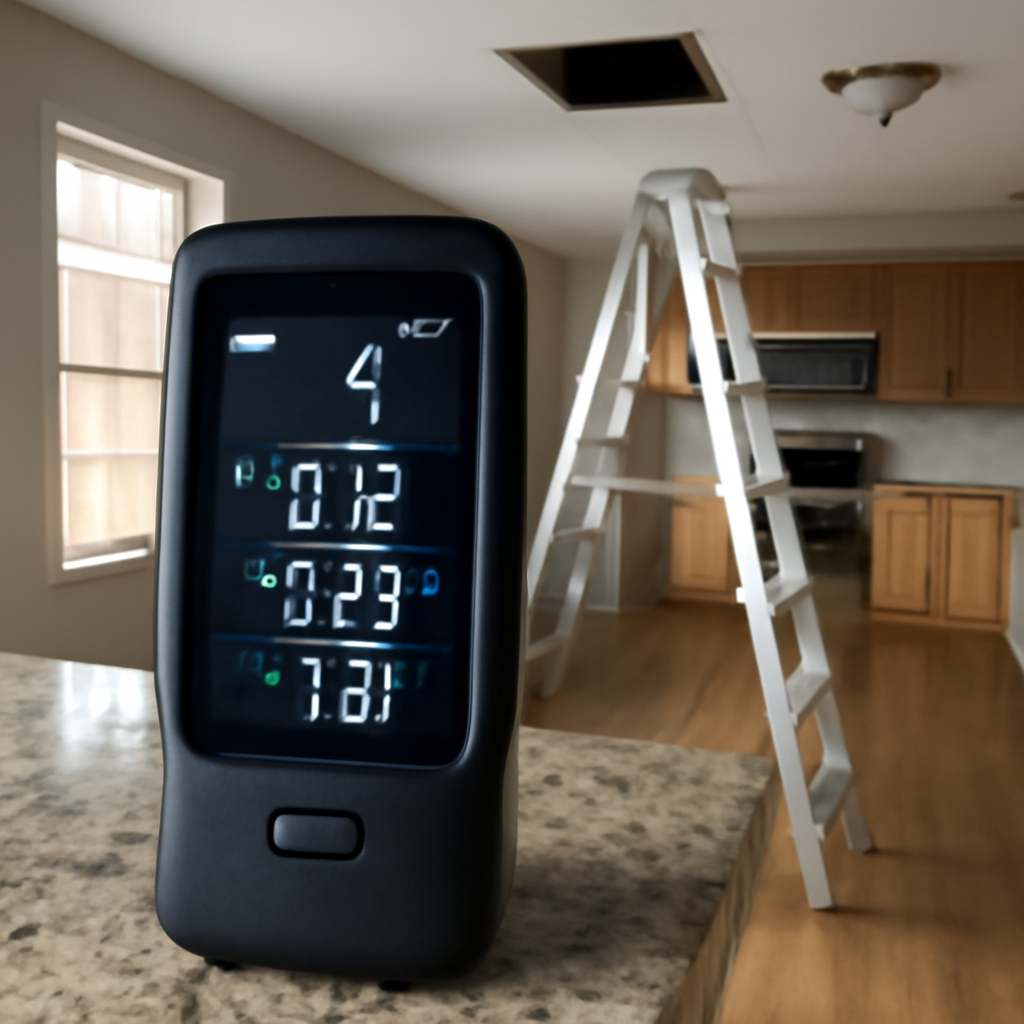
Indoor air drives a surprising share of the health complaints homeowners report, from winter headaches to lingering allergy symptoms, and a desktop monitor is the most accessible way to make the invisible visible. A Temtop air quality monitor is one of the more widely sold consumer lines for measuring particulate matter and, on some models, volatile organic compounds, carbon dioxide, and formaldehyde. The numbers on the screen can guide better ventilation and filtration decisions, but only if you understand what each reading represents and where a consumer sensor stops being reliable. This guide walks through what Temtop monitors measure, how to read the display, and how to use the data without overreacting to it.
Part of our Home Inspection Tools guide — start there for the full picture →
What a Temtop air quality monitor actually measures
Temtop sells several models, and the parameters vary by unit, so the first step is knowing which sensors your specific device carries. Across the lineup the most common measurements are fine particulate matter (PM2.5), coarser particles (PM10), total volatile organic compounds (TVOC), carbon dioxide (CO2), and on certain models formaldehyde (HCHO). A monitor typically shows each value with a color band: green for acceptable, yellow for moderate, and red for elevated.
The core technology for particles is a laser scattering sensor. A small fan pulls room air past a laser beam, and a photodetector counts how much light scatters off airborne particles, translating that into a mass concentration in micrograms per cubic meter. This optical method is reasonably good at tracking relative changes, you can clearly see PM2.5 spike when you fry food or light a candle, and watch it fall as ventilation clears the room. VOC and CO2 readings on consumer units are estimates derived from metal-oxide or, for CO2, sometimes from a true NDIR sensor on higher-tier models; an NDIR CO2 sensor is far more trustworthy than a VOC proxy. For a category-level explanation of how the VOC figure is generated and its caveats, our guide to the home VOC monitor and what its reading means is a useful companion.
How to read the numbers on the display
A monitor only helps if you can interpret its output against recognized reference points.
PM2.5 and the EPA scale
PM2.5 is reported in micrograms per cubic meter (µg/m³). The EPA’s Air Quality Index treats roughly 0 to 12 µg/m³ as good for the 24-hour standard, with higher tiers labeled moderate and unhealthy. Indoors, brief spikes from cooking are normal; what matters is whether levels return to baseline once you ventilate. Persistent elevated PM2.5 with no obvious source warrants a look at filtration and outdoor infiltration, a real concern on Front Range days when wildfire smoke pushes regional particle counts up.
CO2 as a ventilation gauge
Carbon dioxide indoors is less about toxicity at household levels and more about ventilation. Outdoor air sits around 420 parts per million. Readings that climb past 1,000 ppm in an occupied room signal that fresh-air exchange is lagging behind the people breathing in the space. Opening a window or running an HVAC fresh-air cycle usually brings it down. Our guide to a CO2 monitor for the home goes deeper on how to act on these numbers.
Where consumer monitors are strong and where they are not
The honest framing matters here. A Temtop monitor, like any consumer-grade instrument, excels at trend detection and weak at absolute precision. It will reliably tell you that PM2.5 just tripled when you seared a steak, and that it dropped after you ran the range hood. It is far less reliable as a calibrated, lab-grade measurement you could cite in a dispute.
The EPA’s own air-sensor research program notes that low-cost optical particle sensors can drift with humidity and age, and that they are best used for awareness rather than regulatory comparison. VOC sensors are even more approximate, often responding broadly to a mix of compounds without distinguishing harmless cooking aromas from a meaningful chemical source. None of these devices detects radon, carbon monoxide (unless a separate CO sensor is fitted), or mold spores. A monitor that shows “clean” air is not clearing a home of those specific hazards, each of which needs its own purpose-built test.
Putting the readings to work
The value of any monitor is the action it prompts. A practical routine looks like this:
- Establish a baseline. Run the device for a few days in a main living area to learn normal overnight and daytime values.
- Watch the response to events. Note how cooking, cleaning products, candles, and vacuuming move the numbers, then adjust habits or ventilation accordingly.
- Pair high readings with a fix. Elevated PM2.5 points toward better filtration or source control; high CO2 points toward ventilation; a stubborn VOC reading points toward identifying and removing the source.
- Calibrate to fresh air. Some models let you reset the baseline outdoors, which improves the relative accuracy of the readings.
For homeowners specifically worried about dampness-driven biological growth, a particle monitor is an indirect clue at best. Mold concerns are better addressed with humidity tracking and, where warranted, surface or air sampling; our explanation of an air quality monitor for mold spells out why a particle reading alone cannot confirm mold.
Understanding each parameter in more depth
The screen on a Temtop monitor can show several abbreviations, and knowing what each one represents turns the display from a wall of numbers into useful guidance.
PM2.5 and PM10
PM2.5 refers to particles 2.5 microns in diameter or smaller, fine enough to reach deep into the lungs, which is why health agencies track it closely. PM10 captures coarser particles up to 10 microns, such as larger dust and some pollen. Indoors, PM2.5 is the more health-relevant figure, and it responds dramatically to combustion sources: candles, gas stoves, frying, and tobacco smoke all drive it up. On the Front Range, summer wildfire smoke can push outdoor and infiltrating indoor PM2.5 to levels that dwarf normal household sources, and a monitor makes that infiltration visible so you can close windows and run filtration.
TVOC and formaldehyde
Total volatile organic compounds is a catch-all figure for airborne carbon-based chemicals from paints, finishes, cleaning products, air fresheners, and new furnishings. A consumer TVOC reading is an estimate that responds to the overall mix rather than identifying any single compound, so a spike after cleaning or unboxing new furniture is expected and usually temporary. Formaldehyde, where a model measures it, is a specific VOC of interest because it off-gasses from pressed-wood products and some insulation. These readings are best treated as relative indicators that prompt ventilation rather than precise toxicology.
Carbon dioxide and humidity
On models with a CO2 sensor, the reading tracks ventilation more than toxicity at household levels. Some units also report temperature and humidity, and humidity in particular is worth watching because sustained high humidity supports mold growth and dust mites. A reading that climbs and stays elevated in a bathroom or basement is a prompt to ventilate or dehumidify.
How a monitor fits a healthier-home routine
A monitor on its own changes nothing; the value comes from the habits it prompts. Several practical responses follow directly from common readings.
- Cooking spikes: If PM2.5 jumps every time you cook, running the range hood, opening a window, or using a HEPA purifier during and after cooking brings it down quickly.
- Persistent particles: Elevated baseline PM2.5 with no obvious source points toward outdoor infiltration or inadequate filtration; upgrading the furnace filter or adding a purifier helps.
- High CO2: Readings above roughly 1,000 ppm in an occupied room signal that ventilation lags occupancy; cracking a window or running a fresh-air cycle resolves it.
- VOC events: A stubborn VOC reading after a renovation suggests off-gassing materials that need time and ventilation to dissipate.
Front Range homes face a particular tension here. Cold winters encourage tight sealing to save heat, which traps CO2, VOCs, and particles indoors, while summer brings smoke that makes opening windows counterproductive on bad-air days. A monitor helps you navigate that trade-off by showing when ventilation helps and when filtration with windows closed is the better move. The point is to let the data drive ventilation and filtration decisions rather than guessing.
What a monitor cannot replace
It bears repeating that an air quality monitor is a screening and awareness tool, not a substitute for purpose-built tests of the most serious hazards. Three gaps matter most. A particle-and-VOC monitor does not detect radon, the radioactive soil gas that the EPA identifies as the second-leading cause of lung cancer and that is widespread across Colorado. It does not detect carbon monoxide unless a dedicated CO sensor is fitted, and even then a code-listed CO alarm is the appropriate life-safety device. And it cannot confirm mold, since a particle reading cannot distinguish spores from dust or pollen.
Treating a consumer monitor as a complete air-quality verdict is the central error to avoid. A reading of “green” reassures about particles and VOCs while saying nothing about radon or CO. The sensible approach pairs the monitor with the right dedicated tools for those hazards, an approach our broader coverage of indoor-air testing develops in full. The monitor earns its place by building awareness and prompting good ventilation and filtration habits, which is genuinely valuable, provided you understand its boundaries.
Maintenance and accuracy over time
Optical sensors collect dust, and a fan-driven intake will gradually accumulate debris that biases readings high. Keep the device in a clean, draft-free spot away from direct sun and heat vents, and follow the manufacturer’s guidance on cleaning the intake. Rechargeable models lose battery capacity over a few years, and the particle sensor’s laser diode has a finite life measured in tens of thousands of hours of continuous operation.
Because consumer monitors drift, periodic sanity checks help. Comparing your indoor PM2.5 against a nearby outdoor reference, such as a regional air-quality station, during a window-open period tells you whether the device is tracking reasonably. If a reading ever seems alarming and persistent, confirm it with an independent method before spending money on remediation. A monitor is a screening and awareness tool that sits comfortably within a broader kit; our home inspection tools buyer’s guide places air monitors in context alongside moisture meters, thermal cameras, and gas detectors.
Setting realistic expectations for a consumer monitor
The healthiest mindset toward a Temtop or any consumer monitor is to treat it as a thermometer for air, not a laboratory. A thermometer tells you whether a room is warmer or cooler than before and roughly how warm; it does not certify a precise temperature to a fraction of a degree, and you do not expect it to. An air monitor occupies the same role. It reliably tells you the air just got worse or better and roughly how much, which is genuinely useful for everyday decisions.
Where people go wrong is asking the device to settle high-stakes questions it was never built to answer. A monitor reading should not drive a decision to spend thousands on remediation, nor should a reassuring number convince anyone that radon, carbon monoxide, or mold are absent, since the device does not measure those at all. When a reading is alarming and persistent, the right move is to confirm it with an independent method or a professional before acting, not to trust a single consumer sensor.
Used within those bounds, the monitor delivers real value. It builds awareness of how cooking, cleaning, ventilation, and outdoor conditions affect the air a household breathes, and that awareness translates into better habits: running the range hood, cracking a window when CO2 climbs, or closing up and filtering on a smoky Front Range afternoon. The number on the screen is a prompt to act, and acting on it, rather than the precision of the figure itself, is where the benefit lies. A device kept in perspective informs daily choices well, while a device over-trusted can mislead in both directions.
References
- Volatile Organic Compounds and Indoor Air — U.S. Environmental Protection Agency
- Air Sensor Toolbox and Low-Cost Sensor Guidance — U.S. Environmental Protection Agency
- Indoor Air Quality Basics — Centers for Disease Control and Prevention
Frequently asked questions
What does a Temtop air quality monitor measure?
Depending on the model, it measures PM2.5 and PM10 particulate matter, total VOCs, carbon dioxide, and sometimes formaldehyde. Particle readings use a laser scattering sensor, while VOC and lower-tier CO2 readings are estimates.
Is a Temtop air quality monitor accurate?
It is good at showing trends and relative changes, such as a spike from cooking, but it is not a lab-grade calibrated instrument. The EPA notes that low-cost optical sensors can drift with humidity and age, so use the readings for awareness rather than precise measurement.
Can a Temtop monitor detect mold or radon?
No. It measures particles and gases but does not identify mold spores, radon, or carbon monoxide unless a specific sensor is fitted. Those hazards each require their own purpose-built test.
What is a good PM2.5 reading indoors?
The EPA treats roughly 0 to 12 micrograms per cubic meter as good for the 24-hour standard. Brief indoor spikes from cooking are normal as long as levels return to baseline after ventilation.
Indoor air-quality monitors
A continuous IAQ monitor tracks particulates, CO2, VOCs, humidity — and some add radon — so you can see how ventilation and filtration changes affect the air.
| Product | Why | Buy |
|---|---|---|
 Airthings View Plus Airthings View Plus | Radon + PM + CO2 + VOC + humidity. | Amazon — $320.00 |
 Temtop M10 IAQ Monitor Temtop M10 IAQ Monitor | Budget PM2.5 + HCHO + TVOC. | Amazon — $95.00 |