Best Indoor Air Quality Monitor: 2026 Guide
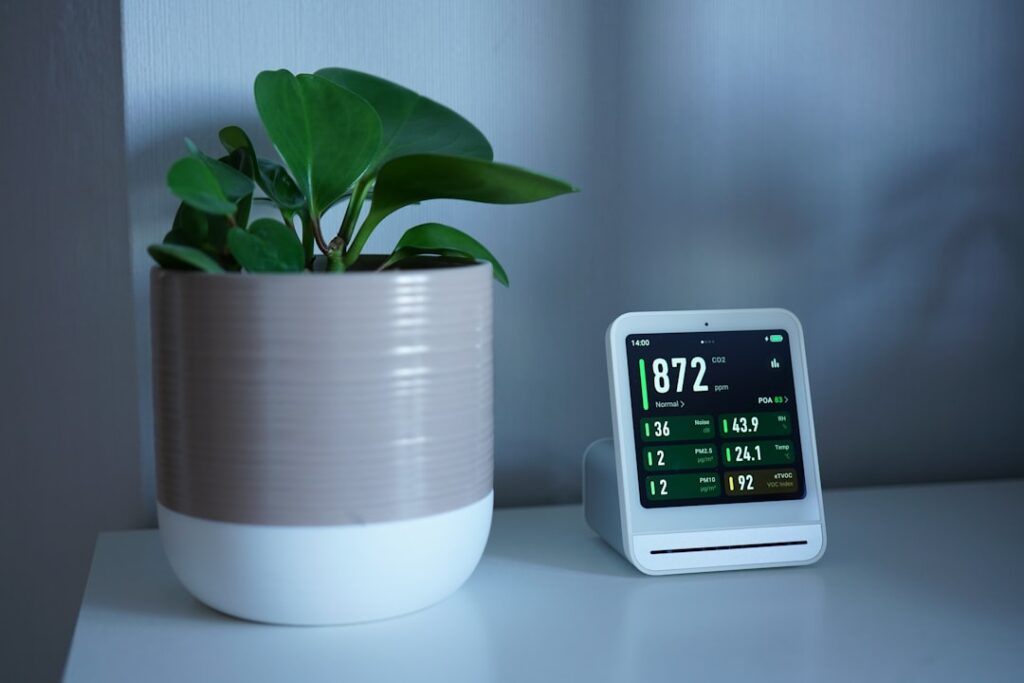
If you want one indoor air quality monitor to cover a whole home, the strongest single choice on Amazon’s current shelf is the Airthings View Plus, because it is the only listing that adds radon to particle, CO2 and VOC sensing. That matters on the Colorado Front Range, where radon, wildfire smoke and tight, dry winter homes all affect the air indoors. One monitor does not suit every household, though. It needs an app and internet to work, it does not measure formaldehyde, and some buyers just want a simple CO2 meter or a screen they can read without a phone. Below is the top pick, five alternatives for specific needs, and a buying guide on what a whole-home monitor should measure and where to put it.
Part of our Home Inspection Tools guide — start there for the full picture →
As an Amazon Associate we earn from qualifying purchases.
How we compared: we compared 22 current Amazon listings for indoor air quality monitors on what each listing actually states: which pollutants are measured, sensor types named, power source, display, alerts, app requirements and data export. Sixteen of the 22 measure CO2, 16 measure PM2.5 and 15 measure VOCs; only one measures radon. We did not lab-test any of these units or use them hands-on. Two carbon monoxide alarms that came up in the same searches were set aside. Prices and availability change often, so check the current listing before buying.
Quick picks: the best indoor air quality monitor and alternatives
| Pick | Best for | Key spec | Key detail |
|---|---|---|---|
| Airthings View Plus (2960) | Best single whole-home monitor | Radon, PM2.5, CO2, VOC, humidity, pressure | Battery powered; app required |
| Aranet4 | CO2-only alternative | NDIR CO2; e-ink | Battery stated up to 4 years |
| Temtop LKC-1000S+ 2nd | Renovations and formaldehyde | Laser PM + electrochemical HCHO + TVOC | 3-month export to Excel, no app |
| Sainlogic 16-in-1 | No-app, big-screen monitor | 9 readings on a 7.2-inch screen | 7 user-set alert thresholds |
| AirKnight AT1000 | Wildfire-season portable | CO2, PM2.5, PM10, TVOC, HCHO | 3,000 mAh battery; US-based support |
| Amazon Smart Air Quality Monitor | Alexa automation | PM2.5, VOC, CO, temp, humidity | Routines switch purifiers and fans |
The top pick and five alternatives, listing by listing
1. Airthings View Plus (2960) — Best Single Whole-Home Indoor Air Quality Monitor

Battery Wi-Fi monitor covering radon, PM2.5, CO2, VOCs, humidity, temperature and pressure in one unit.
Check price on Amazon$320.00 as of Oct 10, 2026 11:06 pm GMT+0000 — prices change; see Amazon for current price.| Specification | Details |
|---|---|
| Pollutants | Radon, PM2.5, CO2, VOCs |
| Comfort readings | Humidity, temperature, air pressure |
| Connectivity | Wi-Fi; needs the Airthings app, a free account and internet access to function |
| Display / power | Customizable e-ink screen; battery powered, no cable required |
| Operating range | 39 to 104°F |
| Warranty | Free registration within 30 days extends coverage to 5 years |
Airthings View Plus 2960 — radon, PM2.5, CO2, VOC, RH, temp, pressure; e-ink; battery; Wi-Fi app required
The Only Monitor That Pairs Radon With Particle, CO2 and VOC Sensing
Every other listing among the 22 leaves out radon entirely. That is the deciding factor for a whole-home monitor in Colorado. The EPA estimates radon causes about 21,000 lung cancer deaths a year in the U.S. and is the leading cause among non-smokers, and radon cannot be seen, smelled or estimated from any other reading. The View Plus tracks it continuously alongside the everyday pollutants most other monitors cover.
Its coverage is broad without being padded. Sixteen listings on the shelf measure CO2 and sixteen measure PM2.5, but only the View Plus adds radon and air pressure to that pair. Being battery powered is another plus for a whole-home role: it can sit in a basement family room or bedroom, where radon and CO2 both tend to be highest, without a cord to an outlet.
The trade-offs are real. The listing says the monitor needs the app, an account and internet to work. It names “electrochemical” as its sensor type rather than NDIR for CO2, and it has no formaldehyde sensor. A continuous radon monitor also complements, rather than replaces, a radon test done by a qualified tester for a home sale.
Pros
- Only radon-capable listing on the shelf
- Covers PM2.5, CO2 and VOCs too
- Battery powered for basement or bedroom placement
- Warranty extendable to 5 years
Cons
- Will not work without app, account and internet
- CO2 sensor not described as NDIR
- No formaldehyde reading
2. Aranet4 — Best CO2-Only Alternative
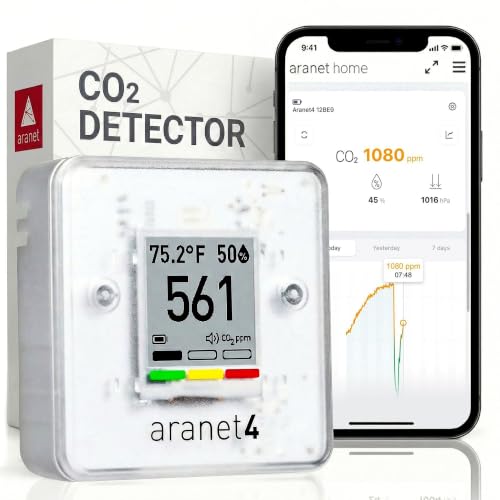
Cordless NDIR CO2 meter with temperature, humidity and pressure, e-ink screen and up to 4 years of battery.
Check price on Amazon$189.00 as of Oct 10, 2026 11:06 pm GMT+0000 — prices change; see Amazon for current price.| Specification | Details |
|---|---|
| Measures | CO2, temperature, relative humidity, atmospheric pressure |
| CO2 sensor | Nondispersive infrared (NDIR) |
| Display / alert | E-ink with color coding; optional buzzer for high CO2 |
| Power | Battery; listing states up to 4 years |
| Data | App with up to 90 days of history graphs |
| Warranty | 2 years |
Aranet4 — NDIR CO2, temp/RH/pressure, e-ink, optional buzzer, up to 4-yr battery, 90-day app history
A Named NDIR Sensor and No Dependence on Wi-Fi
Seven of the 16 CO2-measuring listings name NDIR, the infrared method that measures carbon dioxide directly. The Aranet4 is one of them, and unlike the top pick it does not need an internet connection or an account to show a reading; the screen works on its own and the app is optional for history.
For households whose main concern is stuffy bedrooms or a home office, CO2 is the most useful single reading, and a dedicated NDIR meter does that job with less uncertainty than a multi-sensor unit that does not say how it measures CO2. Its stated battery life of up to 4 years is the longest on the shelf.
The obvious limit: it measures no particles, VOCs or radon. It is the right alternative when ventilation is the question, not when smoke or chemicals are.
Pros
- NDIR CO2 named in the listing
- Works without Wi-Fi or an account
- Longest stated battery life on the shelf
Cons
- No PM2.5, VOC or radon
- No accuracy figure in the listing
- E-ink screen is not backlit
3. Temtop LKC-1000S+ 2nd — Best for Renovations and Formaldehyde

PM2.5/PM10, formaldehyde and TVOC monitor with a 12-hour trend histogram and 3-month export to Excel.
Check price on Amazon$151.99 as of Oct 10, 2026 11:06 pm GMT+0000 — prices change; see Amazon for current price.| Specification | Details |
|---|---|
| Measures | PM2.5, PM10, formaldehyde (HCHO), TVOC, temperature, humidity, AQI |
| Sensors named | Laser particle sensor (3-year designed lifespan); Dart electrochemical HCHO sensor |
| Trends / data | 12-hour on-screen trend histogram; 3 months of logging exported via USB to Excel |
| Power | Battery for 6–8 hours of spot checks; USB-C for 24/7 use |
| Setup notes | Factory calibrated; allow 10 minutes warm-up after temperature changes |
| Not detected | Listing states it does not detect gas or CO leaks |
Temtop LKC-1000S+ 2nd — laser PM2.5/10, Dart HCHO, TVOC, 12-h histogram, USB export, 6–8 hr battery
The Only Listing That Names Its Formaldehyde Sensor Model and States a Particle-Sensor Lifespan
Eleven listings measure formaldehyde. The Lwyinp and ZEMEOLLO listings say only that their sensors are electrochemical, while Temtop names the specific sensor (a Dart electrochemical cell, which it contrasts with cheaper semiconductor types), and only Temtop gives a designed lifespan for its laser particle sensor, three years. Those two details tell a buyer more about long-term reliability than any “high-precision” claim on the shelf.
It is also the only listing that addresses renovation monitoring directly. New cabinets, flooring, paint and adhesives can release formaldehyde and VOCs, and the 12-hour histogram plus 3-month Excel export make it practical to see whether levels fall as a remodel airs out. It is one of five listings on the shelf that mention data export, and one of the few that does so without an app.
It does not measure CO2, so it cannot tell you about ventilation, and Temtop’s listing says plainly that it is not a gas or CO detector. Treat its stated “R² up to 0.999” accuracy as a manufacturer claim.
Pros
- Names its HCHO sensor and particle-sensor lifespan
- 12-hour trend chart on the screen
- Three months of data export, no app
- Honest note that it is not a gas detector
Cons
- No CO2 sensor
- 6–8 hour battery for portable use
- Accuracy claim is the maker’s own
4. Sainlogic 16-in-1 — Best No-App Monitor With a Large Screen

No-app 9-reading monitor (CO2, PM, HCHO, TVOC, AQI) with a 7.2-inch screen and 7 user-set alert thresholds.
Check price on Amazon$105.99 as of Oct 10, 2026 11:06 pm GMT+0000 — prices change; see Amazon for current price.| Specification | Details |
|---|---|
| Measures | CO2, PM2.5, PM10, PM1.0, AQI, HCHO, TVOC, temperature, humidity |
| Display | 7.2-inch screen, three brightness levels; brightens automatically on alerts |
| Alerts | Seven user-defined thresholds; tri-color LED; “open windows” prompt at level 4 or higher |
| Setup | No app or Wi-Fi needed; one-touch reset for sensor recalibration |
| Power | 2,500 mAh battery, up to 8 hours; USB-C |
| Sensor types | CO2 method not stated in listing |
Sainlogic 16-in-1 — CO2, PM1/2.5/10, HCHO, TVOC, temp/RH, 7.2-in screen, 7 alerts, 2,500 mAh, no app
The Largest Stated Screen Among the 22 Listings
Of the listings that give a screen size, Sainlogic’s 7.2-inch display is the biggest, just ahead of YNAK’s 7-inch model. For a household where nobody wants to open an app to check the air, a large screen with color coding in the kitchen or family room is the whole appeal. It also brightens automatically when a reading crosses an alert threshold, so a warning is hard to miss.
The listing is clear that it needs no app or Wi-Fi, and it lets users set seven alert thresholds rather than relying on fixed factory levels. Its stated temperature and humidity accuracy ranges are more detailed than most of the shelf.
The gaps: the listing does not say how CO2 is measured, gives “0.001-level sensitivity” rather than a real accuracy figure, and offers no history or export. Battery life is 8 hours, so for whole-home use it should stay plugged in.
Pros
- Largest stated screen on the shelf
- Works without app or Wi-Fi
- User-set alert thresholds
- Covers CO2, particles and chemicals
Cons
- CO2 sensor type not stated
- No history or data export
- Sensitivity claim is not an accuracy spec
5. AirKnight AT1000 — Best Portable Monitor for Wildfire Season
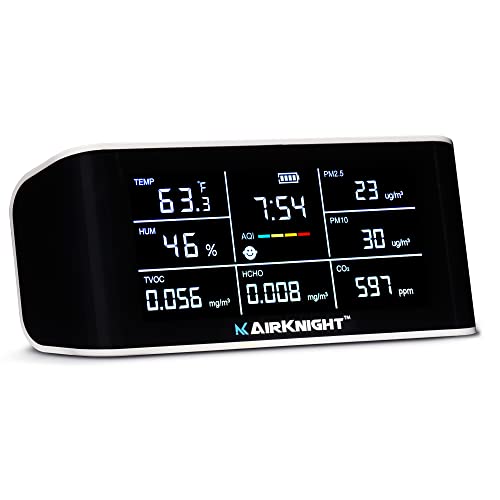
Portable 10-in-1 monitor for CO2, PM2.5, PM10, TVOC and formaldehyde with a 3,000 mAh battery and US support.
Check price on Amazon$89.99 as of Oct 10, 2026 11:06 pm GMT+0000 — prices change; see Amazon for current price.| Specification | Details |
|---|---|
| Measures | CO2, PM2.5, PM10, TVOC, formaldehyde, plus AQI, temperature and humidity |
| Display | Large LCD showing all readings at once |
| Power | 3,000 mAh rechargeable lithium-polymer battery; runtime not stated in listing |
| Support | US-based business with phone support; free extended warranty sign-up |
| Sensor types | Not stated in listing |
| Size | About 7.6 x 3.2 x 2.1 in; 0.75 lb |
AirKnight AT1000 — CO2, PM2.5/10, TVOC, HCHO, temp/RH, LCD, 3,000 mAh battery, US phone support
The Only Listing Written Around Wildfire Smoke, With the Largest Stated Battery
AirKnight is the only listing among the 22 that addresses wildfires directly, describing the monitor as a way to see when particles and VOCs spike during smoke events. Of the three brands that state a battery capacity, its 3,000 mAh pack is the largest, ahead of Sainlogic at 2,500 and ZEMEOLLO at 2,000, which suits carrying it room to room while sealing up a house.
It also stands out for support: it and Temtop are the only two listings that describe US-based customer support. For a device that may need help with calibration or warranty service, that can matter.
What the listing does not give is important too. It names no sensor types, no accuracy figures and no runtime in hours, and it has no app or data history. Use it for spot checks and live readings rather than long-term logging.
Pros
- Covers CO2, particles, TVOC and formaldehyde
- Largest stated battery capacity on the shelf
- US-based phone support and free extended warranty
Cons
- No sensor types or accuracy figures stated
- No runtime in hours
- No app or data history
6. Amazon Smart Air Quality Monitor — Best for Alexa Automation
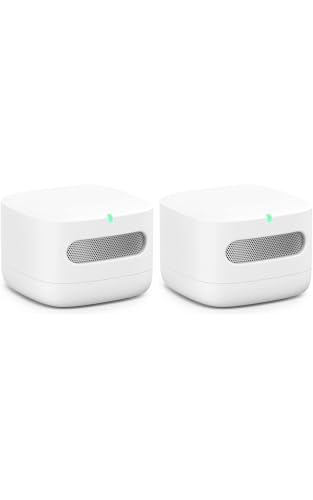
Two plug-in Alexa monitors tracking PM2.5, VOCs, carbon monoxide, temperature and humidity for multi-room coverage.
Check price on Amazon$105.00 as of Oct 10, 2026 11:06 pm GMT+0000 — prices change; see Amazon for current price.| Specification | Details |
|---|---|
| Measures | PM2.5, VOCs, carbon monoxide, humidity, temperature |
| Pack | Two monitors (also sold singly) |
| Display | Color-coded LED; readings and score in the Alexa app |
| Automation | Alexa routines can control compatible purifiers, dehumidifiers and fans |
| Alerts | Phone notifications and Echo announcements |
| Power | Plug-in |
Amazon Smart Air Quality Monitor P3A7EN (2-pack) — PM2.5, VOC, CO, temp/RH, LED + Alexa app, routines
The Only Multi-Room Pack on the Shelf, and the Only CO-Sensing Model
A whole home rarely has one air problem in one room. This 2-pack is the only multi-unit listing among the 22, which makes it easy to cover, say, a main floor and a basement or a bedroom wing. The same model is the only one on the shelf that lists carbon monoxide sensing, though its listing does not present it as a certified CO alarm.
Automation is the main reason to choose it. Alexa routines can switch a purifier, fan or dehumidifier when readings change, and Echo speakers announce poor air. For households already on Alexa, that turns readings into action without manual checking.
It measures no CO2 and no radon, shows only a colored light on the device, and offers no data export. It is a smart-home sensor, not a diagnostic instrument.
Pros
- Two units for multi-room coverage
- Only CO-sensing model on the shelf
- Alexa routines and announcements
Cons
- No CO2 or radon
- No numbers on the device
- Not a substitute for CO alarms
What a whole-home indoor air quality monitor should measure
The EPA describes indoor pollution sources and inadequate ventilation as the primary causes of indoor air problems, and notes that high temperature and humidity can raise concentrations of some pollutants. A whole-home monitor should therefore cover both sides: what is being released and how well it is being diluted.
- CO2 for ventilation. Prefer a listing that names NDIR; 7 of 16 CO2 listings here do.
- PM2.5 for smoke, cooking and dust. The EPA says fine particles can reach deep into the lungs and some may enter the bloodstream.
- TVOC and formaldehyde for chemicals from products and materials. The EPA notes formaldehyde can irritate the skin, eyes, nose and throat, and high exposure may cause some cancers.
- Radon for long-term lung cancer risk, which no other reading can stand in for.
- Humidity for comfort and mold prevention.
No single listing on this shelf does all five. The Airthings View Plus comes closest, missing only formaldehyde. For a deeper explanation of chemical readings, see our VOC monitor guide.
How accurate are indoor air quality monitors?
Few listings publish accuracy figures, and those that do mostly cover CO2 or temperature. Many use terms like “0.001 accuracy,” which describes the number of digits shown, not how close the reading is to the truth. The EPA’s Air Sensor Toolbox explains that low-cost sensors are evaluated by comparing them with reference monitors, which is the only reliable way to know their accuracy.
In practice, home monitors are good at showing direction and relative change: whether the bedroom is stuffier than the living room, whether smoke is getting in, whether a new rug is off-gassing. Treat absolute numbers as approximate, especially for TVOC, where every brand uses its own scale. Our air quality meter guide covers how handheld instruments differ.
Front Range needs: radon, smoke and dry air
Radon
The EPA recommends that every home be tested for radon no matter where it is located, and that homes at 4 pCi/L or higher be fixed, with fixing considered between 2 and 4 pCi/L. Radon enters from the soil, so basements and lower levels typically read highest. A continuous monitor shows how levels swing with weather and season; for a mitigation decision or a real estate transaction, follow up with a proper radon test.
Wildfire smoke
During smoke events, PM2.5 is the reading that matters. The EPA advises portable air cleaners and high-efficiency HVAC filters, such as MERV 13 or as high as the system can take, to remove smoke particles indoors. A monitor shows whether those steps are working. Comparing indoor and outdoor numbers with an outdoor air quality monitor helps decide when to open up again.
Dry winters and tight homes
Front Range winters bring low outdoor humidity, and homes stay closed for months. CO2 builds overnight in closed bedrooms, and humidity can drop low enough to be uncomfortable. A monitor that shows both helps balance fresh air against comfort. The EPA’s guidance to keep indoor humidity below 60 percent, ideally 30 to 50, applies year round, and summer basements are where the upper limit is more likely to be tested.
How many monitors, and where to put them
- Radon: the lowest lived-in level, such as a basement family room or bedroom.
- CO2: the main bedroom, where overnight buildup is most common, or a home office.
- Particles and VOCs: the main living area, away from the stove so cooking does not dominate every reading.
- Keep units at breathing height, away from windows, vents, humidifiers and direct sun.
- Give each monitor several days in place before drawing conclusions.
One well-chosen monitor plus a second CO2 meter in the bedroom covers most homes. Our CO2 monitor for home guide covers bedroom placement in more detail.
Pairing a monitor with action
Readings are only useful if they change something. High CO2 calls for more fresh air: a cracked window, a door left open, longer exhaust fan runs or a checked ventilation system. High PM2.5 calls for filtration; an air purifier with a built-in air quality monitor can respond automatically. High VOCs call for source control and ventilation, and high humidity calls for a dehumidifier or fixing the water source. Air purifiers do not lower CO2, and no monitor fixes radon; that takes mitigation.
Monitor vs professional air assessment
A monitor reports conditions but does not explain them. It cannot find mold behind a wall, a backdrafting water heater, a crawl space moisture problem or an exhaust fan venting into the attic. When readings stay elevated without an obvious cause, or when someone in the home has symptoms that track with time spent indoors, a professional evaluation is the next step. See our guide to home indoor air quality testing for what that involves, and our home inspection tools pillar for the instruments inspectors use.
References
- Introduction to Indoor Air Quality — U.S. Environmental Protection Agency
- Health Risk of Radon — U.S. Environmental Protection Agency
- EPA Map of Radon Zones — U.S. Environmental Protection Agency
- Indoor Particulate Matter — U.S. Environmental Protection Agency
- Formaldehyde’s Impact on Indoor Air Quality — U.S. Environmental Protection Agency
- Wildfires and Indoor Air Quality — U.S. Environmental Protection Agency
Frequently asked questions
What is the best indoor air quality monitor for a whole home?
For a single whole-home monitor, a model that covers radon, PM2.5, CO2 and VOCs gives the broadest picture. On the current shelf, the Airthings View Plus is the only listing that adds radon to those readings. It needs an app and internet, so buyers who want a standalone screen should consider a no-app alternative.
Does an indoor air quality monitor detect radon?
Only monitors with a dedicated radon sensor do. Of 22 listings we compared, just one measures radon. The EPA recommends fixing homes at 4 pCi/L or higher, and a formal radon test is still the standard for real estate decisions.
Are indoor air quality monitors accurate?
They are reliable for spotting changes and comparing rooms, but absolute readings are approximate. Few listings publish real accuracy figures. Choose one that names its sensor types, follow the calibration instructions, and judge trends over several days.
Where should I place an indoor air quality monitor?
Put a radon-capable monitor on the lowest lived-in level, a CO2 monitor in the main bedroom, and a particle or VOC monitor in the main living area. Keep them at breathing height, away from windows, vents, stoves and humidifiers.
Can an indoor air quality monitor replace a professional inspection?
No. A monitor shows that something is off but not why. It cannot locate hidden mold, ventilation defects or combustion problems. If readings stay high without an obvious cause, a professional assessment can find the source.
Want radon, ventilation and indoor air looked at by a professional on the Front Range? Reach out through our contact page to connect with a vetted local inspector.
Indoor air-quality monitors
A continuous IAQ monitor tracks particulates, CO2, VOCs, humidity — and some add radon — so you can see how ventilation and filtration changes affect the air.
| Product | Why | Buy |
|---|---|---|
 Airthings View Plus Airthings View Plus | Radon + PM + CO2 + VOC + humidity. | Amazon — $320.00 |
 Temtop M10 IAQ Monitor Temtop M10 IAQ Monitor | Budget PM2.5 + HCHO + TVOC. | Amazon — $95.00 |