Slimy Black Mold: Wet-Texture Identification Guide
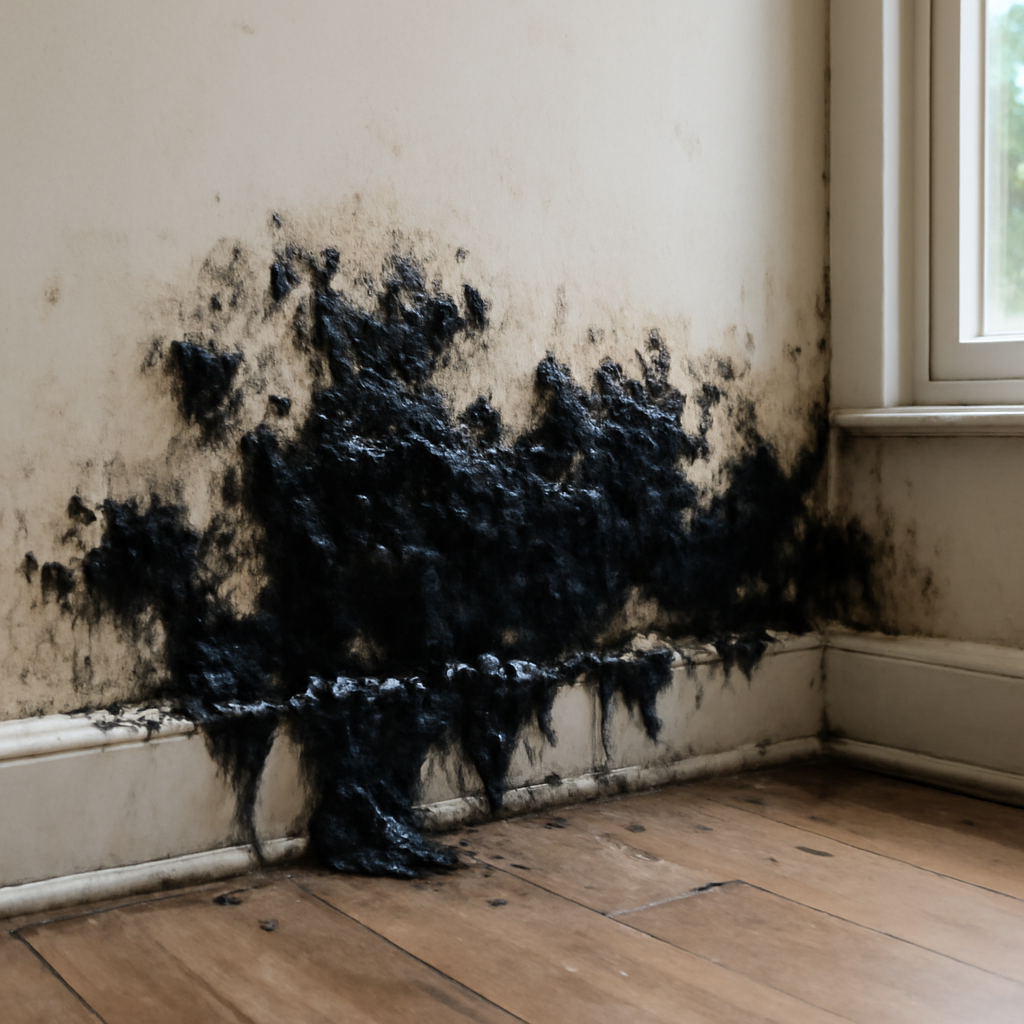
When a homeowner describes the mold they found as “slimy” rather than “fuzzy” or “powdery,” that single texture detail narrows the list of likely species considerably. Stachybotrys chartarum — the species most often labeled toxic black mold — produces a wet, gel-like surface layer that is rare among other indoor molds. This guide explains why slimy black mold has that texture, what the wet appearance actually is at a microscopic level, and how the slime layer affects identification, cleanup, and health risk. This article summarizes EPA, CDC, and NIEHS guidance current as of 2026 — consult a certified mold professional for testing and your physician for any symptoms you connect to indoor exposure.
Part of our Black Mold & Your Health guide — start there for the full picture →
Is this mold, asbestos, or water damage? Get a free instant screen
Upload a clear photo of the suspect area. You'll get an instant AI screening opinion and what to do next. This is screening guidance, not a professional determination.
Screening guidance only. AI can be wrong. Confirm asbestos, mold type, or lead with lab testing or a licensed professional before acting.
What slimy black mold actually is
The slime that gives slimy black mold its distinctive appearance is a layer of spore-bearing structures called conidia, suspended in a wet matrix that Stachybotrys produces while actively growing. According to the U.S. Environmental Protection Agency’s mold-identification reference materials, this wet surface forms because Stachybotrys spores do not become airborne easily compared with dry-spored species like Aspergillus or Penicillium. The slime holds spores in place until physical disturbance, water spray, or strong air currents knock them loose.
Visually, the wet layer looks like a dark olive-green to nearly black coating with a slightly reflective sheen under direct light. Older Stachybotrys colonies sometimes dry out and develop a dusty surface, at which point they more closely resemble Cladosporium or Aspergillus niger. The slimy stage is most diagnostic when growth is still active — typically on drywall, ceiling tile, or wood that has stayed wet for at least one to three weeks.
Why texture matters more than color for identification
Color alone misleads homeowners constantly because at least eight common indoor mold genera can appear dark green or black on certain substrates. Cladosporium turns nearly black on glossy paint, Aspergillus niger forms charcoal-colored powdery colonies on bread or wallpaper paste, and Alternaria produces dark olive patches on damp window frames. None of these typically appears slimy, because they all release spores into the air rather than holding them in a wet matrix. That difference is why the InterNACHI mold inspection standard treats surface texture as a useful preliminary indicator even though it is not species-confirming.
The Centers for Disease Control and Prevention cautions that visual or texture-based identification is never a substitute for laboratory analysis when species confirmation is genuinely needed. The practical homeowner response, however, is the same regardless of species: remove the moisture source and clean or replace contaminated materials. The slime detail mostly matters for understanding what to expect during cleanup and why aggressive scrubbing can be counterproductive.
Best At Home Mold Test Kit: our top 3 picks
| Product | Best for | Key features | Price | Buy |
|---|---|---|---|---|
| Varify 6-Pack | All-round DIY plate kit |
| $13.39as of Nov 25, 2026 9:07 pm GMT+0000 | Buy now →Check current price |
| KAYENQO 12-Test | Testing many rooms |
| $21.65as of Nov 25, 2026 9:07 pm GMT+0000 | Buy now →Check current price |
| Detekt Indoor Air Quality Kit | HVAC vents |
| $36.99as of Nov 25, 2026 9:07 pm GMT+0000 | Buy now →Check current price |


Prices are Amazon’s listed prices as of the time shown and change often; check Amazon for today’s price. As an Amazon Associate we earn from qualifying purchases.
What conditions produce slimy black mold
Stachybotrys requires sustained moisture on a cellulose-rich substrate. The most common scenarios in Front Range homes include drywall behind a roof leak, the back of paper-faced fiberglass insulation, ceiling tiles under a slow plumbing drip, and the underside of subfloor sheathing in a basement that has flooded and dried incompletely. The species does not tolerate brief wetting and drying cycles, which is why it rarely appears on bathroom corners or kitchen splashbacks even though those surfaces are wet often.
Temperature also matters. Stachybotrys grows fastest between 35 and 95 degrees Fahrenheit with optimum activity in the mid-70s, which matches the indoor temperature of most homes year-round. The combination of stable temperature, sustained substrate moisture above roughly 90 percent relative humidity in the material itself, and a cellulose food source produces the active slimy stage within two to three weeks.
Slimy black mold versus fuzzy or powdery black molds
Three texture descriptions cover most homeowner observations: slimy, fuzzy, and powdery. Fuzzy black mold usually indicates Cladosporium or Aspergillus, both of which produce visible aerial hyphae that look like dark velvet under good lighting. Powdery dark mold typically points to Aspergillus niger or aged Penicillium colonies that have stopped active growth and dried out.
The slimy stage is the most concerning because it almost always indicates active Stachybotrys growth on wet cellulose, which the CDC associates with elevated trichothecene mycotoxin production in laboratory studies. The fuzzy and powdery presentations can be hazardous in their own ways — many Aspergillus species produce aflatoxins, and Penicillium species can cause significant respiratory irritation — but the slimy texture is the one most strongly associated with documented building-related illness in occupants.
Why the slime matrix matters for spore release
The wet matrix that gives Stachybotrys its slimy appearance has a direct effect on how the species spreads compared to other indoor molds. Spores bound in the slime layer do not release into the air during normal indoor activity. A homeowner walking past an active slimy Stachybotrys colony in a normal-pressure room is unlikely to disturb spores significantly. The same homeowner walking past a fuzzy Cladosporium or powdery Aspergillus colony will release noticeably more airborne spores into the room with each passage.
This dynamic explains why air samples taken in rooms with significant visible Stachybotrys growth sometimes show lower indoor airborne spore counts than air samples taken in rooms with smaller but more easily disturbed competing mold colonies. The visible-versus-airborne disconnect is one reason indoor air quality professionals look at both surface sampling and air sampling rather than relying on either alone. The slime matrix can mask Stachybotrys presence on air samples until something physically disturbs the colony.
What to do when you find slimy black mold
The first rule the EPA emphasizes is to not disturb the colony unnecessarily. A slimy active colony releases relatively few spores into the air at rest, but vigorous scrubbing, scraping, or applying chemical sprays can break the slime matrix and aerosolize spores in concentrations several orders of magnitude higher than baseline. Photograph the area, note the dimensions, identify the moisture source if possible, and ventilate the room only if the moisture source has been stopped.
For visible colonies under roughly ten contiguous square feet on hard non-porous surfaces with a known moisture source, EPA homeowner guidance allows DIY cleanup using detergent and water along with an N95 respirator, gloves, and eye protection. Larger areas, any growth on drywall or insulation, or any household with respiratory symptoms should be referred to an IICRC-certified remediation contractor. The American Society of Home Inspectors lists mold assessment as an ancillary service offered by many of its certified members.
Why surface cleaning rarely solves slimy mold problems
Stachybotrys mycelia penetrate into porous substrates well below the visible surface layer. Wiping the slime off the face of a drywall sheet removes the conidia and the wet matrix but leaves the underlying hyphal network intact in the gypsum core. That network resumes spore production within days if the moisture remains, and within weeks even after the substrate appears dry. The CDC and EPA both state explicitly that porous materials with visible Stachybotrys growth should be removed and replaced rather than cleaned in place.
The replacement cut should extend at least 12 inches in every direction beyond the visible edge of growth, because the invisible hyphal network typically extends well past the colored colony. Containment with plastic sheeting and negative-air machines during removal is standard professional practice and is described in the IICRC S520 standard for mold remediation.
Health considerations specific to slimy black mold
The toxin profile that gives Stachybotrys its dangerous reputation centers on macrocyclic trichothecenes, a family of mycotoxins documented in peer-reviewed environmental health research indexed at PubMed. These compounds remain bound to fungal cell walls and spore coats, so airborne exposure happens primarily when the slime matrix is broken and spores or spore fragments become respirable. Documented effects in heavily exposed occupants include upper-respiratory irritation, headaches, and in rare severe cases pulmonary symptoms.
The National Institute of Environmental Health Sciences notes that causal links between specific home mold exposures and specific chronic conditions remain difficult to establish in epidemiological studies because exposure measurement is imprecise. The conservative response — remove the mold and dry the building — is justified regardless of whether specific symptoms can be traced to a specific colony.
How drying changes the visual signature
Once the moisture source feeding a Stachybotrys colony is removed and the substrate dries out, the slime matrix collapses and the colony develops a duller, drier appearance over several weeks. Dried Stachybotrys looks more like aged Cladosporium or Aspergillus — a powdery dark patch rather than a wet glossy one. At this stage, visual identification becomes considerably harder, and a homeowner who finds a dry dark colony months after a long-ago leak may not realize that what they’re looking at was originally Stachybotrys.
The drying process also changes the colony’s behavior with respect to spore release. Dried Stachybotrys colonies release spores more readily than active slimy ones because there’s no longer a wet matrix holding the spores in place. Disturbing a dried colony during cleanup or demolition can aerosolize substantial spore concentrations, which is why professional remediation protocols specify HEPA-filter containment and negative-air machines regardless of whether the colony appears active or dormant at the time of inspection.
How professionals confirm slimy black mold
Visual confirmation by a credentialed inspector follows the InterNACHI or ASHI standard of practice and typically includes moisture-meter readings on adjacent materials, a humidity reading in the affected room, and photographic documentation. When species confirmation is needed for an insurance claim, real estate disclosure, or persistent health concern, the inspector takes a surface sample using a sterile tape lift or swab and ships it to an accredited microbiology lab. The lab returns a genus-level identification with relative spore counts.
For broader indoor exposure assessment, an air sample using a spore-trap cassette draws a measured volume of indoor air through a sticky slide that the lab examines under microscopy. Comparing indoor counts against an outdoor baseline sample taken the same day reveals whether spore concentrations indoors are elevated relative to ambient conditions. Detailed mold inspection and testing guidance is available on the pillar hub for homeowners researching what to expect from a professional assessment.
Prevention after slimy black mold remediation
Once active Stachybotrys growth has been removed, preventing recurrence depends entirely on controlling moisture. The EPA’s “Moisture and Mold Prevention and Control Tips” reference identifies three priorities: fix leaks within 24 to 48 hours, keep indoor relative humidity between 30 and 50 percent year-round, and ensure that HVAC condensate drainage works correctly. In Colorado’s relatively dry climate, the third item — bath fan and dryer venting to outdoors rather than into wall or attic cavities — is the most commonly missed by builders and homeowners alike.
A whole-home dehumidifier is rarely necessary in the Front Range, but a basement-specific unit set to 50 percent makes sense in homes with a history of foundation moisture. Annual visual inspection of high-risk areas — under sinks, around toilets, behind washing machines, at exterior wall penetrations — catches new moisture problems before they have time to support active Stachybotrys growth.
More Questions About Slimy Black Mold
Is slimy black mold more dangerous than dry black mold?
Slimy black mold is not automatically more dangerous than dry black mold, but the wet texture signals an active, ongoing moisture problem. Wet growth tends to release fewer airborne spores than dry, powdery growth, while dry colonies shed spores more easily when disturbed.
The practical risk comes from both stages: the wet colony shows the material has been damp for some time, and once it dries it can become a larger spore source. Anyone with asthma, allergies or a weakened immune system should avoid handling it and talk to a doctor if symptoms appear.
Can slimy black mold grow on concrete or tile?
Yes, slimy black mold can form on concrete, grout and tile, although it usually feeds on the soap residue, dust and organic film sitting on the surface rather than the mineral material itself. Basement floors, shower grout and window sills are common spots.
On nonporous surfaces the growth can typically be scrubbed off with detergent and water, then the area dried thoroughly. Repeated regrowth points to ongoing moisture such as condensation, poor ventilation or a hidden leak. Porous grout may need sealing or replacement if staining returns after cleaning.
What should be worn when cleaning slimy black mold?
For small areas of slimy black mold, wear an N-95 respirator, non-vented goggles and long gloves such as nitrile or rubber. These basic protections follow common EPA guidance for homeowner cleanup of small mold patches.
Wet growth can smear and spread easily, so work from the outside of the patch inward and bag used rags immediately. Keep children and pets out of the room and run a fan exhausting outdoors if possible. For areas larger than about 10 square feet, or growth inside walls or ductwork, hire a qualified remediation professional.
Does slimy black mold come back after it is removed?
Slimy black mold usually comes back if the moisture source is not fixed, no matter how thoroughly the surface was cleaned. Mold needs persistent dampness, and the slimy form specifically indicates materials that have stayed wet.
Lasting removal means repairing the leak, condensation or drainage problem, drying materials completely, and replacing porous items such as soaked drywall or insulation that cannot be cleaned. Monitoring indoor humidity and keeping it below about 50 to 60 percent helps confirm the area stays dry after remediation is complete.
References
- A Brief Guide to Mold, Moisture, and Your Home — U.S. Environmental Protection Agency
- Stachybotrys chartarum (Black Mold) Facts — Centers for Disease Control and Prevention
- Mold Health Topic — National Institute of Environmental Health Sciences
- Mold Inspection Standards of Practice — InterNACHI
- Stachybotrys and Trichothecene Mycotoxins Research — PubMed
Frequently asked questions
Why does Stachybotrys feel slimy when other molds feel fuzzy?
Stachybotrys produces a wet matrix that holds its spores in place rather than releasing them into the air the way Aspergillus and Cladosporium do. That matrix gives active colonies a distinctive slimy or wet texture. As the colony ages and dries, it loses the slime and starts to look more like other dark molds.
Can I wipe slimy black mold off the wall with bleach?
Wiping a slimy Stachybotrys colony with bleach removes the visible surface layer but leaves the hyphal network inside porous materials like drywall. The EPA recommends removing and replacing porous materials with visible mold rather than cleaning them in place. Scrubbing also risks aerosolizing spores.
Is slimy black mold always Stachybotrys?
Not always, but the slimy texture is uncommon among the other dark molds found in homes. The most reliable identification comes from a tape-lift sample sent to an accredited lab, which can confirm genus within a few business days. For most homeowners the response is the same regardless of species.
How long does it take slimy black mold to grow after a leak?
Stachybotrys typically takes two to three weeks of sustained moisture on a cellulose surface to produce visible slimy growth. That is slower than most competing molds, which is why drying water-damaged materials within 48 hours is the EPA's primary prevention rule for all mold including Stachybotrys.
Can slimy black mold grow in a shower drain?
Yes, dark slimy growth in shower drains is common, though it is often a mix of bacteria, yeast and mold feeding on soap scum and hair. Regular cleaning with a drain brush and detergent, plus good bathroom ventilation, usually keeps it under control.
Does slimy black mold smell?
Slimy black mold usually produces a strong musty or earthy odor, often stronger than dry growth because it is actively growing. A persistent musty smell in a closed room or near a wall can point to hidden growth even when nothing is visible.
Should slimy black mold be tested by a lab?
Lab testing of slimy black mold is usually unnecessary because cleanup and moisture repair are the same regardless of species. Testing can make sense for legal, insurance or medical reasons, or when a doctor requests species information, and should be done by a qualified professional.
If you’ve found what looks like slimy black mold and want a credentialed inspector to assess it before you start cleanup, Front Range homeowners can request a connection through our contact page.