Radon Testing in Eaton, Colorado | InspectandTest
Eaton sits in EPA Radon Zone 1, the agency’s highest-risk category, where the predicted average indoor level meets or exceeds the 4 pCi/L action threshold. A historic sugar-beet town about ten miles north of Greeley on the northern Weld County plains, Eaton pairs a late-1800s downtown with newer subdivisions and surrounding farm parcels, and any of them can concentrate radon. Radon is a colorless, odorless radioactive gas and the second-leading cause of lung cancer after smoking. This page explains how radon testing eaton homeowners should plan, why the local picture demands it, and what it costs. This summary reflects EPA and CDPHE guidance current as of 2026; consult a certified professional for testing decisions.
Radon testing in Eaton: what to know
Radon testing measures the gas accumulated inside a home in picocuries per liter (pCi/L). The EPA recommends action at or above 4 pCi/L, and because Eaton lies in Zone 1, a meaningful share of local homes test at or above that line. Two neighboring homes on the same downtown block can read very differently depending on foundation cracks, soil contact, and how the home is heated, so the only way to know your number is to test.
Short-term tests of two to seven days suit real-estate timelines, while long-term tests of 90 days or more average seasonal swings for a fuller exposure picture. For device types and the science behind them, our plain-language radon guide for Front Range homeowners covers both approaches in depth.
Why levels vary so much house to house is worth understanding. Radon depends on the uranium content of the plains soil beneath a foundation, the number and size of slab cracks and openings, and how hard the heating system pulls air. Two similar homes a block apart in the original Eaton grid can read 2 pCi/L and 8 pCi/L for exactly these reasons. A neighbor’s clean test tells you nothing about your own home, which is why radon testing is always an individual-home decision.
Why Eaton homes need radon testing
Geology is the driver. Radon comes from the decay of uranium in soil and rock, and the northern Weld plains release it readily. Active DJ Basin oil-and-gas development lies nearby, and the area’s geology keeps soil-gas awareness present locally. Whether a home is in the historic downtown, a newer east-side subdivision, or on a rural farm parcel, the soil beneath the foundation is the source.
Housing puts living space in contact with that soil. Older downtown Eaton homes have basements and crawl spaces with unsealed floors and foundation gaps that let radon in, while newer subdivision homes are built slab-on-grade or with finished basements, and a finished lower level is exactly the soil-contacted space where radon enters through slab cracks, control joints, and sump openings. Rural parcels with basements share the same entry pathways.
Climate concentrates it. Northern-plains winters are cold, so Eaton homes stay sealed for months and furnaces create slight negative pressure that draws soil gas indoors. A basement bedroom or office, whether in an older downtown home or a newer subdivision, is both the lowest, most soil-contacted space and a room where families spend hours daily. That combination, maximum soil contact plus maximum occupancy, is the worst case for radon exposure, and it is why testing the lowest livable level matters here.
What an Eaton radon test covers
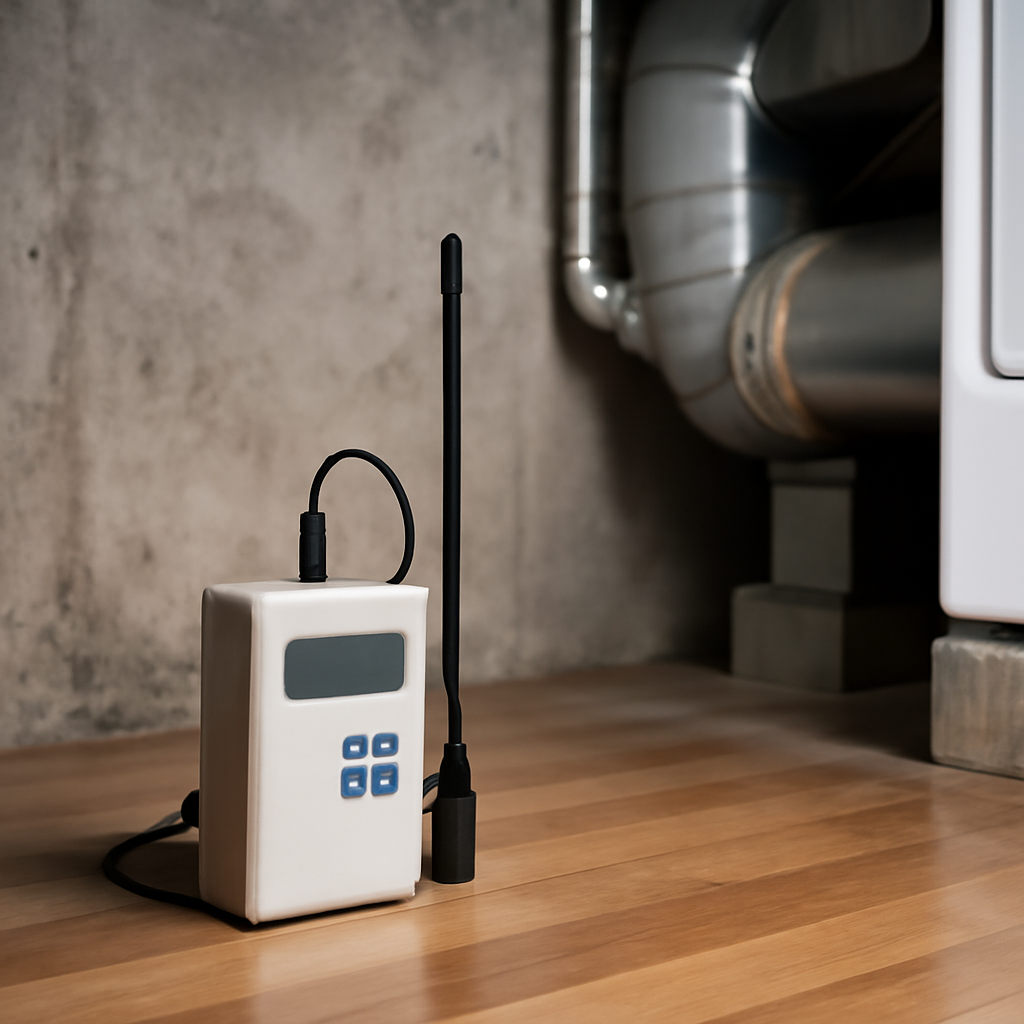
A professional test places a calibrated continuous radon monitor or a passive device in the lowest livable level, usually a basement or ground-floor room, under closed-house conditions. The tester documents placement and the closed-house window so the result holds up if it feeds a real-estate negotiation.
Closed-house conditions
For at least 12 hours before and during a short-term test, windows and exterior doors stay closed except for normal entry. This keeps a breezy plains afternoon from artificially lowering the reading. If a test comes back at or above 4 pCi/L, the next step is mitigation, detailed in our guide to radon mitigation in Eaton.
Continuous monitors versus passive kits
A continuous radon monitor logs hourly readings, so it can show whether a window opened mid-test or whether levels spiked overnight, evidence that protects a buyer from a tampered result. Passive devices like charcoal canisters average exposure and mail to a lab at lower cost. For an Eaton home sale, the continuous monitor’s tamper detection and hour-by-hour record make it the preferred tool. For a homeowner’s own long-term picture, a passive kit left in place for months gives a more representative annual average.
Radon testing cost in Eaton
A professional short-term radon test in the Eaton market typically runs about $135 to $250. A do-it-yourself kit costs roughly $15 to $40 plus lab fees, and CDPHE periodically offers discounted kits to Colorado residents. Bundled into a pre-purchase home inspection, radon testing often adds just $100 to $175 instead of carrying a separate trip charge.
Long-term kits sit at the low end on price but tie up months. For a transaction, the documented short-term professional test is standard because it fits inspection deadlines and produces a defensible closed-house result. Weigh the cost against the protection: the EPA links thousands of lung-cancer deaths a year to radon, and a $200 test that catches a 7 pCi/L basement reading lets a family install a roughly $1,500 mitigation system and cut exposure by 90 percent or more.
The choice between a DIY kit and a professional test usually comes down to purpose. For a homeowner’s own awareness, a CDPHE-discounted kit gives a usable number cheaply. For a real-estate transaction, the professional continuous-monitor test is the standard because its tamper detection, documented placement, and defensible result hold up when the number drives a mitigation request.
Where to place the device
Placement determines whether the result reflects real exposure. The device belongs in the lowest level that is or could become living space, set about 20 inches or more above the floor, away from exterior walls, drafts, direct sun, and sumps or floor drains. In a typical Eaton home that means the basement family room rather than an unfinished mechanical corner. Testing a space no one occupies understates the exposure a family actually experiences.
Conditions during the test matter as much as location. A short-term test needs closed-house conditions for at least 12 hours before and throughout, so windows and exterior doors stay shut except for normal entry. A professional follows EPA placement and closed-house protocol precisely, because a result that drives a mitigation decision or a purchase negotiation has to be defensible.
Colorado regulations and disclosure
Colorado requires radon disclosure in residential real-estate transactions, and the Seller’s Property Disclosure asks sellers to report known radon results and any existing mitigation system. CDPHE runs the state radon program, references the 4 pCi/L EPA action level, and offers discounted kits to residents. Colorado does not license home inspectors, so for any test tied to a sale, confirm the tester follows recognized national measurement protocols rather than assuming a license guarantees competence.
Disclosure shapes negotiations both ways. A seller who has tested and mitigated can offer a clean post-mitigation result as reassurance, while a seller who has never tested leaves the buyer to discover the number during the contingency, often resulting in a mitigation credit. Buyers in Zone 1 Eaton should not waive radon testing to sweeten an offer; the modest cost of the test and fix is small against the long-term health stakes of an untreated basement.
Neighborhoods and areas served
Radon turns up across Eaton regardless of neighborhood: basement homes in the historic downtown and original grid, slab-on-grade and finished-basement homes in the newer east-side subdivisions, and rural parcels on the surrounding plains. The Zone 1 designation does not stop at the town limit, so every part of the area shares the same soil-gas risk.
Service extends across the northern Weld plains, including Greeley, Ault, Severance, and Galeton. Homeowners building a county-wide picture can start with the radon testing guide for Weld County. The whole area sits in Zone 1, so treating radon as a default test rather than an optional add-on reflects reality across these farm-belt communities.
How to choose an Eaton radon testing provider
Ask whether the provider uses a calibrated continuous radon monitor and follows EPA or AARST protocols. A good tester documents closed-house conditions, device placement, and test duration so the result stands up in a sale. Bundling radon with a full home inspection in Eaton is efficient and gives buyers one coordinated report on both the structure and the soil-gas risk.
Confirm the monitor’s calibration is current and, for a purchase, ask the provider to place and retrieve the device themselves rather than handing you a kit, since a tester-administered continuous monitor carries far more weight in a negotiation. If a result comes back borderline, between 2 and 4 pCi/L, a competent provider explains your options, including a follow-up long-term test, rather than pushing an unnecessary mitigation sale.
For homeowners not in a transaction, a CDPHE discounted long-term test kit is a low-cost way to get a representative annual average and a reasonable first step. If that kit comes back at or near the action level, a professional follow-up confirms the result with calibrated equipment before you commit to mitigation. Either path beats not testing, since every Eaton home sits in Zone 1.
How often to retest an Eaton home
A single clean radon test years ago does not guarantee a clean home today, which is why retesting matters in a Zone 1 town like Eaton. The EPA recommends testing every couple of years and after any significant change to the home, because the conditions that drive radon shift over time. A foundation that settles opens new cracks, a basement remodel changes airflow, and a new high-efficiency furnace alters the pressure that pulls soil gas indoors.
Eaton’s housing patterns make a few moments especially worth a fresh test. A homeowner who finishes a basement in an east-side subdivision to add bedrooms has turned the most soil-contacted space into living space, and the radon level in a newly occupied lower level should be confirmed rather than assumed. The same goes for major HVAC replacements, foundation repairs, or large additions on an older downtown home. Each changes how air and soil gas move through the structure.
Seasonality is another reason to think beyond a single reading. Radon tends to run higher in the sealed winter months when furnaces draw soil gas indoors and lower in milder seasons when homes breathe more. A short-term test taken in summer may understate the winter exposure an Eaton family actually experiences, so a long-term test or a winter retest gives a fuller picture. Building retesting into the ordinary rhythm of homeownership, after remodels, after system changes, and periodically regardless, is how a northern-plains household keeps its actual exposure known rather than relying on an outdated number.
Rural Eaton parcels deserve a brief note of their own. Homes on private wells can carry a second, less common radon pathway: radon dissolved in well water that releases into the air during showering, dishwashing, and laundry. For most homes the soil-gas pathway dominates and air testing is the priority, but a farm home with a private well and persistently elevated readings may warrant a water test as well, so the source is correctly identified before any fix.
References
- Radon risk and EPA zone maps — U.S. Environmental Protection Agency
- Colorado radon program and kits — Colorado Department of Public Health and Environment
- Radon and lung cancer — Centers for Disease Control and Prevention
Every Eaton home sits in EPA Zone 1, so radon testing is basic due diligence, not optional. To connect with a vetted local tester before your purchase deadline or this heating season, get in touch through our contact page.