Radon Test Kit Meaning: What Homeowners Need to Know
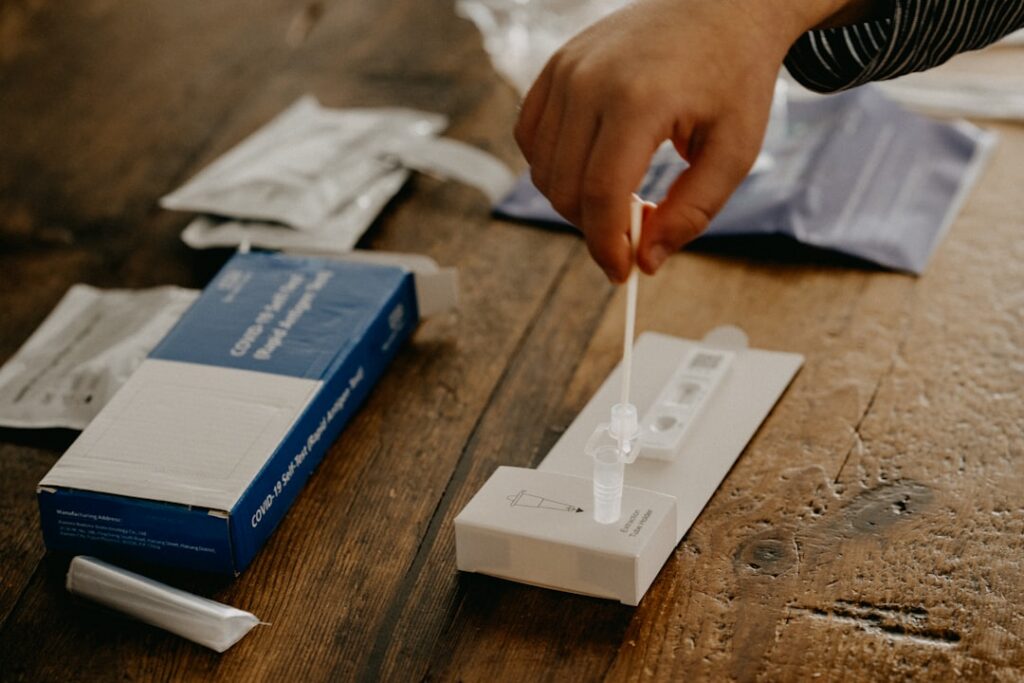
A radon test kit is a self-contained product that lets a homeowner collect a measurement of radon gas concentration in their home and submit it to a laboratory for analysis. The phrase has a specific meaning in EPA testing protocols: a kit is the device plus the deployment instructions plus the lab fee plus the prepaid return mailer. This guide explains what a typical kit contains, how the underlying devices work, and what the resulting lab report actually says. The content summarizes EPA and CDC guidance current as of 2026 and is not a substitute for a certified radon measurement professional when results will inform real-estate transactions or lender requirements.
Part of our Radon Levels guide — start there for the full picture →
What a typical kit contains
A standard mail-in radon test kit ships with the detection device (charcoal canister or alpha-track detector), a chain-of-custody form, deployment instructions, a prepaid return mailer, and the lab analysis fee included in the purchase price. Better kits include a small information packet on EPA placement protocol and closed-house conditions. The kit is consumable — one device per kit, one deployment per device.
The two main device types in kits
Charcoal canister kits use activated charcoal that adsorbs radon over a 48-hour to 7-day deployment. After deployment, the canister is sealed, mailed to the lab, and analyzed via gamma spectroscopy. The lab counts the gamma emissions from radon decay products that accumulated on the charcoal and back-calculates a concentration. Alpha-track kits use a small piece of nitrocellulose film inside a vented housing, deployed for 90 days to 12 months. Alpha particles from radon decay etch tracks on the film. The lab develops the film and counts tracks under a microscope.
What “meaning” the kit produces
The lab report reports a single number — average radon concentration in picocuries per liter (pCi/L) for US kits, or becquerels per cubic meter (Bq/m³) for non-US kits — along with measurement uncertainty, deployment dates, and a comparison to EPA’s 4 pCi/L action threshold. The “meaning” of the kit result is the homeowner’s first data point in the radon decision tree: leave it alone (below 2 pCi/L), retest or consider mitigation (2-4 pCi/L), or install mitigation (4 pCi/L and above).
Cost and turnaround
Charcoal canister kits cost $25 to $50 retail, including lab fee and return shipping. Alpha-track kits cost $30 to $80. Most kits ship from the lab vendor; some are stocked at hardware stores. Turnaround from deployment end to result: 5 to 10 business days for charcoal, 5 to 10 business days for alpha-track (the analysis is the same speed; deployment is what differs). Total time from kit purchase to result is roughly 1 to 2 weeks for short-term, 3 to 12 months for long-term.
How charcoal canisters actually work
The canister contains activated carbon — extremely porous charcoal with a high surface area for gas adsorption. During deployment, radon gas diffuses into the canister and adsorbs onto the carbon surface. Radon’s short half-life (3.8 days) means the radon decay products (polonium, lead, bismuth isotopes) accumulate on the carbon. The lab places the sealed canister in a gamma spectrometer that detects the characteristic gamma emissions from those decay products and back-calculates the radon concentration that produced them.
How alpha-track detectors actually work
The detector housing contains a small piece of nitrocellulose plastic film (commonly CR-39 polymer) protected by a passive filter that allows radon gas to enter but blocks dust and other particulates. Alpha particles from radon decay strike the film and damage it on a microscopic scale. After deployment, the lab chemically etches the film with a sodium hydroxide solution that enlarges the damaged spots into countable pits. The pit count per unit area, divided by the deployment time, gives the radon concentration.
Lab analysis quality and credentialing
The lab analyzing a kit should be AARST-NRPP certified or NRSB-certified — the two recognized US programs. Certification confirms the lab follows EPA Method 502 (charcoal) or EPA Method 503 (alpha-track) protocols, uses calibrated reference standards, and passes blind proficiency testing. The certification number should appear on the lab report. Non-certified labs should not be used for results that may inform formal decisions.
What a complete report says
A complete report identifies the kit by serial number, lists deployment start and end dates and times, reports the average concentration in pCi/L (with uncertainty), notes any closed-house non-compliance flagged by the lab, prints the lab’s certification number, and provides a brief interpretation against the EPA 4 pCi/L action threshold. Better reports include an explanation of next steps for each concentration range.
How to deploy a kit correctly
Place the device in the lowest livable level (basement if finished and used, first floor in slab-on-grade homes). Height 20 inches to 6 feet above the floor. At least 3 feet from doors and windows. At least 1 foot from exterior walls. Away from HVAC supply registers, humidifiers, laundry rooms, bathrooms, and direct drafts. Log the start date and time on the chain-of-custody form. Maintain closed-house conditions for 12 hours before and during the test. Seal and mail same-day at deployment end. For deeper testing protocol, see our how a radon test kit works guide.
Why charcoal canisters fail when shipping is delayed
The lab calculates the radon concentration based on the deployment period and the time between deployment end and lab analysis. If the canister sits in the mail for a week before reaching the lab, the radon decay products on the charcoal continue to decay during transit, degrading the signal. Most lab protocols give a maximum transit window of 4 to 7 days; longer transit triggers a “no usable result” flag and requires a retest. Mail same-day at deployment end and use the prepaid expedited mailer the kit provides.
Why alpha-track detectors are forgiving of shipping delays
Alpha-track devices integrate alpha particle tracks over the full deployment period, and the tracks are permanent etched damage on the film. Once deployment ends and the device is sealed, transit time does not affect the result. The lab can analyze a returned alpha-track device weeks after deployment without degradation. This is one reason alpha-track is the preferred device for long-term deployment and casual mailing schedules.
Kit accuracy compared to professional CRM testing
Charcoal kits from NRPP-certified labs typically achieve ±15 to 20 percent measurement uncertainty under proper deployment conditions. Alpha-track kits achieve ±5 to 10 percent for long deployments. Professional continuous radon monitors achieve similar accuracy to short-term charcoal but add tamper-evident hourly data that makes them the standard for real-estate transactions. The accuracy difference is small; the data resolution and tamper-evidence are what set CRMs apart for transactional use.
Where kits fall short
Kits cannot prove that closed-house conditions were maintained — the lab takes the homeowner’s deployment notes at face value. Kits cannot detect tampering during deployment. Kits cannot produce real-time data for diagnostic purposes (e.g., correlating spikes with HVAC operation). For transactional, mitigation-design, or formal-disclosure purposes, a certified measurement professional with a CRM is the standard. For informal homeowner screening, kits are fine.
When to use a kit versus when to hire a professional
Use a kit for: initial homeowner screening to find out if there might be a radon problem, post-mitigation confirmation after a system has been installed, ongoing surveillance in a known-low home, baseline measurement before a major renovation. Hire a professional for: real-estate transactions, lender-required tests, pre-mitigation assessments that inform system design, formal disclosure filings, and any result that will be used in litigation or insurance claims. The Front Range radon testing hub covers when each is appropriate.
Multi-kit deployment for whole-home testing
For a thorough assessment, EPA recommends multiple kits across multiple levels and rooms. A single basement kit captures the highest likely concentration but does not show how concentrations vary on upper floors. Buyers sometimes deploy 3 to 5 kits simultaneously across the basement, first floor, and second floor to map vertical distribution. Multi-kit packs from major vendors offer per-kit discounts of 20 to 40 percent versus single-kit purchase.
Common kit mistakes
Failing to log start and end times accurately. Placing the kit in a closet or behind furniture. Opening windows during deployment. Using a humidifier or running an exhaust fan in the test area. Delaying mailing the canister beyond the 4-7-day transit window. Letting the alpha-track sit out past its 12-month maximum deployment limit. Using a kit past its shelf-life expiration date. Each invalidates the result.
What kit results trigger
Below 2 pCi/L: leave it alone, retest in 2-5 years. 2 to 4 pCi/L: consider mitigation, especially with smokers or young children present; follow up with long-term test. 4 pCi/L and above: install mitigation system, typically sub-slab depressurization at $1,200 to $2,500 in Colorado. Post-mitigation: retest within 30 days of installation to confirm system effectiveness.
When to call a professional vs. use a kit
Kit for general screening, post-mitigation surveillance, baseline assessment, and casual homeowner curiosity. Certified AARST-NRPP or NRSB professional for any real-estate transaction, any lender-required test, any pre-mitigation assessment that informs system design, and any test where the result will be cited in a disclosure or insurance context. Both pathways produce valid measurements; the differences are tamper-evidence, data resolution, and credential weight.
References
- EPA Radon Measurement Protocols — U.S. Environmental Protection Agency
- CDC Radon Testing — Centers for Disease Control and Prevention
- CDPHE Test Your Home for Radon — Colorado Department of Public Health and Environment
- American Lung Association Radon Page — American Lung Association
Frequently asked questions
What is a radon test kit?
A self-contained product that lets a homeowner collect a measurement of radon gas concentration and submit it to a laboratory for analysis. Standard kits contain the detection device (charcoal canister or alpha-track detector), chain-of-custody form, deployment instructions, prepaid return mailer, and lab fee included in the purchase price. Cost ranges $25 to $80.
How does a charcoal canister kit work?
During the 48-hour to 7-day deployment, radon adsorbs onto activated charcoal inside the sealed canister. The decay products accumulate on the charcoal. After deployment, the canister is sealed and mailed to the lab, where a gamma spectrometer detects emissions from the decay products and back-calculates the radon concentration. Mail same-day to avoid transit degradation.
How does an alpha-track detector work?
A small piece of nitrocellulose film inside a vented housing records alpha particles from radon decay as etched tracks over 90 days to 12 months. The lab develops the film with a sodium hydroxide etch, counts the tracks under a microscope, and calculates an integrated average concentration over the deployment period. Alpha-track gives the most accurate annual-average reading.
Are DIY kits accurate enough for real decisions?
For homeowner screening, post-mitigation confirmation, and ongoing surveillance, yes — NRPP-certified kits achieve ±15 to 20 percent uncertainty for charcoal and ±5 to 10 percent for alpha-track. For real-estate transactions, lender requirements, and pre-mitigation assessments that inform system design, certified continuous radon monitor testing is the standard because of tamper-evident hourly data.
Front Range homeowners ready to test their homes with a kit or a certified provider can reach out through our contact page.
Radon test kits we recommend
Short-term charcoal kits are the cheapest way to get a first reading; mail the canister to the lab and results come back in days.
| Product | Why | Buy |
|---|---|---|
 AirChek Charcoal Radon Test Kit AirChek Charcoal Radon Test Kit | Lab fee usually included; EPA short-term protocol. | Amazon — $21.95 |
 First Alert RD1 Radon Test Kit First Alert RD1 Radon Test Kit | Widely stocked; 48-hour charcoal test. | Amazon — $16.98 |
| Health Metric Radon Test Kit | Two-pack option for closed-house testing. | Amazon — $16.98 |