PEX Fittings: Crimp, Clamp, Expansion and Push-Fit Compared
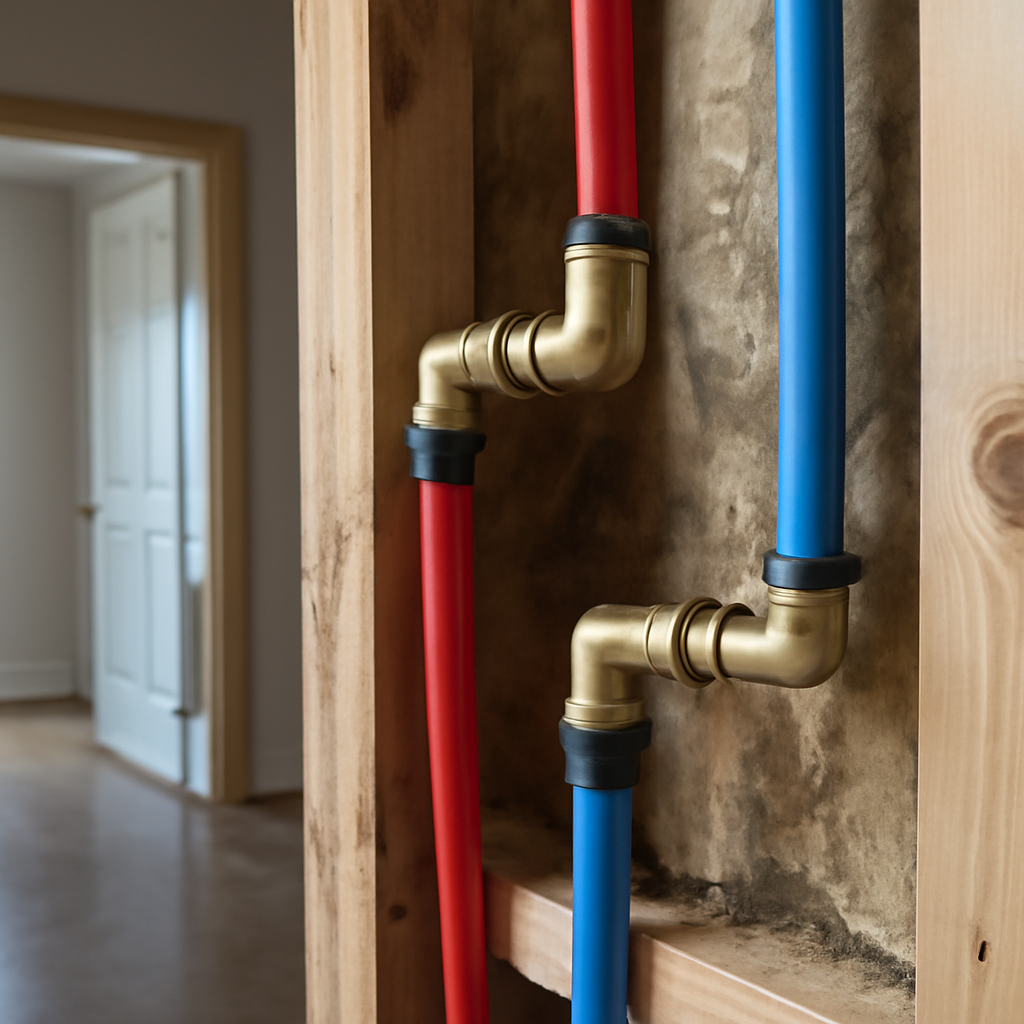
PEX tubing has become the default water supply pipe in a large share of new Front Range homes and in many repiped older ones. The tubing itself rarely fails on its own. When a PEX system leaks, the cause is far more often at a joint: a fitting from the wrong system, a crimp ring that was never fully compressed, a push-fit connector on tubing that was not cut square, or a brass fitting that has started to deteriorate. Understanding the main fitting methods helps homeowners and buyers read what they see under a sink, in a mechanical room or in an unfinished basement, and helps them ask the right questions of a plumber. This guide compares crimp, cinch or clamp, expansion and push-fit connections, explains why fittings must match the PEX type and manufacturer instructions, covers brass versus plastic fittings, lead-free requirements, UV and freeze concerns, transitions to copper, inspection red flags and typical costs.
Part of our Plumbing & Water guide — start there for the full picture →
How PEX Fittings Work
PEX, or cross-linked polyethylene, is a flexible plastic tubing that cannot be glued or soldered. Every joint is mechanical. Most systems use an insert fitting with ribbed barbs that slides inside the tubing, then something on the outside squeezes the tubing tight against those barbs. The differences between systems come down to what does the squeezing and how the installer confirms the joint is correct. A few systems work the other way, expanding the tubing so it shrinks back down over the fitting.
The tubing comes in several types, commonly sold as PEX-A, PEX-B and PEX-C, which are made by different cross-linking methods and differ in flexibility and in how much they can be expanded. Those differences decide which fitting systems a given tube is listed for. Our guide to PEX pipe covers the tubing types, color coding and general pros and cons of PEX as a supply material.
Why the fitting system has to match the tubing
PEX fittings and tools are sold as systems. Tubing, fittings, rings or sleeves, and tools are tested and listed to work together, and the tubing is printed with the standards it meets. Mixing a fitting from one system with tubing listed for another, using the wrong ring size, or using a tool that has not been calibrated can produce a joint that holds at first and fails months later. Installers are expected to follow the tubing and fitting manufacturers’ instructions, and some manufacturers tie their warranties to using matched components. When a buyer sees several different brands of fittings on the same run, that is not automatically a defect, but it is a reason to ask who did the work and when.
The Four Main PEX Fitting Methods
Most residential PEX in the region uses one of four connection methods. Each has a different look, tool and set of failure modes.
Crimp fittings
Crimp connections use a copper ring slid over the tubing and a barbed insert fitting pushed into the tube. A crimp tool compresses the ring around the tubing and barbs. Crimp is one of the most common methods for PEX-B and is widely used in production housing and by homeowners because the tools and fittings are relatively inexpensive.
The weak point is the crimp itself. A ring that is crimped at an angle, positioned too close to or too far from the end of the tubing, or compressed with a worn tool can leak. Installers are expected to check each crimp with a go/no-go gauge. A crimp that looks lopsided, a ring sitting partly off the fitting or a ring with an obvious gap is worth flagging.
Cinch or clamp fittings
Cinch, or clamp, connections use a stainless steel band with a tab. A cinch tool squeezes the tab until the band closes around the tubing. One tool generally covers several pipe sizes, and the tool is designed to release when the clamp is fully closed, which some installers find easier to verify than a crimp ring. A properly closed tab has a consistent, pinched look; a tab that is barely deformed suggests the clamp was not finished.
Stainless clamps resist corrosion better than copper rings in some environments, though both are used successfully. As with crimp, the tubing has to be cut square and the clamp positioned correctly on the fitting.
Expansion fittings
Expansion connections are associated with PEX-A, which is flexible enough to be stretched. The installer slides a PEX ring over the tubing end, expands the tube and ring with an expansion tool, and then pushes the tube onto the fitting. The tubing’s shape memory makes it shrink back tightly over the fitting within seconds to minutes depending on temperature. Some expansion systems use a metal compression sleeve instead of a PEX ring.
Expansion fittings typically have a larger inside diameter than crimp or clamp insert fittings, which can mean slightly less flow restriction at each joint. The tools are more expensive, and in cold conditions the tubing shrinks back more slowly. Expansion is listed only for tubing designed for it, and using expansion fittings on tubing that is not listed for expansion is a mismatch.
Push-fit fittings
Push-fit connectors contain an internal O-ring and a ring of stainless teeth. The installer cuts the tubing square, deburrs it, marks the insertion depth, and pushes the tube into the fitting until it reaches the mark. Many push-fit fittings also work with copper and CPVC, which makes them popular for repairs and transitions.
Push-fit fittings are fast and need no special crimping tool, which makes them common in DIY and emergency repairs. They depend on the O-ring and the teeth, on correct insertion depth and on any required internal stiffener for PEX. Whether a given push-fit fitting is approved for concealed locations, such as inside a finished wall, depends on its listing and the local code. Some plumbers treat push-fit as a repair method for accessible locations rather than a whole-house approach. A push-fit fitting buried inside a wall or ceiling without access is a reasonable question to raise.
Best PEX Crimp Tool: our top 3 picks
| Product | Best for | Key features | Price | Buy |
|---|---|---|---|---|
| IWISS IWS-3801SH | Copper rings, 3/8 to 1 inch |
| $72.97as of Nov 20, 2026 10:29 pm GMT+0000 | Buy now →Check current price |
| SharkBite UC961 | Name-brand cinch tool |
| $61.99as of Nov 20, 2026 10:29 pm GMT+0000 | Buy now →Check current price |
| iCrimp IWS-1807CN | Copper rings in tight spaces |
| $94.97as of Nov 20, 2026 10:29 pm GMT+0000 | Buy now →Check current price |


Prices are Amazon’s listed prices as of the time shown and change often; check Amazon for today’s price. As an Amazon Associate we earn from qualifying purchases.
Brass vs Poly Fittings
Insert fittings for crimp and clamp systems come in two main materials: brass and engineered plastic, often called poly or polysulfone fittings. Expansion fittings are also available in both brass and engineered plastic.
- Brass fittings are strong and resist mechanical damage. Some brass alloys, in some water chemistries, can lose zinc through a process called dezincification, which can leave the fitting porous and weak and may produce white or crusty deposits on the outside. Many current fittings use alloys formulated to resist this, and whether a given installation is at risk depends on the alloy and the water. That does not mean every brass fitting is suspect.
- Engineered plastic fittings do not corrode the way metal can, are lighter and often cost less. They can crack if overtightened at threaded transitions, if struck, or if stressed by tubing that is pulled sideways without support.
For a buyer, the practical question is not which material is better in the abstract but whether the visible fittings show signs of trouble: crusty white or green deposits, weeping, cracks or staining below a joint.
Lead-Free Requirements for Drinking Water Fittings
Any fitting that carries drinking water has to meet federal lead-free requirements. The U.S. Environmental Protection Agency explains that Section 1417 of the Safe Drinking Water Act defines lead free as a weighted average of 0.25 percent lead across the wetted surfaces of a pipe, pipe fitting, plumbing fitting or fixture, and 0.2 percent lead for solder and flux. The Act prohibits using a pipe, fitting or fixture that is not lead free in the installation or repair of plumbing in facilities providing water for human consumption. EPA notes that the 0.25 percent weighted average replaced the earlier 8 percent limit for pipes and fittings through the Reduction of Lead in Drinking Water Act of 2011.
EPA’s final lead-free rule also requires manufacturers and importers to certify that their products meet the requirements, and EPA states that certification became required in 2023. EPA’s fact sheet on identifying lead-free certification marks explains that certified products typically carry a third-party certifier’s mark and identifier text on the packaging or engraved on the product, and that where small parts or packaging lack the mark, contacting the manufacturer is the best way to confirm the product meets the requirement. EPA also lists exemptions, such as plumbing devices used exclusively for nonpotable services.
In practical terms, homeowners should buy brass fittings for potable water from reputable suppliers, look for certification marks, and avoid salvaged or unmarked fittings of unknown origin on drinking water lines. Fittings left over from irrigation or industrial work should not end up in a kitchen supply line.
UV Exposure, Freezing and Heat
PEX tubing is sensitive to ultraviolet light. Manufacturers limit how long tubing can be exposed to sunlight during storage and construction, and they generally do not permit PEX to be left exposed to sunlight permanently. Tubing that has been exposed outdoors, near a window in an unfinished basement or under a skylight can degrade over time. Exposed PEX on an exterior wall, a deck or a hose bib run is worth noting.
PEX is often described as more freeze tolerant than copper or CPVC because the flexible tubing can expand somewhat when water freezes. That tolerance has limits. Repeated freezing can still damage tubing, and fittings are frequently the weakest part of a frozen run, since metal or rigid plastic fittings do not stretch the way the tube does. Supply lines in crawl spaces, exterior walls, garages and attics still need insulation and protection. Our guide to frozen pipes covers prevention and safe thawing, which matters on the Front Range during sudden cold snaps.
Heat matters too. PEX should be kept away from direct contact with high-temperature sources, and many manufacturers specify a length of metal pipe at water heater connections before PEX begins. Tubing that has been run directly onto a water heater flue area, or fittings that show discoloration near a heat source, should be evaluated.
Transitions to Copper and Other Materials
Very few homes are all PEX. Repipes and repairs create transitions to existing copper, CPVC or galvanized steel, and transitions are a common place for leaks. Typical methods include:
- Sweat adapters that solder onto copper on one end and accept a PEX connection on the other. The soldering should be done before the PEX is attached so heat does not damage the tubing.
- Threaded adapters that connect to male or female pipe threads, often at water heaters, valves and older galvanized lines. Overtightening plastic threaded adapters can crack them.
- Push-fit transitions that join PEX directly to copper or CPVC, which are quick but depend on correct preparation of both pipe ends.
Where PEX joins old galvanized steel, the galvanized side often has internal corrosion that leads to restricted flow or future leaks, regardless of how good the PEX side is. Our guides to copper pipe and CPVC pipe cover those materials and their own failure patterns.
Inspection Red Flags With PEX Fittings
A home inspector’s scope for plumbing generally covers visible supply and distribution piping. The ASHI Standard of Practice lists inspecting interior water supply and distribution systems, including fixtures and faucets, and describing the water supply piping materials. It does not require an inspector to measure water supply flow and pressure. That means an inspector can comment on what is visible, but hidden fittings inside walls and ceilings are beyond the scope.
Common red flags include:
- Water staining, mineral crust or green or white deposits at or below a fitting.
- Crimp rings that are crooked, partly off the fitting or visibly uncompressed.
- Clamp tabs that look barely closed.
- Mixed fitting brands on the same run, especially on tubing listed for a different system.
- Push-fit fittings in inaccessible locations, or tubing pulled at an angle out of a push-fit connector.
- Tubing kinked at sharp bends or left unsupported over long spans.
- PEX exposed to sunlight, in direct contact with a water heater, or near a flue.
- Unprotected PEX in an unheated crawl space, garage or exterior wall.
EPA’s WaterSense Fix a Leak Week guidance suggests examining faucet gaskets and pipe fittings for any water on the outside of the pipe as one way to find surface leaks, and checking the water meter before and after a two-hour period with no water use. If the meter changes, there is probably a leak. Where water pressure is very high, fittings throughout the house are under more stress; our guide to a water pressure test explains how to check it. The plumbing and water inspections section covers the rest of the plumbing portion of an inspection, and our guide to hiring a home inspector explains how to choose one.
PEX Fitting Costs
Costs vary with tubing size, fitting material, the connection system and how accessible the work is. As a rough 2026 guide:
- Crimp and clamp fittings: individual fittings and rings are usually inexpensive, often just a few dollars each in common residential sizes, with brass costing more than poly.
- Expansion fittings: fittings are often similar in price, but expansion tools cost considerably more, which is one reason the method is more common with professionals.
- Push-fit fittings: usually the most expensive per fitting, often several times the cost of a crimp fitting, offset by needing no special tool.
- A single accessible leak repair by a plumber: commonly a service call plus parts, more if drywall has to be opened.
- Whole-house repiping with PEX: typically thousands of dollars, depending on the size of the house, the number of fixtures and the amount of wall and ceiling repair needed.
Written quotes should state the PEX type, the fitting system, the brand and whether patching and permits are included. Mixing systems to save money on one repair is a false economy if it voids a warranty or creates a joint that leaks later. Before buying a home with PEX, it is worth asking whether the system was installed by a licensed plumber under a permit and which fitting system was used.
More Questions About PEX Fittings
How long do PEX fittings last?
Properly installed PEX fittings are generally expected to last decades, with many manufacturers backing their systems with long warranties when the pipe and fittings are matched. Lifespan depends on water chemistry, temperature, installation quality and exposure. Brass fittings can suffer dezincification in some aggressive water, while poly fittings avoid corrosion but can crack if over-stressed. Fittings exposed to sunlight, chemicals or constant high heat age faster. Using the right tool, a calibrated crimper and the fitting system listed for the tubing matter more than the brand.
Can PEX fittings be reused after removal?
Most PEX fittings should not be reused once removed. Crimp and cinch rings are cut off, and the insert fitting barbs are usually scarred, so a new fitting is the reliable choice. Expansion fittings are removed by cutting the pipe, and the fitting can sometimes be reused only if the manufacturer allows it and the barbs are undamaged. Push-fit fittings are designed to be removable with a release tool and are often reusable, but check the manufacturer’s instructions and inspect the O-ring first.
Why is my PEX crimp fitting leaking?
A leaking PEX crimp fitting usually means the ring was not compressed correctly, was placed too close to or too far from the pipe end, or the pipe was cut at an angle. An out-of-calibration crimp tool is a common cause, which is why installers check every ring with a go/no-go gauge. Debris, a scratched barb or a ring installed at an angle can also leak. The fix is to cut out the fitting, square-cut the pipe and install a new fitting and ring properly.
Can PEX fittings be buried underground or in concrete?
Some PEX fittings can be buried underground or in concrete, but only if the manufacturer lists them for direct burial, and many codes discourage joints in inaccessible locations. Brass fittings in soil may need a protective wrap against corrosion. Push-fit fittings are generally not approved for burial. The best practice is to run continuous PEX through slabs and buried runs, with fittings placed where they can be reached later. Sleeves are used where PEX passes through concrete to protect it from abrasion.
What tools are needed for each PEX fitting method?
Each PEX fitting method needs its own tool. Crimp fittings use a crimp tool sized to the pipe plus a go/no-go gauge. Cinch or clamp fittings use a ratcheting cinch tool, which works across sizes. Expansion fittings require an expansion tool and heads matched to the brand of PEX-A pipe. Push-fit fittings need only a pipe cutter, depth gauge and release tool. All methods require a clean, square cut, so a dedicated PEX cutter is worth having for any of them.
References
- Use of Lead Free Pipes, Fittings, Fixtures, Solder, and Flux for Drinking Water — U.S. Environmental Protection Agency
- How to Identify Lead Free Certification Marks for Pipes, Fittings, Fixtures, Solder, and Flux Used for Drinking Water — U.S. Environmental Protection Agency
- Fix a Leak Week — U.S. Environmental Protection Agency WaterSense
- ASHI Standard of Practice for Home Inspections — American Society of Home Inspectors
Frequently asked questions
Can I mix PEX fittings from different brands?
PEX tubing, fittings, rings and tools are tested and listed as systems. Mixing components from different systems can produce joints that fail later and may affect warranties. Follow the tubing and fitting manufacturers' instructions.
Which is better, crimp or cinch PEX fittings?
Both are widely used. Crimp rings are inexpensive but each crimp should be checked with a go/no-go gauge. Cinch clamps use one tool for several sizes and are often easier to verify visually. Correct installation matters more than the method.
Are push-fit PEX fittings allowed inside walls?
It depends on the specific fitting's listing and the local code. Many plumbers prefer push-fit fittings for accessible repairs. Check the product listing and with the local building department before concealing them.
Do brass PEX fittings have lead?
Fittings used for drinking water must meet the federal lead-free definition of a weighted average of no more than 0.25 percent lead across wetted surfaces. Look for third-party lead-free certification marks and buy from reputable suppliers.
Can PEX fittings freeze and break?
Yes. PEX tubing tolerates some freezing better than rigid pipe, but fittings do not stretch and are often where frozen lines fail. Insulate and protect lines in crawl spaces, garages and exterior walls.
Do PEX fittings reduce water flow?
Yes, insert-style PEX fittings narrow the inside diameter at each joint, which slightly reduces flow compared with the pipe itself. Expansion fittings restrict flow less because the pipe is expanded over the fitting. In long runs with many fittings, upsizing the pipe can help.
How do you check that a PEX crimp ring is installed correctly?
A PEX crimp ring is checked with a go/no-go gauge slid over the ring after crimping. The ring should pass the go slot and not fit into the no-go slot. Visual checks also confirm the ring sits about a quarter inch from the pipe end and is square.
Can you connect PEX fittings directly to a water heater?
Many manufacturers and local codes require a metal connector or a short length of metal pipe between a water heater and PEX, because of heat near the tank. Gas water heaters especially call for clearance. The PEX manufacturer's instructions and local code set the exact requirement.
Not sure what kind of fittings are hiding behind the access panels of a house you are buying? Get in touch and we will connect you with a Front Range inspector who looks closely at visible supply piping.