Best Gas Lawn Mowers (2026): 7 Push and Self-Propelled Picks
The best gas lawn mower is still the default for a lot of Front Range yards: no battery to charge, no runtime ceiling, and enough engine to push through a spring flush of Kentucky bluegrass after a wet May. But gas walk-behinds vary more than the “144cc push mower” headline suggests. Engine size, deck width, discharge modes, wheel size and weight all change how a mower handles a quarter-acre lot versus a sloped half acre. This page sticks to gas engines only, mostly push models, with one self-propelled pick for hills. Below are seven picks matched to specific yards, then a buying guide on engines, safety, fuel and altitude.
Part of our Structure & Exterior guide — start there for the full picture →
As an Amazon Associate we earn from qualifying purchases.
How we compared: we compared 13 current Amazon listings for gas walk-behind mowers on what each listing actually states: engine displacement, torque, deck width, discharge modes, cutting-height range, wheel sizes, weight and warranty. Two battery mowers that surfaced in the same search were set aside. We did not lab-test any of these mowers or use them hands-on. Prices and availability change often, so check the current listing before buying.
Quick picks: the best gas lawn mowers by yard type
| Product | Best for | Key features | Price | Buy |
|---|---|---|---|---|
| SENIX LSPG-M14 21in | Best overall gas push mower |
| $237.49as of Oct 20, 2026 10:07 pm GMT+0000 | Buy now →Check current price |
| BILT HARD 201cc 21in | Most push-mower torque |
| $279.99as of Oct 21, 2026 3:10 pm GMT+0000 | Buy now →Check current price |
| SENIX HI6 22in | Slopes and bigger lawns |
| $359.10as of Oct 21, 2026 10:29 am GMT+0000 | Buy now →Check current price |
| SENIX L6 21in | Mulching without a bag |
| $249.99as of Oct 21, 2026 3:10 pm GMT+0000 | Buy now →Check current price |
| PowerSmart DB8618P | Compact 3-in-1 for storage |
| $249.99as of Oct 21, 2026 3:10 pm GMT+0000 | Buy now →Check current price |
| BILT HARD 20in 144cc | Low cuts and overseeding prep |
| $209.99as of Oct 21, 2026 3:10 pm GMT+0000 | Buy now →Check current price |
| SENIX LSPGL1 18in | Lightest gas mower here |
| $161.99as of Oct 21, 2026 3:10 pm GMT+0000 | Buy now →Check current price |
Prices are Amazon’s listed prices as of the time shown and change often; check Amazon for today’s price. As an Amazon Associate we earn from qualifying purchases.
The 7 picks, compared listing by listing
1. SENIX LSPG-M14 21-Inch 144cc — Best Overall Gas Push Mower

21-inch 3-in-1 push mower with a 144cc OHV engine, 6 cut heights and a 1.7-bushel bag in the box.
Check price on Amazon$237.49 as of Oct 20, 2026 10:07 pm GMT+0000 — prices change; see Amazon for current price.Why we like it
- Mulch, rear bag and side discharge from one steel deck
- Engine arrives with oil already added
- Only listing here that states fuel use per hour
- 11-inch rear wheels on a push mower
- 2-year limited warranty named in the listing
| Specification | Details |
|---|---|
| Engine | 144cc 4-cycle OHV; 3.4 HP and 5.8 ft-lb torque stated |
| Deck / modes | 21-inch steel deck; mulching, rear bagging and side discharge |
| Cutting height | 6 positions, 1.25 to 3.75 inches, dual-lever adjustment |
| Wheels | 8-inch front, 11-inch rear |
| Weight | 54.2 lb listed |
| Included / warranty | Mulch plug, side chute, 1.7-bushel bag, oil; 2-year limited warranty |
SENIX LSPG-M14 — 144cc OHV, 21 in 3-in-1 steel deck, 1.25–3.75 in (6 positions), 8/11 in wheels, 54.2 lb, 2-yr limited warranty
The Only Listing That States How Much Fuel It Burns
Thirteen gas mowers made the comparison, and this is the only one whose listing puts a number on fuel consumption, at roughly 27 ounces an hour. It is also one of just two that state horsepower as well as torque. Those figures are manufacturer claims, not test results, but they let a buyer estimate how many tank refills a large lot will need, which no other listing here allows.
The bigger reason it leads is balance. Eight of the 13 listings offer all three clipping modes, and this is the lightest of the 3-in-1 push models with a full set of stated specs: 54.2 lb against 73.8 lb for the BILT HARD 201cc push decks. It pairs that with 11-inch rear wheels, a size only four listings on the shelf state, which helps on lumpy, clay-heavy Front Range lawns.
What the listing does not say matters too. It does not describe the blade-stop control, the handle fold, or whether the deck has a washout port. The height range tops out at 3.75 inches, which is fine for most cool-season lawns but leaves no room above that for drought stress in July.
Pros
- Three clipping modes plus a bag in the box
- States fuel use, horsepower and torque
- Large rear wheels for a push mower
- Pre-filled oil shortens the first start
Cons
- 144cc can bog in very tall, wet grass
- Dual levers, not a single height lever
- No handle-fold or washout port described
Check SENIX LSPG-M14 21in price on Amazon
2. BILT HARD 21-Inch 201cc Push — Most Torque in a Push Mower

21-inch 3-in-1 push mower with a 201cc OHV engine rated at 9.0 ft-lb and a single-lever height system.
Check price on Amazon$279.99 as of Oct 21, 2026 3:10 pm GMT+0000 — prices change; see Amazon for current price.Why we like it
- 201cc engine with 9.0 ft-lb torque stated
- No choke and no primer to start
- Single lever sets all four wheels at once
- Ball-bearing wheels, 9.5-inch rear
| Specification | Details |
|---|---|
| Engine | 201cc 4-stroke OHV; 9.0 ft-lb torque stated |
| Deck / modes | 21-inch steel deck; mulching, side discharge and rear bagging |
| Cutting height | 1.2 to 3.75 inches; title says 8 positions, text says 10 |
| Wheels | 8-inch front, 9.5-inch rear, double ball bearings |
| Weight | About 73.8 lb listed |
| Warranty | Support promised; length not stated in listing |
BILT HARD 21 in 201cc push — 9.0 ft-lb OHV, 3-in-1 steel deck, 1.2–3.75 in single lever, 8/9.5 in bearing wheels, 73.8 lb
Highest Stated Torque Among the Push Mowers
Five listings on this shelf use a 201cc engine, and three of those are self-propelled. Of the push mowers, only this one and its near-identical BILT HARD sibling listing state 9.0 ft-lb of torque, the highest push-mower figure here. The 144cc push decks state 5.8 ft-lb where they give a number at all. More torque means the blade holds speed when the deck hits a thick patch, which is what a homeowner notices when the lawn has gone ten days between cuts.
The trade is weight. At about 73.8 lb this is roughly 20 lb heavier than the SENIX pick above, and it has no drive wheels to help. On a flat lot that is manageable; on a sloped yard it is the reason to look at pick 3 instead.
The listing has two gaps worth knowing. Its title promises 8 height positions while the feature text says 10, so count the notches once it arrives. And unlike most SENIX and PowerSmart listings, it does not state a warranty length, only that the support team will help.
Pros
- Most push-mower torque on the shelf
- Easy no-choke, no-primer starting
- Four-wheel single-lever height adjustment
- Full 3-in-1 deck
Cons
- Heavy for a mower with no drive
- Height-position count is inconsistent in the listing
- Warranty length not stated
Check BILT HARD 201cc 21in price on Amazon
3. SENIX HI6 22-Inch 201cc Self-Propelled — Best for Slopes and Bigger Lawns

22-inch rear-wheel-drive gas mower with a 201cc OHV engine, variable speed and cut heights up to 4 inches.
Check price on Amazon$359.10 as of Oct 21, 2026 10:29 am GMT+0000 — prices change; see Amazon for current price.Why we like it
- Rear-wheel drive with variable speed in the title
- 22-inch deck, tied for widest here
- Tallest stated cut height on the shelf
- Single-lever, 6-position height adjustment
| Specification | Details |
|---|---|
| Engine | 201cc 4-cycle OHV; torque not stated |
| Drive | Rear-wheel drive self-propel; variable speed named in title |
| Deck / modes | 22-inch steel deck; bag, mulch and side discharge |
| Cutting height | 6 positions, 1.25 to 4 inches, single lever |
| Wheels / weight | 11-inch rear wheels; 79 lb listed |
| Warranty | Not stated in listing |
SENIX HI6 — 201cc OHV, RWD variable-speed self-propel, 22 in 3-in-1 deck, 1.25–4 in, 11 in rear wheels, 79 lb
The Tallest Cutting Height Among These Gas Mowers
Only two of the 13 listings set the blade higher than 3.75 inches: a PowerSmart push mower at 3.9 inches and this SENIX at a full 4 inches. That top setting matters on the Front Range, where cool-season lawns stress in hot, dry spells and the EPA’s WaterSense program advises raising the mowing height to between two and four inches in summer. This mower covers that whole band.
It is one of four self-propelled gas listings on the shelf, and the drive is the point. The CPSC suggests considering a self-propelled mower if the person mowing will tire quickly pushing all the time, and a 79 lb machine on a hillside lot is exactly that case. Rear-wheel drive also keeps traction when a full bag shifts weight to the back.
The listing does not give a torque figure, a warranty length or the drive’s speed range, and “variable speed” appears only in the title. Our exterior and grounds guides cover the drainage and grading issues that tend to show up on the same sloped lots.
Pros
- Self-propel takes the work out of slopes
- 4-inch top cut for summer stress
- Wide 22-inch deck covers more per pass
- Large rear wheels for traction
Cons
- 79 lb to steer and store
- No torque or warranty stated
- Speed range not described
Check SENIX HI6 22in price on Amazon
4. SENIX L6 21-Inch 144cc 2-in-1 — Best for Mulching Without a Bag
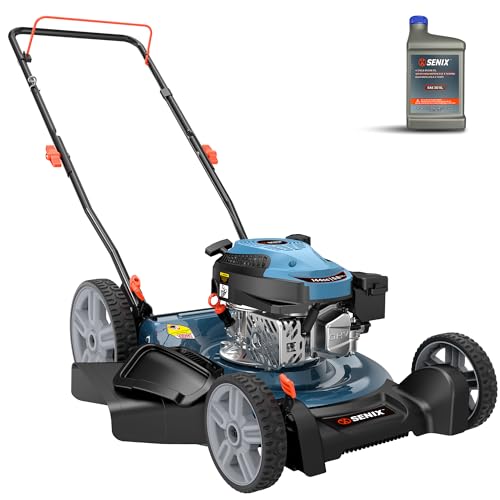
21-inch push mower that mulches or side-discharges, with high 11-inch rear wheels and a 6-position height range.
Check price on Amazon$249.99 as of Oct 21, 2026 3:10 pm GMT+0000 — prices change; see Amazon for current price.Why we like it
- Mulch or side discharge, no bag to empty
- High 11-inch rear wheels on a push deck
- Rated for yards up to half an acre
- 2-year warranty on engine, deck and wheels
| Specification | Details |
|---|---|
| Engine | 144cc 4-cycle; torque figure not stated |
| Deck / modes | 21-inch deck; mulching and side discharge (no rear bag) |
| Cutting height | 6 positions, 1.25 to 3.75 inches, dual lever |
| Wheels | 8-inch front, 11-inch rear |
| Weight | 50 lb listed |
| Warranty | 2 years covering engine, deck and wheels |
SENIX L6 — 144cc 4-cycle, 21 in mulch/side deck, 1.25–3.75 in (6 positions), 8/11 in wheels, 50 lb, 2-yr warranty
The Only 2-in-1 Mulch and Side-Discharge Deck on the Shelf
Every other listing here either offers all three modes or side discharge alone. This SENIX is the one deck sold specifically as mulch-or-side, with no rear bag at all. That suits owners who leave clippings on the lawn anyway; the EPA notes that grass clippings left in place are a good natural source of fertilizer and can reduce how much fertilizer a lawn needs.
It is also the lightest 21-inch gas mower here at 50 lb, and one of four listings with 11-inch rear wheels. The listing claims the larger wheels cut rolling resistance by 30 percent against 7-inch wheels; that is a marketing figure with no method behind it, but bigger rear wheels do roll over roots and ruts more easily.
The “up to half an acre” claim is the most generous coverage figure among the push mowers, where most say a quarter acre. Treat it as a ceiling: half an acre on foot with a 21-inch push deck is a long afternoon.
Pros
- Light for a 21-inch gas deck
- Mulching feeds the lawn, no bag hauling
- Big rear wheels for rough yards
- Warranty coverage spelled out
Cons
- Cannot bag leaves or clippings
- No torque or horsepower stated
- Coverage claim is optimistic for push mowing
Check SENIX L6 21in price on Amazon
5. PowerSmart EasyCut DB8618P 18-Inch — Best Compact 3-in-1 for Storage

18-inch 144cc push mower with mulch, bag and side discharge, a folding handle and tool-free assembly.
Check price on Amazon$249.99 as of Oct 21, 2026 3:10 pm GMT+0000 — prices change; see Amazon for current price.Why we like it
- Only 18-inch deck here with all three modes
- Folding handle for tight garage storage
- Tool-free assembly described
- Auto choke with recoil start
| Specification | Details |
|---|---|
| Engine | 144cc 4-stroke OHV; auto choke |
| Deck / modes | 18-inch steel deck; mulch, side discharge and rear bag |
| Cutting height | 6 positions per title; range not stated in listing |
| Storage | Foldable handle |
| Weight | 55 lb listed |
| Warranty | Not stated in this listing |
PowerSmart DB8618P — 144cc OHV auto choke, 18 in 3-in-1 steel deck, 6 heights, folding handle, 55 lb
The Only Listing That Describes a Folding Handle
Storage is the forgotten spec on a gas mower. A mower with fuel in it belongs in a detached shed or garage, not a basement or a utility room shared with a water heater, so the footprint matters. This PowerSmart is the only one of the 13 listings that describes a foldable handle for compact storage, and the only one that says assembly needs no tools.
Three listings use an 18-inch deck. The other two, a PowerSmart sibling and the SENIX pick 7, offer side discharge only, so this is the one compact gas mower here that can also bag and mulch. For a townhome lawn or a narrow side yard, that combination is more useful than an extra three inches of cut width.
The listing names 6 height positions in its title but never gives the range, and it states no warranty, unlike the sibling DB8618C, which lists two years. Check the range before ordering if the lawn is kept long.
Pros
- Full 3-in-1 on a compact deck
- Folds for small garages and sheds
- No tools needed to assemble
- Steel deck
Cons
- Height range not stated
- Narrower cut means more passes
- Warranty not listed
Check PowerSmart DB8618P price on Amazon
6. BILT HARD 20-Inch 144cc — Best for Low Cuts and Overseeding Prep

20-inch 144cc push mower with an 8-position single lever that drops to 0.7 inch, plus no-primer starting.
Check price on Amazon$209.99 as of Oct 21, 2026 3:10 pm GMT+0000 — prices change; see Amazon for current price.Why we like it
- Lowest stated minimum cut height on the shelf
- 8-position four-wheel single lever
- No primer and no choke to start
- Ball-bearing wheels and foam-wrapped grip
| Specification | Details |
|---|---|
| Engine | 144cc 4-stroke OHV; 5.8 ft-lb torque stated |
| Deck | 20-inch cutting deck; modes not spelled out in features |
| Cutting height | 8 positions, 0.7 to 3.2 inches, single lever |
| Wheels | 6-inch front, 7-inch rear, double ball bearings |
| Weight | 51 lb listed |
| Warranty | Not stated in listing |
BILT HARD 20 in 144cc — 5.8 ft-lb OHV, 0.7–3.2 in (8 positions) single lever, 6/7 in bearing wheels, 51 lb
The Lowest Cut Height Any of These Listings States
Most gas decks on this shelf bottom out around 1.2 to 1.5 inches. This BILT HARD drops to 0.7 inch, the lowest minimum among the 13 listings. That is useful a few times a year rather than every week: scalping a lawn down before overseeding or core aeration in early fall, or cutting back a patch before laying sod.
The flip side is the top setting. At 3.2 inches it has one of the lower maximums here, so it is not the mower for holding a bluegrass lawn tall through a dry August. The EPA cautions that cutting off more than a third of the grass blade at once can shock the plant, which is exactly what happens if this low range is used on a routine cut.
The listing’s size field calls it a 2-in-1, but the features never say which two modes. It also gives no warranty, and the small 7-inch rear wheels are among the smallest here. It is a specialist pick, not an all-rounder.
Pros
- Goes lower than any other deck here
- Eight height steps on one lever
- Simple no-primer start
- Light enough to push easily
Cons
- Low 3.2-inch maximum
- Clipping modes unclear
- Small rear wheels on rough ground
- No warranty stated
Check BILT HARD 20in 144cc price on Amazon
7. SENIX LSPGL1 18-Inch 144cc — Lightest Gas Mower Here

18-inch 144cc side-discharge push mower at 37.5 lb, with 3 height settings for small yards.
Check price on Amazon$161.99 as of Oct 21, 2026 3:10 pm GMT+0000 — prices change; see Amazon for current price.Why we like it
- 37.5 lb, the lightest gas listing
- Compact 18-inch deck for narrow yards
- Side discharge with a vortex tunnel
- Marketed for first-time mower owners
| Specification | Details |
|---|---|
| Engine | 144cc 4-cycle |
| Deck / modes | 18-inch blade; side discharge only |
| Cutting height | 3 positions, 1.2 to 3.15 inches |
| Wheels | 7-inch rear |
| Weight | 37.5 lb listed |
| Warranty | Not stated in this listing |
SENIX LSPGL1 — 144cc 4-cycle, 18 in side-discharge, 1.2–3.15 in (3 positions), 7 in rear wheels, 37.5 lb
The Lightest of the 13 Gas Mowers
Weight is what decides whether a gas mower gets lifted into a pickup, carried down a few steps to a back lawn or wrestled over a curb. At 37.5 lb this SENIX is the lightest gas listing on the shelf, just under the 39.3 lb SENIX LSPG-L4 and more than 50 lb lighter than the heaviest self-propelled model. For an older homeowner or a small lot reached by stairs, that gap is decisive.
The cost is features. It offers side discharge only, three height positions, and small 7-inch rear wheels. Only two gas listings here, this one and the LSPG-L4, limit the height adjustment to three steps.
The listing states a 1/4-acre yard as its target. That is honest for an 18-inch push deck. It does not state torque or a warranty length, which most other SENIX listings here do provide.
Pros
- Easiest gas mower here to lift and carry
- Fits narrow side yards and dog runs
- Simple controls
Cons
- Side discharge only, no bag or mulch
- Just three height settings
- Small rear wheels
- No warranty stated
Check SENIX LSPGL1 18in price on Amazon
How to read a gas mower listing
Engine size and torque
On this shelf, gas walk-behinds come in three engine sizes: seven listings at 144cc, one at 170cc and five at 201cc. Displacement is a rough guide; torque in ft-lb is the more useful number because it describes how well the blade holds speed under load. Six listings state torque, from 5.8 ft-lb on the 144cc decks to 9.0 on the 201cc BILT HARD models. A 144cc engine handles a weekly cut on a quarter acre. Lawns that routinely get away from their owner, or thick turf watered heavily in June, justify the bigger engine.
Deck width and yard size
Deck widths here run 18, 20, 21 and 22 inches, with six listings at 21 inches. Wider decks finish faster but are heavier and harder to turn in tight beds. An 18-inch deck makes sense below about a quarter acre with lots of obstacles; 21 or 22 inches pays off on open lawns. Narrow strips along fences and foundations are better handled with a trimmer; our trimmer line guide covers matching line diameter to the trimmer head.
Clipping modes
Eight of 13 listings offer mulch, bag and side discharge. Mulching returns nutrients, bagging keeps a clean look and collects leaves in fall, and side discharge handles tall grass that would clog the other two. If the plan is to mulch nearly every week, a 2-in-1 like the SENIX L6 saves weight; if fall leaves pile up, a bag or a dedicated tool from our gas leaf blower roundup is the better route.
Push or self-propelled
Nine listings here are push mowers and four are self-propelled. Self-propel adds weight and a drive system to maintain, but on a slope it turns the job from a workout into a walk. The CPSC’s power mower fact sheet lists who will be mowing, and whether they will tire pushing the whole time, as the first question in choosing a walk-behind.
Height range
The EPA recommends a mowing height between two and four inches for the warm part of the year and warns against removing more than a third of the blade at once. Check that a mower’s top setting reaches at least 3.5 inches. Eleven of the 13 listings state a range, and only two exceed 3.75 inches.
Safety, fuel and the garage
Every new walk-behind rotary mower sold in the U.S. must meet the federal blade-safety standard that took effect in 1982, according to the CPSC. The rule requires a blade control that stops the blade within three seconds of releasing the handle bar, a rear foot shield, and a label reading “Meets CPSC blade safety requirements.” None of the 13 listings here mentions that label, which is normal for marketplace copy; look for it on the mower itself.
The CPSC’s mowing guidance also says to:
- Fill the tank before starting, and never refuel while the engine is running or hot.
- Walk the lawn first to pick up sticks, rocks and toys that the blade can throw.
- Mow across a slope with a walk-behind, never up and down, and push forward rather than pulling back.
- Keep children off the lawn while mowing, and wear sturdy shoes and long pants.
- Stop the engine and let the blade halt before clearing a clogged chute.
Store gasoline in an approved container away from the house, as the CPSC advises. Gas mowers are also a carbon monoxide source: the EPA lists generators and other gasoline-powered equipment among indoor CO sources, so never start or run a mower inside a closed garage or shed. If a fuel-burning appliance shares that garage, our gas shut-off valve guide explains where the appliance valve is and when to use it.
Hearing is the quieter risk. The CDC’s NIOSH program treats noise at or above 85 dBA as hazardous. None of these listings states a sound level, so ear protection for anyone mowing more than a few minutes is a sensible default, and the CPSC lists hearing protection among the gear to wear with motor-driven yard equipment.
Running a gas mower on the Front Range
Altitude is the first local wrinkle. Carbureted small engines take in less oxygen per stroke at 5,000 to 7,000 feet, so they run rich and make a little less power. Some engine makers publish high-altitude jet kits or settings; the engine manual is the place to check. In practice, this is one more reason to size up the engine if the lawn is thick.
The mowing season is short and intense. Lawns explode in May and June after spring snow, then slow in the dry heat of July and August, when the top height setting earns its keep. Many Denver-area lawns are Kentucky bluegrass or tall fescue, the cool-season grasses the EPA notes go dormant in hot, dry weather and resume growth when it cools. Raise the deck before a heat wave rather than after the lawn browns.
Winter storage matters more than in milder places. A mower sits for five or six months, and fuel left in the tank and carburetor all winter is a common cause of hard spring starts. Follow the manual’s storage steps for fuel, oil and the spark plug before the first snow. Owners who want to skip engine upkeep entirely on a small, flat lot should read our reel mower roundup.
Finally, watch the grade. Mowing over a soggy low spot every week, or a slope that drains toward the foundation, is often the first sign of a lot-grading problem. Our yard drainage guide explains what to look for.
When the lawn problem is really a house problem
A mower cannot fix standing water near the foundation, a negative grade along a wall, or a downspout dumping onto a slope. Those show up during a home inspection as grading and drainage items, and they are worth catching before a purchase rather than after. Buyers who want the exterior, grading and drainage of a Front Range property looked at by a professional can get in touch through our contact page to be connected with a vetted local inspector.
Frequently asked questions
What size engine does a gas lawn mower need?
For a quarter-acre lawn cut weekly, a 144cc engine is usually enough. Thick, fast-growing or frequently overgrown grass benefits from a 170cc or 201cc engine, which on current listings states more torque, up to 9.0 ft-lb. Torque is a better guide than displacement when a listing gives it.
Is a self-propelled gas mower worth it?
It is worth it on slopes, on lawns above about a third of an acre, and for anyone who tires pushing a 55 to 75 lb mower. Self-propelled models add weight and drive parts to maintain, so a flat, small lawn is usually better served by a lighter push mower.
What cutting height should a Front Range lawn be mowed at?
The EPA's WaterSense program recommends a mowing height between two and four inches during the warm part of the year and warns against cutting more than one-third of the grass blade at once. Choose a mower whose top setting reaches at least 3.5 inches for dry summers.
Can a gas mower be stored in an attached garage?
Many people do, but keep fuel in an approved container away from the house, let the engine cool before parking it, and never start or run the mower with the garage closed. The EPA lists gasoline-powered equipment as a carbon monoxide source, so starting and warming up should happen outdoors.
Does altitude affect a gas lawn mower?
Yes. At Front Range elevations, carbureted engines take in less oxygen and run slightly rich, which can reduce power and make starting fussier. Check the engine manual for any high-altitude jet or adjustment the maker recommends, and consider a larger engine for thick lawns.
References
- Power Lawn Mowers fact sheet — U.S. Consumer Product Safety Commission
- Lawn and Garden Safety Tips — U.S. Consumer Product Safety Commission
- Turfgrass and Water Efficiency — U.S. Environmental Protection Agency, WaterSense
- Carbon Monoxide’s Impact on Indoor Air Quality — U.S. Environmental Protection Agency
- About Occupational Hearing Loss — CDC, National Institute for Occupational Safety and Health