Orangeburg Pipe: Spotting Fiber Sewer Lines Before You Buy
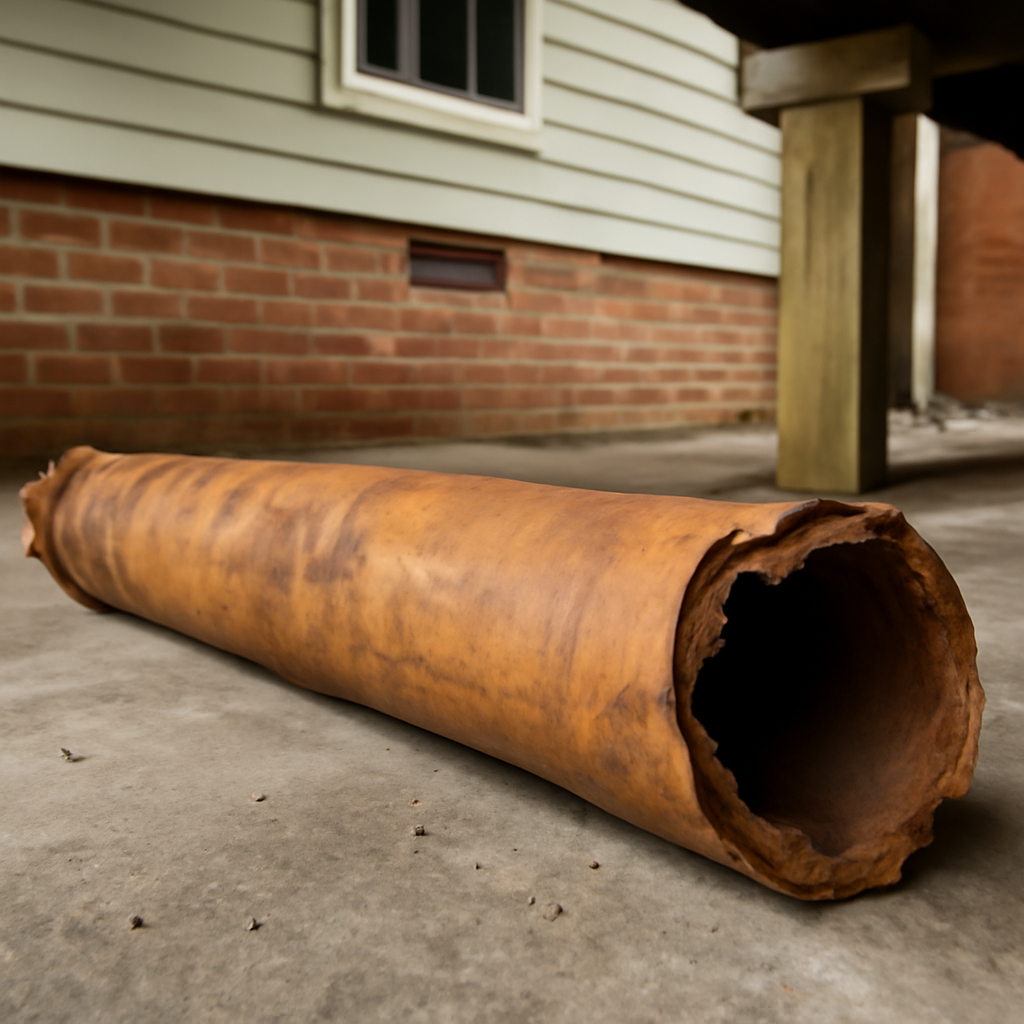
Some of the most expensive surprises in a home purchase are buried a few feet under the front yard. Orangeburg pipe is one of them. It is a fiber-based sewer pipe that was installed in many American homes in the middle of the twentieth century, and it tends to fail slowly and quietly until the day a drain backs up. Because the pipe sits outside the house and underground, a standard visual inspection cannot see it. Buyers usually learn about it only when a camera goes down the line. This guide explains what the material is, how it typically fails, why a sewer scope is worth ordering on older Front Range homes and what replacement and negotiation tend to look like when it turns up in a report.
Part of our Plumbing & Water guide — start there for the full picture →
Plumbing problem? Talk to a local plumber now.
📞 Call (877) 637-1527What Orangeburg Pipe Is
Orangeburg pipe is a bituminized fiber pipe: layers of wood or cellulose fiber pulp bonded together and saturated with a coal-tar pitch or similar bituminous compound. The name comes from the town in New York where one of the best-known manufacturers operated, and the term is now used generically for this type of fiber sewer pipe regardless of who made it.
The material was used most heavily from roughly the 1940s into the 1970s, although exact dates vary by region and some installations fall outside that window. It was light, inexpensive, easy to cut with ordinary hand tools and quick to join with tapered couplings, which made it attractive during the postwar housing boom when metal was expensive and builders were putting up whole subdivisions at once. It was most commonly used for the building sewer, the buried line that runs from the house to the municipal main or to a septic tank, and sometimes for storm drains and downspout leaders.
On rural and semi-rural lots, that buried line feeds a septic system rather than a city main. The EPA explains that all water runs out of a house from one main drainage pipe into the septic tank, which holds wastewater long enough for solids to settle. A deteriorated fiber pipe between the house and the tank can disrupt that flow just as it would on a municipal connection, so the same concerns apply on septic properties along the foothills and eastern plains.
The weakness of the design is that the pipe is essentially compressed, tar-soaked paper. Over decades, groundwater, soil pressure and the wastewater itself work on it. Many plumbers consider the material to have reached or passed the end of its useful life in most homes where it is still present, which is why it draws attention when a sewer camera identifies it.
How It Differs From Other Old Sewer Materials
Mid-century homes can have several different sewer materials, sometimes in the same line. Cast iron was common for the portion inside and just outside the foundation; our guide to cast iron drain pipe covers that material. Vitrified clay was the other common choice for the buried lateral, and it behaves very differently; see our guide to clay sewer pipe. Clay is rigid and long-lived but has joint problems. Orangeburg is flexible and short-lived by comparison, and its problems are in the pipe wall itself.
How Orangeburg Pipe Fails
Fiber pipe does not usually fail all at once. It moves through a fairly predictable series of changes that a sewer camera can often document. Understanding the sequence helps buyers interpret report language and judge how urgent a finding is.
Deformation and Ovaling
The most common defect is deformation. Under the weight of backfill soil, and sometimes vehicles or landscaping above, the round pipe slowly flattens into an oval. A pipe that started round may lose a meaningful share of its vertical clearance over the years. On camera, the pipe looks squashed, and the crown sags toward the invert. Ovaling reduces flow capacity, makes it easier for solids and paper to snag and makes cleaning cables more likely to tear the softened wall.
Blistering and Delamination
As the bituminous binder breaks down, the inner surface can bubble, blister and peel in layers. Blisters protrude into the flow path and catch debris. Flaking layers may hang down or detach. A camera operator may describe the interior as rough, scaly or delaminating, and those words usually indicate an advanced stage.
Collapse and Root Entry
Eventually the weakened wall can crack, split or collapse entirely. Once there is an opening, soil can wash in and roots can find the moisture and nutrients inside. A partial collapse often shows up as a camera that cannot pass a certain point. A full collapse may cause recurring backups, soggy spots in the yard, sewer odors outdoors or sinkholes above the line. The EPA lists blockages and line breaks among the causes of sewage releases from sanitary sewer systems and notes that such releases can back up into homes, causing property damage and threatening public health.
| Stage | What a scope may show | Typical significance |
|---|---|---|
| Early deformation | Slight oval shape, smooth wall | Monitor; budget for future replacement |
| Moderate ovaling | Visibly flattened crown, minor debris catching | Plumber evaluation; replacement often recommended |
| Blistering or delamination | Bubbles, peeling layers, rough interior | Wall breaking down; replacement usually advised |
| Cracks, holes or roots | Openings, soil, root masses | Active failure; backups likely |
| Collapse | Camera cannot pass, line blocked | Replacement needed before normal use |
Why a Sewer Scope Matters on Older Homes
A general home inspection focuses on the parts of the plumbing system inside the house. The ASHI Standard of Practice directs the inspector to inspect interior water supply and distribution systems and interior drain, waste and vent systems, and to describe interior supply and drain piping materials. Its list of items the inspector is not required to inspect includes septic and other sewage disposal systems, and it does not require the inspector to determine whether sewage disposal is public or private. The buried lateral between the foundation and the street is outside what a standard visual inspection can reach.
That gap is exactly where Orangeburg lives. A drain that flows fine during a two-hour inspection says little about the condition of a buried fiber pipe that may be partially flattened. The only practical way to see the line is to run a camera through it. Our guide to the sewer scope home inspection explains how the service works, and the overview of adding a sewer scope to a home inspection covers when it is typically ordered and how it fits the inspection timeline.
On a home built in the middle of the twentieth century, a scope is usually money well spent. Pricing varies by market and access, but a sewer scope is commonly quoted in the low hundreds of dollars, and our breakdown of sewer scope inspection cost explains what moves the price. Compared with a sewer replacement that may run into the thousands or tens of thousands, the scope is a small cost for a large amount of information.
What to Ask for in the Scope
- A full run from an accessible cleanout to the main or as far as the camera can go, with the distance noted.
- A recorded video file, not just a summary, so a plumber can review it later.
- Identification of each material change along the line, since a lateral may switch from cast iron to fiber to plastic.
- Locations of defects measured from the access point, which helps estimate how much digging a repair would take.
- A note on whether the camera reached the city connection or stopped short, and why.
Camera operators identify Orangeburg mainly by appearance: a dark, sometimes glossy interior, distinctive joints and the ovaling or blistering described above. Identification is a judgment call, and sometimes the pipe is so deteriorated that the material is hard to confirm. A plumber reviewing the video may reach a different conclusion, which is another reason to keep the recording.
Front Range Housing Stock and Where It Turns Up
Denver, Aurora, Lakewood, Arvada, Englewood, Littleton and older parts of Colorado Springs, Boulder, Fort Collins and Greeley all saw large waves of residential construction in the decades after World War II. Ranch homes and bi-levels from that era can have Orangeburg laterals, though many have since been replaced, and there is no reliable public record of which homes still have the original fiber line. Homes from before the war more often have clay or cast iron; homes built after the 1970s more often have plastic.
Colorado’s expansive clay soils, freeze-thaw cycles and mature street trees can all add stress to an aging buried line. Many local utilities also treat the service lateral as the property owner’s responsibility up to the main, though the exact boundary varies by city and district, so buyers should confirm the rule with the local utility. That means a failed lateral under the street can still be the owner’s bill.
Signs that a lateral may have been replaced include a newer plastic cleanout near the foundation, a patched strip of lawn or concrete running toward the street or permit records showing sewer work. None of these prove the whole line was replaced, and partial replacements are common. A scope settles the question.
Replacement Options: Dig Versus Trenchless
When Orangeburg is confirmed, replacement is the usual recommendation. Spot repairs can address a single collapsed section, but the rest of the fiber line is generally the same age and in similar condition, so many plumbers advise against investing heavily in patches. The two main approaches are open-trench excavation and trenchless methods.
Open-Trench Replacement
The traditional method digs a trench along the line, removes the old pipe and lays new plastic pipe, usually PVC, on proper bedding with correct slope. It allows full visual verification of grade and joints and can correct bellies or sags. The downsides are disruption and restoration: lawns, driveways, sidewalks, trees and sometimes the street may need to be cut and restored. Deep lines and lines under hardscape cost more.
Trenchless Pipe Bursting
Pipe bursting pulls a cone-shaped head through the old line, fracturing it outward while pulling new high-density polyethylene pipe in behind it. It needs access pits at each end but avoids a continuous trench. Fiber pipe is generally a good candidate for bursting because it breaks apart easily, though heavily collapsed sections may need to be cleared or dug out first.
Lining
Cured-in-place lining installs a resin-saturated sleeve inside the existing pipe. It works best when the host pipe still holds its shape. Badly ovaled or collapsed fiber pipe is often a poor host because the liner takes the shape of whatever it is installed in, so many contractors steer Orangeburg jobs toward bursting or excavation instead. A contractor’s assessment of the specific line is what decides it.
Costs vary widely with length, depth, soil, access, surface restoration and whether the work extends into the public right-of-way. As a rough guide, replacing a residential lateral can range from several thousand dollars for a short, shallow run to well over ten thousand for a long, deep line under a driveway or street. Our guide to sewer line replacement cost goes through the variables. Get at least two written bids that state the method, length, pipe material, permit responsibility and restoration scope.
Negotiating After an Orangeburg Finding
A sewer scope that identifies fiber pipe, especially with deformation or blistering, gives a buyer a documented, specific issue to raise. The usual options are a price reduction, a seller credit at closing, a seller-completed repair before closing or, in some cases, walking away if the inspection contingency allows it.
Several practical points tend to matter:
- Get a contractor bid quickly. A written estimate from a licensed sewer contractor carries more weight than a range from an article, and inspection deadlines are short.
- Share the video. Sending the recording, with timestamps of key defects, lets the seller’s side see the problem rather than argue about a summary.
- Consider who controls the work. A credit lets the buyer choose the contractor and method. A seller repair moves faster but leaves the quality decisions to someone who is about to leave.
- Ask for documentation. If the seller replaces the line, request the permit, the invoice and a post-repair scope video.
- Check lender and insurance angles. Some loan programs or appraisers may flag sewer issues. Homeowners insurance generally does not cover deterioration of an old pipe, though policies and endorsements vary.
A buyer’s agent can advise on how local sellers usually respond. Our plumbing and water hiring guide discusses how to handle plumbing findings within the inspection window, and the main home inspector hiring guide covers selecting inspectors and add-on services such as scopes.
Living With an Older Line Until Replacement
Sometimes a buyer accepts the house knowing the line will need work, or a homeowner learns about fiber pipe but cannot replace it immediately. A few habits can reduce the chance of a backup in the meantime:
- Keep grease, wipes, paper towels and other solids out of drains. The EPA notes that fats, oils and grease and products such as baby wipes can create blockages in sewers.
- Be cautious with aggressive mechanical cleaning. Heavy cutting heads can tear softened fiber walls. Tell any drain technician what the pipe is before work begins.
- Watch for warning signs: gurgling fixtures, slow drains on the lowest level, sewer odors in the yard or wet depressions along the line.
- Know where the cleanout is and keep it accessible so a backup can be relieved quickly.
- Keep basement storage off the floor near floor drains.
If sewage does back up into a living space, treat it as a sanitation problem, not just a water problem. The EPA notes that when basements flood with sewage, the damaged area must be thoroughly cleaned and disinfected, and that rugs, curtains, flooring, wallboard and upholstered furniture that contact sewage usually must be replaced.
Planning the replacement on a schedule, rather than after a collapse, usually gives the owner more choice of method and contractor. It can also avoid a winter excavation, which is often slower and more expensive on the Front Range.
More Questions About Orangeburg Pipe
How much does it cost to replace Orangeburg pipe?
Replacing Orangeburg pipe typically costs from a few thousand dollars to $15,000 or more, according to industry estimates, depending on line length, depth, access, and replacement method.
Open-trench replacement under a lawn is often cheapest, while digging under driveways, mature trees, or landscaping raises the bill. Trenchless pipe bursting avoids much of that surface damage and is often priced per foot. Permits, connection to the city main, and street or sidewalk repair add cost. Getting at least two quotes after a sewer scope gives the clearest number.
Is Orangeburg pipe the same as asbestos cement pipe?
No, Orangeburg pipe is not asbestos cement pipe. Orangeburg pipe is made from layers of wood pulp fiber bonded with coal tar pitch, while asbestos cement pipe, often called transite, is made from cement reinforced with asbestos fibers.
The two can look somewhat similar on a sewer camera, since both are older non-metallic materials, but asbestos cement is stiffer and grayer. Asbestos cement pipe requires careful handling during removal to avoid releasing fibers. A plumber or sewer inspector can usually identify the material from the camera footage and pipe joints.
Who is responsible for a failing Orangeburg sewer line?
In most U.S. cities, the homeowner is responsible for the private sewer lateral running from the house to the connection at the public main, which includes any Orangeburg section on the property.
Some municipalities make the owner responsible for the lateral all the way to the main under the street, while others take over at the property line or at a cleanout. Local rules vary, so homeowners should check with the city’s utility department before scheduling repairs. Some cities offer cost-sharing programs or lateral replacement loans.
What are signs of Orangeburg pipe failure inside the house?
Common signs of Orangeburg pipe failure inside the house include slow drains throughout the home, gurgling toilets, recurring clogs, and sewage backing up into the lowest floor drain or basement shower.
Outside, warning signs include soggy patches or unusually green grass over the sewer path, sinkholes in the yard, and sewer odors. Frequent drain-cleaning visits that only help for a short time are another clue. Because these symptoms also come from roots or other pipe types, a sewer camera inspection is the only way to confirm Orangeburg failure.
References
- ASHI Standard of Practice for Home Inspections — American Society of Home Inspectors
- Sanitary Sewer Overflows (SSOs) — U.S. Environmental Protection Agency
- Sanitary Sewer Overflow Frequent Questions — U.S. Environmental Protection Agency
- How Your Septic System Works — U.S. Environmental Protection Agency
Frequently asked questions
How can you tell if a house has Orangeburg pipe?
The usual way is a sewer camera inspection. Operators identify fiber pipe by its dark interior, joint style and signs such as ovaling or blistering. Home age is a clue, but it cannot confirm the material.
How long does Orangeburg pipe last?
Service life varies with soil, load and use, but many fiber lines installed in the mid-twentieth century have already deformed or failed. Most plumbers treat any remaining Orangeburg as near or past the end of its useful life.
Can Orangeburg pipe be lined instead of replaced?
Sometimes, if the pipe still holds its round shape. Badly ovaled or collapsed fiber pipe is usually a poor host for a liner, so bursting or excavation is more often recommended.
Will a standard home inspection find Orangeburg pipe?
Usually not. Standard inspections cover interior drain, waste and vent piping, and the buried lateral is outside that scope. A separate sewer scope is needed to see the line.
Should a buyer walk away from a house with Orangeburg pipe?
Not necessarily. Many buyers negotiate a credit or seller repair based on a contractor bid. The decision depends on the line's condition, the cost of replacement and the contract terms.
Does homeowners insurance cover Orangeburg pipe replacement?
Homeowners insurance usually does not cover Orangeburg pipe replacement, since deterioration and wear are typically excluded. Some insurers sell optional service line coverage that can pay for repairing or replacing a failed private sewer lateral.
Can roots be cleared from Orangeburg pipe?
Roots can be cleared from Orangeburg pipe, but aggressive cutting heads can tear the soft fiber walls and speed collapse. Gentle cleaning is a short-term fix, and replacement is usually recommended once roots have penetrated the line.
Do sewer scope inspections always identify Orangeburg pipe?
A sewer scope usually identifies Orangeburg pipe by its black, layered fiber walls and characteristic blistering or ovaling, but heavy debris or water can obscure it. A clear camera view after cleaning gives the most reliable identification.
Buying a mid-century home and want the sewer line checked before your deadline? Reach out to us and we can help you find a Front Range inspector who offers sewer scopes.