Mold Testing in Platteville, CO | InspectandTest
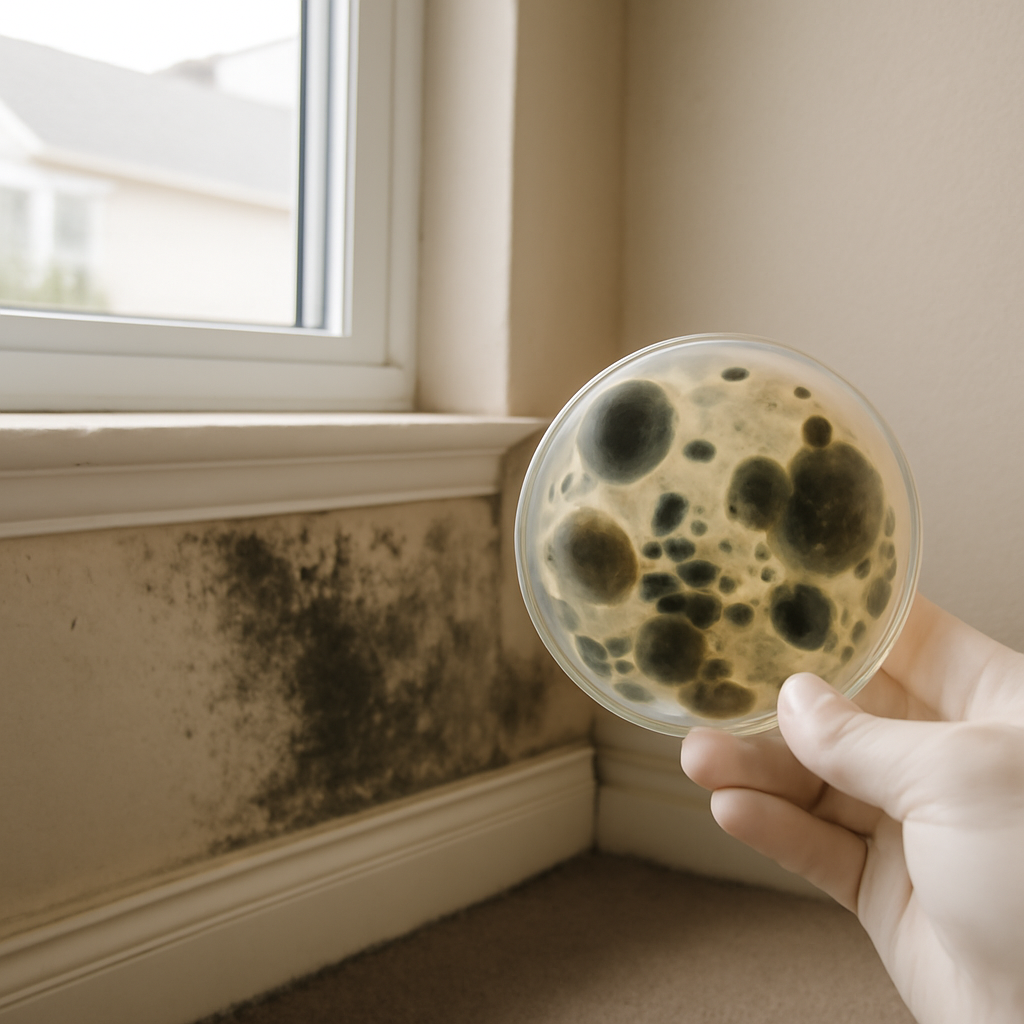
Platteville is a small historic South Platte River farm town in southern Weld County, near the old Fort Vasquez site, with an older downtown grid, newer subdivision edges, and rural acreage on private wells and septic. Where a mold inspection finds moisture and visible growth, mold testing measures what is in the air or on a surface and identifies it through a laboratory. This page explains how mold testing platteville homeowners should approach the process, when sampling is worth it, and what the results mean. This summary reflects EPA and CDPHE guidance current as of 2026; consult a certified professional for decisions about your home.
Part of our Mold Testing & Inspection guide — start there for the full picture →
Is this mold, asbestos, or water damage? Get a free instant screen
Upload a clear photo of the suspect area. You'll get an instant AI screening opinion and what to do next. This is screening guidance, not a professional determination.
Screening guidance only. AI can be wrong. Confirm asbestos, mold type, or lead with lab testing or a licensed professional before acting.
Mold testing in Platteville: what to know
Mold testing collects samples, typically air or surface, and sends them to a laboratory that identifies the mold types present and estimates their concentration. Testing answers questions a visual inspection cannot: what species is growing, whether airborne spore counts indoors exceed the outdoor baseline, and whether a hidden source is releasing spores into living space. The EPA is clear that testing is not always necessary, since any visible mold should be cleaned up regardless of type, but sampling has real value in specific situations.
In Platteville, those situations come up often because of the high water table. A buyer purchasing an older downtown home may want confirmation that a basement with a history of seepage is not harboring hidden growth. A homeowner with a musty crawl space and an occupant who has asthma may want to know whether airborne spore counts are elevated. A rural property owner on well and septic who suspects a hidden source may use testing to confirm whether spores are migrating into living space. For the broader framework on when sampling helps, our mold inspection and testing hub lays out the decision plainly.
Testing is most useful paired with a moisture investigation, not as a substitute for it. A spore count is a snapshot of one moment, and Platteville’s seasonal swings, lower groundwater in winter, higher during irrigation season, mean a single air sample reflects the conditions on the day it was taken. Interpreting that number against an outdoor control and the home’s moisture findings is what turns raw lab data into a useful conclusion.
Why Platteville homes need mold testing
Local moisture sources make sampling worthwhile in many Platteville homes. The South Platte high water table and surrounding irrigation push groundwater into basements and crawl spaces, where mold can grow unseen and release spores that travel upward through the home. Testing the main-floor air against an outdoor baseline can reveal whether a hidden basement or crawl-space colony is affecting living space, which a homeowner cannot determine by smell alone.
Well and septic systems on rural Platteville acreage add another reason. A slow leak from a well pressure tank or a saturated septic field can feed persistent dampness in utility rooms and basements, and where that moisture has fed growth behind finishes, air sampling helps confirm the extent before a wall is opened. Summer evaporative coolers add indoor humidity that can support growth, and freeze-thaw foundation cracks admit meltwater that supports hidden colonies in wall cavities.
Older downtown Platteville construction is a strong case for testing. Late-1800s and early-1900s homes often have wall assemblies with poor vapor control and shallow foundations that wick groundwater, conditions that can hide mold deep in cavities. The CDC links damp indoor environments to respiratory symptoms, so for a household with a sensitive occupant, confirming whether the indoor air carries elevated spore counts can guide both cleanup priorities and medical conversations. Mold testing in Platteville turns a vague musty smell into specific, actionable data.
What a Platteville mold test covers
A mold testing visit combines sampling with the moisture context that makes the results meaningful. The tester decides where to sample based on the suspected source and the spaces occupants actually use.
Air sampling
Air samples capture airborne spores indoors and compare them against an outdoor control taken the same day. A result showing indoor counts well above the outdoor baseline, or water-damage indicator species, points to an active indoor source. In a Platteville home with a groundwater-prone basement or a suspect crawl space, air sampling on the occupied level is the most common test because it reflects what people actually breathe.
Surface and lab analysis
Surface samples, taken by swab or tape lift from visible growth or staining, confirm what a discolored patch actually is. The laboratory identifies the mold genera present and notes whether they are common outdoor types or water-damage indicators. The tester then interprets the lab report alongside the moisture findings, because a number alone, without the context of where the moisture comes from, does not tell a Platteville homeowner what to fix.
Mold testing cost in Platteville
Mold testing in the Platteville and Weld County market is usually priced per sample plus a base visit fee. A single air or surface sample with laboratory analysis commonly runs about $100 to $200, and a typical home assessment uses two to four samples, so a full testing visit often lands in the $300 to $700 range depending on the number of locations.
Larger rural homes, properties with multiple suspected sources, or homes where the tester recommends sampling several rooms sit at the higher end. Many providers bundle testing with a visual mold inspection, which is the more cost-effective path because the inspection identifies exactly where sampling will be most informative rather than testing blindly.
Spending on testing makes the most sense when the result will change a decision. For a Platteville buyer weighing a contingency, a sensitive occupant evaluating whether a home is safe, or a homeowner verifying that a remediation worked, lab confirmation is worth the cost. The EPA cautions against routine testing where visible mold already justifies cleanup, so a provider who tells you when testing is unnecessary saves you money and is more trustworthy for it.
Platteville regulations and disclosure
Colorado’s Seller’s Property Disclosure asks sellers to report known water damage, prior mold, and moisture problems, but it does not require testing. A buyer who wants documented air-quality data must arrange testing independently, which is the practical route when a disclosure is silent or vague about a basement’s seepage history. Colorado does not license mold assessors, so the laboratory’s accreditation and the tester’s adherence to recognized sampling protocols carry the weight a state credential might elsewhere.
Platteville is an incorporated Weld County town, so any repair or remediation work that follows a positive test runs through town and county permitting as applicable. CDPHE guidance for Colorado residents emphasizes moisture source control over testing for testing’s sake, and points homeowners toward fixing the water problem, here often groundwater management, first. A Platteville homeowner who uses testing to confirm a suspicion, then corrects the moisture source, follows the sequence the state recommends.
Neighborhoods and areas served
Mold testing serves Platteville’s full range of homes: the older stock of downtown Platteville and the original grid, the newer subdivision edges, and the rural well-and-septic acreage across the surrounding farmland. Coverage commonly extends to adjacent Fort Lupton, Gilcrest, La Salle, Mead, and Hudson, which share Platteville’s South Platte valley water table and seasonal moisture patterns.
For the wider regional picture, our Weld County mold testing hub explains how the county’s geology and irrigation shape indoor moisture, and pairing testing with a mold inspection in Platteville gives you both the visual source-finding and the lab confirmation in a single coordinated visit.
How to choose a Platteville mold testing provider
Ask whether the provider uses an accredited laboratory, collects an outdoor control sample for comparison, and interprets the results alongside a moisture assessment rather than handing you a raw spore count with no context. A number without an outdoor baseline and a source explanation is nearly impossible for a homeowner to act on, so the interpretation is as important as the sampling.
For a rural Platteville property, confirm the tester will sample crawl spaces and well-equipment areas where hidden growth is most likely, not just the obvious finished rooms. A good provider also tells you honestly when testing is unnecessary, when visible mold already justifies cleanup, rather than selling samples by default. That candor, combined with proper protocol and a credible lab, is what separates useful mold testing from an expensive guess.
How to read a Platteville mold test report
A lab report becomes useful once you understand its central comparison: indoor against outdoor. Outdoor air always carries mold spores, so the question is never whether spores exist indoors but whether indoor counts are elevated relative to the outdoor control taken the same day and whether the species mix points to an indoor source. The lab reports spore counts and the genera identified for each sample, and the tester interprets your indoor results against that baseline.
Some genera matter more than others. Common outdoor types like Cladosporium appear in nearly every sample, and when indoor and outdoor levels track together they usually signal normal infiltration rather than a problem. Water-damage indicator species, including Stachybotrys, Chaetomium, and certain Aspergillus and Penicillium types, are more concerning indoors at levels above the outdoor baseline, because they grow on chronically wet building materials rather than blowing in. In a Platteville home with a groundwater-affected basement or a damp crawl space over high-water-table soil, finding these indicators on the occupied level signals that a hidden source is feeding the air rather than spores simply drifting in from outside.
Context converts the numbers into a conclusion. A tester weighs the data against where the samples were taken, the home’s moisture findings, and the season, since Platteville’s groundwater rises during irrigation season and recedes in winter, shifting the indoor baseline. A single elevated reading next to an obvious source means something different than uniformly high counts throughout a home. A good report does not just list numbers; it explains what they mean for your specific Platteville home and what to do next.
When to retest a Platteville home for mold
Testing is a snapshot, so certain moments call for a follow-up. The most common is after remediation. Clearance testing, done once the moisture source is corrected and the affected materials are cleaned or removed, confirms that indoor spore counts have returned to a level consistent with outdoors. For a Platteville household that invested in fixing a basement or crawl-space problem driven by the high water table, that post-work test is the proof the cleanup actually worked rather than masking the visible growth.
Retesting also makes sense after a new water event, a basement that took on water during irrigation season or a wet spring, a plumbing failure, or a roof leak, since these can establish fresh growth an earlier clean test would not reflect. A household whose members have persistent respiratory symptoms despite an apparently dry home may retest to confirm whether a hidden source remains. Because Platteville’s groundwater is seasonal, a homeowner who tested in dry winter conditions and later suspects a problem once nearby fields are irrigated has good reason to sample again. The EPA and CDPHE both stress the same underlying point: keep moisture controlled, and the mold problem, and the need for repeated testing, largely takes care of itself.
References
- Mold testing and sampling guidance — U.S. Environmental Protection Agency
- Mold and your health — Centers for Disease Control and Prevention
- Mold guidance for Colorado residents — Colorado Department of Public Health and Environment
Frequently asked questions
Do I really need mold testing in Platteville, or just an inspection?
The EPA says visible mold should be cleaned up regardless of type, so testing is not always needed. It helps when a source is hidden, an occupant is sensitive, or a real-estate negotiation calls for documented air-quality data.
How much does mold testing cost in Platteville?
Sampling typically runs $100 to $200 per air or surface sample plus a base fee, so a two-to-four-sample home visit often totals $300 to $700 depending on locations tested.
What does an air sample tell me in a Platteville home?
It compares indoor airborne spore counts against an outdoor control taken the same day. Counts well above the baseline, or water-damage indicator species, suggest an active hidden source, often a groundwater-affected basement or crawl space.
Why test crawl spaces in rural Platteville homes?
The South Platte high water table and well-and-septic systems often leave crawl spaces damp, where mold grows unseen and releases spores upward. Sampling confirms whether that hidden source is reaching living space.
Will testing tell me how to fix the problem?
Testing identifies and quantifies mold but does not fix moisture. CDPHE and the EPA emphasize correcting the water source first; a good tester interprets results alongside moisture findings so you know what to repair.
From downtown Platteville’s groundwater-prone basements to well-and-septic acreage, mold testing turns a musty suspicion into data you can act on. To connect with a vetted Weld County provider who tests only when it genuinely helps, reach out through our contact page.