How Do I Test for Radon: A Plain-Language Guide

The question “how do I test for radon” splits cleanly into two paths: do it yourself with a consumer kit, or hire a certified radon measurement professional. Both paths produce valid results when executed correctly. The choice depends on whether the testing is for personal information, for a real estate transaction, for post-mitigation verification, or for a regulatory submission. This guide compares the DIY and pro options head-to-head, with cost ranges, timing, accuracy, and use cases. This guide summarizes EPA and CDPHE guidance current as of 2026 — consult a certified radon professional for transactional testing.
Part of our Radon Levels guide — start there for the full picture →
The two paths at a glance
Path one: a DIY consumer test kit purchased online, at a hardware store, or sometimes free from a state health department. Cost runs $15 to $50 for a short-term kit including lab analysis. The homeowner deploys the kit, mails it to the lab, and receives results in 7 to 14 days. Path two: a hire a certified radon measurement professional who uses a continuous radon monitor (CRM) or deploys a passive device with documented chain of custody. Cost runs $150 to $250 for a single test. Results in 48 to 72 hours.
When DIY testing is the right choice
DIY testing fits four scenarios: personal information about a home you already own; pre-purchase due diligence during a homebuying timeline that allows 7 to 14 days for results; baseline testing before considering mitigation; or post-occupancy monitoring after a known mitigation event. The cost-benefit is excellent: a $20 kit produces lab-grade results from a NRPP-accredited or NRSB-accredited laboratory. The result is the same data point a professional test would produce, just without the professional’s chain-of-custody documentation.
When professional testing is the right choice
Professional testing fits four scenarios: real estate transactions where chain of custody matters; post-mitigation clearance testing required by a state radon program; commercial property testing under EPA’s protocol; and situations where the homeowner wants 48-hour results. The CRM used by professionals provides hourly data, tamper detection, and documented placement, which protects against test-condition disputes in transactional contexts. The cost premium of $130 to $200 over a DIY kit buys the chain of custody and the speed.
The three DIY device types
Three consumer device categories produce valid results. Charcoal canisters absorb radon onto activated charcoal over a 2 to 7 day exposure; they are the cheapest option at $15 to $30 and produce a snapshot of conditions during the exposure window. Alpha-track detectors record alpha particle tracks on a plastic film over 90 days to one year, producing an annual average for $30 to $60. Electronic short-term monitors are battery-powered devices producing instant readings; they range from $130 to $300 for a single-use device or $200 to $600 for a continuous monitor.
How to deploy a DIY charcoal canister
Place the canister in the lowest livable level of the home, at least 20 inches above the floor, away from drafts and exterior walls, away from heat sources, and away from high humidity. Close all windows and doors except for normal entry and exit (“closed-house conditions”) for 12 hours before and during the test. Expose the canister for 48 to 96 hours per the kit instructions. Seal the canister, complete the chain-of-custody form, and mail to the lab within 24 hours of test completion. Results arrive in 7 to 14 days. See our how a radon test kit works guide for the device chemistry.
How to deploy an alpha-track detector
Alpha-track placement follows similar rules: lowest livable level, 20 inches above the floor, away from drafts and exterior walls. Closed-house conditions are less critical for alpha-track because the long exposure window averages over normal occupancy patterns. Deploy for at least 90 days; one full year produces the most accurate annual average. At the end of the exposure period, seal the device and mail to the lab. Results arrive in 14 to 30 days. Alpha-track is the EPA’s recommended method for long-term testing.
What a professional CRM measurement looks like
A certified professional arrives with a calibrated continuous radon monitor (CRM), typically a Sun Nuclear, Femto-Tech, or Pylon device. The monitor is placed in the lowest livable level under closed-house conditions, set to record hourly readings, and tamper-sealed. After 48 to 96 hours, the technician retrieves the device, downloads the data, and produces a report showing hourly trends, the average, the high and low, and an interpretation. Chain of custody is documented at each step. Total elapsed time from deployment to report is 48 to 72 hours.
Cost comparison: DIY versus professional
DIY total cost: $15 to $30 for a charcoal kit including lab fee; $30 to $60 for alpha-track including lab fee; $130 to $300 for an electronic single-use device. Professional total cost: $150 to $250 for a short-term CRM test; $200 to $350 for a long-term alpha-track placement and retrieval; $400 to $700 for combined short- and long-term protocol. Bundled with a home inspection, professional radon testing typically runs $125 to $200. The professional premium buys speed, chain of custody, and interpretation. Our radon test for home inspection guide covers the bundled-pricing path.
EPA testing protocol for real estate
EPA’s recommended protocol for real estate transactions uses one of three approaches. First: a short-term test with results above 4 pCi/L followed by a confirmatory short-term test, with mitigation if the average of the two exceeds 4 pCi/L. Second: two simultaneous short-term tests, with mitigation if the average exceeds 4 pCi/L. Third: a long-term test, with mitigation if the result exceeds 4 pCi/L. Real estate timelines typically force the short-term approaches. Professional testing using a CRM under closed-house conditions satisfies the EPA protocol.
Closed-house conditions explained
Closed-house conditions require keeping all exterior windows and doors closed except for normal entry and exit, for 12 hours before and throughout the testing period. HVAC operation should be normal. Fireplace dampers can be either open or closed but should remain in their normal state. Closed-house conditions prevent transient ventilation effects from masking baseline radon levels. Tests performed without closed-house conditions can underreport actual levels. Professional CRMs detect ventilation events through humidity and pressure sensors, helping interpret anomalies.
Interpreting results in pCi/L
Results above 4 pCi/L trigger EPA’s recommended mitigation. Results between 2 and 4 pCi/L are EPA’s “consider mitigation” zone; CDPHE and WHO use 2.7 pCi/L (100 Bq/m³) as the action threshold. Results below 2 pCi/L are below all major action levels but not zero risk; EPA notes that no level is considered completely safe. A single short-term result is a snapshot; confirmation through a second test or a long-term measurement strengthens the decision basis. See the how to check radon levels guide for the interpretation detail.
Why short-term and long-term results sometimes differ
Indoor radon varies seasonally, daily, and hourly. Heating season (October through April in Colorado) typically produces higher readings because reduced ventilation and stack-effect pressure draw soil gas inward. Summer readings can run 30 to 50 percent lower in the same home. A short-term test in February may show 6 pCi/L while a follow-up in July shows 3 pCi/L. The long-term average is the more accurate basis for mitigation decisions, but the higher reading is the more conservative basis for buyer protection in real estate.
Post-mitigation testing
After a sub-slab depressurization system is installed, EPA recommends a post-mitigation test to verify performance. The test should run for at least 24 hours under closed-house conditions, no earlier than 24 hours after the system is energized. Most mitigation contractors include a post-installation test as part of the service. Homeowners should request a post-mitigation result below 2 pCi/L; results between 2 and 4 indicate the system is working but room exists for tuning the fan or sealing entry points.
Where to buy DIY kits
EPA and state health departments maintain lists of NRPP- or NRSB-accredited test kit providers. AccuStar, Air Chek, RTCA, and Alpha Energy Labs are well-established providers of charcoal and alpha-track kits. Many state radon programs distribute free or subsidized kits; Colorado’s CDPHE radon program has offered subsidized kits in the past, with availability depending on annual funding. Hardware-store kits are generally fine if the lab is accredited, which is shown on the package or in the included paperwork.
What to do with elevated results
Results above 4 pCi/L on a confirmed short-term or long-term test indicate the need for mitigation. The next step is a quote from a certified radon mitigation contractor; sub-slab depressurization for a typical single-family home runs about $800 to $2,500. NRPP and NRSB maintain contractor directories. Post-installation testing verifies the system performance. The full path from initial test to confirmed mitigation typically takes 4 to 8 weeks elapsed time. The parent radon testing in Colorado guide covers the mitigation contractor selection process.
The radon test as part of home maintenance
EPA recommends radon retesting every 2 years even after a clean initial result, plus after any significant structural change to the home (new foundation work, basement finishing, additions, HVAC replacement) that could alter air pressure or soil-gas entry pathways. The 2-year cadence catches gradual changes in foundation cracking or sump pump openings that develop over time. Mitigated homes follow the same cadence to verify the SSD system continues to perform. Most homeowners forget the 2-year retest; setting a calendar reminder at installation captures the discipline that protects long-term performance.
Free or subsidized testing programs
Several state health departments offer free or subsidized radon test kits, typically distributed during January’s National Radon Action Month. CDPHE has historically distributed limited free kits to Colorado homeowners on a first-come basis. Some county health departments and local libraries participate in similar programs. EPA partners with state agencies on outreach in Map Zone 1 areas including the Front Range. Free kits use the same NVLAP-equivalent NRPP-accredited labs as commercial products. Availability is intermittent; check the CDPHE website annually.
If you’re in the Front Range and want to talk to a vetted radon professional or are weighing DIY versus professional testing, reach out through our contact page.
More Questions About Radon Testing
Where can I get a free radon test kit?
Free or discounted radon test kits are often available through state radon programs, county or city health departments, and some university extension offices, especially during National Radon Action Month in January.
Availability varies by state and funding year, and some programs offer kits only to residents of specific counties. Kits typically include lab analysis and return postage. Searching the state radon program or calling the local health department is the fastest way to find a current offer. Some hardware stores sell short-term kits for about $15 to $50.
Where should a radon test kit be placed?
A radon test kit should be placed in the lowest lived-in level of the home, at least 20 inches above the floor, away from drafts, exterior walls, heat sources and high humidity areas like bathrooms and kitchens.
Keep it at least 3 feet from doors and windows to the outside and about 1 foot from exterior walls. A bedroom or living room in a finished basement is common. Do not move it during the test. Note the start and end times exactly, since the lab uses them to calculate results.
Can I test for radon in the summer?
Yes, radon can be tested in summer, but short-term results may read lower than winter results because windows are opened more often and the stack effect is weaker.
Keep windows and exterior doors closed for at least 12 hours before and during a short-term test, except for normal entry and exit. Air conditioning is fine to run as long as it does not bring in outside air. A long-term test of 90 days or more averages seasonal changes and gives the best estimate of annual exposure.
What should I do if a radon test is high?
If a radon test reads 4 pCi/L or higher, confirm it with a second test and plan mitigation if the average stays above the action level.
The EPA suggests a follow-up short-term test if the first result is very high, or a long-term test if it is closer to 4 pCi/L. A certified mitigation contractor can install a system, typically $800 to $2,500 in industry estimates. Retest after installation to confirm levels have dropped.
References
- EPA on finding a radon test kit or professional — U.S. Environmental Protection Agency
- CDC radon resources — Centers for Disease Control and Prevention
- CDPHE radon program — Colorado Department of Public Health and Environment
- NIEHS radon health research — National Institute of Environmental Health Sciences
Frequently asked questions
Should I test for radon myself or hire a professional?
DIY testing fits personal information, baseline screening, and post-mitigation verification. Professional testing fits real estate transactions, post-mitigation clearance, and situations requiring 48-hour results with documented chain of custody.
What does a DIY radon test cost?
Charcoal canister kits run $15 to $30 including lab analysis. Alpha-track long-term detectors run $30 to $60. Electronic single-use monitors run $130 to $300. Each method produces lab-grade results from an accredited laboratory.
How long does a radon test take?
Short-term charcoal tests run 48 to 96 hours of exposure plus 7 to 14 days for lab analysis. Alpha-track long-term tests run 90 days to one year. Professional CRM tests produce results in 48 to 72 hours from deployment to report.
What's the EPA action level?
EPA recommends mitigation at indoor radon levels of 4 pCi/L or higher. Between 2 and 4 pCi/L, EPA recommends considering mitigation. The WHO and Norway use a stricter 2.7 pCi/L (100 Bq/m³) action level.
Do radon test kits include lab fees?
Many short-term radon test kits include lab analysis in the purchase price, while some charge a separate lab fee. Check the package before buying. Return the kit promptly after sampling because labs often require arrival within a few days.
Can a radon test be done during rain?
A radon test can be done during rain, but heavy storms and severe weather can affect results. The EPA advises avoiding short-term tests during unusually severe storms or high winds, since pressure changes may push radon higher or lower temporarily.
Is a radon test needed in an apartment?
A radon test is most important for ground-floor and basement apartments, where radon from soil is more likely. Upper-floor units usually have lower levels, but testing is inexpensive and can confirm. Tenants can ask landlords whether the building has been tested.
Test your home for radon
Radon is invisible and odorless, so a test is the only way to know your level. A short-term kit gives a first reading in days; a digital monitor tracks it over time.
| Product | Why | Buy |
|---|---|---|
 AirChek Charcoal Radon Test Kit | Lab fee usually included; EPA short-term protocol. | Amazon — $21.95 |
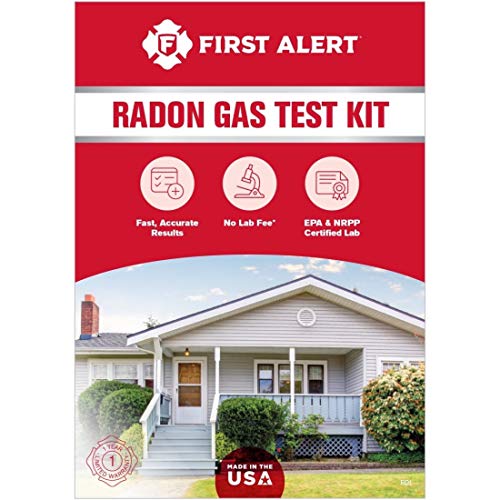 First Alert RD1 Radon Test Kit | Widely stocked; 48-hour charcoal test. | Amazon — $17.95 |
 Airthings Corentium Home | Digital monitor with a long-term average. | Amazon — $99.99 |