High Resolution Thermal Camera: 2026 Resolution Tier Guide
A high resolution thermal camera is a relative label rather than an absolute one — what counts as “high resolution” today (640×480 or higher) was research-grade equipment a decade ago, and what now counts as entry-level (160×120) once required a multi-thousand-dollar investment. This guide walks through the actual resolution tiers in the 2026 market, what pixel-coverage math each tier produces at typical home-inspection standoffs, which brands and products occupy each tier, and what application demands actually justify paying for higher resolution. The frame is residential and small-commercial home-inspection use, where a 320×240 sensor is usually plenty and a 640×480 sensor is sometimes meaningfully better.
Part of our Thermal Imaging for Homes guide — start there for the full picture →
What “resolution” means for thermal cameras
Thermal-camera resolution refers to the count of individual sensor pixels in the microbolometer array. Each pixel produces an independent temperature reading. Higher resolution means more pixels covering the same scene, and therefore each pixel covers a smaller real-world area. A 160×120 sensor has 19,200 thermal pixels. A 320×240 sensor has 76,800. A 640×480 sensor has 307,200 — roughly 16× the pixel count of a 160×120 sensor, distributed across the same field of view.
Resolution interacts with field of view (FoV) and standoff distance to determine the size of each pixel’s footprint on the target surface. A 25° horizontal FoV at 8-foot standoff produces a roughly 3.5-foot-wide image on a wall. Divide that 3.5 feet by the horizontal pixel count to get pixel coverage:
- 160×120 sensor: 3.5 ft / 160 px ≈ 0.26 inches per pixel horizontally. Actually most marketed as 25° FoV which means closer to 1.5-inch pixels at 8 ft depending on detector pitch.
The practical heuristic that practitioners use, accounting for actual lens FoV and standoff geometry on real residential cameras:
- 160×120 at 8-foot standoff → ~1.5-inch pixels.
- 320×240 at 8-foot standoff → ~0.75-inch pixels.
- 640×480 at 8-foot standoff → ~0.4-inch pixels.
Pixel coverage determines what features the camera can resolve. A 1.5-inch pixel cannot distinguish two adjacent screw connections on an electrical lug; a 0.4-inch pixel can. A 1.5-inch pixel can identify a missing insulation batt between studs; a 0.75-inch pixel can show whether the gap is at the top, bottom, or one side of the bay.
Resolution tiers in the 2026 market
80×60 (4,800 pixels) — entry budget tier
Lowest-end phone-attach modules and budget pistol-grip imagers. Adequate for finding obvious anomalies. Pixel coverage at typical residential standoffs is too coarse for subtle work. Generally not recommended for home-inspection professional use.
160×120 (19,200 pixels) — residential entry tier
Common in phone-attach modules and entry pistol-grip imagers. Workable for homeowner DIY and entry inspector walkthrough. Limitations show at longer standoffs and subtle-pattern work.
256×192 (49,152 pixels) — common mid-tier
A relatively new resolution standard pushed by Chinese-manufacturer brands (Hikmicro, Topdon) to fill the gap between 160×120 and 320×240 at attractive pricing. Roughly 60% the pixel count of 320×240.
320×240 (76,800 pixels) — residential sweet spot
The resolution that most professional residential inspectors use. Pixel coverage at typical standoffs is fine enough for subtle work, file sizes are manageable, and pricing in 2026 is reasonable. The most common resolution in $800–$2,500 pistol-grip imagers.
464×348 (~161,000 pixels) — intermediate prosumer
Less common; some FLIR T-series and other prosumer models occupy this tier. Sits between 320×240 and 640×480 in pixel count and price.
640×480 (307,200 pixels) — high-resolution professional
The high-end of routine home-inspection equipment. Required for some compliance applications (energy-audit BPI thermography, NETA electrical thermography at certain levels). Common in $2,500–$15,000+ pistol-grip imagers.
1280×1024 and higher — research and specialty
Available in commercial and research-grade cameras. Rare in routine residential or building-science work. Generally not relevant for homeowner buying decisions.
When higher resolution is actually worth the price
Long-standoff inspection
Roof inspection from grade, exterior facade work on multi-story buildings, and large-area surveys benefit from higher resolution because pixel coverage on the target degrades with distance. A 640×480 imager at 25 feet produces the same pixel coverage as a 160×120 imager at 6 feet.
Electrical-panel work at the connection level
Identifying which specific connection or breaker is failing on a dense electrical panel rewards 320×240 or higher resolution. A 160×120 image shows that some part of the panel is hot; a 640×480 image shows which lug screw.
Subtle building-envelope thermography
Low-temperature-differential conditions (small temperature gradients between interior and exterior) require both higher resolution and better NETD to resolve subtle features. Energy-audit BPI thermography specifically calls for higher-resolution equipment.
Large-area survey work
Surveying a 10,000-square-foot warehouse or a multi-unit residential complex benefits from higher resolution because each image covers more useful area at sufficient pixel-coverage. Workflow time drops.
Report-grade output for transactional contexts
Real-estate transactional reports benefit from higher-resolution imagery in part because the visual clarity reads as more authoritative. The substantive content of a 320×240 report and a 640×480 report is usually similar; the visual impact differs.
When higher resolution doesn’t add practical value
Close-standoff applications. If the typical use distance is within arm’s reach (most plumbing-leak tracing, most residential electrical-outlet work, most refrigerator-seal checks), 160×120 to 256×192 provides ample pixel coverage and the higher-resolution premium is wasted. Routine homeowner walkthrough. A homeowner using the camera periodically for air-leak hunting and seasonal checks gets all the value at 160×120 to 320×240; the 640×480 increment doesn’t change outcomes. Educational or curiosity use. The “wow factor” of a high-resolution thermal image fades after the first few uses; ongoing value tracks application complexity, not novelty.
Brand and product map by resolution tier
FLIR
FLIR One Pro: 160×120. FLIR C3-X, C5: 128×96 to 160×120. Ex-series: 80×60 to 320×240 across generations. T-series: 320×240, 464×348, 640×480 by model. Most homeowner-relevant high-resolution options sit in the T-series. A separate high-definition thermal camera guide covers the highest-resolution market specifically.
Fluke
TiS series: 80×60 to 160×120 at entry. Ti series: 160×120 to 320×240 at mid. TiX series: 320×240 to 640×480 at prosumer/professional. Strong electrical-test integration.
Hikmicro
B-series and M-series: 160×120 to 384×288. Higher-resolution models at very competitive pricing relative to FLIR and Fluke equivalents.
Seek Thermal
CompactPRO: 320×240 in phone-attach form. ShotPro: 320×240 in pistol-grip. Limited high-resolution options.
Klein Tools and Topdon
Generally entry-to-mid tier; 160×120 to 256×192 common, less presence in 640×480.
Pricing by resolution tier in 2026
- 80×60: $200–$500.
- 160×120: $300–$1,200.
- 256×192: $400–$1,500.
- 320×240: $1,500–$5,000.
- 464×348: $4,000–$9,000.
- 640×480: $5,000–$15,000+.
Pricing varies by brand and feature set. Higher NETD performance, faster refresh rate, interchangeable lenses, and full radiometric file support all add to base resolution pricing. The home inspection tools hub covers the broader homeowner decision context.
What matters at high resolution besides pixel count
NETD performance
A 640×480 sensor with poor NETD (>80 mK) produces visually higher-resolution but functionally similar output to a 320×240 sensor with strong NETD (35 mK) on subtle thermal patterns. Resolution and NETD must improve together to translate into real diagnostic capability.
Lens options
High-resolution sensors paired with telephoto lenses produce dramatic standoff-extension capabilities. Wide-lens options improve close-range coverage. Interchangeable lens systems are common at 640×480 and above; rarer at 320×240.
Radiometric file format
High-resolution imagery captured without radiometric per-pixel temperature data cannot be re-leveled or re-analyzed after capture. Verify that the camera writes radiometric files (FLIR’s .seq format or similar) before buying for inspector workflow.
Software ecosystem
Post-processing software (FLIR Thermal Studio Pro, Fluke SmartView, Hikmicro Inspector) gates what the higher resolution can deliver in report output. Cameras and software must be evaluated together.
Common high-resolution buying mistakes
Three patterns recur. Overspending on resolution without matching NETD improvement, producing visually impressive but diagnostically equivalent output. Ignoring lens FoV — a 640×480 sensor with a 45° wide lens has roughly the same pixel coverage at standoff as a 320×240 sensor with a 25° lens. Buying high-resolution gear without the post-processing software workflow to use it, leaving the camera operating effectively as a colorized JPEG generator rather than a radiometric instrument. A high-res thermal camera guide develops these traps further.
Sample applications by resolution requirement
| Application | Minimum resolution | Recommended resolution |
|---|---|---|
| Homeowner air-leak walkthrough | 80×60 | 160×120 |
| Residential inspector building envelope | 160×120 | 320×240 |
| Residential electrical panel scan | 160×120 | 320×240 |
| Plumbing-leak slab tracing | 160×120 | 256×192 |
| Roof investigation from grade | 320×240 | 640×480 |
| Energy-audit BPI thermography | 320×240 | 640×480 |
| NETA electrical thermography compliance | 320×240 | 640×480 |
| Commercial-roof thermal survey | 320×240 | 640×480 or higher |
Care, longevity, and resale value
High-resolution thermal cameras hold value better than entry-tier units because the high-resolution tier evolves more slowly. A 640×480 imager bought in 2018 still performs at near-current-generation level in 2026 because the resolution standard hasn’t shifted dramatically. Microbolometer sensors are stable across years of normal use, and most high-resolution units carry 2-year body warranties with longer (up to 10-year) sensor warranties on prosumer and professional models. Calibration is stable across years for diagnostic use; annual recertification matters only for compliance applications.
Rental and try-before-buy
Specialty test-equipment rental houses carry 640×480 imagers for project-specific rental. Rental fees are typically $150–$400 per day. For one-time projects, rental is more cost-effective than purchase. Professional thermographers bring high-resolution equipment as part of their service for one-off needs. The hiring process hub walks through engaging thermographers.
More Questions About High-Resolution Thermal Cameras
Can a high resolution thermal camera attach to a smartphone?
Yes, some higher-resolution thermal cameras attach to smartphones, with mid-range attachments reaching 256×192 or more, but native 640×480 resolution is mostly found in handheld and pistol-grip cameras. Phone attachments trade some resolution and features for low cost.
Phone modules depend on the phone’s port, app compatibility and battery. They are convenient for homeowners and quick checks. Professional inspectors often prefer handheld cameras for durability, focus control, radiometric reporting and independence from a phone. Check the native detector resolution rather than upscaled image size when comparing attachments.
Does a high resolution thermal camera help find roof leaks?
Yes, a high resolution thermal camera can help find roof leaks by showing wet insulation and damp areas in ceilings and roof assemblies, especially after a sunny day when wet materials hold heat longer. Higher resolution helps from a distance.
Interior scans of ceilings can show cool, damp patches below a leak. Exterior roof scans are typically done at dusk on dry, calm days. Findings should be confirmed with a moisture meter or core sample. A roofer then finds and repairs the actual entry point, which is often some distance from where moisture appears.
Is a high resolution thermal camera good for HVAC work?
Yes, a high resolution thermal camera is useful for HVAC work, showing duct leaks, blocked registers, uneven radiant floor heating, refrigerant line issues and electrical connections on equipment. Mid-range resolution often covers most HVAC tasks.
Higher resolution helps when inspecting small electrical components or long duct runs in attics from a distance. Technicians often combine thermal images with pressure, airflow and temperature measurements. A thermal image shows where to look, but standard HVAC diagnostics confirm the cause before repairs are made.
How long does a high resolution thermal camera last?
A high resolution thermal camera typically lasts many years, often 10 years or more, if it is handled carefully and supported by the manufacturer. Batteries usually need replacing well before the detector wears out.
Software updates, calibration services and parts availability often decide practical lifespan. Drops, moisture and pointing the lens at the sun can damage the camera. Storing it in a protective case and keeping maintenance and calibration records helps preserve accuracy and resale value, which is relatively strong for well-known professional models.
References
- ENERGY STAR: Seal and Insulate — U.S. Environmental Protection Agency (ENERGY STAR)
- InterNACHI Infrared Thermography — International Association of Certified Home Inspectors
- ASHI Inspection Equipment — American Society of Home Inspectors
- ASHRAE Technical Resources — American Society of Heating, Refrigerating and Air-Conditioning Engineers
Frequently asked questions
What counts as a high resolution thermal camera in 2026?
640 by 480 pixels and higher is generally considered high resolution for residential and commercial home-inspection use. 320 by 240 is the residential sweet spot but not universally labeled high resolution; 1280 by 1024 and higher exists in commercial and research equipment.
Do I really need 640 by 480 for home inspection?
For routine residential inspection, 320 by 240 is sufficient. 640 by 480 helps with long-standoff work, compliance thermography, and large-area surveys. Many professional inspectors use 320 by 240 successfully throughout their careers.
How much does a high resolution thermal camera cost?
640 by 480 pistol-grip imagers run roughly 5,000 to 15,000 dollars. 320 by 240 prosumer-grade units run 1,500 to 5,000 dollars. Higher resolutions in commercial and research equipment can exceed 25,000 dollars.
Does higher resolution mean better thermal images?
Higher resolution captures more pixel detail, but image quality also depends on NETD performance, lens choice, and post-processing. A high-resolution sensor with poor NETD can produce visually crisp but diagnostically weak output.
Can a high resolution thermal camera be used in a home inspection report?
Yes, high resolution thermal images are commonly included in home inspection reports to show moisture, insulation gaps and electrical hot spots. Inspectors should explain what each image shows and recommend follow-up by the appropriate trade when problems appear.
Do high resolution thermal cameras record video?
Many high resolution thermal cameras record video, and some record radiometric video that keeps temperature data in every frame. Video helps document changing conditions, like equipment warming up. Check frame rate and storage format before buying for video work.
Is a high resolution thermal camera waterproof?
Many professional thermal cameras have dust and water resistance ratings, such as IP54, which protect against rain and splashes but not submersion. Check the specific rating before using a camera in wet conditions, and dry it before storing.
Thermal imaging cameras
Infrared cameras reveal hidden moisture, missing insulation, and air leaks. Phone-attachment models are the budget entry point; standalone units have higher resolution.
| Product | Why | Buy |
|---|---|---|
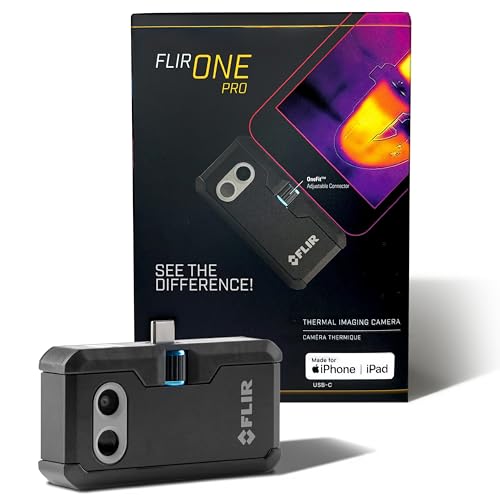 FLIR ONE Pro (phone) | Plugs into iPhone/Android; inspector favorite. | Amazon — $296.65 |
 Topdon TC001 | High-res phone module at a low price. | Amazon — $249.00 |
 FLIR C5 Compact | Standalone pocket camera with Wi-Fi. | Amazon — $593.99 |