Flir One Pro Resolution: What Homeowners Need to Know
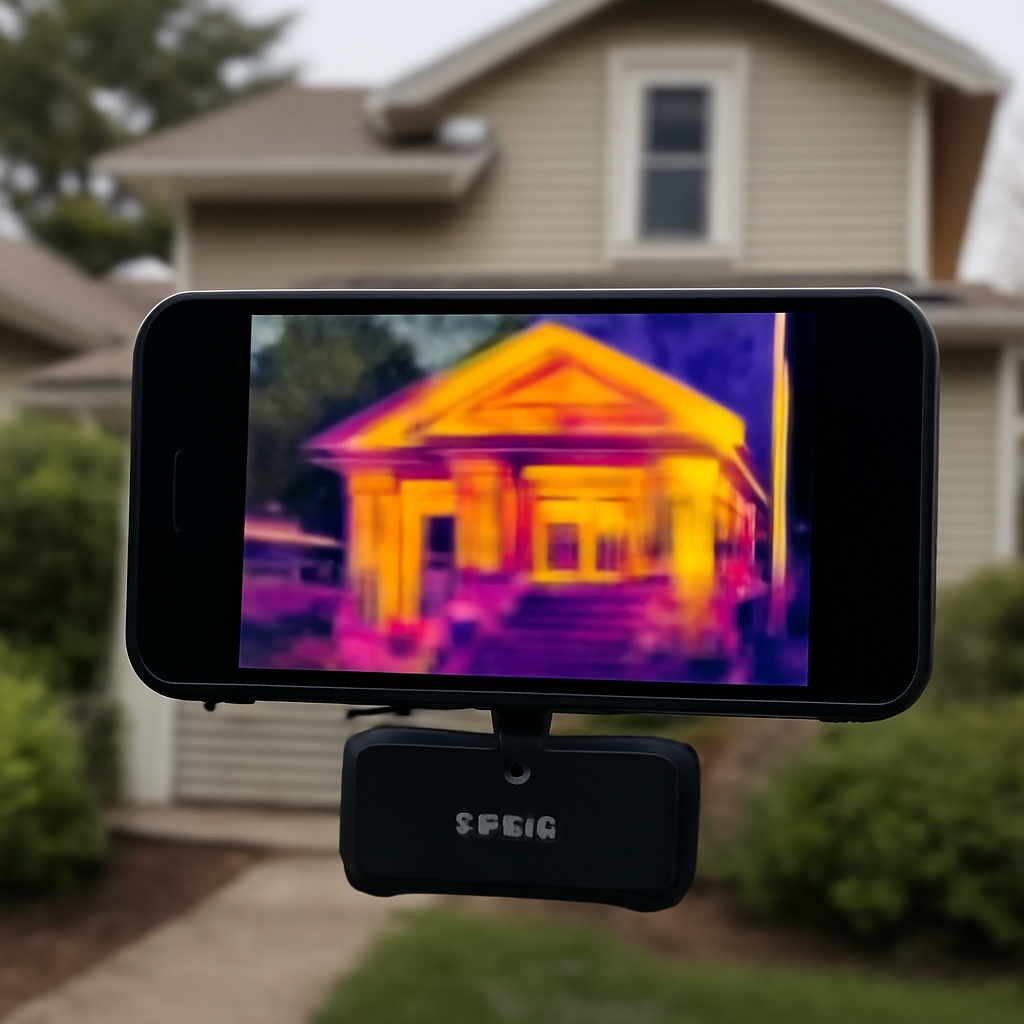
Flir One Pro resolution is one of the most-searched specs for the popular smartphone thermal attachment because it directly determines what homeowners can and cannot see when they aim the camera at a wall or ceiling. The published spec is a 160×120 thermal sensor blended with a 1440×1080 visible-light MSX overlay. Those two numbers describe two different things, and confusing them is one of the most common mistakes buyers make when evaluating the product against alternatives.
What the 160×120 Number Actually Means
The 160×120 figure refers to the native thermal sensor resolution — the number of independent thermal pixels the camera actually measures. Each thermal pixel represents a real surface temperature reading from a small patch of whatever the lens is pointed at. The product of those numbers is 19,200 thermal pixels per frame. For comparison, the Flir ONE Pro LT’s 80×60 sensor delivers 4,800 thermal pixels, and the Seek CompactPRO’s 320×240 sensor delivers 76,800 thermal pixels.
Thermal pixel count is the spec that matters most for diagnostic usefulness. Higher counts mean the camera can resolve smaller anomalies, capture useful detail at greater distances, and produce images that are clearly defined rather than ambiguous. A wet stud bay that shows up as four or five distinguishable pixels on the Flir ONE Pro might be a clearly defined rectangle of fifteen or twenty pixels on the Seek CompactPRO.
What the 1440×1080 MSX Overlay Does
The second resolution number — 1440×1080 — refers to the visible-light camera on the Flir ONE Pro that captures a standard photograph at the same moment as the thermal frame. Flir’s MSX technology then etches the edges of the visible image onto the thermal frame, producing a composite that shows both the temperature pattern and the underlying structure of the room or wall.
The MSX feature does not increase the thermal data the camera collects. It is a visual aid that makes the thermal image easier to interpret. A warm rectangle floating in space is less useful than a warm rectangle that clearly sits above a doorframe. Without MSX, thermal images can be disorienting for new users. With MSX, the same image becomes immediately interpretable.
This distinction matters because some marketing materials and informal reviews mash the two numbers together — implying the camera “has 1440×1080 resolution” when it really has 160×120 thermal resolution with a much higher resolution visible-light overlay. Buyers comparing the Flir ONE Pro against a Seek CompactPRO should compare the thermal numbers (160×120 vs 320×240), not the MSX overlay number against the competing thermal number.
How 160×120 Performs in Real Home Inspection Scenarios
For most homeowner diagnostic tasks, 160×120 is functional but limited. The camera produces usable images for:
- Spotting major air leaks around windows and doors during cold-weather scans
- Finding obvious insulation gaps in attics during winter
- Locating recent water leaks behind walls when evaporation is still active
- Verifying that floor heating delivers uniform temperatures across a slab
- Identifying overheating breakers and outlets in an electrical panel
The images become harder to interpret for subtle anomalies, scans at greater distances, and situations where the temperature differential is small. A working inspector scanning a wall from twelve feet away during a real estate inspection often gets ambiguous results on the Flir ONE Pro that would be clearly defined on a 320×240 or higher camera.
When 160×120 Resolution Is Enough
For homeowners who want thermal imaging as an occasional diagnostic tool — not a daily workhorse — the Flir ONE Pro’s resolution is enough for most use cases. The price-to-resolution ratio is reasonable, the MSX feature is well-implemented, and the iPhone or Android integration is mature. A homeowner using the camera to verify the success of an attic insulation upgrade, locate a suspected leak behind a kitchen wall, or troubleshoot a comfort problem in one room gets meaningful diagnostic value out of the 19,200 thermal pixels per frame.
Our overview of home inspection tools and what each tier reveals compares the practical resolution differences across the price spectrum.
When 160×120 Resolution Becomes Limiting
Several scenarios push the Flir ONE Pro’s resolution past its usable range. Working inspectors who need to deliver client-facing reports on multiple inspections per day find that the lower resolution produces images that require more interpretation work and look less impressive in the final report. Industrial diagnostics, electrical panel inspections at distance, and detailed building science work all benefit from the higher resolutions available in Flir’s E76 or higher models.
Homeowners who are diagnosing subtle envelope problems — small air leaks, thin insulation rather than missing insulation, slow moisture migration — often find that the Flir ONE Pro shows the area in question but does not produce the crisp image they had hoped for. The camera is not faulty; it is operating at the edge of what 160×120 can resolve. For these scenarios, hiring an inspector with a higher-resolution camera produces better diagnostic information than continuing to scan with the consumer attachment.
The “Super-Resolution” Software Feature
Flir’s app for the ONE Pro includes a feature sometimes called super-resolution or VividIR that produces output images larger than the native 160×120 sensor by computational processing. The output is typically 480×360 or higher. This is not the same as a higher-resolution sensor capturing more real thermal data; it is upscaling that smooths the visible appearance of the image. The diagnostic value is debatable. The upscaled image looks cleaner but does not actually contain more thermal information than the native sensor produced.
For homeowners and inspectors, this means the published “image resolution” of 480×360 in some Flir materials should be discounted back to the native 160×120 when comparing against other cameras. A Seek CompactPRO with a true 320×240 sensor produces more real thermal data than a Flir ONE Pro with a 160×120 sensor upscaled to 480×360, even though the upscaled image looks larger.
Thermal Sensitivity: The Other Spec That Matters
Resolution is not the only spec that determines image quality. Thermal sensitivity, sometimes called NETD (noise equivalent temperature difference), measures the smallest temperature difference the camera can detect. The Flir ONE Pro publishes an NETD of about 70 millikelvin, meaning it can detect temperature differences of about 0.07 degrees Celsius. Higher-tier handheld Flir cameras publish NETD values closer to 30 or 40 millikelvin, meaning they can detect subtler differences.
For typical homeowner uses, the ONE Pro’s sensitivity is adequate. For working inspectors hunting for very subtle moisture problems, the higher-sensitivity cameras reveal patterns the consumer attachment misses. Our walkthrough of how infrared camera inspections actually work covers the sensitivity-to-application mapping in more depth.
Comparing the Flir ONE Pro Against the Competition on Resolution
The most direct competitors for the Flir ONE Pro on a resolution-per-dollar basis include:
- Seek Thermal CompactPRO — 320×240 sensor at roughly comparable price point, meaningfully higher thermal pixel count
- Hikmicro Pocket2 — 256×192 standalone handheld, slightly higher resolution than the Flir ONE Pro and not dependent on a phone
- Klein TI120 — 49×49 thermal sensor in a phone-attached form factor, much lower resolution but lower price
- Topdon TC001 — 256×192 attachment in similar price range, increasingly visible in the consumer market
For a buyer focused purely on resolution-per-dollar, the Seek CompactPRO is the strongest competitor. The Flir ONE Pro’s advantages lie in the MSX implementation, the app ecosystem, and the brand’s repair and calibration network. Whether those advantages justify the resolution gap depends on how the camera will be used.
Practical Buying Advice Based on Resolution Needs
For homeowners who plan to use the camera occasionally for DIY diagnostics on their own home, the Flir ONE Pro’s 160×120 is enough. For homeowners who plan to use it frequently or who want clearly defined images of subtle anomalies, stepping up to the Seek CompactPRO or a low-end standalone handheld delivers more real thermal data per dollar. For working inspectors building client reports, the consumer attachments are best as backups; the primary camera should be a higher-resolution handheld.
The resolution conversation also intersects with how the camera will be presented to clients or used in reports. A homeowner sharing a Flir ONE Pro thermal image with a contractor will get useful conversation; the same image included in a formal inspection report might look less authoritative than what a 320×240 or higher camera produces.
What the Resolution Spec Does Not Tell You
A few practical realities sit outside the resolution number entirely. The camera’s ability to lock focus quickly on a moving target, the responsiveness of the app, the reliability of the connector under repeated insertion cycles, the quality of the export format, and the calibration accuracy over multi-year use all matter as much as the headline resolution. The Flir ONE Pro generally performs well on these secondary factors but is not perfect — the connector is a known wear point, and the app occasionally produces inconsistent image exports across iOS versions.
Buyers who treat the resolution spec as the single deciding factor sometimes regret the purchase when the secondary factors turn out to matter more than the headline number. Reading multi-month user reviews from working inspectors typically provides better buying guidance than the spec sheet alone.
Working With Resolution Limits: Tactics That Help
Homeowners and inspectors stuck with a 160×120 camera can still produce useful diagnostic images by adjusting their scanning approach. The biggest single improvement is reducing distance to the target. A camera held two feet from a wall captures more thermal pixels per square inch of wall than the same camera held twelve feet away. For attics and crawl spaces, getting physically close to suspect framing produces dramatically better images than scanning from the access opening.
The second tactic is widening the temperature differential. Scanning when the indoor-outdoor temperature gap is at least twenty degrees Fahrenheit makes thermal anomalies more pronounced. Running the HVAC system at the high or low end of its range for thirty minutes before scanning forces the building envelope to expose its weakest points. Winter scans in the early morning and summer scans in the late afternoon produce the strongest differentials on the Front Range.
The third tactic is capturing multiple images of the same area from different angles. A single 160×120 frame might be ambiguous; three frames from different distances and angles often reveal the same anomaly clearly enough to act on. The Flir app supports batch capture and review on a computer screen, which makes this multi-image workflow more efficient.
Final Takeaway on Flir ONE Pro Resolution
The Flir ONE Pro’s 160×120 thermal resolution sits in a usable middle ground — enough for most homeowner diagnostic tasks, not enough for production inspector reporting on subtle anomalies at distance. Buyers who understand what the spec actually represents, and who match the camera to use cases it can handle, generally find the ONE Pro a satisfying tool. Buyers who confuse the 1440×1080 MSX number with the thermal resolution number and expect that level of detail in thermal data will be disappointed.
References
- Infrared Thermography for Home Inspectors — International Association of Certified Home Inspectors
- Infrared Inspection Standards — American Society of Home Inspectors
- Insulation Diagnostics and Energy Efficiency — U.S. Department of Energy
- Building Envelope Performance Standards — ASHRAE
Thermal imaging cameras
Infrared cameras reveal hidden moisture, missing insulation, and air leaks. Phone-attachment models are the budget entry point; standalone units have higher resolution.
| Product | Why | Buy |
|---|---|---|
 FLIR ONE Pro (phone) FLIR ONE Pro (phone) | Plugs into iPhone/Android; inspector favorite. | Amazon — $349.00 |
 Topdon TC001 Topdon TC001 | High-res phone module at a low price. | Amazon — $199.99 |
 FLIR C5 Compact FLIR C5 Compact | Standalone pocket camera with Wi-Fi. | Amazon — $449.00 |